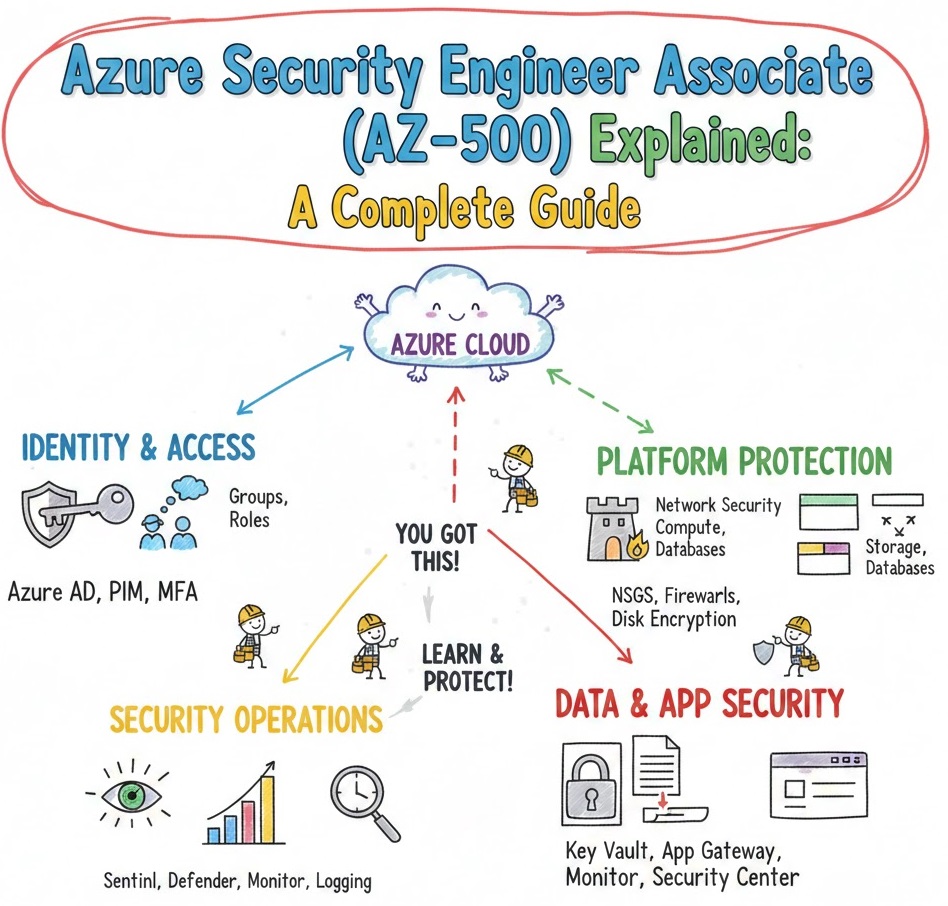
Introduction
The Azure Security Engineer Associate (AZ-500) certification is a pivotal credential for professionals who want to demonstrate their proficiency in securing Microsoft Azure environments. With more companies adopting cloud technologies, the demand for skilled Azure security engineers has soared. This certification validates your ability to design and implement security controls, manage identity and access, and protect Azure data, applications, and networks.
In this guide, we’ll cover everything you need to know about the AZ-500 certification, including:
- Overview of the certification
- The skills you will gain
- Exam preparation strategies
- Common mistakes to avoid
- Career outcomes and the next steps for certifications
By the end of this article, you’ll have a clear path forward to achieve the AZ-500 certification and enhance your career in cloud security.
What is the Azure Security Engineer Associate (AZ-500)?
The Azure Security Engineer Associate (AZ-500) certification focuses on securing Microsoft Azure services. It validates your ability to manage Azure identity and access, implement platform protection, manage security operations, and secure data, applications, and networks. Azure’s growing presence as a cloud platform makes this certification valuable for professionals looking to enhance their skills and stand out in the competitive IT field.
Who Should Take the AZ-500 Certification?
This certification is tailored for professionals who are directly involved in securing Azure cloud environments. The typical candidates for this certification include:
- Security Engineers: Engineers focusing on protecting Azure-based resources and implementing security controls.
- Cloud Engineers: Engineers who work on cloud infrastructure and wish to specialize in securing cloud environments.
- DevOps Engineers: Professionals already working in DevOps but aiming to include a security aspect to their skill set (DevSecOps).
- IT Managers: Managers overseeing cloud security practices and Azure deployment in their organizations.
- Software Engineers: Developers working in the cloud who need to integrate security best practices into their coding and deployment processes.
Skills You’ll Gain
The AZ-500 certification equips you with the following in-demand skills:
- Azure Identity & Access Management: You’ll learn to configure and manage Azure Active Directory (Azure AD), implement role-based access control (RBAC), and manage Azure AD Connect for hybrid environments.
- Platform Protection: Gain knowledge in securing Azure compute services, virtual networks, and firewalls.
- Security Operations Management: Understand how to configure and manage Azure Security Center and Azure Sentinel, as well as monitoring and responding to security threats.
- Data Protection: Learn to implement encryption, manage secrets using Azure Key Vault, and protect data both at rest and in transit.
- Network Security: Master Azure network security features like Azure Firewall, network security groups, and VPNs to protect network traffic in your Azure environment.
Real-World Projects You Should Be Able to Do After the AZ-500 Certification
After passing the AZ-500, you’ll be able to implement security solutions that align with best practices. Here are a few projects you should be able to manage:
- Implementing a Secure Azure Network: Using Network Security Groups (NSG), Azure Firewall, and VPNs to configure a secure virtual network.
- Managing Identity Access: Configuring Azure AD Connect for hybrid identity, setting up Multi-Factor Authentication (MFA), and securing access to cloud applications.
- Setting Up Azure Sentinel: Configuring security alerts and automating responses to security threats.
- Data Protection with Azure Key Vault: Managing sensitive information such as API keys, passwords, and certificates securely.
- End-to-End Security Monitoring: Using Azure Security Center to assess vulnerabilities and apply patches to Azure VMs, ensuring continuous security monitoring.
Preparation Plan
The preparation for the AZ-500 exam involves a blend of theoretical knowledge and practical, hands-on labs. Below is a recommended study plan depending on your available time.
7-14 Days Preparation Plan:
- Key Focus Areas:
- Azure Security Center basics
- Azure Active Directory and RBAC fundamentals
- Azure Identity and Access Management (IAM) basics
- Activities:
- Study the exam guide and familiarize yourself with the exam structure.
- Perform hands-on labs that focus on network security configurations and identity management.
30 Days Preparation Plan:
- Key Focus Areas:
- Platform protection, including Azure firewalls and secure compute services.
- Security monitoring and management using Azure Sentinel and Security Center.
- Activities:
- Complete all the major modules in the official Microsoft learn platform.
- Focus on more advanced security topics like encryption, secure data management, and logging.
60 Days Preparation Plan:
- Key Focus Areas:
- End-to-end security architecture for cloud applications.
- Advanced data protection methods and multi-layer security.
- Activities:
- Work through advanced Azure scenarios in hands-on labs.
- Review all concepts, practice mock exams, and take practice tests from platforms like MeasureUp.
Common Mistakes to Avoid
- Skipping Hands-On Labs: Without hands-on practice, you might not fully grasp how to implement the security features you learn in theory.
- Underestimating the Complexity: The AZ-500 exam is more than just understanding concepts. It’s about solving real-world security problems with Azure.
- Focusing Only on One Domain: Ensure you cover all areas of the exam, such as identity management, platform protection, and security operations, instead of focusing on just one topic.
- Relying on Outdated Study Materials: Always use updated resources that match the current exam objectives to stay aligned with the exam content.
Best Next Certification After AZ-500
- Same Track: Microsoft Certified: Azure Solutions Architect Expert – Once you’re done with the AZ-500, the next logical step is to enhance your skills in designing secure, scalable cloud architectures.
- Cross-Track: Certified Cloud Security Professional (CCSP) – If you want to expand your knowledge beyond Azure, consider this vendor-neutral certification.
- Leadership: Certified Information Systems Security Professional (CISSP) – A leadership-level certification for professionals who want to step into managerial roles in cybersecurity.
Choose Your Path (6 Learning Paths)
DevOps:
- Security is a critical part of DevOps. Learn how to integrate security into continuous integration/continuous deployment (CI/CD) pipelines with security tools like Azure Key Vault and Sentinel.
DevSecOps:
- As a security professional in DevSecOps, you’ll focus on securing DevOps workflows and maintaining governance in the Azure environment.
SRE:
- Site Reliability Engineers (SRE) implement the practices of DevSecOps while maintaining uptime and reliability. AZ-500 prepares you for securing services in highly available environments.
AIOps/MLOps:
- Use Azure security tools to secure machine learning models, workflows, and data, ensuring that AI solutions stay compliant with security standards.
DataOps:
- A focus on securing cloud-based data storage and managing access to critical data platforms in Azure.
FinOps:
- Learn to manage cloud finances while securing financial data, cloud assets, and resources across Azure’s services.
Role → Recommended Certifications Mapping
| Role | Recommended Certifications |
|---|---|
| DevOps Engineer | Azure Security Engineer Associate (AZ-500), Azure DevOps Engineer Expert |
| SRE | Azure Security Engineer Associate (AZ-500), Azure Solutions Architect Expert |
| Platform Engineer | Azure Security Engineer Associate (AZ-500), Azure Kubernetes Service (AKS) |
| Cloud Engineer | Azure Security Engineer Associate (AZ-500), Azure Solutions Architect Expert |
| Security Engineer | Azure Security Engineer Associate (AZ-500), Certified Information Systems Security Professional (CISSP) |
| Data Engineer | Azure Security Engineer Associate (AZ-500), Azure Data Engineer Associate |
| FinOps Practitioner | Azure Security Engineer Associate (AZ-500), Microsoft Certified: Azure Fundamentals |
| Engineering Manager | Azure Security Engineer Associate (AZ-500), Certified Cloud Security Professional (CCSP) |
Comparison Table of Azure Security Engineer Associate (AZ-500) with Other Certifications
| Certification | Track | Level | Who It’s For | Prerequisites | Skills Covered | Recommended Order |
|---|---|---|---|---|---|---|
| Azure Security Engineer Associate (AZ-500) | Cloud Security | Associate | Security Engineers, Cloud Engineers, DevOps Engineers, Managers | Basic Azure knowledge is recommended | Managing identity and access, platform protection, security operations, data protection, network security | Azure Fundamentals → AZ-500 |
| Microsoft Certified: Azure Solutions Architect Expert | Cloud Architecture | Expert | Cloud Engineers, Solutions Architects, Technical Architects | Azure Fundamentals, Azure Administrator Associate | Designing security and architecture solutions, implementing virtual networks, security management in Azure | Azure Fundamentals → AZ-104 → AZ-303 |
| Certified Cloud Security Professional (CCSP) | Cloud Security | Professional | Security professionals, IT auditors, Risk managers | 5 years of work experience in information security | Cloud security governance, risk management, and legal compliance, data protection, cloud architecture, and security models | After Azure Security Engineer or CISSP |
| Certified Information Systems Security Professional (CISSP) | Information Security | Expert | Security Managers, Security Architects, CISOs | 5 years of security experience | Security and risk management, asset security, security architecture, engineering, network security, software development security | After AZ-500 or CCSP |
| AWS Certified Security – Specialty | Cloud Security | Specialty | AWS Security Engineers, Cloud Engineers | AWS Certified Solutions Architect – Associate | Security on AWS, identity and access management, incident response, data protection, security monitoring | AWS Certified Solutions Architect → AWS Certified Security Specialty |
| Certified Information Security Manager (CISM) | Information Security | Professional | IT Auditors, Risk Managers, Information Security Managers | 5 years of work experience in IT security | Information risk management, incident response, governance, and program development | After CISSP or similar certifications |
| CompTIA Security+ | General Security | Entry-level | Aspiring security professionals, network engineers | None | Network security, threat management, cryptography, identity management, access control | Entry-level → CompTIA Security+ |
FAQs
1. How difficult is the AZ-500 exam?
The AZ-500 exam is moderately difficult. It requires both theoretical knowledge and practical experience with Azure’s security tools and services.
2. How long does it take to prepare for the AZ-500 exam?
It typically takes 30-60 days depending on your prior experience with Azure and security practices.
3. What are the prerequisites for the AZ-500?
There are no mandatory prerequisites, but it’s recommended to have a basic understanding of Azure services and cloud computing.
4. What skills are covered in the AZ-500 certification?
The skills covered include identity and access management, platform protection, security operations, data security, and network security in Azure.
5. Can I take the AZ-500 certification without prior cloud experience?
While not mandatory, it’s beneficial to have prior experience with cloud services, especially Azure.
6. What is the passing score for the AZ-500 exam?
The passing score for the AZ-500 exam is 700 out of 1000.
7. Can I retake the AZ-500 exam if I fail?
Yes, you can retake the AZ-500 exam. However, you must wait 24 hours after your first attempt, and each subsequent attempt requires a 14-day waiting period.
8. Is the AZ-500 certification worth it?
Yes, the AZ-500 certification is highly valued by employers, particularly those utilizing Azure for cloud services. It demonstrates your expertise in securing Azure environments.
Next Certifications to Take
- Same Track: Azure Solutions Architect Expert
- Cross-Track: Certified Cloud Security Professional (CCSP)
- Leadership: Certified Information Systems Security Professional (CISSP)
Top Institutions for Azure Security Engineer Associate (AZ-500) Training
1. DevOpsSchool
DevOpsSchool offers a structured and practical training program focused on AZ-500 certification goals. Their courses cover identity and access management, platform protection, security operations, data protection, and network security. The training includes real-world scenarios, labs, and expert instruction to ensure you can implement Azure security effectively in enterprise environments.
2. Cotocus
Cotocus delivers targeted training aimed at cloud security roles, with emphasis on Microsoft Azure security services. Their AZ-500 preparation includes hands-on workshops, exam strategy sessions, and code-to-cloud security implementation practices. They also help learners understand how to secure Azure resources in complex organizational setups.
3. ScmGalaxy
ScmGalaxy provides instructor-led and self-paced training for Azure security topics, explaining exam concepts in easy language. The course focuses on real use cases, common security pitfalls, and how to solve them using Azure security tools. They also offer guidance on building practical skills for projects outside of certification.
4. BestDevOps
BestDevOps delivers end-to-end preparation for AZ-500 with practical labs, security exercises, and architecture deep dives. Their approach emphasizes clear understanding of Azure security domains, scenario-based learning, and ongoing mentorship to help learners solidify their knowledge and succeed in the exam.
5. DevSecOpsSchool
DevSecOpsSchool specializes in blending security practices into DevOps workflows. Their AZ-500 training emphasizes securing DevOps pipelines on Azure, automating compliance checks, and monitoring threats using Azure Security Center and Azure Sentinel. This institution is ideal if you aim for a DevSecOps career path.
6. SRESchool
SRESchool focuses on Site Reliability Engineering with an added lens on security. Their training helps learners understand how security concerns align with reliability principles in Azure environments. Through labs and real-world examples, you learn both foundational security tasks and reliability practices that drive secure operations.
7. AIOpsSchool
AIOpsSchool blends cloud security with AI/ML practices. Their AZ-500 training gives exposure to security automation, threat detection using AI tools, and data-driven monitoring. Students learn how to leverage Azure security services intelligently using analytics and automation for real-world security operations.
8. DataOpsSchool
DataOpsSchool teaches how to secure cloud data workflows, databases, and data services in Azure. Their AZ-500 training focuses on data security techniques, encryption best practices, and protecting sensitive information in large-scale data operations, which is crucial for data engineers and security professionals alike.
9. FinOpsSchool
FinOpsSchool provides training that bridges cloud cost management with security practices. Their AZ-500 certification preparation helps learners understand how financial decisions impact security, and how to manage Azure spending without compromising on security posture. This makes the learning especially relevant for cloud and FinOps practitioners.
FAQs
1. How difficult is the AZ-500 exam?
The AZ-500 exam is moderately difficult, especially for those without prior hands-on experience with Azure security. It requires both theoretical knowledge and practical experience with Azure’s security tools and services.
2. How long does it take to prepare for the AZ-500 exam?
The preparation time can vary depending on your existing knowledge and experience with Azure. Typically, it takes around 30-60 days of study and hands-on practice.
3. What are the prerequisites for the AZ-500 exam?
There are no formal prerequisites for the AZ-500 exam, but a foundational understanding of Azure and cloud computing is recommended. Familiarity with Azure services and security concepts is beneficial.
4. What skills are covered in the AZ-500 certification?
The AZ-500 exam covers key skills such as identity and access management, platform protection, security operations, data protection, and network security within the Azure ecosystem.
5. Can I take the AZ-500 certification without prior Azure experience?
While it is not mandatory, having some prior experience with Azure services can make your exam preparation smoother. However, with focused study, even beginners can clear the exam.
6. What is the passing score for the AZ-500 exam?
The passing score for the AZ-500 exam is 700 out of 1000.
7. How many questions are in the AZ-500 exam?
The AZ-500 exam consists of around 40-60 questions. These can include multiple-choice questions, case studies, and hands-on lab scenarios.
8. How much does the AZ-500 exam cost?
The AZ-500 exam typically costs around $165 USD, though pricing may vary by location and currency.
9. How long is the AZ-500 certification valid?
The AZ-500 certification is valid for two years. After that, you must renew your certification to keep it active.
10. Can I retake the AZ-500 exam if I fail?
Yes, you can retake the AZ-500 exam if you fail. The policy requires a 24-hour wait after the first attempt, and you can retake the exam after 14 days for subsequent attempts.
11. What are the best resources to prepare for the AZ-500 exam?
Some of the best resources include Microsoft Learn, practice exams, Azure documentation, online courses from platforms like Pluralsight and Udemy, and hands-on labs for practical experience.
12. What career outcomes can I expect after obtaining the AZ-500 certification?
After achieving the AZ-500 certification, you can pursue roles such as Azure Security Engineer, Cloud Security Engineer, or DevSecOps Engineer. The certification opens doors to positions that require expertise in securing cloud environments, particularly with Microsoft Azure.
Conclusion
The Azure Security Engineer Associate (AZ-500) certification is a vital credential for anyone aiming to work in the growing field of cloud security. By mastering key security concepts and practices within Azure, this certification prepares you to protect vital data, manage identities, and safeguard applications across the Azure cloud environment. With cloud technologies becoming an integral part of modern businesses, the demand for professionals with expertise in cloud security is on the rise.Preparing for and obtaining the AZ-500 certification not only demonstrates your expertise in securing cloud infrastructure but also positions you for advanced roles in cybersecurity and cloud engineering. Whether you’re a security professional, cloud engineer, or DevOps specialist, AZ-500 is a strategic step forward in your career path.

Find Trusted Cardiac Hospitals
Compare heart hospitals by city and services — all in one place.
Explore Hospitals
This blog is very helpful and easy to understand. It clearly explains the AZ-500 certification, who should take it, what skills you can learn, and how it can help in a cloud security career. A good guide for anyone who wants to start or grow in Azure security.