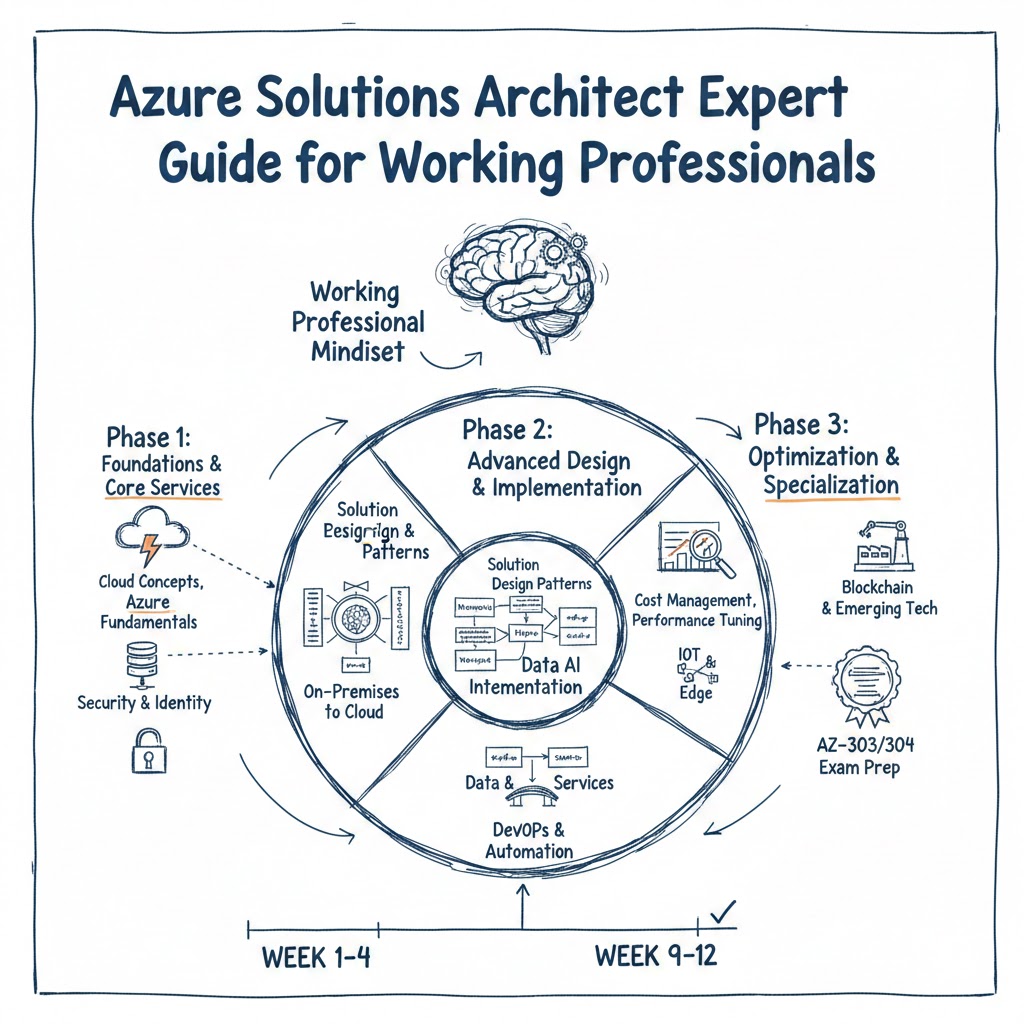
If you are building cloud systems that must be reliable, secure, cost-aware, and ready for real business traffic, this certification can be a strong milestone. Azure Solutions Architect Expert is designed for professionals who make architecture decisions—how systems are designed, how they scale, how they are secured, how they recover from failures, and how they integrate with business needs. This guide is written for working engineers and managers who want a clear, practical path—without confusing jargon.In this master guide, you will learn what the certification is, who it’s for, what skills it proves, what projects you should be able to deliver after it, and how to prepare in 7–14 days, 30 days, or 60 days depending on your current level. You will also get learning paths across DevOps, DevSecOps, SRE, AIOps/MLOps, DataOps, and FinOps, plus role-based certification mapping and FAQs.
Why Azure Solutions Architect Expert Matters
Modern software systems are not just “applications.” They are distributed platforms: microservices, APIs, event streams, containers, identity, governance, monitoring, backups, and cost controls. In most organizations, cloud is now the default platform—and architecture mistakes become expensive fast (downtime, security gaps, runaway cost, slow delivery).
This certification signals that you can:
- Translate business requirements into a secure, scalable Azure design
- Choose the right Azure services for compute, network, storage, and identity
- Build resilient systems with backup, DR, and high availability
- Align architecture with governance, compliance, and cost discipline
- Create designs that teams can actually implement and operate
Who This Guide Is For
- Software Engineers who want to move into cloud architecture
- Cloud Engineers aiming for senior roles
- DevOps / Platform Engineers moving into end-to-end design ownership
- Security Engineers supporting cloud governance and security design
- Engineering Managers who need architecture literacy for better decisions
- SREs designing reliability and resilience on Azure
Certification Overview
What is Azure Solutions Architect Expert?
Azure Solutions Architect Expert validates your ability to design Azure solutions that cover compute, storage, networking, identity, security, data, monitoring, and business continuity. It focuses on architecture-level decisions, trade-offs, and real production concerns—not just “how to click buttons.”
Typical skills covered at a high level
- Identity and access design (authentication, authorization, governance)
- Networking design (connectivity, segmentation, hybrid patterns)
- Compute and platform design (IaaS, PaaS, containers)
- Data and storage design (data lifecycle, performance, security)
- Business continuity (backup, disaster recovery, high availability)
- Observability and operations (monitoring, alerting, logging)
- Cost, scalability, and performance planning
Certifications Table (Tracks, Levels, and Progression)
Note: You requested a table with “Link” but also requested “no external links” and only the provided official certification link. So, for certifications where a link was not provided, the Link field is marked as Not provided.
| Track | Level | Certification | Who it’s for | Prerequisites | Skills covered | Recommended order |
|---|---|---|---|---|---|---|
| Cloud Architecture | Expert | Azure Solutions Architect Expert | Cloud/Platform/DevOps Engineers, Senior Developers, Architects | Azure fundamentals + hands-on Azure experience recommended | Architecture design across identity, network, compute, data, security, BC/DR | 1 |
| Cloud Administration | Associate | Azure Administrator (typical precursor) | Ops/Cloud engineers starting Azure | Basics of Azure services and operations | Resource management, networking basics, storage, governance | 2 |
| App Development | Associate | Azure Developer (typical cross-skill) | Developers building cloud apps | App development fundamentals | PaaS services, app hosting, integration, deployment | 3 |
| DevOps | Expert | Azure DevOps Engineer (typical cross-track) | DevOps/Platform engineers | CI/CD + Azure basics | Pipelines, IaC, release strategies, observability | 4 |
| Security | Associate | Azure Security Engineer (typical cross-track) | Security/Cloud engineers | Security fundamentals | Identity security, governance, threat protection | 5 |
| Data | Associate | Azure Data Engineer (typical cross-track) | Data engineers on Azure | SQL/data fundamentals | Data pipelines, storage, processing, governance | 6 |
| SRE / Reliability | Advanced | SRE Skills on Azure (skill path) | SREs/Platform engineers | Production ops knowledge | SLOs, incident response, resilience patterns, monitoring | 7 |
| FinOps | Professional | FinOps Practitioner (skill path) | Cloud cost owners, managers | Cloud billing basics | Cost allocation, optimization, governance | 8 |
Azure Solutions Architect Expert (Main Certification)
What it is
Azure Solutions Architect Expert is a professional-level credential that validates your capability to design complete Azure solutions—secure, scalable, resilient, and operationally manageable. It focuses on architecture decisions and how to implement them in real environments.
Who should take it
- Engineers already working with Azure who want to move into architecture ownership
- DevOps / Platform Engineers designing platform blueprints and landing zones
- Senior Developers moving from coding-only to system design and cloud strategy
- Cloud Engineers aiming for leadership roles in cloud design and governance
- Engineering Managers who want practical architecture confidence
Skills you’ll gain
- Designing secure identity and access using role-based access patterns
- Planning networking: hub-spoke, segmentation, routing, private access patterns
- Choosing compute: VMs vs PaaS vs containers based on workload needs
- Designing storage and data layers for performance, security, and lifecycle
- Creating business continuity plans (backup + DR + availability patterns)
- Observability thinking: logs, metrics, traces, alerts, dashboards
- Governance and compliance approach: policies, standards, guardrails
- Cost-aware design: right-sizing, scaling strategy, predictable spend
Real-world projects you should be able to do after it
- Enterprise landing zone blueprint with governance, subscriptions, and policies
- Secure hybrid connectivity design with proper network segmentation
- Highly available application architecture across multiple zones/regions
- Multi-tier microservices platform with networking, identity, and monitoring
- Data platform architecture with storage tiers, lifecycle, and access control
- BC/DR implementation plan with RTO/RPO thinking and testing approach
- Cost governance model with tagging, budgets, alerts, and optimization cycles
Preparation plan (7–14 days / 30 days / 60 days)
7–14 Days Plan (Fast-track: for experienced Azure engineers)
Best if you already build and operate Azure workloads.
- Day 1–2: Architecture domains overview + service map (identity/network/compute/data)
- Day 3–4: Identity + governance deep focus (RBAC mindset, policy thinking)
- Day 5–6: Networking design patterns (connectivity, segmentation, private access)
- Day 7–8: Compute and app hosting choices (VM vs container vs PaaS decision practice)
- Day 9–10: Data + storage design (performance tiers, lifecycle, security)
- Day 11–12: BC/DR + observability (availability patterns, backup/restore drills)
- Day 13–14: Full mock practice: scenario-based design questions + revision
Outcome: You sharpen architecture decision-making quickly.
30 Days Plan (Balanced: most working professionals)
- Week 1: Azure architecture fundamentals + identity/governance
- Week 2: Networking + security patterns + hybrid architecture options
- Week 3: Compute + application architecture + integration patterns
- Week 4: Data/storage + BC/DR + monitoring + full scenario practice
Outcome: Strong coverage with practical design confidence.
60 Days Plan (Steady: if you’re new to architecture ownership)
- Weeks 1–2: Azure basics + hands-on foundations (deployments, networking basics)
- Weeks 3–4: Identity, governance, security-by-design principles
- Weeks 5–6: Architecture case studies, patterns, migration and modernization thinking
- Weeks 7–8: Mock scenarios, review, refine weak areas, finalize exam readiness
Outcome: You build both skills and architecture maturity.
Common mistakes (and how to avoid them)
- Treating it like a memorization exam instead of scenario-based design thinking
- Overusing one service for everything (design must fit the workload)
- Ignoring governance early (policies and structure should come first)
- Missing network segmentation and private access considerations
- Underestimating BC/DR (designing availability is not the same as recovery)
- Forgetting operational needs (monitoring, alerts, runbooks, ownership)
- Designing without cost discipline (scaling without guardrails becomes expensive)
Best next certification after this
Choose based on your career direction:
- Same track (architecture depth): Advanced cloud architecture specialization skills and multi-cloud design approach
- Cross-track (delivery speed): Azure DevOps Engineer style pathway to build and release faster
- Leadership track: Cloud strategy, governance, and platform operating model ownership
Choose Your Path
This section helps you decide what to learn next depending on the role you want.
DevOps Path (Build + Release + Operate)
Best for engineers who want faster delivery with stability.
- Focus: CI/CD, IaC, release strategy, platform automation
- Skills to add after architect: pipelines strategy, environment management, deployment patterns
- Typical outcomes: platform delivery, engineering enablement, faster release cycles
DevSecOps Path (Security built into delivery)
Best for teams building secure systems and compliance-ready pipelines.
- Focus: shift-left security, policy-as-code, secure identity, compliance guardrails
- Skills to add: security scanning strategy, secrets management, governance automation
- Typical outcomes: secure software delivery, reduced risk, audit readiness
SRE Path (Reliability and resilience ownership)
Best for engineers responsible for uptime, performance, and incident response.
- Focus: SLOs, error budgets, incident response, resilience engineering
- Skills to add: monitoring design, alert tuning, capacity planning, chaos testing mindset
- Typical outcomes: fewer outages, faster recovery, reliable operations
AIOps/MLOps Path (Automation + intelligence in ops)
Best for large systems where operations data is huge.
- Focus: anomaly detection, event correlation, automated remediation, model lifecycle
- Skills to add: log/metric strategies, automated insights, MLOps pipelines
- Typical outcomes: reduced alert fatigue, smarter operations, better MTTR
DataOps Path (Reliable data pipelines and governance)
Best for data-heavy organizations and modern analytics platforms.
- Focus: data pipeline reliability, quality, observability, lineage
- Skills to add: orchestration patterns, data lifecycle, access governance
- Typical outcomes: trusted data platforms, fewer data incidents, faster analytics delivery
FinOps Path (Cost ownership and optimization)
Best for engineers and managers who want cost discipline without slowing down.
- Focus: cost allocation, optimization, budgeting, governance, unit economics
- Skills to add: tagging strategy, cost dashboards, forecasting, guardrails
- Typical outcomes: predictable cloud spend, less waste, better business alignment
Role → Recommended Certifications Mapping
Note: Only the Azure Solutions Architect Expert has a provided official link in this prompt. For other certifications, links are marked as Not provided to follow your “no external links” rule.
| Role | Primary goal | Recommended certifications (order) | Why it fits |
|---|---|---|---|
| DevOps Engineer | Faster delivery + stability | Azure Solutions Architect Expert → DevOps-focused certification (Not provided) | Strong architecture + delivery automation |
| SRE | Reliability + incident excellence | Azure Solutions Architect Expert → SRE skill track (Not provided) | Better resilience and operational design |
| Platform Engineer | Platform blueprint + governance | Azure Solutions Architect Expert → DevOps/Platform specialization (Not provided) | Landing zones + scalable platform patterns |
| Cloud Engineer | Azure design and implementation | Azure Solutions Architect Expert → Security/DevOps cross-skill (Not provided) | Better design choices + safer builds |
| Security Engineer | Secure cloud architecture | Azure Solutions Architect Expert → Security-focused certification (Not provided) | Security becomes part of architecture |
| Data Engineer | Azure data platform design | Azure Solutions Architect Expert → Data-focused certification (Not provided) | Better storage, security, pipeline architecture |
| FinOps Practitioner | Cost governance + optimization | Azure Solutions Architect Expert → FinOps track (Not provided) | Design systems that stay cost-efficient |
| Engineering Manager | Better architecture decisions | Azure Solutions Architect Expert → Leadership path (Not provided) | Improves planning, risk management, cost clarity |
Next Certifications to Take (3 Options)
You asked for same track, cross-track, leadership options. Here is a practical way to choose:
1) Same Track (Go deeper in Architecture)
Choose this if your job is architecture ownership across teams.
- Advanced architecture patterns (multi-region, hybrid, governance at scale)
- Security-by-design specialization
- Data platform architecture specialization
2) Cross-Track (Boost delivery speed and engineering outcomes)
Choose this if you want stronger execution across build and release.
- DevOps engineering pathway (CI/CD, IaC, release strategy)
- SRE reliability pathway (SLOs, incident response, observability depth)
- Platform engineering specialization (golden paths, self-service infrastructure)
3) Leadership Track (Architecture + business + operating model)
Choose this if you lead teams or want to.
- Cloud strategy and governance operating model
- FinOps leadership and cloud economics mindset
- Enterprise architecture and stakeholder management skills
Training + Certification Support Institutions
Below are institutions that commonly support learners with training, practice, and structured certification guidance for Azure Solutions Architect Expert. The right choice depends on whether you want instructor-led training, project-based learning, or structured exam preparation.
DevOpsSchool
DevOpsSchool supports structured learning paths that blend cloud architecture concepts with practical delivery thinking. It is useful for professionals who want guided preparation plus hands-on outcomes. The learning style generally fits working engineers who prefer clear structure and real-world examples. It is also helpful when you want career guidance along with certification readiness. Many learners prefer it because it focuses on “how to apply” concepts, not just theory.
Cotocus
Cotocus is commonly associated with practical enablement and support for modern cloud and engineering practices. It can be useful when learners want guidance that connects architecture to real implementation work. The value usually comes from practical exposure and structured mentorship style support. It is suited for teams and individuals who want clarity on how cloud design connects to delivery and operations.
Scmgalaxy
Scmgalaxy is often referenced by learners who want structured IT learning support across engineering skills. It can be useful for foundational-to-advanced progression when you want a guided roadmap. The training approach typically supports skill building with practical orientation. It is a fit for learners who want a consistent step-by-step learning track.
BestDevOps
BestDevOps is positioned for learners who want to strengthen DevOps-aligned capabilities. For Azure architects, this matters because architecture is not complete without delivery automation and operational maturity. It can help bridge gaps between design and deployment. It’s suitable if you want to improve CI/CD and infrastructure automation thinking alongside architecture.
devsecopsschool
devsecopsschool supports security-minded training orientation. For architects, security is not a separate task—it is part of the design. This institution is useful if you want to strengthen identity, governance, and secure-by-default design thinking. It can help learners avoid common mistakes like weak access models or ungoverned environments.
sreschool
sreschool is useful for reliability-driven learning. Azure architecture becomes stronger when you add SRE thinking: SLOs, incident response, resilience patterns, and observability. This is a good direction if your role expects uptime ownership and production readiness. It supports learning that reduces outages and improves recovery.
aiopsschool
aiopsschool supports learners interested in smarter operations and automation using data. For architects, AIOps thinking helps at scale where monitoring signals are massive. It is useful for learning patterns around anomaly detection, event correlation, and automated response. This is a strong add-on if you work in large production systems.
dataopsschool
dataopsschool aligns well for professionals building reliable data platforms. Azure architects often support analytics, pipelines, and governance. This institution helps strengthen data reliability thinking: quality, lineage, and operational data management. It’s ideal if your work includes data platform architecture.
finopsschool
finopsschool focuses on cloud cost discipline and value measurement. Architecture choices strongly impact cost: networking, compute types, scaling strategy, and data lifecycle. This institution is useful if you want to design systems that are cost-aware and predictable. It supports a mindset where engineering and finance align.
FAQs Focused on Difficulty, Time, Prerequisites, Sequence, Value, Career Outcomes
1) Is Azure Solutions Architect Expert difficult?
It is challenging because it tests decision-making across many areas: identity, network, compute, data, security, and resilience. If you already build Azure systems, it becomes manageable with scenario practice.
2) How much time do I need to prepare?
If you already work on Azure and make architecture decisions, 7–14 days can work. If you are strong technically but new to architecture ownership, 30 days is safer. If you are transitioning into cloud architecture from another background, use 60 days.
3) What are the prerequisites?
Practical Azure experience helps most—deploying services, understanding identity and networking basics, and being comfortable reading architecture requirements. Real project exposure is more valuable than theory.
4) Do I need to be a “solution architect” job title to take it?
No. Many DevOps engineers, platform engineers, senior developers, and SREs take it because they already design parts of systems and want formal validation.
5) What is the best sequence before this certification?
A common path is: Azure fundamentals → administration and deployment exposure → architecture scenarios. You can still start directly if you already build Azure workloads.
6) What career outcomes can I expect after completing it?
It strengthens your eligibility for roles like Cloud Architect, Solutions Architect, Platform Architect, Senior Cloud Engineer, and Architecture-focused DevOps roles. It also helps engineers communicate design decisions confidently.
7) Will it help me as an Engineering Manager?
Yes. Managers benefit by understanding architecture trade-offs, cost impacts, reliability planning, and security governance. It improves decision-making and reduces risk in delivery timelines.
8) Does it improve salary potential?
It can, especially when combined with demonstrable project experience. Hiring managers pay for results: stable systems, secure design, lower downtime, and predictable cost—this certification supports that story.
9) What kind of questions should I expect?
Expect scenario-based design problems: choosing services, designing secure access, planning hybrid connectivity, designing for failure, and building governance. Practical trade-offs matter.
10) What is the biggest mistake people make while preparing?
They memorize service names without practicing decision-making. This certification rewards architecture thinking: why one design is better than another in a given scenario.
11) Is it more useful for developers or infrastructure engineers?
Both can benefit. Developers gain cloud design and platform understanding; infrastructure engineers gain application architecture and integration thinking. The best architects understand both sides.
12) How do I prove I’m ready beyond passing the exam?
Build 2–3 architecture case studies: landing zone, highly available app design, secure hybrid design, and cost governance model. If you can explain your trade-offs clearly, you’re ready.
FAQs Specifically on Azure Solutions Architect Expert
1) What kind of work does an Azure Solutions Architect do daily?
They translate requirements into design, review system architecture, define patterns, guide teams on implementation, and ensure security, reliability, and cost discipline are built in from day one.
2) Is this certification only about Azure services?
It is Azure-focused, but the real value is architecture thinking: trade-offs, patterns, security models, resilience, and governance. Those skills transfer across cloud providers too.
3) What should I practice most for success?
Practice scenario decisions: identity design, networking layout, compute selection, data lifecycle, and BC/DR. Also practice explaining “why” your design fits a scenario.
4) How important is networking for this certification?
Very important. Many architecture failures come from networking mistakes: poor segmentation, insecure access, or weak hybrid connectivity design.
5) Do I need to learn everything in Azure?
No. Focus on core architecture domains and the services commonly used in enterprise architecture. Learn patterns and decision rules rather than trying to learn every service.
6) How do I make my preparation more practical?
Design a reference architecture for a real system: e-commerce, banking-style system, internal enterprise app, or data platform. Document identity, network, compute, data, monitoring, and DR.
7) What should I be able to explain confidently after certification?
You should be able to explain your architecture choices: security model, networking plan, scaling plan, availability strategy, monitoring approach, and cost controls—without confusion.
8) What’s the fastest way to improve architecture judgment?
Review real incidents and outages (even from your own projects). Ask: what failed, why it failed, and what design change would reduce that risk next time.
Conclusion
Azure Solutions Architect Expert is not just a certificate—it is a signal that you can design systems that survive real business pressure. If you want better senior roles, higher ownership, and stronger credibility in cloud decisions, this is a meaningful milestone. Focus on practical architecture thinking: identity and governance first, networking design next, then compute and data choices, and finally reliability, monitoring, and cost guardrails. Pick your path based on your role goals—DevOps for delivery speed, DevSecOps for security-by-default, SRE for reliability, AIOps/MLOps for smart operations, DataOps for trusted pipelines, or FinOps for cost control.
Find Trusted Cardiac Hospitals
Compare heart hospitals by city and services — all in one place.
Explore Hospitals