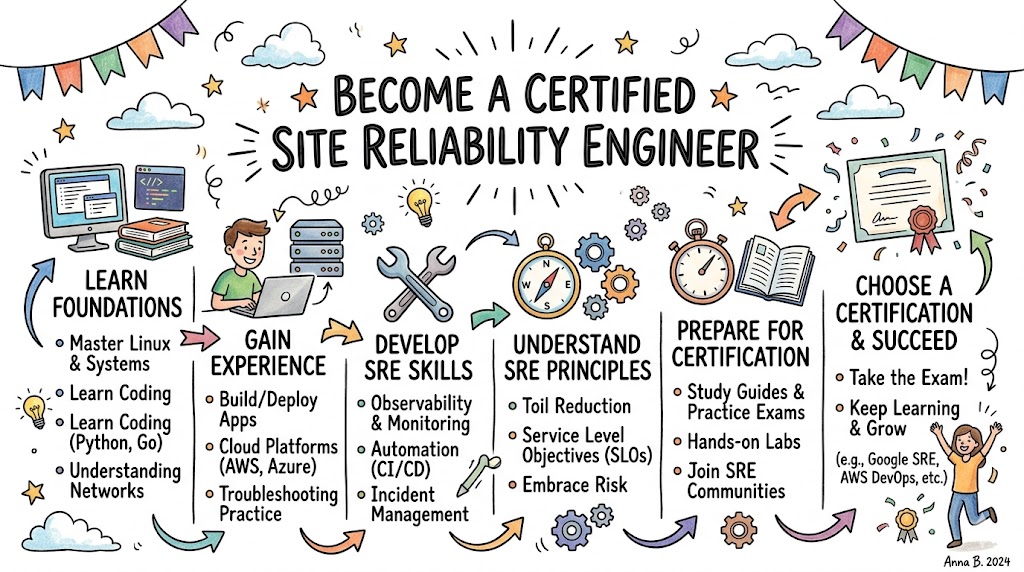
Introduction
The Certified Site Reliability Engineer designation is a professional benchmark designed to bridge the gap between traditional operations and modern software engineering. This guide is crafted for engineers and technical managers who recognize that uptime is no longer just about “keeping the lights on” but about engineering scalable and highly available systems. In the current landscape of cloud-native ecosystems and platform engineering, understanding SRE principles is essential for staying competitive and delivering value. This comprehensive breakdown will help you navigate the certification landscape and determine how this specific path aligns with your long-term career goals in DevOps and infrastructure.
What is the Certified Site Reliability Engineer?
The Certified Site Reliability Engineer program represents a shift from reactive firefighting to proactive systems engineering. It exists to validate an engineer’s ability to apply software engineering practices to infrastructure and operations problems. Unlike certifications that focus purely on a single cloud provider’s buttons and dials, this program emphasizes real-world, production-focused learning. It aligns with modern engineering workflows by teaching professionals how to manage risk, measure reliability through SLIs and SLOs, and automate away toil within complex enterprise environments.
Who Should Pursue Certified Site Reliability Engineer?
This certification is highly beneficial for DevOps engineers, systems administrators, and cloud architects who want to formalize their reliability engineering skills. It is equally relevant for security professionals and data engineers who must ensure their specialized platforms remain resilient under load. For beginners, it provides a structured mental model for how large-scale systems function, while for experienced engineers and managers, it offers a framework for leading site reliability teams. Both in the Indian market and globally, there is a massive demand for professionals who can prove they understand the discipline of reliability.
Why Certified Site Reliability Engineer is Valuable and Beyond
The demand for SREs continues to outpace supply as enterprises move away from legacy silos toward integrated platform teams. This certification provides long-term career longevity because it focuses on principles—such as error budgets and observability—that remain constant even as specific tools change. Organizations are increasingly adopting SRE as their standard operating model to reduce the cost of downtime and improve deployment velocity. Investing time in this certification offers a high return by positioning you as a high-value asset capable of managing the business-critical infrastructure that drives modern revenue.
Certified Site Reliability Engineer Certification Overview
The program is delivered via the official SRE School portal and is hosted on the It utilizes a multi-tiered assessment approach that combines theoretical knowledge with practical, scenario-based evaluations. The certification structure is designed to be practical, ensuring that those who earn the credential can actually perform the tasks required in a production environment. It is owned and maintained by industry experts who ensure the content stays mapped to the evolving standards of the SRE community and enterprise requirements.
Certified Site Reliability Engineer Certification Tracks & Levels
The certification is structured to support professionals at every stage of their career, starting with the Foundation level which establishes the core vocabulary and concepts. From there, practitioners can move into Professional and Advanced levels that delve deeper into complex system architecture and leadership. Specialization tracks allow engineers to map their reliability skills to specific domains like FinOps for cost-efficiency or DevSecOps for integrated security. This tiered approach ensures that your learning path mirrors your actual career progression from an individual contributor to a technical leader.
Complete Certified Site Reliability Engineer Certification Table
| Track | Level | Who it’s for | Prerequisites | Skills Covered | Recommended Order |
| SRE | Foundation | Associate Engineers | Basic Linux/Cloud | SLIs, SLOs, Toil, Error Budgets | 1 |
| SRE | Professional | Senior Engineers | Foundation Level | Automation, Incident Response | 2 |
| SRE | Advanced | Lead Engineers | Professional Level | Capacity Planning, Architecture | 3 |
| FinOps | Specialist | Cloud Economists | SRE Foundation | Cloud Cost Optimization | 4 |
| DevSecOps | Specialist | Security Engineers | SRE Foundation | Resilience & Security | 4 |
Detailed Guide for Each Certified Site Reliability Engineer Certification
Certified Site Reliability Engineer – Foundation
What it is
This certification validates a fundamental understanding of the SRE philosophy and the core metrics used to measure system health. It ensures the candidate understands the difference between traditional operations and the engineering-led approach to reliability.
Who should take it
This is suitable for junior DevOps engineers, system administrators transitioning to SRE roles, and technical managers who need to speak the language of their engineering teams. No deep coding experience is required, but a general understanding of IT operations is helpful.
Skills you’ll gain
- Defining Service Level Indicators (SLIs) and Service Level Objectives (SLOs).
- Calculating and managing Error Budgets.
- Identifying and eliminating “Toil” through automation.
- Understanding the pillars of Observability: Metrics, Logs, and Traces.
- Implementing blameless post-mortems and incident management cultures.
Real-world projects you should be able to do
- Draft an SLO document for a sample web application.
- Create a basic dashboard reflecting the “Four Golden Signals.”
- Conduct a mock blameless post-mortem for a service outage.
Preparation plan
- 7–14 days: Intensive review of the SRE handbook and core definitions; focus on vocabulary and the “why” behind SRE.
- 30 days: Engaging with practical labs and case studies; practicing the calculation of availability and error budgets.
- 60 days: Deep dive into the integration of SRE with existing DevOps pipelines and organizational culture shifts.
Common mistakes
- Focusing too much on specific tools (like Prometheus) rather than the underlying principles.
- Underestimating the importance of the “cultural” aspects of SRE, such as psychological safety.
- Confusion between SLIs, SLOs, and SLAs.
Best next certification after this
- Same-track option: Certified Site Reliability Engineer – Professional
- Cross-track option: DevSecOps Foundation
- Leadership option: Engineering Management for SRE
Choose Your Learning Path
DevOps Path
The DevOps path focuses on the seamless integration of development and operations through continuous delivery. For an SRE, this means building the guardrails that allow developers to ship code quickly without breaking the production environment. You will learn how to automate the entire lifecycle while maintaining a focus on stability. This path is ideal for those who enjoy building CI/CD pipelines and infrastructure as code.
DevSecOps Path
In this path, reliability and security are treated as two sides of the same coin. You will learn how to integrate automated security scanning and compliance checks into the SRE workflow. This ensures that the system is not only up and running but also protected against vulnerabilities. Professionals here focus on building “secure-by-design” systems that can withstand both traffic spikes and malicious attacks.
SRE Path
The pure SRE path is for those who want to specialize in the deep mechanics of system reliability and performance. It covers advanced topics such as distributed systems tracing, chaos engineering, and complex incident response. You will become an expert in managing the lifecycle of production services. This is the core track for anyone aiming to become a Principal Reliability Engineer at a major tech firm.
AIOps Path
This path explores the use of machine learning and data science to automate IT operations. As systems become too complex for humans to monitor manually, AIOps provides the tools to predict outages before they happen. You will learn how to use algorithmic analysis to reduce alert fatigue and correlate events across massive datasets. It is a forward-looking track for engineers interested in the intersection of AI and infrastructure.
MLOps Path
The MLOps path is specialized for those managing the reliability of machine learning models in production. Unlike standard software, ML models require monitoring for data drift and model decay. You will apply SRE principles to the specific challenges of training pipelines and inference engines. This path is essential for organizations that rely on real-time AI predictions for their business logic.
DataOps Path
DataOps focuses on the reliability and quality of data pipelines. SREs in this path ensure that data flows from sources to warehouses without corruption or lag. You will apply SLOs to data latency and accuracy, ensuring that downstream analytics and business intelligence tools are always fed with reliable information. This is a critical role in data-driven enterprises.
FinOps Path
The FinOps path marries SRE principles with financial accountability. You will learn how to optimize cloud spend without sacrificing performance or reliability. This involves understanding cloud billing structures, identifying wasted resources, and implementing automated cost-control measures. It is a high-impact path that directly relates engineering decisions to the company’s bottom line.
Role → Recommended Certified Site Reliability Engineer Certifications
| Role | Recommended Certifications |
| DevOps Engineer | Certified SRE Foundation, DevSecOps Practitioner |
| SRE | Certified SRE Foundation, SRE Professional |
| Platform Engineer | Certified SRE Foundation, Infrastructure as Code Specialist |
| Cloud Engineer | Certified SRE Foundation, Cloud Architecture Specialist |
| Security Engineer | Certified SRE Foundation, DevSecOps Specialist |
| Data Engineer | Certified SRE Foundation, DataOps Specialist |
| FinOps Practitioner | Certified SRE Foundation, FinOps Specialist |
| Engineering Manager | Certified SRE Foundation, SRE Leadership |
Next Certifications to Take After Certified Site Reliability Engineer
Same Track Progression
Once you have mastered the SRE Foundation, the natural progression is to move toward the Professional and Advanced levels. These certifications shift the focus from understanding concepts to implementing complex automation and managing large-scale distributed systems. Deep specialization in areas like Chaos Engineering or Advanced Observability allows you to become the go-to expert for high-stakes production environments.
Cross-Track Expansion
Broadening your skills into adjacent areas like DevSecOps or FinOps makes you a more versatile “T-shaped” professional. By understanding how reliability interacts with security and cost, you can make better architectural decisions that benefit the entire organization. Cross-training ensures that you are not siloed and can contribute to various parts of the platform engineering ecosystem.
Leadership & Management Track
For those looking to move into management, the next step involves certifications focused on SRE team leadership and organizational transformation. This track teaches you how to manage stakeholders, negotiate SLOs with product owners, and build a culture of reliability across multiple departments. It is the bridge between technical excellence and strategic business alignment.
Training & Certification Support Providers for Certified Site Reliability Engineer
DevOpsSchool provides extensive hands-on training for SRE candidates, focusing on practical lab environments that simulate real-world production outages. Their curriculum is designed by industry veterans who emphasize the marriage of theory and practice.
Cotocus offers specialized coaching for enterprise teams looking to adopt SRE practices at scale. They provide tailored roadmaps that align certification goals with specific business objectives and technical stacks.
Scmgalaxy is a community-driven platform that offers a wealth of resources, including tutorials and study guides for SRE aspirants. It serves as a hub for professionals to share knowledge and stay updated on the latest industry trends.
BestDevOps focuses on delivering high-quality, instructor-led training sessions that cover the breadth of the SRE certification levels. They are known for their focus on the “Golden Signals” and observability best practices.
devsecopsschool integrates security deeply into the SRE conversation, offering training that ensures reliability and security are handled as a single discipline. Their courses are ideal for those following the DevSecOps track.
sreschool is the primary host for the certification, providing the official curriculum and assessment platform. They ensure that all training materials are perfectly aligned with the exam objectives and industry requirements.
aiopsschool specializes in the emerging field of AI-driven operations, helping SREs learn how to leverage machine learning tools to manage modern, complex environments.
dataopsschool provides the necessary training for engineers who want to apply SRE principles to data pipelines and big data infrastructure, ensuring high data availability and quality.
finopsschool focuses on the intersection of cloud engineering and finance, teaching SREs how to manage the economics of the cloud while maintaining high levels of service reliability.
Frequently Asked Questions
- How difficult is the Certified Site Reliability Engineer Foundation exam? The Foundation level is designed to be accessible for those with a basic background in IT, focusing on concepts and vocabulary rather than deep coding.
- How long does it take to prepare for the certification? Most professionals find that 30 days of consistent study is sufficient to master the material for the Foundation level.
- Are there any strict prerequisites for the Foundation level? There are no formal prerequisites, though a basic understanding of the software development lifecycle and cloud computing is recommended.
- What is the ROI of getting an SRE certification? Certified SREs often command higher salaries and have access to more senior roles in platform engineering and cloud architecture.
- Is this certification recognized globally? Yes, SRE principles are universal, and the certification is designed to be relevant in any market, including India, Europe, and North America.
- Does the certification expire? Standard practice involves a renewal process every two to three years to ensure your skills stay current with evolving technology.
- Is there a coding requirement for the exam? The Foundation level does not require deep coding, but higher levels will test your ability to use automation scripts and configuration tools.
- Can I take the exam online? Yes, the certification is delivered through an online platform, allowing you to take the assessment from anywhere in the world.
- How does SRE differ from DevOps in this certification? The certification clarifies that while DevOps is a cultural philosophy, SRE is a specific implementation of that philosophy using engineering practices.
- What kind of study materials are provided? Official materials typically include study guides, practice exams, and access to recorded lectures or live sessions.
- Are there group discounts for corporate teams? Most training providers associated with the certification offer bulk pricing for organizations looking to certify their entire engineering department.
- What happens if I fail the exam on the first try? Most programs allow for a retake after a specific waiting period, often providing feedback on which areas need improvement.
FAQs on Certified Site Reliability Engineer
- What is the core focus of the Certified Site Reliability Engineer – Foundation level? The focus is on establishing a shared language around reliability, specifically focusing on the creation and management of SLOs and error budgets to balance innovation with stability.
- How does this certification help with “Toil” reduction? It teaches you how to identify repetitive, manual tasks and provides a framework for prioritizing automation projects that return the most time to the engineering team.
- Does this certification cover multi-cloud environments? Yes, the principles taught are cloud-agnostic, meaning you can apply them whether your organization uses AWS, Azure, Google Cloud, or on-premises data centers.
- How are labs conducted during the training? Labs are typically hosted in browser-based environments where you can practice setting up monitoring tools and responding to simulated service degradations.
- What is the importance of “Blamelessness” in the curriculum? The certification emphasizes that reliability is a systemic issue, teaching engineers how to conduct investigations that focus on fixing processes rather than punishing individuals.
- Will this certification help me move into a Platform Engineering role? Absolutely, as SRE is a foundational pillar of modern platform engineering, providing the reliability standards that the platform must deliver to internal users.
- How does the certification address incident management? It covers the full lifecycle of an incident, from initial detection through automated alerting to the final post-mortem and implementation of preventive measures.
- Is there a focus on cost-optimization? While primarily focused on reliability, the certification introduces the concept that an “over-reliable” system is an unnecessary expense, helping you find the right balance.
Conclusion
If you are looking to move beyond the “ops” label and want to be recognized as an engineer who solves complex systemic problems, the Certified Site Reliability Engineer path is a sound investment. It is not a magic bullet that will transform your career overnight, but it provides the structured knowledge and industry-recognized credential needed to open doors to high-level roles. My advice as a mentor is to focus less on the certificate itself and more on the transition in mindset it requires—from manual intervention to automated engineering. For those committed to the discipline of building resilient systems, this certification serves as a powerful validation of your expertise.
Find Trusted Cardiac Hospitals
Compare heart hospitals by city and services — all in one place.
Explore Hospitals