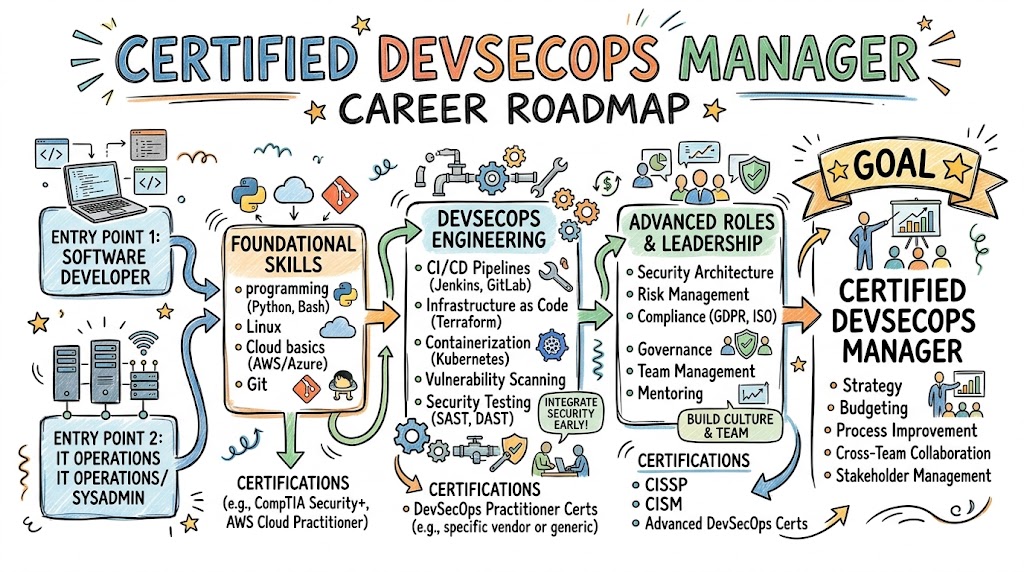
Introduction
Security can no longer sit outside your delivery pipeline. It must be designed, implemented, and managed as part of how your teams build and ship software every day. A Certified DevSecOps Manager is the person who owns this responsibility at a leadership and execution level.This guide is for working engineers, leads, and managers in India and across the world who want to move into security-aware leadership roles in DevOps and cloud environments. It explains what the Certified DevSecOps Manager program is, who it is for, what skills you gain, how to prepare, and how to connect it with long-term career paths like DevOps, SRE, DevSecOps, AIOps/MLOps, DataOps, and FinOps.
What is a Certified DevSecOps Manager?
A Certified DevSecOps Manager is a professional who leads how security is built into DevOps pipelines, cloud platforms, and engineering teams. They do not just run tools; they align people, process, and technology so that security is continuous, automated, and measurable.
This role sits between engineering, operations, and security stakeholders. It focuses on governance, risk management, compliance, and culture, while still staying close enough to technology to make practical decisions on tools, pipelines, and architecture.
What it is
The Certified DevSecOps Manager program is a leadership-focused certification that teaches you how to design, roll out, and manage DevSecOps practices across teams and platforms. It combines security strategy, governance, and implementation planning with practical views of pipelines, tools, and cloud environments.
Who should take it
- Engineering managers responsible for multiple teams or products
- DevOps leads and SRE leads who want to formalize security leadership
- Security engineers moving into DevSecOps program ownership
- Cloud, platform, or architecture leads who must align security with delivery speed
Skills you’ll gain
- DevSecOps strategy and roadmap design
- Governance models, policies, and risk management
- Integrating security into CI/CD and cloud platforms
- Choosing and governing DevSecOps toolchains
- Designing metrics, KPIs, and maturity models
- Leading culture change and cross‑team collaboration
- Aligning DevSecOps with compliance and audits
Real‑world projects you should be able to do after it
- Design and roll out a DevSecOps operating model across multiple teams
- Define and implement secure CI/CD pipelines for cloud‑native apps
- Build a DevSecOps maturity roadmap with clear phases and KPIs
- Align security controls with regulations and audit requirements
- Lead incident response improvement and post‑incident learning cycles
- Standardize toolchains and guardrails across business units
Preparation plan
You can treat preparation in three phases inspired by broader DevOps mastery programs:
- 7–14 days (foundation):
- 30 days (skills and frameworks):
- 60 days (leadership and execution):
- Design a full DevSecOps rollout plan for your organization or a sample organization.
- Define KPIs, reporting dashboards, and maturity levels.
- Practice communicating trade‑offs and roadmaps to CXOs, security leaders, and engineering teams.
Common mistakes
- Treating DevSecOps as only tool installation instead of culture + process + tooling
- Focusing only on application security and ignoring cloud and platform risks
- Not involving developers and SREs early when designing new controls
- Over‑complicating policies and slowing down delivery unnecessarily
- Ignoring metrics, so leadership cannot see progress or value
- Making one‑time changes instead of building a continuous improvement loop
Best next certification after this
After becoming a Certified DevSecOps Manager, strong “next step” options are:
- A deeper DevOps or SRE leadership path such as a Master in DevOps Engineering–style program
- A specialized Cloud or Security Architect certification (for example, cloud platform or security engineer tracks)
- A leadership‑oriented program focusing on architecture, platform engineering, or security program management
Why Certified DevSecOps Manager Matters Now
Organizations are under pressure to ship faster, adopt cloud, and stay compliant with strict regulations at the same time. Traditional security teams working as a gate cannot keep up with this speed. DevSecOps is the response, and DevSecOps Managers are the people who make it real across teams.
In many companies, there is a gap between senior management (CIO, CISO) and hands‑on engineers. The Certified DevSecOps Manager role fills that gap by turning strategy into day‑to‑day practices, guardrails, and metrics inside pipelines and platforms.
Certified DevSecOps Manager in the DevOps Career Ecosystem
The Certified DevSecOps Manager program fits into a larger certification ecosystem where professionals move through DevOps, SRE, DevSecOps, MLOps, and related tracks as their career grows. Ecosystem‑style programs such as “Master in DevOps Engineering” show how modern careers cut across multiple roles and levels.
You can think of Certified DevSecOps Manager as a mid‑ to senior‑level leadership credential inside the DevSecOps and security‑aware DevOps stream, aligned with roles like DevOps Lead, SRE Lead, Security Engineer, and Engineering Manager.
Certification overview table
Below is an example table placing Certified DevSecOps Manager inside a broader ecosystem of certifications and learning levels. The details are aligned with multi‑level DevOps career frameworks like Master in DevOps Engineering, adapted to focus on DevSecOps and related streams.
| Certification / Program | Track | Level | Who it’s for | Prerequisites | Skills covered | Recommended order |
|---|---|---|---|---|---|---|
| Certified DevSecOps Manager | DevSecOps | Manager / Lead | Engineering managers, DevOps/SRE leads, security leaders | 3–5+ years in DevOps/SRE/security, basic cloud + CI/CD | DevSecOps strategy, governance, risk management, secure CI/CD, policy design, metrics, culture change, compliance alignment | After DevOps/SRE practitioner level |
| DevSecOps‑focused DevOps Practitioner* | DevSecOps | Practitioner | DevOps engineers, SREs, security‑minded developers | Basic Linux, Git, CI/CD, scripting | DevOps fundamentals, DevSecOps basics, pipelines, monitoring, IaC, automation | Early career or pre‑manager |
| DevSecOps Engineer / Professional* | DevSecOps | Professional | Security engineers, senior DevOps, platform engineers | Strong CI/CD and cloud experience | Secure SDLC, SAST/DAST/SCA, IaC security, vulnerability management, DevSecOps toolchains, threat modeling | Before or parallel to Manager |
| Master in DevOps Engineering (ecosystem)* | DevOps | Multi‑level (Associate to Expert) | DevOps, SRE, platform, and cloud engineers seeking end‑to‑end mastery | 1–3+ years in IT or software | CI/CD, containers, Kubernetes, IaC, monitoring, SRE practices, security integration, automation at scale | Core DevOps foundation before leadership |
| SRE / Reliability Manager* | SRE | Manager / Lead | SRE leads, reliability managers, platform leads | Solid SRE and observability experience | Error budgets, SLOs, reliability strategy, incident management, capacity planning, reliability governance | Parallel or next after DevSecOps Manager |
| Cloud Security / DevSecOps Architect* | DevSecOps | Architect | Senior architects, security architects, platform architects | Strong cloud + security + DevOps background | Secure cloud architecture, zero trust, multi‑cloud security, compliance by design, advanced DevSecOps patterns | After Manager‑level maturity |
Choose your path: 6 learning paths
Use the Certified DevSecOps Manager program as a hub inside one of six long‑term learning paths.
1. DevOps path
- Start with DevOps fundamentals and CI/CD skills.
- Move to a multi‑level DevOps mastery path (similar to Master in DevOps Engineering) covering automation, containers, Kubernetes, and IaC.
- Add Certified DevSecOps Manager to bring strong security leadership into your DevOps programs.
2. DevSecOps path
- Begin with DevSecOps basics, pipelines, and application security fundamentals.
- Take an engineer‑level DevSecOps certification that focuses on tools and implementation.
- Move to Certified DevSecOps Manager to own governance, culture, metrics, and cross‑team rollout.
3. SRE path
- Start with SRE basics: SLIs, SLOs, error budgets, and incident management.
- Move into advanced observability and reliability engineering.
- Add Certified DevSecOps Manager to unify reliability and security practices, such as secure incident management, secure rollbacks, and risk‑aware error budgets.
4. AIOps/MLOps path
- Build strong DevOps and cloud foundations, then specialize in monitoring, telemetry, and automation (AIOps) or model lifecycle (MLOps).
- Implement automated detection, anomaly analysis, and secure data flows for ML pipelines.
- Use Certified DevSecOps Manager to add governance, risk controls, and security policies around these automated systems and ML workflows.
5. DataOps path
- Learn DataOps fundamentals: data pipelines, ETL/ELT, data quality, and versioning.
- Implement CI/CD‑style practices for data workflows and analytics platforms.
- Apply DevSecOps Manager principles to secure data pipelines, control access, manage compliance, and automate checks around sensitive data.
6. FinOps path
- Start with cloud cost management skills and FinOps principles.
- Learn how usage, performance, and cost metrics link to engineering work.
- Use Certified DevSecOps Manager practices to ensure that cost‑optimization changes remain secure, compliant, and aligned with risk policies.
Role → Recommended certifications mapping
This section maps common roles to recommended certification sequences and shows where Certified DevSecOps Manager fits in, taking cues from multi‑track programs like Master in DevOps Engineering.
| Role | Early focus certifications* | Mid‑career / core certifications* | Leadership / advanced certifications* (including DevSecOps Manager) |
|---|---|---|---|
| DevOps Engineer | DevOps fundamentals, CI/CD and automation practitioner programs | Multi‑level DevOps programs (similar to Master in DevOps Engineering), container and Kubernetes certifications | Certified DevSecOps Manager; SRE or platform engineering leadership programs; cloud architect‑style training |
| SRE | SRE fundamentals, monitoring and observability courses | Advanced SRE, incident management, and reliability engineering programs | Certified DevSecOps Manager; reliability/DevOps leadership programs with security + compliance focus |
| Platform Engineer | Linux, cloud platform fundamentals, IaC and container basics | Advanced Kubernetes, platform engineering, and automation certifications | Certified DevSecOps Manager; cloud security or DevSecOps architect‑style programs |
| Cloud Engineer | Cloud provider associate‑level certifications, basic DevOps and CI/CD | Multi‑level DevOps or cloud engineering programs, container and security add‑ons | Certified DevSecOps Manager; cloud security engineer / architect certificates |
| Security Engineer | Security fundamentals, application security, DevSecOps or secure coding certifications | DevSecOps engineer‑level certifications, cloud security courses | Certified DevSecOps Manager; DevSecOps Architect or security leadership programs |
| Data Engineer | Data engineering fundamentals, SQL, ETL, data platform certifications | DataOps or MLOps‑style programs, cloud data platform certifications | Certified DevSecOps Manager (for securing data pipelines and governance); data security or privacy‑focused programs |
| FinOps Practitioner | Cloud billing and cost management courses, FinOps principles | FinOps practitioner or professional certifications | Certified DevSecOps Manager (to align cost and security policies); cloud governance and compliance programs |
| Engineering Manager | General project and people management training, agile and DevOps awareness | DevOps/SRE leadership programs, architecture awareness | Certified DevSecOps Manager; broader multi‑track leadership programs like Master in DevOps Engineering‑style ecosystems with security and reliability |
Next certifications to take after Certified DevSecOps Manager
Using the ecosystem idea from Master in DevOps Engineering, you can plan three types of “next steps”: same track, cross‑track, and leadership.
1. Same track
Stay in the DevSecOps and security track to go deeper into architecture and advanced security design.
- Advanced DevSecOps engineer or professional‑level certification, with more focus on hands‑on pipelines and labs
- Cloud security engineer programs focused on securing AWS, Azure, or GCP environments end‑to‑end
- DevSecOps or security architect‑style programs with emphasis on design and enterprise patterns
2. Cross‑track
Move sideways into complementary tracks that strengthen your technical depth and operational view.
- Multi‑level DevOps programs like Master in DevOps Engineering to solidify CI/CD, Kubernetes, IaC, and automation skills
- SRE or observability certifications that deepen your understanding of reliability, SLIs, SLOs, and incident response
- Platform engineering or Kubernetes‑focused programs to manage the platforms where DevSecOps will actually run
3. Leadership
Grow into broader leadership roles that own both strategy and execution across multiple domains.
- Engineering or DevOps leadership programs focusing on portfolio‑level governance and transformation
- Architecture‑oriented certifications (cloud architect, enterprise architect) with strong security integration
- Advanced governance and compliance programs where you can position DevSecOps as the backbone of risk management
Training and certification support: Top institutions
Several specialist institutions support training and certification journeys for DevOps, DevSecOps, and related roles. They help with structured learning, hands‑on labs, mentoring, and exam preparation.
DevOpsSchool
DevOpsSchool is a leading platform for DevOps, SRE, DevSecOps, and related cloud certifications, including ecosystem‑style programs like Master in DevOps Engineering. It offers live online and self‑paced courses, hands‑on labs, mentorship, and performance‑based assessments aligned with real industry problems.
Cotocus
Cotocus works as a specialist consulting and training organization focused on DevOps, cloud, security, and automation skills. It helps organizations design role‑based learning paths, including DevSecOps leadership roles like Certified DevSecOps Manager. Its trainers typically bring strong industry experience and align content with real project scenarios.
ScmGalaxy
ScmGalaxy focuses on software configuration management, DevOps, CI/CD, and related engineering practices. It supports professionals who want a strong technical base before or alongside management programs like Certified DevSecOps Manager by offering tooling‑heavy workshops and project‑oriented labs.
BestDevOps
BestDevOps is a content and training hub that aggregates DevOps, SRE, and DevSecOps learning resources, training programs, and community activities. It helps learners understand emerging career paths, compare multiple programs, and access curated guides such as Master in DevOps Engineering when planning a long‑term roadmap.
devsecopsschool
DevSecOpsSchool is the dedicated DevSecOps training and certification provider behind the Certified DevSecOps Manager program. It brings together DevSecOps thought leaders to build hands‑on, real‑world courses focused on pipelines, governance, culture, and leadership across DevOps and security teams.
sreschool
SRESchool focuses on Site Reliability Engineering skills such as SLIs, SLOs, incident response, and observability. Its programs pair well with Certified DevSecOps Manager if you want to manage reliability and security together in complex, cloud‑native environments.
aiopsschool
AIOpsSchool is geared toward applying AI and automation to operations, monitoring, and incident management. Learners who combine AIOps skills with Certified DevSecOps Manager knowledge can design secure, automated operations frameworks that use telemetry, analytics, and machine learning responsibly.
dataopsschool
DataOpsSchool specializes in DataOps practices—versioning, testing, and automating data pipelines. Paired with Certified DevSecOps Manager, it enables leaders to secure data workflows, govern access, and align analytics projects with security and compliance standards.
finopsschool
FinOpsSchool focuses on cloud financial management and FinOps practices like cost optimization, budgeting, and value tracking. When combined with Certified DevSecOps Manager, it helps leaders connect cost, performance, and security decisions across cloud platforms and delivery teams.
FAQs about Certified DevSecOps Manager
- What is the main goal of the Certified DevSecOps Manager program?
The main goal is to prepare managers and leads who can design, govern, and scale DevSecOps practices across an organization, linking security directly to business and delivery goals. - Is this certification more technical or managerial?
It is designed as a manager‑level program, but it expects you to understand DevOps, cloud, and security at a practical level so that you can make realistic decisions about tools and pipelines. - Who is the ideal candidate for this certification?
Ideal candidates include DevOps leads, SRE leads, security engineers moving into management, engineering managers, and cloud or platform leads who must integrate security into delivery at scale. - Do I need hands‑on DevOps experience before taking it?
Yes, you should have real experience with CI/CD, cloud, and basic security concepts so that the governance and strategy topics are not just theory. This is aligned with how ecosystem programs like Master in DevOps Engineering expect working experience. - What topics does the certification typically cover?
It covers DevSecOps principles, security governance, risk and compliance, secure CI/CD pipelines, toolchain strategy, metrics and KPIs, culture change, and incident and vulnerability management. - How long does it take to prepare?
With focused effort, many working professionals can prepare in 30–60 days by combining theory, labs, and a real or simulated DevSecOps rollout plan, similar to the phased approach used in Master in DevOps Engineering. - How does this certification help my career?
It positions you as a go‑to leader for secure digital transformation, enabling you to move into roles like DevSecOps Manager, Head of DevSecOps, or Security‑focused Engineering Manager across global organizations. - Is the certification relevant outside India?
Yes. The concepts—DevSecOps, governance, cloud security, and compliance—are used globally, and the program is designed for both India and international professionals. - Can developers benefit from this certification?
Senior developers or tech leads who already work closely with CI/CD and cloud can benefit, especially if they are moving into architect or manager roles with security ownership. - How does this certification relate to DevOps and SRE?
DevSecOps Manager builds on DevOps and SRE by adding structured security governance, risk management, and compliance into existing reliability and delivery practices. - What kind of projects can I showcase after completing it?
You can showcase projects like designing a DevSecOps operating model, building secure CI/CD templates, defining a maturity roadmap, or implementing security metrics dashboards. - Which institutions can help me train for this certification?
DevOpsSchool, DevSecOpsSchool, Cotocus, ScmGalaxy, BestDevOps, and the other specialist schools (SRESchool, AIOpsSchool, DataOpsSchool, FinOpsSchool) provide training, mentoring, and ecosystem‑level roadmaps aligned with DevSecOps leadership roles.
FAQs
- How difficult is the Certified DevSecOps Manager exam?
The exam is challenging at a manager level because it tests your ability to connect security, DevOps, and business outcomes rather than only tool knowledge. With the right preparation and real project exposure, it is achievable. - How much time should a working professional plan for preparation?
Most working engineers and managers should plan 30–60 days with 1–2 hours per day, combining reading, labs, and designing a DevSecOps rollout plan for a sample or real organization. This pattern mirrors the suggested phases of broader DevOps mastery programs. - What are the minimum prerequisites to start?
You should understand basic DevOps concepts, CI/CD pipelines, cloud platforms, and fundamental security ideas like vulnerabilities, threats, and basic controls. Experience with actual projects makes a big difference. - In what sequence should I take this relative to other certifications?
Use it after you have passed through a DevOps or SRE practitioner phase (for example, a program like Master in DevOps Engineering at core or professional levels), and after at least one security or DevSecOps engineer‑level course. - Is it better to do DevOps or security certifications first?
A strong approach is to build DevOps or SRE foundations first, then add one or two DevSecOps or security engineer‑level courses, and finally aim for Certified DevSecOps Manager once you can connect both perspectives. - What is the long‑term value of this certification?
Long term, it positions you as a specialist in secure delivery and transformation, making you suitable for high‑impact roles such as DevSecOps Manager, Head of DevSecOps, Security‑focused Engineering Manager, or Cloud Security Program Lead. - Can this certification help me move into management roles?
Yes. It demonstrates that you can speak both “engineering language” and “business language” when it comes to security, which is exactly what many organizations want from managers and leads. - How does this certification compare to pure security certifications?
While pure security certifications focus deeply on security tools and theory, Certified DevSecOps Manager concentrates on integrating those practices into DevOps pipelines, cloud platforms, and day‑to‑day team work.
Conclusion
Certified DevSecOps Manager is a powerful step for experienced engineers and managers who want to lead secure digital transformation, not just talk about it. It takes the best of DevOps speed, SRE reliability, and security governance, and connects them into a single leadership role that can guide teams across cloud, application, and platform layers.By pairing this certification with a broader ecosystem of DevOps, SRE, AIOps/MLOps, DataOps, and FinOps learning paths, you create a long‑term, flexible career roadmap that stays relevant as technologies change. If you already work with cloud and CI/CD and want to own both security and delivery outcomes, this program is a natural next move in your journey.
Find Trusted Cardiac Hospitals
Compare heart hospitals by city and services — all in one place.
Explore Hospitals