Introduction
Software teams now deploy many times a day, across microservices, containers, and multiple clouds. Security can no longer sit outside this flow as a slow, separate step. If you want to build and run systems that are both fast and safe, you need DevSecOps skills.The Certified DevSecOps Professional program is designed exactly for that need. It helps working engineers and managers learn how to weave security into pipelines, infrastructure, and day‑to‑day engineering work, instead of treating it as an afterthought. In this guide, you will see what the certification covers, who should do it, how to prepare, and how it fits into long‑term DevOps, SRE, AIOps/MLOps, DataOps, and FinOps career paths.
Why DevSecOps is critical today
Traditional security models assume long release cycles and clear hand‑offs between teams. That world is almost gone. Today, product teams ship features weekly or daily, and infrastructure changes are scripted and automated. If security does not keep up, the organization ends up exposed.
DevSecOps closes this gap by:
- Bringing security checks into the same CI/CD pipelines that build and deploy software
- Using automation and policy to enforce controls at scale
- Making developers, operations, and security share responsibility for risk and quality
For working professionals, this means DevSecOps is no longer “nice to have”; it is a core capability for modern engineering roles. A certification like Certified DevSecOps Professional proves that you can apply these ideas in real projects, not just talk about them.
What it is
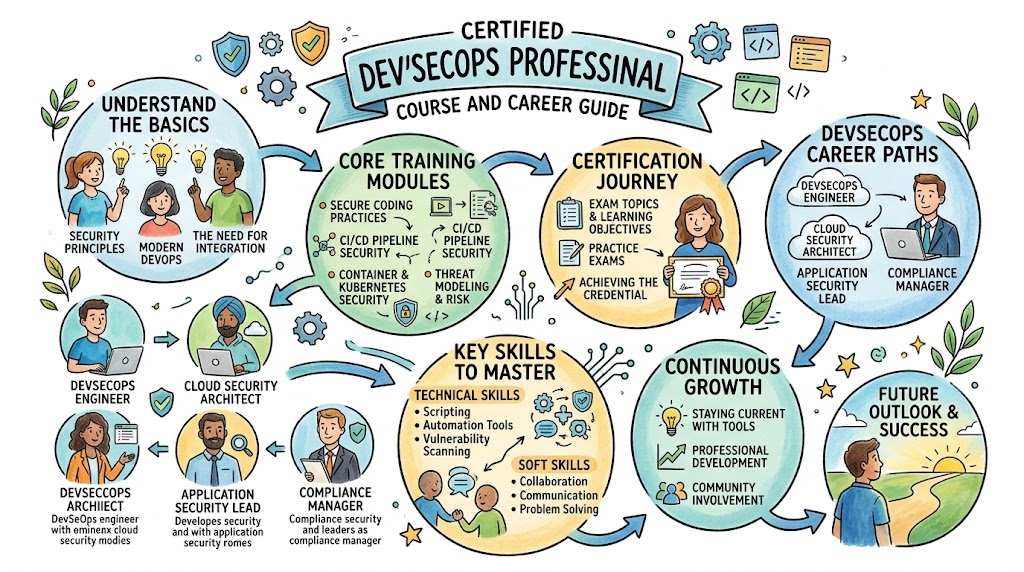
Certified DevSecOps Professional is a role‑oriented certification that teaches you how to embed security into the full DevOps lifecycle—from code and build to deployment and operations. The emphasis is on hands‑on practice, tools, and patterns that you can directly reuse in your projects.
Who should take it
This certification makes sense if you are:
- A software engineer who commits code and works with pipelines
- A DevOps engineer or SRE responsible for reliability and deployments
- A security engineer wanting to work closer with product teams
- A team lead or manager who owns delivery quality and risk
Skills you’ll gain
By the end of this program, you should be able to:
- Design secure CI/CD pipelines with integrated SAST, SCA, and DAST
- Apply DevSecOps principles across development and operations stages
- Secure Docker and Kubernetes environments and manage container risk
- Scan and harden Infrastructure as Code templates (Terraform, Ansible, etc.)
- Implement practical vulnerability management workflows in real teams
- Use compliance‑as‑code ideas to support audits and governance
Real‑world projects you should be able to do
After completing Certified DevSecOps Professional, you should be confident to lead or deliver projects such as:
- Building a CI/CD pipeline that automatically runs code, dependency, and dynamic checks on every change
- Implementing a container security setup with image scanning, policies, and runtime protection around Kubernetes clusters
- Adding IaC scanning so that cloud resources are checked for misconfigurations before provisioning
- Setting up a vulnerability management process with defined SLAs and integration into issue trackers
- Creating simple compliance‑as‑code rules that check security baselines on each deployment
Preparation plan (7–14 / 30 / 60 days)
Your study plan depends on your starting point. Below are three realistic options.
7–14 day intensive plan
Best for engineers already comfortable with DevOps tools and basic security.
- Day 1–2: Quick revision of DevOps lifecycle, CI/CD, and container basics
- Day 3–4: DevSecOps concepts and threat understanding; read through core exam domains
- Day 5–7: Focused labs on pipeline security and container security
- Day 8–10: IaC security, vulnerability management, and simple compliance checks
- Day 11–14: Mixed practice with scenario‑based questions and consolidated notes
30‑day balanced plan
Ideal for most working professionals who can study 1–2 hours per day.
- Week 1: DevOps + DevSecOps fundamentals, security culture, and basic risk thinking
- Week 2: Tools and patterns for securing CI/CD pipelines (SAST, SCA, DAST)
- Week 3: Containers, Kubernetes, secrets handling, and infrastructure security
- Week 4: IaC and compliance‑as‑code, vulnerability management practices, exam revision
60‑day foundation‑plus‑depth plan
Use this if you are newer to DevOps or security.
- Month 1: Build strong foundations in Linux, Git, CI/CD, and basic networking
- Month 2: Deep dive into DevSecOps topics, toolchains, and lab work; finish with two weeks of exam‑focused practice
Common mistakes
Candidates often underestimate the breadth and practical nature of DevSecOps. Frequent mistakes include:
- Treating the course as theory only and skipping hands‑on practice
- Ignoring Linux and CI/CD basics, which are assumed knowledge
- Learning tool commands but not understanding where they fit in a pipeline
- Leaving containers and IaC to the last minute, even though many tasks involve them
- Cramming in the final week instead of following a steady, spaced schedule
Best next certification after this
Once you have Certified DevSecOps Professional, you can go deeper into DevSecOps or broaden into DevOps/SRE, depending on your role. A natural next step is a master‑level DevOps program that combines DevOps, DevSecOps, and SRE skills—like Master in DevOps Engineering—so you can design and lead complete platforms, not only secure pipelines.
Certification landscape and key programs
DevSecOps sits within a wider ecosystem of DevOps, security, and reliability certifications. Many modern programs try to cover multiple aspects together—for example, courses that blend DevOps, DevSecOps, and SRE in one agenda.
The idea is simple: organizations do not want isolated specialists who only know one step of the lifecycle. They look for professionals who can understand how development, security, and operations work as a whole. Certified DevSecOps Professional is one building block in that bigger picture.
Certification overview table
The table below shows how Certified DevSecOps Professional relates to other major certifications in the same space.
| Certification | Track | Level | Who it’s for | Prerequisites | Skills covered | Recommended order |
|---|---|---|---|---|---|---|
| Certified DevSecOps Professional | DevSecOps | Intermediate | DevOps, Security, Software Engineers, Leads | Linux, DevOps concepts, basic CI/CD | CI/CD security, container and IaC security, SAST/DAST, vulnerability management | After DevOps fundamentals, before master/manager programs |
| DevSecOps Certified Professional (DSOCP) | DevSecOps / Security | Intermediate–Advanced | DevOps and security practitioners | Understanding of Linux, DevOps, CI/CD | CI/CD security, container security, IaC scanning, compliance | First major step in a DevSecOps career path |
| DevSecOps Certified Professional Training (DevOps/DevSecOps/SRE agenda) | DevOps/DevSecOps/SRE | Intermediate | Engineers wanting blended skills | DevOps basics, SDLC familiarity | DevOps, DevSecOps, SRE concepts, CI/CD/CM, transition best practices | Early to mid‑career, before master programs |
| Master in DevOps Engineering (MDE) | DevOps + DevSecOps + SRE | Master | Senior engineers, architects, managers | Practical DevOps experience, some automation skills | Deep DevOps, integrated DevSecOps, SRE, 40+ tools | Mid‑career or later, after core DevOps/DevSecOps certs |
Choose your path: 6 learning paths
Your career will not follow a straight line. It will move between skills and roles over time. Here are six practical paths where Certified DevSecOps Professional adds clear value.
1. DevOps path
Goal: become a strong DevOps engineer who owns automation and delivery.
- Step 1: DevOps and CI/CD fundamentals
- Step 2: Cloud and container skills
- Step 3: Certified DevSecOps Professional to secure your pipelines and environments
- Step 4: Master‑level DevOps certifications such as MDE for architecture and leadership
2. DevSecOps path
Goal: specialize in automation‑driven security for modern systems.
- Step 1: Basic DevOps and security foundations
- Step 2: Certified DevSecOps Professional
- Step 3: Additional DevSecOps engineer/advanced programs and focus on larger, more complex environments
- Step 4: DevSecOps manager or architect roles with governance and strategy focus
3. SRE path
Goal: build and run reliable, observable, and secure services.
- Step 1: SRE basics (SLOs, SLIs, incidents, capacity)
- Step 2: Platform and observability tools
- Step 3: Certified DevSecOps Professional to ensure reliability and security are designed together
- Step 4: SRE master or advanced reliability programs for large‑scale systems
4. AIOps/MLOps path
Goal: use data and automation to make operations and ML pipelines smarter.
- Step 1: DevOps and cloud foundations
- Step 2: Data basics and ML lifecycle understanding
- Step 3: Certified DevSecOps Professional to secure CI/CD and data paths used by models
- Step 4: AIOps/MLOps courses that add monitoring intelligence and ML pipeline automation
5. DataOps path
Goal: manage data flows securely and reliably from source to analytics.
- Step 1: Data engineering and orchestration fundamentals
- Step 2: DevOps approaches for data pipelines
- Step 3: Certified DevSecOps Professional for securing data movement, IaC, and related services
- Step 4: DataOps and governance programs focused on quality, lineage, and compliance
6. FinOps path
Goal: balance cost, performance, and risk in the cloud.
- Step 1: Cloud billing and cost optimization basics
- Step 2: DevOps/cloud engineering skills for real infrastructure understanding
- Step 3: Certified DevSecOps Professional so cost decisions consider secure architectures and controls
- Step 4: FinOps training to manage budgets, reporting, and optimization at scale
Role → recommended certifications mapping
Different roles require different mixes of DevOps, DevSecOps, SRE, data, and financial skills. The table below gives a practical mapping that you can refine for your own audience.
| Role | Early certifications | Core certifications (include DevSecOps) | Advanced / leadership |
|---|---|---|---|
| DevOps Engineer | DevOps foundation, CI/CD tool training | Certified DevSecOps Professional, container and cloud certs | MDE and other architecture‑oriented DevOps programs |
| SRE | Linux/network fundamentals, monitoring basics | SRE course plus Certified DevSecOps Professional | SRE master‑level programs, reliability architecture |
| Platform Engineer | Cloud associate, Kubernetes admin | Certified DevSecOps Professional, IaC‑specific courses | DevOps/SRE master certifications, platform design |
| Cloud Engineer | Cloud associate/professional certs | Cloud security courses plus Certified DevSecOps Professional | Multi‑cloud or architect programs with security focus |
| Security Engineer | Security fundamentals, network and app sec | Certified DevSecOps Professional, offensive/defensive certs | DevSecOps manager and security architect pathways |
| Data Engineer | Data engineering and ETL certs | DataOps courses plus Certified DevSecOps Professional | Data governance and advanced DataOps programs |
| FinOps Practitioner | Cloud and cost fundamentals | FinOps practitioner training plus Certified DevSecOps Professional | FinOps leader or architect‑level courses |
| Engineering Manager | Agile/project management certificates | High‑level DevOps/SRE plus Certified DevSecOps Professional | DevSecOps manager and master DevOps/SRE leadership |
Next certifications after Certified DevSecOps Professional
When you complete Certified DevSecOps Professional, you should already plan the next 1–2 steps. Think in three dimensions: deepen, widen, and lead.
1. Same track
Here you want to become the “go‑to” DevSecOps specialist in your team. Good options include:
- Advanced DevSecOps engineer or professional‑level programs with longer, lab‑heavy exams
- Courses that focus on complex pipelines, multi‑cloud security, and large‑scale vulnerability management
This track is ideal if you enjoy hands‑on security engineering and platform work.
2. Cross‑track
This path makes you more versatile across the stack. Examples:
- Master in DevOps Engineering (MDE) to deepen your DevOps and SRE skills while keeping DevSecOps integrated
- SRE‑specific programs that strengthen incident, reliability, and observability skills
- Data‑oriented training if you work around analytics or data platforms, to combine DataOps with DevSecOps
Cross‑track certifications open doors to broader roles like platform engineer or solution architect.
3. Leadership
If you lead teams or plan to, leadership‑focused programs will be important. You can consider:
- DevSecOps manager‑style courses that cover governance, metrics, and organization‑wide adoption
- Master‑level DevOps and SRE programs with a strong focus on transformation and decision‑making
This route shifts you from implementing pipelines to shaping roadmaps and guiding multiple teams.
Top training and certification institutions
DevOpsSchool
DevOpsSchool provides structured courses that blend DevOps, DevSecOps, and SRE topics with strong lab coverage and tool exposure. Their programs often follow real‑world project flows, from planning to monitoring, and include exam‑oriented modules for certifications like MDE and DevSecOps‑focused tracks. For working engineers, this combination of labs, mentoring, and flexible formats is valuable.
Cotocus
Cotocus focuses on specialized DevOps and automation training for individuals and teams. It usually offers instructor‑led sessions, practice assignments, and guidance that connects skills like CI/CD, configuration management, and security with real enterprise setups. This is useful if you want structured support while preparing for DevSecOps certifications.
Scmgalaxy
Scmgalaxy has a long history around SCM, DevOps, and tool‑chain training. It typically covers key DevOps and DevSecOps tools, pipeline patterns, and best practices for configuration and release management. This makes it a good option if you want to understand how security fits into source control, builds, and deployment strategies.
BestDevOps
BestDevOps aggregates training focused on in‑demand DevOps skills such as CI/CD, containers, and security automation. Programs offered there generally emphasize hands‑on practice and exam alignment, so learners can quickly move from concepts to practical application. This can complement your journey toward Certified DevSecOps Professional.
devsecopsschool
devsecopsschool concentrates on DevSecOps‑related topics and security automation practices. It usually offers roadmaps, training content, and resources that map directly to DevSecOps certifications, pipelines, and modern security patterns. This is a natural choice if you want to focus strongly on integrating security into DevOps.
sreschool
sreschool is geared towards Site Reliability Engineering, with topics like SLOs, error budgets, and incident management. If you combine this training with DevSecOps certification, you can design systems that are both secure and reliable at scale. This mix is especially powerful for SRE and platform engineering roles.
aiopsschool
aiopsschool focuses on AIOps and MLOps, where automation, data, and intelligence help run systems more efficiently. By pairing these programs with DevSecOps training, you can secure automated operations workflows and ML pipelines, which is increasingly important in data‑heavy environments.
dataopsschool
dataopsschool offers courses around DataOps, data pipelines, and governance. With DevSecOps skills, you can apply security, compliance, and risk thinking to data flows, storage, and processing tools. This is valuable for data engineers and architects who must protect sensitive information end‑to‑end.
finopsschool
finopsschool specializes in FinOps and cloud cost management training. Combining FinOps with DevSecOps helps you design solutions that are not only secure and reliable but also cost‑efficient and accountable from a budgeting point of view. This is particularly useful for leads and managers responsible for both risk and spend.
FAQs
1. Is DevSecOps only for security specialists?
No. DevSecOps is for anyone involved in building and running systems—developers, DevOps engineers, SREs, and security teams. The goal is shared responsibility, not a separate “DevSecOps department.”
2. How hard is DevSecOps compared to pure DevOps?
DevSecOps adds security concepts and tools to the DevOps tool‑set, so it has a broader scope. If you already know DevOps basics, the additional concepts are manageable with consistent practice.
3. Do I need strong coding skills?
You do not need to be a high‑end developer, but you should be comfortable reading code, editing scripts, and understanding how pipelines run tests and builds. Basic scripting and automation skills are very helpful.
4. How long does it take to be productive in a DevSecOps role?
If you have DevOps experience, a few months of focused study and real project work can make you productive in a DevSecOps position. Becoming a senior expert will depend on the variety and complexity of systems you work on.
5. What background helps the most before DevSecOps?
Experience with CI/CD, containers, cloud providers, and basic security concepts (authentication, authorization, encryption, vulnerabilities) helps a lot. Even small projects using these technologies can make the learning curve smoother.
6. Should I start with DevOps or DevSecOps?
If you are new to both, start with DevOps fundamentals first so you understand how teams ship software. Then add DevSecOps to secure those pipelines and platforms.
7. Does DevSecOps improve salary and job stability?
Role descriptions that combine DevOps and security are in strong demand and are often well‑paid because they sit at the intersection of multiple skills. DevSecOps knowledge also makes it easier to move into senior engineering or leadership roles.
8. Is DevSecOps mainly tools or mindset?
It is both. You need the right mindset around shared responsibility and automation, and you also need to understand specific tools that fit into pipelines, infrastructure, and monitoring. Ignoring either side limits your effectiveness.
9. What is the best order of learning topics?
A practical order is: DevOps basics → CI/CD pipelines → containers and Kubernetes → basic security concepts → DevSecOps patterns and tools → IaC and cloud security → advanced topics like compliance‑as‑code and maturity models. This sequence aligns well with how most teams actually work.
10. Will DevSecOps remain relevant with more managed cloud services?
Yes. Even with more managed services, someone still needs to define secure configurations, pipelines, and policies. DevSecOps ensures security is built into how you consume cloud, not only into what you host yourself.
11. Can DevSecOps experience help with cloud security roles?
Definitely. Cloud security engineers often work with the same tools and patterns—pipelines, IaC, container security, and monitoring. DevSecOps gives you strong practical grounding for these positions.
12. How can managers benefit from learning DevSecOps?
Managers who understand DevSecOps can set realistic expectations, fund the right initiatives, and read the right metrics. This helps them drive improvements without blocking delivery speed unnecessarily.
FAQs specific to Certified DevSecOps Professional
These answers focus directly on the certification you are writing about.
1. What does the Certified DevSecOps Professional exam actually test?
It tests your ability to apply DevSecOps concepts in practical scenarios—secure pipelines, containers, IaC, and vulnerability handling—rather than only theory. Expect tasks and questions that assume you understand how these pieces fit into real SDLC workflows.
2. How challenging is the exam for a working engineer?
For someone already using CI/CD and cloud tools, the exam is challenging but achievable with focused preparation. It becomes more difficult if you lack hands‑on practice in areas such as containers or IaC.
3. How much time should I schedule for preparation?
A typical working professional needs 4–8 weeks of regular study, depending on their starting point. Those with strong DevOps experience may finish faster, while those new to automation or security should allow more time.
4. What are the major domains covered?
Core domains usually include DevSecOps principles, CI/CD security, container and Kubernetes security, IaC and compliance‑as‑code, and vulnerability management practices. Each topic connects back to how modern teams build and operate software.
5. Which topics do candidates often overlook?
Many candidates spend little time on IaC scanning, supply chain risk, and maturity models, even though they are important for real organizations. Container runtime issues and secrets management are also commonly under‑prepared.
6. Is lab work mandatory to pass?
You might pass with minimal labs, but you will struggle with scenario‑based questions and real‑world application. Lab practice dramatically improves your confidence and helps you remember patterns instead of isolated commands.
7. Can I rely only on official material?
Official material gives you a strong base, but many learners also supplement with community resources, open‑source tools, and their own practice environments. Structured training from the listed institutions can further speed up learning and reduce trial‑and‑error.
8. What should I do after passing Certified DevSecOps Professional?
Apply what you’ve learned to at least one live or pilot project, such as securing a key pipeline or implementing IaC checks. Then select your next certification—same track, cross‑track, or leadership—based on where you want your role to go.
Conclusion
DevSecOps is now one of the most important skill sets in modern engineering, linking speed, safety, and reliability. The Certified DevSecOps Professional program gives you a structured way to build and prove those skills with practical, hands‑on focus.For working engineers and managers in India and across the world, this certification can be a turning point: it makes you more valuable to your current organization and more competitive in the market. Use this guide as your roadmap—choose your path, plan your preparation, select your next certifications, and treat each project as a chance to apply DevSecOps in the real world.
Find Trusted Cardiac Hospitals
Compare heart hospitals by city and services — all in one place.
Explore Hospitals