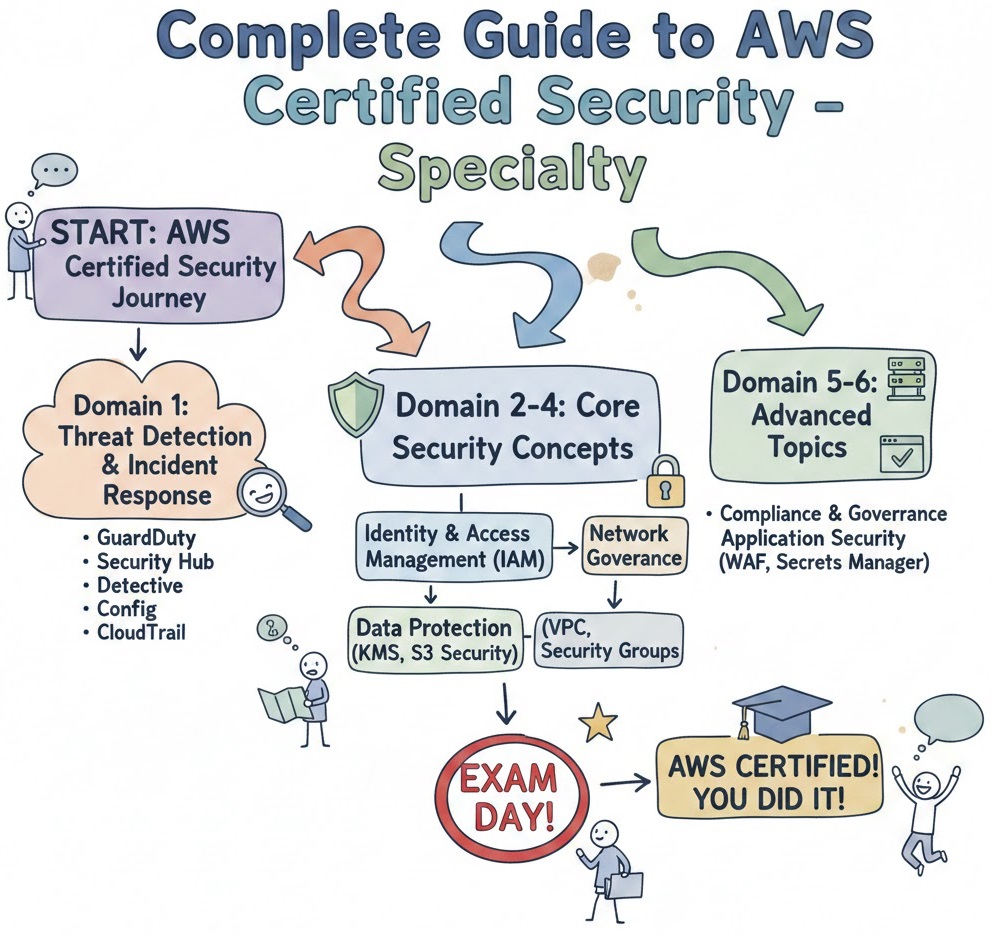
Introduction
In today’s digital age, securing cloud environments is more crucial than ever. With businesses increasingly relying on cloud technologies, especially AWS (Amazon Web Services), the need for skilled professionals to secure these environments has never been greater. The AWS Certified Security – Specialty certification stands out as a dedicated certification designed for professionals aiming to specialize in securing AWS environments. In this guide, we will cover everything you need to know about this certification, including its prerequisites, preparation strategy, career outcomes, and how it can help you secure your career in cloud security.
What is the AWS Certified Security – Specialty Certification?
The AWS Certified Security – Specialty is an advanced certification offered by Amazon Web Services to validate the expertise of professionals in securing AWS cloud environments. This certification is designed for individuals working in security roles who want to deepen their knowledge of AWS security features and capabilities. It covers areas such as data protection, incident response, identity management, and vulnerability management within AWS environments.
This exam helps to demonstrate your proficiency in security operations and solutions, making you a valuable asset in any organization that uses AWS services. It goes beyond general cloud security and focuses on AWS-specific tools and best practices.
Who Should Take the AWS Certified Security – Specialty?
This certification is designed for individuals who are already working in security-focused roles or have a deep interest in cloud security. Some specific roles that will benefit from this certification include:
- Cloud Security Engineers: Individuals responsible for securing cloud infrastructure and data.
- Security Architects: Professionals who design secure cloud architectures and implement security solutions.
- DevSecOps Engineers: Those who integrate security practices into the DevOps pipeline, ensuring that security is embedded throughout the software development lifecycle.
- AWS Architects: Engineers responsible for designing AWS architectures that meet both functional and security requirements.
- Compliance Specialists: Those working in compliance-related roles, ensuring that cloud environments meet regulatory and security standards.
If you have experience in security operations or if you’ve worked with AWS previously, this certification will help you enhance your cloud security skillset.
Skills You’ll Gain
Achieving the AWS Certified Security – Specialty certification equips you with the necessary skills to secure AWS cloud infrastructures. Some of the key skills you’ll acquire include:
- Cloud Security Design: You’ll gain the ability to design secure cloud environments using AWS services. This includes implementing secure VPCs, using encryption methods for data protection, and ensuring secure access control.
- Incident Response and Security Operations: You’ll learn how to detect, respond to, and mitigate security threats in AWS environments. You’ll become proficient in using AWS CloudTrail and AWS Config to monitor and log events.
- Identity and Access Management (IAM): You’ll master the use of AWS IAM to create and manage policies and permissions, ensuring only authorized individuals have access to AWS resources.
- Monitoring and Logging: Learn how to configure AWS services like CloudWatch and CloudTrail to provide continuous monitoring and logging, enabling proactive threat detection.
- Data Protection: Understand how to use encryption (in transit and at rest) and backup strategies to secure sensitive data stored within AWS.
- Security Automation: Automate security operations using AWS tools such as AWS Systems Manager and AWS Lambda for incident response and security remediation.
These skills will help you tackle the complex security challenges organizations face when operating in the cloud.
Real-World Projects You Should Be Able to Do After It
After earning the AWS Certified Security – Specialty, you’ll be well-equipped to handle a variety of real-world security projects:
- Designing Secure AWS Architectures: Implementing robust security measures within AWS infrastructures, such as creating secure VPCs, configuring IAM policies, and setting up multi-factor authentication (MFA).
- Incident Response Management: Setting up automated incident response workflows using AWS services such as AWS CloudWatch, GuardDuty, and Lambda to detect and respond to security breaches.
- Compliance and Regulatory Standards: Ensuring that your AWS infrastructure is compliant with relevant regulations like GDPR, HIPAA, and PCI-DSS by using AWS compliance tools such as AWS Artifact and AWS Config.
- Data Encryption Implementation: Configuring encryption for data both at rest and in transit using AWS services like KMS (Key Management Service) and S3 Encryption.
- Security Auditing and Vulnerability Scanning: Using AWS tools like Inspector and Trusted Advisor to identify vulnerabilities and misconfigurations in the AWS environment, and then patching those issues.
Preparation Plan
Preparing for the AWS Certified Security – Specialty exam requires focused study and hands-on practice. The following preparation plan will help guide your study process:
7-14 Days Preparation (For experienced AWS security professionals)
If you’re already experienced with AWS security concepts, focus on reviewing exam-specific topics. You can use AWS training resources, practice exams, and review guides. During this time, aim to:
- Review AWS security documentation and AWS whitepapers.
- Take the AWS Certified Security – Specialty training courses offered by AWS or third-party providers.
- Focus on topics such as incident response, monitoring, and encryption.
- Complete hands-on labs and exercises using AWS to apply theoretical knowledge.
30 Days Preparation (For individuals with a basic understanding of AWS)
If you’re familiar with AWS but need to focus on security, extend your study plan to 30 days. Here’s how:
- Spend the first 10 days reviewing AWS core services and security best practices.
- In the next 10 days, delve into AWS security tools and practices, including IAM, encryption, and logging.
- Use the final 10 days for hands-on labs, review, and practice exams to reinforce your learning.
60 Days Preparation (For beginners with no AWS security experience)
If you’re new to AWS security or AWS in general, dedicate two months to preparation. Here’s a structured approach:
- Month 1: Learn AWS basics (services, security concepts) and gain an understanding of cloud security.
- Month 2: Dive into AWS security tools and best practices, focusing on IAM, data protection, and incident response. Set up hands-on labs, work on real-world scenarios, and engage with AWS’s security services.
Common Mistakes
Avoid these common mistakes to improve your chances of passing the certification exam:
- Not doing enough hands-on practice: AWS certifications, especially this one, require a strong practical understanding. Set up real-world labs and test configurations.
- Rushing through the study materials: Take time to thoroughly understand each topic and service covered by the exam.
- Not reviewing the exam guide thoroughly: AWS provides a detailed exam guide that lists the topics you need to focus on. Make sure to study these areas in depth.
- Skipping practice exams: Practice exams are a great way to identify weak areas and improve your test-taking skills.
Best Next Certification After This
Once you achieve the AWS Certified Security – Specialty, consider the following next certifications:
- Same Track: AWS Certified Advanced Networking – Specialty
- This certification expands your knowledge of networking, which is crucial for securing large-scale AWS architectures.
- Cross-Track: Certified Kubernetes Administrator (CKA)
- Security in Kubernetes and containerized environments is increasingly vital, making the CKA a great option after AWS Security.
- Leadership Track: AWS Certified Solutions Architect – Professional
- If you are looking to move into more senior roles, this certification covers designing complex AWS architectures, with an emphasis on scalability and security.
Choose Your Path
AWS Certified Security – Specialty aligns well with several career tracks in cloud and IT operations. Below are the recommended learning paths for various professional goals:
DevOps Path:
Security-focused DevOps professionals integrate security into the CI/CD pipeline. The AWS Certified Security – Specialty equips you with the knowledge to handle security in automated environments.
DevSecOps Path:
DevSecOps engineers are responsible for integrating security into the development lifecycle. This certification provides the tools and strategies needed to automate security within DevOps pipelines.
Site Reliability Engineering (SRE) Path:
For SREs, understanding security in the context of infrastructure reliability is crucial. This certification offers insights into securing AWS workloads while ensuring reliability and availability.
AIOps / MLOps Path:
Security concerns in AI/ML and data pipelines are significant, and this certification prepares you to secure those systems within AWS environments.
DataOps Path:
Security for data management in cloud-based architectures is vital. This certification will provide insights into securing AWS data lakes and analytics environments.
FinOps Path:
Securing financial operations in the cloud requires specialized knowledge. AWS Certified Security – Specialty helps you secure financial applications and cloud spending.
Role → Recommended Certifications
Mapping AWS Certified Security – Specialty to specific roles and further certification paths:
| Role | Recommended Certifications |
|---|---|
| DevOps Engineer | AWS Certified DevOps Engineer – Professional, Certified Kubernetes Administrator (CKA) |
| SRE | AWS Certified Solutions Architect – Associate, AWS Certified Advanced Networking – Specialty |
| Platform Engineer | AWS Certified Security – Specialty, AWS Certified Solutions Architect – Professional |
| Cloud Engineer | AWS Certified Security – Specialty, AWS Certified Solutions Architect – Associate |
| Security Engineer | AWS Certified Security – Specialty, Certified Information Systems Security Professional (CISSP) |
| Data Engineer | AWS Certified Data Analytics – Specialty, AWS Certified Solutions Architect – Associate |
| FinOps Practitioner | AWS Certified Cloud Practitioner, AWS Certified Solutions Architect – Associate |
| Engineering Manager | AWS Certified Solutions Architect – Professional, AWS Certified Security – Specialty |
Comparison Table: AWS Certified Security – Specialty Certification
| Certification Name | Track | Level | Who It’s For | Prerequisites | Skills Covered | Recommended Order |
|---|---|---|---|---|---|---|
| AWS Certified Security – Specialty | Cloud Security | Advanced | Security Engineers, Cloud Architects, DevSecOps Engineers | Basic understanding of AWS (AWS Certified Cloud Practitioner is recommended) | IAM, data protection, incident response, vulnerability management, encryption | Can be taken after basic AWS knowledge, or AWS Certified Solutions Architect – Associate |
| AWS Certified Solutions Architect – Associate | Cloud Architecture | Associate | Cloud Architects, Solutions Engineers | Understanding of basic AWS services | Designing secure and scalable AWS architectures | Recommended before Security – Specialty |
| AWS Certified DevOps Engineer – Professional | DevOps | Professional | DevOps Engineers, Cloud Engineers | AWS Certified Developer – Associate or Solutions Architect – Associate | Automation, CI/CD pipelines, monitoring, scaling, and security integration | After completing DevOps-related certifications |
| AWS Certified Advanced Networking – Specialty | Cloud Networking | Specialty | Networking Engineers, Cloud Network Architects | Advanced AWS Networking knowledge and experience | VPC design, hybrid networking, securing network traffic | After AWS Certified Solutions Architect – Associate |
| Certified Kubernetes Administrator (CKA) | Containerization | Associate | Kubernetes administrators, Cloud Engineers | Basic knowledge of Kubernetes | Deploying, securing, and scaling containerized applications | Cross-track for cloud-native environments |
| Certified Information Systems Security Professional (CISSP) | Security | Professional | Security Managers, IT Security Consultants | At least five years of professional experience in security | Security governance, risk management, asset security, network security | Suitable after AWS Certified Security – Specialty for broadening security expertise |
| Certified Cloud Security Professional (CCSP) | Cloud Security | Professional | Cloud Security Architects, Risk Management Professionals | At least five years of security experience, with knowledge of cloud platforms | Cloud security architecture, governance, risk management, data protection | Cross-track after AWS Certified Security – Specialty |
| AWS Certified Solutions Architect – Professional | Cloud Architecture | Professional | Advanced AWS Solutions Architects | AWS Certified Solutions Architect – Associate | Designing complex AWS environments, scalability, and security | Ideal for architects focusing on advanced AWS design |
| Certified Ethical Hacker (CEH) | Security | Professional | Penetration testers, IT security professionals | Basic understanding of IT security, ethical hacking experience | Vulnerability analysis, hacking methodologies, risk management | Great for complementing AWS security with ethical hacking skills |
| AWS Certified Developer – Associate | Cloud Development | Associate | Application developers, Cloud Engineers | Familiarity with basic AWS services, development tools | Writing and deploying applications securely in AWS | A good base before moving into AWS security and other specialized areas |
Top Institutions Providing AWS Certified Security – Specialty Training
1. DevOpsSchool
DevOpsSchool is a widely recognized training provider specializing in DevOps and cloud certifications with a strong focus on AWS security. Their AWS Security training includes structured modules covering IAM, data protection, incident response, and monitoring. They provide hands‑on labs, real‑world case studies, and exam strategy planning, which helps learners transition from theory to practice. Experienced industry instructors guide students through complex scenarios and offer doubt‑clearing sessions. Their curriculum aligns closely with AWS exam domains, making it ideal for certification preparation and career application.
2. Cotocus
Cotocus offers practical AWS certification training with an emphasis on real AWS console experience and scenario‑based learning. Their AWS Security – Specialty track focuses heavily on securing cloud environments, managing encryption keys, and automating security responses. Cotocus also includes mentorship support, personalized feedback, and curated study resources aligned with the AWS exam blueprint. Their hands‑on labs help learners gain confidence in configuring security services like GuardDuty, CloudTrail, and AWS Config. Many professionals praise Cotocus for effective teaching that bridges knowledge and job readiness.
3. ScmGalaxy
ScmGalaxy provides interactive AWS certification programs with a strong focus on cloud and security topics. Their AWS Security training covers identity access management, threat detection practices, encryption methods, and compliance automation. They provide flexible schedules, live training sessions, and mock exams designed to mirror the actual certification environment. Hands‑on labs are integrated into the curriculum to build real skills rather than memorization. Post‑training support is available, helping learners clarify doubts and reinforce learning even after course completion.
4. BestDevOps
BestDevOps offers AWS Security specialization training with a practical, industry‑aligned approach. Their course emphasizes securing infrastructure, automating monitoring, and deploying security best practices across AWS environments. Training includes real‑world use cases such as secure VPC design, logging setups, and incident simulation labs. BestDevOps also includes guidance on resume building and interview preparation for cloud security roles. Learners often highlight the relevance of course scenarios to real enterprise environments and security challenges.
5. DevSecOpsSchool
DevSecOpsSchool focuses on integrating security practices into DevOps workflows — making it ideal for professionals pursuing DevSecOps roles. Their AWS Security – Specialty training teaches automated security testing within CI/CD pipelines and secure configuration management. The course covers AWS native tools like IAM, KMS, CloudTrail, GuardDuty, and Inspector with hands‑on labs and tactical strategies. Instructors typically bring cross‑domain experience in both security and automation practices. This makes their curriculum especially valuable for engineers who want to embed security deeply into development and deployment cycles.
6. SRESchool
SRESchool specializes in Site Reliability Engineering training combined with cloud security best practices. Their AWS curriculum includes modules focused on resilient system design, security observability, incident response, and alerting mechanisms. SRE‑centric scenarios teach how to reduce security downtime while maintaining performance and availability. Their training also covers automation tools like CloudWatch and AWS Config for secure and reliable operations. The integration of reliability and security skill sets makes this perfect for SREs handling critical production systems.
7. AIOpsSchool
AIOpsSchool offers training that combines cloud operations, infosec, and automated incident management with AWS security principles. Their AWS Security – Specialty track emphasizes securing data pipelines, machine learning environments, and automation platforms in AWS. Training includes labs on logging, anomaly detection, automated response workflows, and security alert frameworks. Their curriculum prepares learners to handle security challenges in AI‑driven operational environments where observability and mitigation matter. This makes AIOpsSchool great for engineers working at the intersection of automation and cloud security.
8. DataOpsSchool
DataOpsSchool focuses on data engineering, analytics, and secure data lifecycle management in AWS environments. Their AWS Security training covers data protection techniques, encryption of data at rest/in transit, and secure architectures for analytics pipelines. The course places special emphasis on compliance, audit logging, and query‑level security for data warehouses. Hands‑on exercises teach learners how to secure data lakes using AWS tools while maintaining performance. This school is ideal for data engineers, data security specialists, or analysts responsible for securing enterprise data workloads in the cloud.
9. FinOpsSchool
FinOpsSchool provides training at the intersection of cloud cost governance and security management. Their AWS Security – Specialty preparation includes modules on configuring security tools cost‑efficiently, risk reporting, and compliance controls. The course emphasizes securing AWS infrastructure while maintaining FinOps principles like cost visibility and resource optimization. Learners gain insights into secure identity management, logging practices, and governance models that align with enterprise financial policies. This track is useful for professionals who must secure cloud environments with cost accountability and compliance in mind.
FAQs
1. What is the difficulty level of the AWS Certified Security – Specialty exam?
This exam is considered advanced. You should have hands-on experience with AWS services and a solid understanding of security concepts.
2. How long does it take to prepare for the AWS Certified Security – Specialty exam?
It typically takes between 7 to 60 days depending on your prior experience with AWS.
3. What are the prerequisites for the AWS Certified Security – Specialty certification?
While there are no mandatory prerequisites, it is recommended that you have experience with AWS and a basic understanding of cloud security.
4. Is the AWS Certified Security – Specialty exam difficult?
Yes, the exam requires both theoretical knowledge and practical experience. You’ll need to be familiar with AWS services and security concepts.
5. How can I improve my chances of passing the AWS Certified Security – Specialty exam?
Focus on hands-on labs, review the AWS exam guide, take practice exams, and thoroughly understand each service and security concept.
6. What career paths are possible with this certification?
With this certification, you can pursue roles such as Cloud Security Engineer, Security Architect, DevSecOps Engineer, and Cloud Compliance Manager.
7. How does this certification compare to other security certifications?
AWS Certified Security – Specialty is more focused on cloud security in the AWS environment, while other certifications like CISSP offer broader security knowledge.
8. What are the career benefits of earning AWS Certified Security – Specialty?
This certification makes you a highly specialized cloud security professional, opening up new job opportunities in cloud security, DevSecOps, and AWS-focused roles.
FAQs
1. What is the AWS Certified Security – Specialty exam difficulty level?
The AWS Certified Security – Specialty exam is considered advanced, and it requires deep knowledge of AWS security services, tools, and best practices. It’s designed for experienced professionals with hands-on experience in cloud security. You should be familiar with AWS’s wide range of security services, including IAM, CloudTrail, GuardDuty, KMS, and more.
2. How much time does it take to prepare for AWS Certified Security – Specialty?
The preparation time varies depending on your background:
- 7–14 days if you’re already familiar with AWS and security.
- 30 days if you’re comfortable with AWS but need to strengthen your security knowledge.
- 60 days if you’re new to AWS or cloud security.
3. What are the prerequisites for the AWS Certified Security – Specialty exam?
There are no formal prerequisites, but it’s recommended to have an understanding of AWS cloud services and security fundamentals. Having an AWS Certified Cloud Practitioner or an AWS Certified Solutions Architect – Associate certification is beneficial but not mandatory.
4. How is the AWS Certified Security – Specialty exam structured?
The exam is a multiple-choice format, consisting of 65 questions to be completed in 170 minutes. The questions test your ability to secure AWS environments, covering areas like incident response, IAM, monitoring, vulnerability management, and encryption.
5. Can I retake the AWS Certified Security – Specialty exam if I fail?
Yes, you can retake the exam if you fail. However, you must wait 14 days before retaking the exam. AWS allows a maximum of 3 attempts within a 12-month period.
6. What is the cost of the AWS Certified Security – Specialty exam?
The exam costs $300 USD. In addition, AWS offers a free practice exam that costs $40 USD, allowing you to familiarize yourself with the exam format and question types.
7. How long is the AWS Certified Security – Specialty certification valid?
The certification is valid for 3 years. After this period, you must recertify by taking the latest version of the exam to maintain your certification status.
8. How much weight do the AWS Security topics have in the exam?
The exam covers six domains, and the weight distribution is as follows:
- Domain 1: Incident Response (20%)
- Domain 2: Identity and Access Management (20%)
- Domain 3: Detection (20%)
- Domain 4: Infrastructure Protection (20%)
- Domain 5: Data Protection (20%)
9. What are the best resources for preparing for the AWS Certified Security – Specialty exam?
Some excellent resources include:
- AWS training courses (free and paid)
- AWS Security Whitepapers
- A Cloud Guru and Linux Academy courses
- AWS documentation and service-specific guides
- Practice exams from AWS or third-party platforms
10. What real-world projects can I handle after passing the AWS Certified Security – Specialty exam?
After certification, you should be able to:
- Secure AWS cloud infrastructures by applying best practices and leveraging AWS security tools.
- Design IAM policies to control access to AWS resources.
- Respond to security incidents using automated response mechanisms.
- Set up encryption and data protection strategies to secure data at rest and in transit.
- Implement compliance monitoring and auditing systems using AWS tools like CloudTrail.
11. How can AWS Certified Security – Specialty certification boost my career?
This certification is highly respected in the industry and can open doors to roles such as Cloud Security Engineer, Security Architect, DevSecOps Engineer, and Compliance Officer. It demonstrates your expertise in securing cloud environments and handling complex security scenarios in AWS, increasing your career opportunities in both AWS-focused companies and organizations using AWS.
12. What is the best next certification after AWS Certified Security – Specialty?
It depends on your career path. Here are a few suggestions:
- Same Track: AWS Certified Advanced Networking – Specialty to deepen your knowledge in networking security.
- Cross-Track: Certified Kubernetes Administrator (CKA) to secure containerized applications.
- Leadership: AWS Certified Solutions Architect – Professional to advance your architecture design skills while incorporating security best practices.
Conclusion
The AWS Certified Security – Specialty certification is an essential credential for professionals aiming to specialize in securing cloud environments, particularly within AWS. With the growing demand for cloud security experts, this certification provides an edge in an increasingly competitive job market. It validates your ability to design and implement security controls, monitor and respond to security events, and ensure compliance with industry standards within the AWS cloud.Through this certification, you’ll gain hands-on experience with AWS security tools and concepts, enabling you to tackle real-world security challenges. Whether you’re already in a security role or looking to move into cloud security, this certification is a great step toward advancing your career. The knowledge and expertise you’ll acquire can make you a highly sought-after professional in the field of cloud security.
Find Trusted Cardiac Hospitals
Compare heart hospitals by city and services — all in one place.
Explore Hospitals