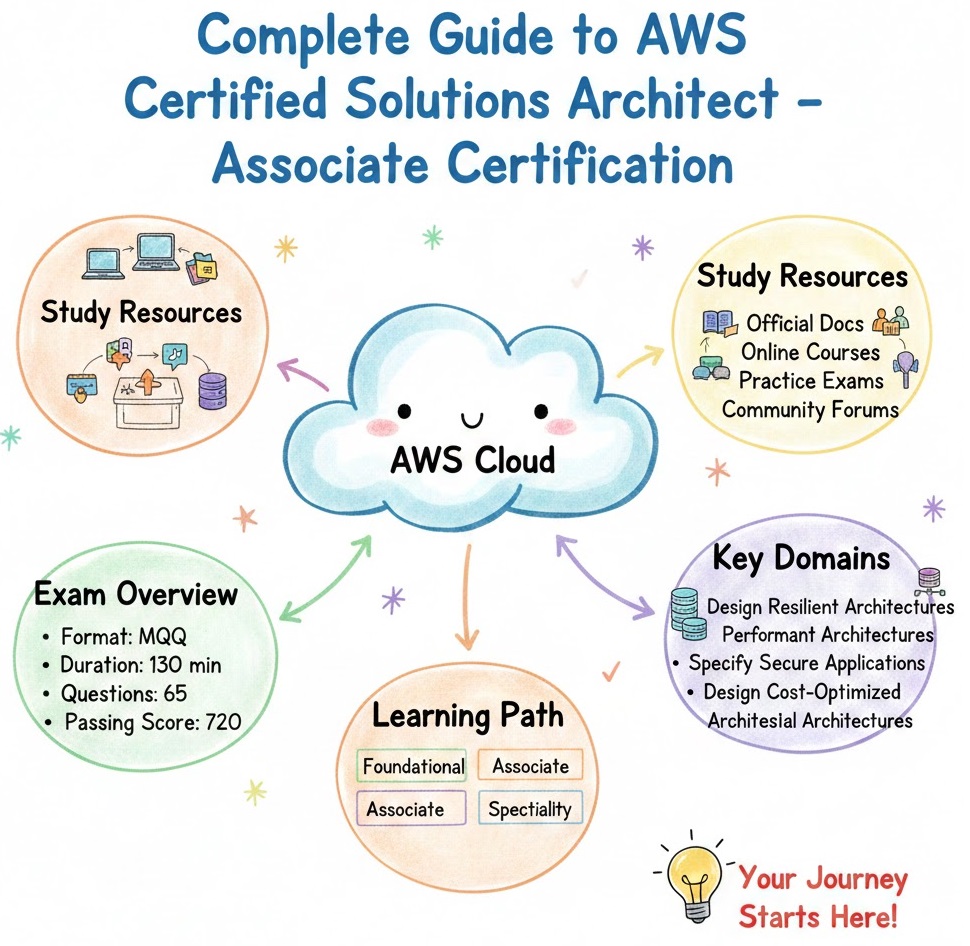
Introduction
The AWS Certified Solutions Architect – Associate certification is a globally recognized credential that validates your ability to design and deploy scalable, highly available, and fault-tolerant systems using Amazon Web Services (AWS). As more and more organizations move their infrastructure to the cloud, the demand for professionals who can build robust cloud solutions has grown significantly. AWS, being one of the leading cloud providers, powers millions of businesses worldwide, making this certification highly valuable in today’s IT landscape.This certification is designed for professionals who want to showcase their expertise in architecting solutions that leverage AWS technologies effectively. It’s not just about knowing how AWS works; it’s about understanding how to use it to solve real-world problems, from hosting websites to deploying large-scale enterprise systems.
What Is AWS Certified Solutions Architect – Associate?
The AWS Certified Solutions Architect – Associate is a certification that validates your skills in designing and deploying robust, secure, and scalable solutions on the Amazon Web Services (AWS) platform. This certification focuses on how to design systems that can handle various workloads, including how to make them available, cost-effective, and fault-tolerant. AWS is widely used across industries for cloud infrastructure, and having this certification ensures you are prepared to architect cloud solutions that meet the high standards of reliability and efficiency required by businesses today.
Why It Matters
As organizations transition to cloud environments, AWS has emerged as one of the most trusted platforms for hosting infrastructure. Professionals who understand how to leverage AWS’s capabilities and architect solutions effectively are highly sought after. This certification ensures that you are equipped with the knowledge needed to design complex cloud-based solutions.
Who Should Take It?
This certification is ideal for individuals with a technical background who are either currently working in or transitioning into roles where designing AWS-based architectures is critical.
Ideal Candidates:
- Cloud Architects: Professionals who are tasked with designing cloud infrastructures.
- Software Engineers: Those who need to understand how to deploy and integrate their software in the cloud.
- System Engineers: Professionals with experience in traditional IT infrastructure who want to broaden their skill set with AWS.
- IT Managers: Managers who need a deeper understanding of AWS to oversee their teams’ cloud migration efforts.
- Solutions Architects: Those who design technology solutions for clients, ensuring they are optimized for AWS.
- Software Developers: Developers working with AWS and want to improve their cloud design capabilities.
This certification is designed for those who have hands-on experience with AWS, or at least a basic understanding of the cloud, and it can greatly enhance your career trajectory.
Skills You’ll Gain
The AWS Certified Solutions Architect – Associate certification program provides a well-rounded set of skills that will make you proficient in the following key areas:
- AWS Core Services: Learn to utilize core AWS services like EC2, S3, RDS, Lambda, VPC, IAM, CloudWatch, and more. You’ll be equipped to choose the right services for specific application needs.
- Scalability and Elasticity: Learn to design systems that can scale with demand. This includes using Elastic Load Balancers (ELB), Auto Scaling, and AWS Elastic Beanstalk to ensure that applications are always available, even under varying loads.
- Fault Tolerance and High Availability: You’ll understand how to design fault-tolerant and highly available systems using tools like AWS Route 53, S3, and CloudFront. Learn how to build systems that stay operational in the event of a failure.
- Security Best Practices: Understand AWS’s security infrastructure, including IAM (Identity and Access Management), AWS KMS (Key Management Service), and best practices for securing data both at rest and in transit.
- Cost Optimization: Learn how to design solutions that are not only scalable and secure but also cost-effective. You’ll be able to leverage AWS’s pricing models, including reserved instances, spot instances, and savings plans, to optimize your infrastructure costs.
- Monitoring and Logging: Learn to use CloudWatch and CloudTrail to monitor, log, and manage AWS resources. These are essential skills for keeping track of system performance and ensuring security compliance.
Real-World Projects You Should Be Able to Do
After earning your AWS Certified Solutions Architect – Associate certification, you will be equipped to handle a range of real-world cloud architecture projects. Some examples include:
- Architecting a Scalable Web Application: You’ll be able to design a system where the front end runs on EC2 instances, backend databases use RDS or DynamoDB, and the data is served via CloudFront for global delivery.
- Designing a Fault-Tolerant System: Using ELB, Auto Scaling, and Route 53, you can design systems that handle varying traffic loads and automatically scale up or down to meet the demand.
- Cloud Migration: If you’re working with a company looking to migrate its on-premises infrastructure to AWS, you’ll be able to architect the entire migration process, including choosing the right AWS services and implementing them.
- Cost-Effective Cloud Architecture: By learning the AWS pricing models, you’ll be able to design infrastructures that are highly efficient in terms of cost while still meeting business requirements for performance and security.
- Implementing Security Best Practices: Implement solutions using IAM, VPC Security Groups, KMS, and AWS WAF (Web Application Firewall) to ensure that applications are secure and meet regulatory compliance standards.
Preparation Plan
Here’s a detailed preparation strategy for this exam, tailored to different time commitments:
7–14 Days: Kickstart Your Learning
- Day 1-3: Get familiar with AWS fundamentals: EC2, VPC, S3, and IAM. These are the building blocks of AWS, and understanding them is crucial.
- Day 4-6: Focus on designing network solutions using VPC, Subnets, Security Groups, and Elastic Load Balancers. Start learning basic security services.
- Day 7-10: Study architectural best practices for high availability and fault tolerance. Learn about Auto Scaling, Route 53, and CloudFront.
- Day 11-14: Finish up with security practices and monitoring using CloudWatch and CloudTrail.
30 Days: Deep Dive into AWS Services
- Day 15-20: Understand storage options like EBS, S3, Glacier, and RDS. Learn when to use each for different application needs.
- Day 21-25: Dive deeper into Cost Optimization strategies, focusing on AWS pricing models, Spot Instances, and Savings Plans.
- Day 26-30: Practice designing full systems using services like Elastic Beanstalk, Lambda, and RDS. Review study materials and focus on any weak spots.
60 Days: Advanced Preparation
- Day 31-40: Focus on advanced topics like hybrid cloud setups and Direct Connect. Implement complex multi-region and multi-AZ solutions.
- Day 41-50: Deepen your knowledge of security practices using AWS WAF, KMS, and IAM Roles for granular access control.
- Day 51-60: Take multiple practice exams and work on labs. Focus on areas where you scored lower, and reinforce hands-on experience.
Common Mistakes to Avoid
While studying for the AWS Certified Solutions Architect – Associate exam, watch out for these mistakes:
- Skipping Hands-on Labs: AWS is a hands-on platform, and theory alone won’t help you pass the exam. Practical experience is crucial.
- Neglecting Security: AWS security features, such as IAM, KMS, and WAF, are often tested, so don’t skip this critical topic.
- Overlooking Cost Models: A major part of the exam is designing cost-efficient architectures, so understanding AWS pricing models is a must.
- Not Reviewing the AWS Well-Architected Framework: This framework is essential for designing cloud architectures that are scalable, secure, and efficient.
- Underestimating the Complexity: This exam tests both theoretical knowledge and practical application of AWS services. Don’t underestimate the level of depth required.
Next Certifications to Take
After passing the AWS Certified Solutions Architect – Associate exam, here are a few recommended certifications for your next step:
- Same Track: AWS Certified Solutions Architect – Professional – If you want to deepen your knowledge and gain expertise in designing complex systems on AWS.
- Cross-Track: AWS Certified DevOps Engineer – Professional – For those interested in automating and managing AWS infrastructure and deployment pipelines.
- Leadership: AWS Certified Security – Specialty – For those focusing on cloud security, this certification dives deep into AWS security services and compliance.
Choose Your Path: Learning Paths
After earning the AWS Certified Solutions Architect – Associate certification, you can specialize further by following these learning paths based on your career goals.
1. DevOps
- Focus: Automating and managing cloud infrastructure, CI/CD pipelines, and system monitoring.
- Next Certs: AWS Certified DevOps Engineer – Professional, AWS Certified Developer – Associate
2. DevSecOps
- Focus: Integrating security within DevOps processes for secure cloud environments.
- Next Certs: AWS Certified Security – Specialty, Certified Information Systems Security Professional (CISSP)
3. SRE (Site Reliability Engineering)
- Focus: Ensuring system reliability, performance, and uptime.
- Next Certs: AWS Certified SysOps Administrator – Associate, Google Professional Cloud DevOps Engineer
4. AIOps/MLOps
- Focus: Combining AI/ML with operations for automated IT and predictive systems.
- Next Certs: AWS Certified Machine Learning – Specialty, Google Professional Machine Learning Engineer
5. DataOps
- Focus: Managing data pipelines and ensuring data quality and governance.
- Next Certs: AWS Certified Data Analytics – Specialty, Google Professional Data Engineer
6. FinOps
- Focus: Managing cloud costs and optimizing cloud financial management.
- Next Certs: AWS Certified Cloud Financial Management – Specialty, Certified Cloud Financial Professional (CCFP)
Role → Recommended Certifications Mapping
| Role | Recommended Certifications |
|---|---|
| DevOps Engineer | – AWS Certified DevOps Engineer – Professional – AWS Certified Solutions Architect – Associate |
| SRE (Site Reliability Engineer) | – AWS Certified SysOps Administrator – AWS Certified Solutions Architect – Associate |
| Platform Engineer | – AWS Certified Solutions Architect – Associate – AWS Certified DevOps Engineer – Professional |
| Cloud Engineer | – AWS Certified Solutions Architect – Associate – AWS Certified Cloud Practitioner |
| Security Engineer | – AWS Certified Security – Specialty – AWS Certified Solutions Architect – Associate |
| Data Engineer | – AWS Certified Data Analytics – Specialty – AWS Certified Solutions Architect – Associate |
| FinOps Practitioner | – AWS Certified Cloud Financial Management – Specialty – AWS Certified Solutions Architect – Associate |
| Engineering Manager | – AWS Certified Solutions Architect – Associate – AWS Certified DevOps Engineer – Professional |
Comparison Table: Key AWS Services for Solutions Architect – Associate Exam
| Service | Description | Use Case | Key Features |
|---|---|---|---|
| Amazon EC2 (Elastic Compute Cloud) | Provides scalable compute capacity in the cloud. | Hosting virtual servers (instances) for running applications and websites. | Flexible compute capacity, on-demand scaling, various instance types, auto-scaling. |
| Amazon S3 (Simple Storage Service) | Object storage service for storing and retrieving any amount of data. | Storing backups, media files, logs, or large amounts of unstructured data. | High availability, scalability, lifecycle management, and data encryption. |
| Amazon VPC (Virtual Private Cloud) | Isolates a section of the AWS cloud for launching AWS resources in a virtual network. | Creating isolated cloud networks, defining subnets, routing, and setting security. | Private IP range, custom routing, security groups, and VPN connections. |
| AWS RDS (Relational Database Service) | Managed database service for relational databases such as MySQL, PostgreSQL, SQL Server, etc. | Hosting SQL databases with minimal administrative effort. | Automated backups, multi-AZ deployments, and scaling. |
| AWS IAM (Identity and Access Management) | Manages access to AWS services and resources securely. | Controlling user permissions for accessing AWS services. | Role-based access, fine-grained policies, MFA (Multi-Factor Authentication). |
| AWS CloudFront | Content Delivery Network (CDN) to deliver data, videos, and APIs to users with low latency. | Distributing static content globally and optimizing performance for end-users. | Edge locations, caching, content encryption, and SSL/TLS support. |
| AWS Lambda | Serverless compute service that runs code in response to events. | Running backend services without managing servers. | Event-driven, scaling, and only pay for usage based on execution time. |
| Elastic Load Balancer (ELB) | Automatically distributes incoming application traffic across multiple instances. | Load balancing for web applications to ensure high availability. | Multiple load balancing options (Application, Network, Classic), auto-scaling integration. |
| AWS Route 53 | Scalable Domain Name System (DNS) web service for routing end-user requests to endpoints. | Routing traffic for your website, DNS management, and health checks for web services. | High availability, global routing, health checks, and latency-based routing. |
| AWS CloudWatch | Monitoring and logging service for AWS cloud resources and applications. | Monitoring application performance, resource utilization, and generating alerts. | Metrics collection, log management, alarms, and automatic scaling actions. |
List of Top Institutions Providing AWS Certified Solutions Architect – Associate Training
1. FinOpsSchool
FinOpsSchool provides specialized AWS certification training for financial operations professionals. They teach cloud cost optimization, cost forecasting, and budget management using AWS services, perfect for those looking to specialize in FinOps practices.
2.DevOpsSchool
DevOpsSchool is renowned for offering comprehensive AWS training, focusing on both foundational and advanced cloud solutions. They provide hands-on learning experiences, real-world projects, and expert-led sessions to ensure students are well-prepared for the certification exam.
3.Cotocus
Cotocus offers specialized AWS certifications with an emphasis on practical skills and cloud infrastructure management. Their training programs cover all AWS services essential for solutions architecture, ensuring a deep understanding of designing scalable and cost-effective systems.
4.Scmgalaxy
Scmgalaxy provides in-depth AWS Solutions Architect training, designed for both beginners and advanced learners. They focus on cloud architecture, cost optimization, and security best practices, preparing students for real-world cloud solution design.
5.BestDevOps
BestDevOps offers AWS certification programs with a unique curriculum combining DevOps principles and cloud architecture. Their training equips professionals with the skills to design scalable solutions while maintaining a high level of security and efficiency in AWS.
6.DevSecOpsSchool
DevSecOpsSchool specializes in integrating security into cloud architecture training. Their AWS Solutions Architect program emphasizes building secure, compliant, and reliable cloud environments, making it ideal for professionals pursuing a security-first approach in cloud solutions.
7.SRESchool
SRESchool focuses on training students to design highly available, scalable systems on AWS. Their program is tailored for those looking to specialize in Site Reliability Engineering (SRE) in cloud environments, with a strong focus on performance and uptime.
8.AIOpsSchool
AIOpsSchool combines AWS training with machine learning and AI-powered operations. Their courses prepare students for the evolving cloud environment, integrating AI for predictive monitoring and automation of cloud infrastructure.
9.DataOpsSchool
DataOpsSchool offers AWS training with a focus on managing cloud-based data solutions. They emphasize building efficient data pipelines, analytics, and data governance using AWS services, making it an excellent choice for those focusing on cloud data architecture.
FAQs on AWS Certified Solutions Architect – Associate
1. How difficult is the AWS Certified Solutions Architect – Associate exam?
The exam is moderately difficult. It requires both theoretical understanding and practical experience with AWS services.
2. What’s the ideal study time for this certification?
On average, 30 to 60 days of preparation is sufficient, depending on your familiarity with AWS.
3. What are the prerequisites for the AWS Certified Solutions Architect – Associate exam?
There are no formal prerequisites, but prior experience with cloud concepts and AWS will make the exam easier.
4. What services should I focus on for the exam?
Focus on EC2, S3, IAM, VPC, RDS, CloudWatch, Lambda, and Route 53.
5. Is this certification worth it?
Yes, AWS is one of the most popular cloud platforms, and this certification is recognized globally, opening up many career opportunities.
6. Can I take the exam online?
Yes, AWS offers the option to take the exam online from your home or office.
7. How many questions are on the exam?
The exam consists of 65 multiple-choice questions.
8. How long is the exam?
The exam lasts for 130 minutes.
FAQs on AWS Certified Solutions Architect – Associate
1. How difficult is the AWS Certified Solutions Architect – Associate exam?
The exam is moderately difficult and requires a solid understanding of AWS services and cloud architecture principles. It tests both theoretical knowledge and practical skills in designing cloud solutions.
2. How long does it take to prepare for the AWS Certified Solutions Architect – Associate exam?
On average, it takes 30 to 60 days to prepare for the exam, depending on your familiarity with AWS and cloud technologies. Consistent study and hands-on practice will help speed up the learning process.
3. What are the prerequisites for the AWS Certified Solutions Architect – Associate exam?
While there are no formal prerequisites, it’s recommended that candidates have basic knowledge of cloud computing concepts and some hands-on experience with AWS. A background in IT infrastructure is also helpful.
4. How many questions are on the exam?
The exam consists of 65 multiple-choice and multiple-response questions that cover a broad range of AWS services and architectural best practices.
5. What is the passing score for the exam?
The passing score for the exam is 720 out of 1000. While there is no official breakdown of how many questions you need to answer correctly, aim to score consistently high across all areas to ensure you pass.
6. Can I take the exam online?
Yes, AWS offers the option to take the exam online through a remote proctoring service, which allows you to take the exam from your home or office.
7. How long is the AWS Certified Solutions Architect – Associate exam?
The exam is 130 minutes long, and you’ll need to answer 65 questions during that time.
8. What is the validity of the AWS Certified Solutions Architect – Associate certification?
The certification is valid for three years. After that, you will need to recertify by passing the latest version of the exam to maintain your certification.
9. What are the key AWS services to focus on for the exam?
Focus on EC2, S3, RDS, VPC, IAM, CloudWatch, and Route 53. These services are core to most AWS solutions, and a deep understanding of them is essential for the exam.
10. Is AWS Certified Solutions Architect – Associate the right certification for me if I am new to AWS?
Yes, this certification is suitable for individuals with basic cloud knowledge. However, if you’re entirely new to AWS, you may want to consider starting with the AWS Certified Cloud Practitioner certification before diving into the Solutions Architect track.
11. How much does the AWS Certified Solutions Architect – Associate exam cost?
The exam costs $150 USD. AWS also offers an optional practice exam for $20 USD to help you prepare.
12. Can I use study materials from AWS to prepare for the exam?
Yes, AWS provides a wealth of official study resources, including the AWS Training and Certification portal, whitepapers, documentation, and practice exams. These resources are highly recommended for preparation.
Conclusion
The AWS Certified Solutions Architect – Associate certification is a valuable credential for professionals looking to prove their expertise in designing scalable, fault-tolerant, and cost-effective solutions using AWS services. Whether you are starting your cloud journey or looking to expand your skillset, this certification provides the foundation needed to design and deploy AWS-based infrastructures that are secure, reliable, and efficient.By following the right study path, practicing hands-on labs, and focusing on AWS best practices, you’ll be well on your way to achieving the certification. This certification not only enhances your technical knowledge but also significantly boosts your career opportunities in the growing field of cloud computing. As AWS continues to dominate the cloud market, having this certification will help you stand out as a qualified professional in cloud architecture.
Find Trusted Cardiac Hospitals
Compare heart hospitals by city and services — all in one place.
Explore Hospitals