Introduction
Microservices, containers, cloud platforms, and APIs make everything fast, but they also make it hard to see what is really happening inside your systems.In this environment, traditional monitoring alone is not enough.You need observability to understand not just that something is broken, but why it is broken, where it started, and how it impacts users and business.The Master in Observability Engineering (MOE) program from DevOpsSchool is designed to help working engineers, SREs, and managers become experts in building and running observable systems.
This guide will walk you through what observability is, what this certification covers, who it is for, and how to use it as a key step in your DevOps, SRE, or platform engineering career.
What Is Observability Engineering?
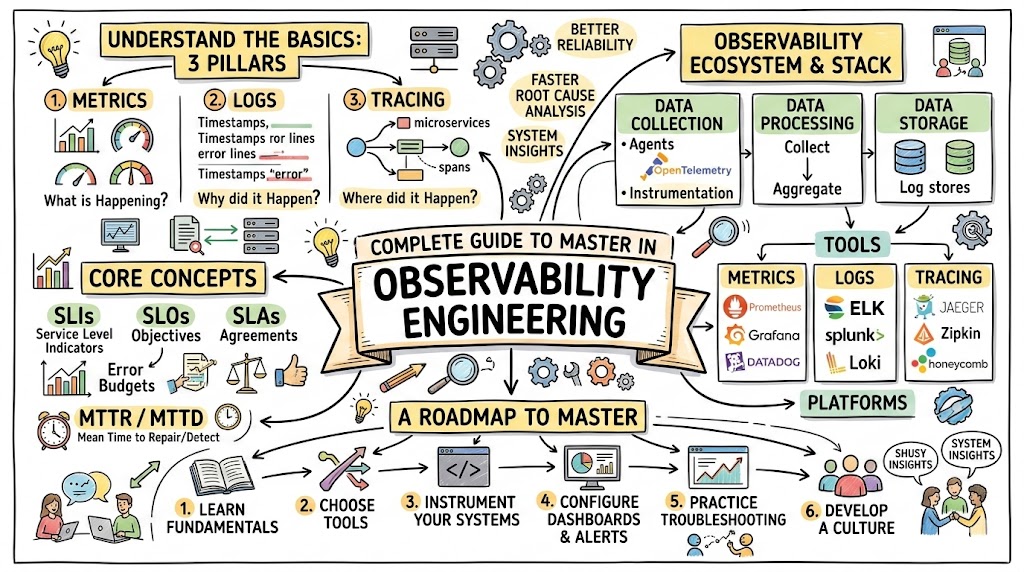
Observability engineering is the practice of designing systems so that you can answer any question about their behavior using signals like logs, metrics, traces, and events.
Instead of guessing or manually checking servers, you build an ecosystem where your applications tell you what is happening in real time.
A good observability engineer focuses on:
- Collecting the right telemetry (logs, metrics, traces) from all services.
- Defining SLIs, SLOs, and SLAs that reflect user experience.
- Using tools like Prometheus, Grafana, ELK, Jaeger, CloudWatch, New Relic, and OpenTelemetry.
- Automating alerting, dashboards, and incident workflows.
This role sits at the intersection of DevOps, SRE, platform engineering, and performance engineering.
If you can design strong observability, you become the person teams rely on during outages and performance issues.
Master in Observability Engineering – Certification Summary
What It Is
Master in Observability Engineering is an advanced certification that teaches you how to design, implement, and run observability for modern, distributed systems.
It goes beyond basic monitoring to cover full-stack visibility across infrastructure, applications, microservices, and user experience.
Who Should Take It
This certification is ideal for:
- DevOps engineers who want to own monitoring and reliability.
- SREs who need deep skills in metrics, tracing, and incident response.
- Platform engineers building internal platforms with built-in observability.
- Cloud engineers managing multi-cloud or hybrid environments.
- Engineering managers who want to understand observability to improve reliability culture.
Skills You Will Gain
After completing the program, you should be comfortable with:
- Observability fundamentals: monitoring vs observability, pillars, SLIs, SLOs, SLAs.
- Metrics: time series data, Prometheus-style scraping, aggregations, and alert rules.
- Logs: central logging, log pipelines, parsing, indexing, and search.
- Traces: distributed tracing, spans, context propagation, and service maps.
- Dashboards: building practical dashboards in tools like Grafana and similar platforms.
- Cloud-native observability: containers, Kubernetes, service mesh, and OpenTelemetry integration.
- Incident management: alert design, runbooks, triage, and root cause analysis.
- Automation: CI/CD integration, observability as code, and pipelines for telemetry.
Real-World Projects You Should Be Able To Do
By the end of the course, you should be able to:
- Design a complete observability stack for a microservices-based application.
- Implement metrics, logs, and traces collection using OpenTelemetry and compatible tools.
- Build dashboards for application health, performance, and business KPIs.
- Set up smart alerting that reduces noise and catches real incidents.
- Run post-incident reviews using trace data and metrics.
- Integrate observability into CI/CD pipelines so that new services are instrumented by default.
Preparation Plan (7–14 / 30 / 60 Days)
You can approach preparation in phases based on your available time.
- 7–14 days (fast track):
- Review basics of monitoring vs observability.
- Learn the three pillars: logs, metrics, traces.
- Practice with one stack (for example, metrics plus dashboards plus tracing) on a sample app.
- 30 days (standard track):
- Go through each module slowly: fundamentals, metrics, logs, traces, dashboards, alerting, incident response.
- Build a small project where you instrument a simple microservices demo and create dashboards and alerts.
- Study SLIs and SLOs in detail and design them for your own or sample services.
- 60 days (deep track):
Common Mistakes To Avoid
Many learners and teams make these mistakes:
- Treating observability as just tool installation instead of system design.
- Collecting too much data without clear questions or KPIs.
- Creating dashboards that look nice but do not help in incidents.
- Setting noisy alerts and then ignoring them.
- Ignoring tracing and focusing only on metrics and logs.
- Not integrating observability into CI/CD and infrastructure as code.
Best Next Certification After This
After Master in Observability Engineering, strong next options include:
- Master in DevOps Engineering, which deepens your overall DevOps and platform skills.
- SRE-focused certifications, which build more on reliability, incident response, and SLO culture.
- AIOps or MLOps certifications, to explore AI-driven operations and intelligent monitoring.
Table: Master in Observability Engineering Certification Snapshot
| Track | Level | Who it is for | Prerequisites | Skills covered | Recommended order |
|---|---|---|---|---|---|
| Observability / DevOps | Advanced / Master | DevOps, SRE, platform, cloud engineers, managers | Basic Linux, scripting, DevOps fundamentals | Observability pillars, SLIs/SLOs, metrics, logs, traces, dashboards, incident response, automation | After basic DevOps or SRE foundation certifications |
How This Certification Fits Into Your Career
Master in Observability Engineering is not an entry-level program.
It is designed for professionals who already understand basic DevOps, infrastructure, or application development and now want to specialize in reliability and visibility.
For working engineers:
- It makes you the go-to person for outages, performance issues, and production stability.
- It gives you concrete skills that map directly to SRE, observability engineer, and platform engineer roles.
For managers:
- It helps you design teams, processes, and KPIs around SLOs and observability.
- It gives you language and structure to talk about reliability with leadership and customers.
Choose Your Path: Six Learning Paths Around Observability
Observability touches many disciplines.
You can use this certification as a core part of different learning paths depending on your role and interests.
1. DevOps Path
Focus: CI/CD, automation, infrastructure as code, and continuous delivery backed by strong observability.
Possible sequence:
- DevOps foundational certification.
- Master in DevOps Engineering.
- Master in Observability Engineering.
This path is ideal if you are responsible for build, deploy, and run cycles and want full visibility into your pipelines and services.
2. DevSecOps Path
Focus: secure software delivery and runtime security, with observability for threats, anomalies, and compliance.
Sequence:
- DevSecOps Certified Professional or similar.
- Master in Observability Engineering to design security-aware telemetry, alerts, and dashboards.
- Further security certifications for specific tools or clouds.
This path suits security engineers who work closely with DevOps teams and need strong observability to detect and respond to security incidents.
3. SRE Path
Focus: reliability, SLOs, error budgets, incident management, and production engineering.
Sequence:
- SRE Certified Professional or similar reliability-focused certification.
- Master in Observability Engineering to deepen your telemetry and diagnostics skills.
- Leadership-level reliability or architecture programs.
This is a natural path if you are already acting as an SRE or want to move into that role.
4. AIOps / MLOps Path
Focus: using AI and machine learning to improve operations, anomaly detection, and automated remediation.
Sequence:
- AIOps or MLOps foundational certification.
- Master in Observability Engineering to build strong telemetry pipelines for AI models.
- Advanced AIOps or MLOps programs focused on automation and intelligent insights.
This path is good if you want to work on intelligent monitoring, predictive alerts, and advanced analytics on observability data.
5. DataOps Path
Focus: data pipelines, ETL, analytics platforms, and ensuring data reliability and quality.
Sequence:
- DataOps Certified Professional.
- Master in Observability Engineering to instrument data platforms and pipelines.
- Additional data engineering or analytics certifications.
This path fits data engineers who manage complex data flows and want better visibility into performance and failures.
6. FinOps Path
Focus: cloud cost optimization, usage visibility, and financial accountability in engineering.
Sequence:
- FinOps foundational certification.
- Master in Observability Engineering to connect performance, usage, and cost signals.
- Advanced FinOps or cloud architecture certifications.
This path is ideal if you help your organization control cloud spend while keeping reliability high.
Role → Recommended Certifications Mapping
This mapping helps you see how Master in Observability Engineering fits with other certifications.
Next Certifications To Take After Master in Observability Engineering
Based on the structure used for Master in DevOps Engineering and related programs, three good next steps are:
- Same track (deepening technical skills)
- Move to a broader DevOps or SRE master-level certification such as Master in DevOps Engineering.
- This helps you combine observability with CI/CD, infrastructure as code, and platform automation.
- Cross-track (expanding scope)
- Leadership (moving into senior or manager roles)
- Choose leadership-oriented programs around DevOps transformation, SRE leadership, or platform strategy.
- This helps you drive culture, processes, and metrics at team or organization level using observability as a core pillar.
Training and Certification Providers For Master in Observability Engineering
Several institutions are involved in training, coaching, and certification support around Master in Observability Engineering and related programs.
DevOpsSchool
DevOpsSchool is the main provider of the Master in Observability Engineering certification.
They offer live instructor-led classes, self-paced video learning, and corporate batches, with a curriculum that combines theory, labs, and real-world projects.
Their trainers are experienced practitioners who work in DevOps, SRE, and platform roles.
The course includes work on metrics, logs, traces, OpenTelemetry, and cloud-native observability, plus interviews and project guidance.
They also support learners with resume preparation and interview readiness in the observability and SRE space.
Cotocus
Cotocus focuses on specialized DevOps and cloud consulting and training services, and supports advanced certifications like Master in Observability Engineering.
They often work closely with enterprises that want to build internal observability platforms and reliability capabilities.
Their involvement usually includes customized training plans, use-case driven labs, and long-term advisory for production adoption.
Cotocus can be a good choice if your organization wants a tailored path around observability and platform engineering.
They emphasize practical skills that can be applied directly in complex and regulated environments.
ScmGalaxy
ScmGalaxy is known for DevOps and software configuration management training and content, and also promotes advanced programs like MOE.
They produce tutorials, blogs, and project-based content around observability tools, SRE practices, and automation.
If you learn well from community-style resources and real-world examples, their materials can support your MOE journey.
They frequently align their learning content with certifications from DevOpsSchool and related providers.
This makes it easier for learners to move from theory to hands-on practice and then to certification.
BestDevOps
BestDevOps is a content and learning portal that aggregates DevOps, SRE, and related training programs, including observability-focused tracks.
You can find articles, guides, and links to structured courses that help you understand where MOE fits in your career.
They highlight top certifications across DevOps, SRE, DevSecOps, and observability, which can help you design your own roadmap.
Their role is often to guide learners to suitable programs and share success stories and case studies.
This makes them useful when you are still exploring which certifications to prioritize after or alongside MOE.
DevSecOpsSchool
DevSecOpsSchool specializes in combining security and DevOps practices, including security visibility and runtime protection.
They support training paths where observability is integrated with security monitoring and incident response.
If you are a security engineer or DevSecOps practitioner, using MOE together with their programs helps you see both security and reliability dimensions of your systems.
They often stress secure logging, audit trails, and compliance-focused observability.
This alignment is very useful in regulated industries or high-risk environments.
Sreschool
Sreschool is focused on Site Reliability Engineering training, which naturally overlaps with observability.
Their courses emphasize SLOs, error budgets, incident management, and reliability culture.
When combined with Master in Observability Engineering, you get a strong foundation in both reliability principles and observability implementation.
Sreschool programs also include production-style labs and case studies around outages and performance issues.
This makes them a strong companion for learners aiming for senior SRE or platform roles.
Aiopsschool
Aiopsschool trains professionals in AI-driven operations and modern AIOps practices.
They focus on using machine learning and advanced analytics to detect anomalies, predict issues, and automate responses.
Observability data is a key input to AIOps systems, so MOE and Aiopsschool programs fit well together.
If you want to work on intelligent observability, predictive alerts, or self-healing systems, this combination is powerful.
It helps you move from manual dashboards and alerts toward smarter, data-driven operations.
Dataopsschool
Dataopsschool focuses on DataOps, data pipelines, and reliable data delivery.
Their programs show how to treat data platforms with the same rigor as application systems, including observability for pipelines and jobs.
When you pair MOE with Dataopsschool training, you learn how to instrument data flows, detect data quality issues, and monitor performance.
This is very useful for data engineers and analytics teams running complex ETL or streaming platforms.
It helps ensure that data reliability and system reliability move together.
Finopsschool
Finopsschool trains professionals in managing cloud costs, budgets, and financial accountability.
They highlight how to connect technical telemetry with cost data and business metrics.
With MOE, you get the technical side of observability, and with Finopsschool, you learn how to interpret it from a financial and business perspective.
This blend is ideal for FinOps practitioners and engineering leaders who must balance cost, performance, and reliability.
It also supports better decisions on scaling, right-sizing, and architecture choices based on real observability data.
FAQs (Master in Observability Engineering – General Observability Focus)
Here we cover general questions about observability and this certification.
- Is observability only for very large companies?
No. Even small teams benefit from observability, because it reduces time to find issues and supports faster releases.
You can start small with one app and grow your observability stack over time. - Do I need deep programming skills to learn observability?
You do not need to be a full-time developer, but basic scripting and understanding of application behavior is helpful.
You mainly use configuration, queries, and small code changes to instrument services. - What tools will I likely work with in observability roles?
You will work with metrics, log, and tracing tools such as Prometheus-like systems, Grafana-style dashboards, ELK-like stacks, tracing platforms, cloud-native monitoring, and OpenTelemetry. - How is observability different from traditional monitoring?
Monitoring checks known conditions with fixed dashboards and alerts, while observability lets you explore and answer new questions during incidents without predefining all conditions. - Can observability help reduce costs?
Yes, because you can see which services are underused, overprovisioned, or inefficient, and you can tie performance data to cost insights, especially when combined with FinOps practices. - Is this certification only for backend engineers?
No. Frontend, backend, full-stack, DevOps, SRE, and data engineers can all benefit since user experience and data flows depend on end-to-end visibility. - Does observability improve security?
Observability does not replace security tools, but it helps detect unusual behavior, failed logins, strange traffic, and performance anomalies that can indicate security issues. - Will this certification help if I am already an SRE?
Yes, because observability is a core part of SRE practice, and deeper skills in tracing, metrics, and SLIs make you more effective in incident response and reliability work. - How soon can I apply observability skills in my current job?
In many cases you can start immediately by adding better logging, metrics, and simple dashboards to your existing services. - Does observability require a full platform redesign?
Not always. You can introduce observability step by step, starting with critical services, then expanding to more systems and environments. - Is this certification useful for managers and leads?
Yes. It gives you a structured way to think about reliability, KPIs, and incident handling, and helps you guide your teams on where to invest effort. - Can I combine observability with AI and automation?
Yes. Observability data is the base for AIOps solutions which use machine learning to detect anomalies and automate responses.
FAQs (Specific To Master in Observability Engineering)
These questions focus directly on the MOE program.
- How difficult is the Master in Observability Engineering certification?
The difficulty is moderate to high if you are new to DevOps and SRE, but manageable if you already understand basic infrastructure and application behavior.
The structured modules and hands-on labs are designed to guide you step by step. - How much time should I plan to complete the training and be ready for certification?
Many working professionals can complete the core training and practice projects in a few weeks if they study regularly.
If you are balancing a full-time job, plan for a month or two of focused learning. - What are the prerequisites for enrolling in MOE?
You should be comfortable with basic Linux, scripting, networking, and at least one cloud or container platform.
Prior exposure to DevOps, SRE, or application development will help you move faster. - In what sequence should I take this compared to Master in DevOps Engineering?
Many learners first build a wide base with Master in DevOps Engineering, then specialize with Master in Observability Engineering.
If you are already strong in DevOps, you can start MOE directly and then add broader programs later. - What real-world value does this certification provide?
The certification signals that you can design and run observability for complex systems, which is highly valued in roles like SRE, platform engineer, and senior DevOps engineer. - Does the program include hands-on projects and labs?
Yes. The curriculum includes practical labs, case studies, and project-style work such as building dashboards, configuring telemetry, and running incident simulations. - Is placement assistance or interview support available?
While direct placement is not guaranteed, the provider supports interview preparation, real-world project experience, and resume guidance. - Can I take this certification if I am outside India?
Yes. Online and self-paced formats allow learners from any region to participate, and the concepts apply to global cloud and DevOps environments.
Conclusion
Observability is now a core requirement for any serious engineering team, not a luxury.
It enables you to understand your systems, reduce outages, improve user experience, and support faster, safer releases.The Master in Observability Engineering certification from DevOpsSchool gives you a structured, hands-on way to build these skills as a working engineer or manager.
You learn to design telemetry, build dashboards, create smart alerts, integrate OpenTelemetry, and drive incident response with data.Whether you are a DevOps engineer, SRE, platform engineer, cloud specialist, security engineer, data engineer, FinOps practitioner, or an engineering manager, this program fits naturally into your growth path.When combined with related certifications in DevOps, SRE, DevSecOps, AIOps, DataOps, and FinOps, it becomes a powerful foundation for a strong, long-term career in modern engineering and operations.
Find Trusted Cardiac Hospitals
Compare heart hospitals by city and services — all in one place.
Explore Hospitals