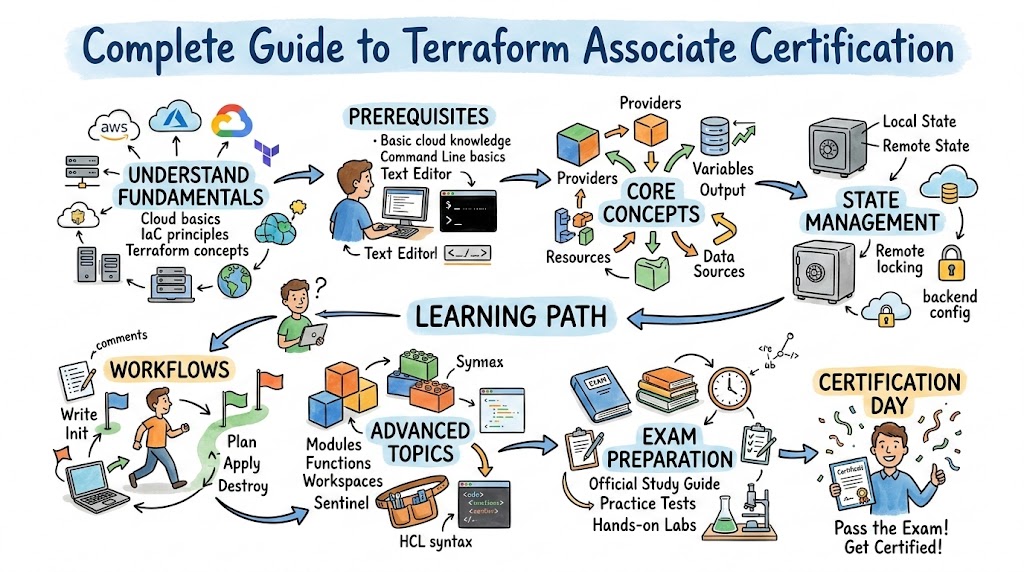
For engineers and managers, Terraform is no longer just a nice skill to have. It has become one of the clearest ways to show that you understand modern infrastructure, automation, repeatability, and cloud operations. The Hashicorp Certified Terraform Associate certification is designed to validate foundational Terraform knowledge, including infrastructure as code, workflow, modules, state, and multi-cloud usage. DevOpsSchool presents it as a foundational certification for DevOps engineers, cloud engineers, system administrators, infrastructure engineers, IT operations staff, developers, architects, consultants, and even learners entering infrastructure automation.This guide is written for working engineers, software professionals, and technical managers in India and across global teams. The goal is simple: help you understand what this certification is, who should take it, how to prepare, what projects you should be able to handle after earning it, and what learning path makes sense after it. I am also mapping this certification into the wider DevOpsSchool certification ecosystem so you can choose the next step with confidence.
Why this certification matters
Terraform has become one of the most practical tools in cloud and platform work because it helps teams define infrastructure in code, keep environments consistent, reduce manual errors, and support repeatable delivery. According to DevOpsSchool’s Terraform Associate course page, this certification validates foundational Terraform knowledge, covers workflow, modules, state, outputs, variables, and cloud usage, and serves as a base for more advanced Terraform certifications and infrastructure automation roles.
For individual professionals, this certification is useful because it helps prove that you can read, write, understand, and troubleshoot Terraform configurations. For managers, it helps identify people who understand standard IaC practices and can contribute to cloud automation, environment consistency, and safer change delivery. For organizations, the value is even bigger: better repeatability, clearer change history, easier collaboration, and more reliable deployments.
The certification landscape around Terraform and modern DevOps
Below is a practical certification table based on the broader DevOpsSchool certification landscape and the MDE roadmap. I am using it to show where Terraform Associate sits in a larger career path. The MDE roadmap positions Master in DevOps Engineering as the broad foundation, followed by specialist tracks such as DevOps, DevSecOps, SRE, AIOps, DataOps, and FinOps. The broader certification catalog also includes Terraform Associate and other hands-on certifications.
| Certification | Track | Level | Who it’s for | Prerequisites | Skills covered | Recommended order |
|---|---|---|---|---|---|---|
| HashiCorp Certified Terraform Associate | IaC / Cloud Automation | Foundation | DevOps engineers, cloud engineers, system admins, infra engineers, developers | Basic Linux, CLI familiarity, text editor, some exposure to systems or automation | IaC concepts, Terraform workflow, state, modules, variables, outputs, Terraform Cloud basics | 1st or 2nd |
| DevOps Certified Professional (DCP) | DevOps | Professional | Engineers building CI/CD and automation skills | General DevOps basics | Automation, CI/CD, tooling depth | 2nd |
| Site Reliability Engineering Certified Professional (SRECP) | SRE | Professional | Reliability, operations, platform, and support engineers | System administration experience | SLOs, reliability, metrics, operations | 2nd |
| DevSecOps Certified Professional (DSOCP) | DevSecOps | Professional | Security-aware DevOps and platform teams | DevOps basics | Secure pipelines, security integration, compliance thinking | 2nd |
| AiOps Certified Professional (AIOCP) | AIOps | Advanced | Automation leads, platform teams, ops analysts | Python or data basics | ML in operations, anomaly detection, operational intelligence | 3rd |
| DataOps Certified Professional (DOCP) | DataOps | Advanced | Data engineers, analytics platform teams | Data pipeline exposure | Data workflow automation, orchestration, quality | 3rd |
| FinOps Certified Professional | FinOps | Advanced / Leadership | Cloud cost owners, architects, managers | Cloud architecture familiarity | Cost governance, usage visibility, unit economics | 3rd |
| Master in DevOps Engineering (MDE) | Cross-domain | Master | Engineers and managers moving toward architect or lead roles | Basic Linux/coding; broad technical interest | CI/CD, Kubernetes, Terraform, SRE, DevSecOps thinking | Best as foundation or leadership target |
The main idea is this: Terraform Associate is a high-value foundational certification, but it becomes even more powerful when placed inside a bigger career plan. If you stop at one credential, you prove a tool skill. If you continue into DevOps, SRE, DevSecOps, or MDE, you turn that skill into a broader role identity.
HashiCorp Certified Terraform Associate
What it is
The HashiCorp Certified: Terraform Associate certification validates your foundational understanding of Terraform and infrastructure as code. It focuses on the standard Terraform workflow, configuration basics, modules, variables, outputs, state, and the practical use of Terraform across cloud platforms and team environments.
It is best seen as an entry-to-mid-level certification for professionals who want to prove they can work with Terraform in real delivery pipelines, not just read theory. It shows that you understand how Terraform fits into cloud automation and repeatable infrastructure delivery.
Who should take it
This certification is a smart fit for:
- DevOps Engineers
- Cloud Engineers
- System Administrators
- Infrastructure Engineers
- IT Operations Staff
- Platform Engineers
- Software Engineers working with cloud infrastructure
- Consultants advising on cloud automation
- Students or early-career engineers entering IaC work
- Technical managers who want practical understanding of automation workflows
If your daily work touches provisioning, cloud changes, reusable infrastructure, environment consistency, or platform automation, this certification is relevant. If you are moving from manual cloud setup to automated infrastructure management, this is one of the best starting points.
Skills you’ll gain
- Understanding Infrastructure as Code principles
- Writing Terraform configuration files
- Working with providers, resources, variables, outputs, and data sources
- Using the Terraform workflow: init, plan, apply, destroy
- Managing and understanding Terraform state
- Creating and reusing Terraform modules
- Understanding backends and collaboration basics
- Using Terraform Cloud and Enterprise concepts
- Applying basic Terraform best practices
- Troubleshooting common configuration and workflow issues
Real-world projects you should be able to do after it
- Provision a basic AWS, Azure, or GCP environment using Terraform
- Create reusable modules for network, compute, and storage components
- Build a repeatable dev, test, and staging environment from code
- Manage variables and outputs for multi-environment deployments
- Store and manage remote state for team collaboration
- Create a simple multi-tier application infrastructure
- Integrate Terraform into a CI/CD pipeline for infrastructure changes
- Review infrastructure changes safely using
terraform plan - Destroy lab or temporary environments cleanly to control waste
- Troubleshoot state, drift, and common syntax issues
Preparation plan
7–14 day fast-track plan
This path works if you already know Linux, cloud basics, and command line work. Spend the first few days on core Terraform concepts, configuration blocks, providers, resources, variables, outputs, and workflow. Then move into modules, state, and backend basics. Use the last days for practice questions, revision, and building one small hands-on project such as a simple VPC plus compute stack. The goal here is not deep mastery. The goal is clean understanding plus enough hands-on repetition to avoid exam confusion. This is realistic for working engineers who already work near cloud platforms.
30 day balanced plan
This is the most practical option for most people. Use week one for IaC concepts and Terraform basics. Use week two for variables, outputs, modules, and file structure. Use week three for state, backends, team workflows, Terraform Cloud basics, and troubleshooting. Use week four for revision, mock questions, and at least two practical mini-projects. One project should be a single-environment deployment. The second should use modules and multiple variable files. This plan gives you enough time to build confidence instead of memorizing keywords.
60 day deep plan
This is the best path for career changers, developers new to infrastructure, or managers who want strong conceptual understanding. Month one should build pure foundations: Linux basics, cloud basics, Git basics, IaC principles, and Terraform syntax. Month two should focus on reusable modules, state handling, backend thinking, team workflows, Terraform Cloud concepts, and real lab work. End with at least three hands-on builds: a network stack, a multi-tier app stack, and a reusable module-based environment layout. This path gives you not just exam readiness, but job-readiness.
Common mistakes
- Memorizing commands without understanding workflow
- Ignoring state concepts and remote-state basics
- Treating modules as an advanced topic and skipping them
- Focusing only on one cloud console instead of Terraform thinking
- Not practicing variables, outputs, and reusable file structure
- Studying theory without building at least one real project
- Confusing provisioning steps with ongoing operations
- Forgetting why
planmatters beforeapply - Not reviewing troubleshooting patterns
- Thinking the certification is only for DevOps roles
Best next certification after this
The strongest same-track next step is HashiCorp Certified: Terraform Authoring and Operations Professional, because DevOpsSchool describes it as validating advanced Terraform skills such as reusable module creation, scalable infrastructure design, advanced state handling, CI/CD integration, and security best practices.
If you want broader role growth instead of deeper Terraform specialization, your best cross-track next steps are:
- DevOps Certified Professional (DCP) for CI/CD and automation breadth
- SRE Certified Professional (SRECP) for reliability thinking
- DevSecOps Certified Professional (DSOCP) for security integration
- Master in DevOps Engineering (MDE) for architect or lead-level development
How hard is this certification in real life?
For most engineers, this is a moderate certification, not an easy one and not an expert-only one. The hard part is not syntax. The hard part is understanding how Terraform behaves as a workflow system: what state is doing, why planning matters, how modules make code reusable, how variable design changes maintainability, and how team collaboration affects infrastructure work. DevOpsSchool’s course structure also shows that the learning path goes beyond simple commands into labs, modules, state, Terraform Cloud, collaboration, and exam preparation.
This means beginners can clear it, but only if they study with hands-on practice. Experienced engineers often fail to respect the basics because they assume their cloud knowledge is enough. It is not. Terraform rewards process thinking, not just cloud familiarity.
What value does it add to your career?
The immediate value of Terraform Associate is credibility. Hiring managers and technical leads can look at this certification and quickly see that you have at least a validated foundation in infrastructure as code. That matters in roles where cloud changes, repeatability, automation, and multi-environment consistency are important. DevOpsSchool also positions the certification as valuable for career advancement, best-practice understanding, and as a stepping stone to advanced certifications.
The deeper value is practical. Once you learn Terraform properly, you start thinking differently about infrastructure. You stop asking, “Who will create this manually?” and start asking, “How do we define it, review it, version it, reuse it, and deploy it safely?” That mindset helps across DevOps, SRE, platform engineering, cloud engineering, and even FinOps, because code-defined infrastructure is easier to govern, repeat, and optimize.
For managers, this certification can also help build better hiring and skilling decisions. Team members with Terraform knowledge are easier to place into standardization, automation, environment setup, and cloud modernization projects. This is especially useful in organizations moving from manual operations to platform-driven delivery.
Choose your path
The same Terraform certification can support different career paths. The right next step depends on the type of work you want to own.
1. DevOps path
Choose this path if you want to own automation, CI/CD, environment consistency, and release speed. Terraform Associate gives you the infrastructure layer. Pair it with DevOps Certified Professional to deepen pipeline design, automation flow, and delivery thinking. Later, MDE becomes the leadership-grade step.
2. DevSecOps path
Choose this if you want to secure infrastructure delivery and shift security into pipelines. Terraform gives you codified infrastructure. DevSecOps then teaches how to layer policy, scanning, governance, and secure change control into that process. This path is strong for cloud security engineers and platform security teams.
3. SRE path
Choose this if you care most about reliability, production resilience, and operational discipline. Terraform helps define systems consistently. SRE helps ensure those systems run safely at scale using observability, SLOs, reliability design, and incident discipline. This is ideal for platform and reliability engineers.
4. AIOps / MLOps path
Choose this if you want automation plus intelligent operations or ML platform workflows. Terraform is useful here because ML platforms and AIOps stacks still require repeatable infrastructure. After Terraform, move into AIOps or MLOps-oriented certifications to understand operational intelligence, ML workflow support, and smarter automation.
5. DataOps path
Choose this if your work is centered on data platforms, analytics systems, orchestration, and reproducible environments for data teams. Terraform helps you standardize the infrastructure layer for pipelines and platforms. DataOps adds the workflow, orchestration, and quality side.
6. FinOps path
Choose this if you are moving into cloud cost visibility, usage governance, and platform economics. Terraform matters here because codified infrastructure supports standardization, tagging, lifecycle control, and cleaner governance. FinOps then helps you turn technical control into financial control. This is powerful for architects and engineering managers.
Role → Recommended certifications
Below is a practical role mapping that uses Terraform Associate as a foundation and then aligns the next certification to the role’s deeper need.
| Role | Recommended starting point | Best next certification | Why it fits |
|---|---|---|---|
| DevOps Engineer | Terraform Associate | DevOps Certified Professional | Adds CI/CD, automation, and delivery breadth |
| SRE | Terraform Associate | SRE Certified Professional | Builds reliability, observability, and production discipline |
| Platform Engineer | Terraform Associate | MDE or SRE Certified Professional | Supports platform standardization and scalable operations |
| Cloud Engineer | Terraform Associate | DevOps Certified Professional or Terraform Professional | Builds stronger automation and deeper IaC capability |
| Security Engineer | Terraform Associate | DevSecOps Certified Professional | Combines IaC with security and governance |
| Data Engineer | Terraform Associate | DataOps Certified Professional | Useful for reproducible data infrastructure and pipelines |
| FinOps Practitioner | Terraform Associate | FinOps Certified Professional | Supports infrastructure governance and cloud cost control |
| Engineering Manager | Terraform Associate | Master in DevOps Engineering | Gives broader architecture and organizational context |
This mapping is consistent with the MDE roadmap, which separates specialist tracks by domain focus while keeping MDE as the broader architect-level progression.
Next certifications to take after Terraform Associate
Option 1: Same track
HashiCorp Certified: Terraform Authoring and Operations Professional
Choose this if you want to become the Terraform expert on your team. This certification is the best same-track continuation because it goes deeper into scalable module design, advanced state management, CI/CD integration, and enterprise-grade Terraform practices. It is ideal if you want to own reusable infrastructure frameworks or platform modules.
Option 2: Cross-track
DevOps Certified Professional (DCP)
Choose this if you want a broader engineering role. Terraform proves your IaC base, but DCP expands you into a fuller DevOps workflow that includes automation, delivery practices, and toolchain thinking. This is often the best move if your role includes both application delivery and infrastructure work.
Option 3: Leadership
Master in DevOps Engineering (MDE)
Choose this if your long-term target is architect, lead, or engineering manager. The MDE roadmap describes it as a master-level program spanning DevOps, DevSecOps, and SRE principles together, with Terraform included as part of a much larger delivery and reliability framework. This is the strongest path if you want full-system thinking rather than tool-only expertise.
Top Institutions That Help with Training cum Certifications for HashiCorp Certified Terraform Associate
1. DevOpsSchool
DevOpsSchool is one of the strongest options for HashiCorp Certified Terraform Associate preparation because it offers a dedicated Terraform Associate training path, practical labs, and certification-focused coverage for engineers, administrators, architects, and consultants. Its Terraform program is designed to build real infrastructure-as-code skills, not just theoretical understanding.
2. Cotocus
Cotocus is a useful option for learners who want broader DevOps and cloud capability around Terraform. It is also known for sharing guidance related to the Terraform Associate certification journey, making it valuable for working professionals who want both practical and career-focused learning support.
3. ScmGalaxy
ScmGalaxy is known as a consulting and training-oriented platform for cloud, automation, and DevOps learning. For candidates preparing for Terraform Associate, it fits well as part of a broader ecosystem that supports infrastructure, cloud, and automation skill development.
4. BestDevOps
BestDevOps is another strong choice because it offers Terraform training from beginner to certified associate level. Its learning style is practical and job-oriented, which helps learners prepare not only for the exam but also for real-world Terraform use in projects.
5. DevSecOpsSchool
DevSecOpsSchool is helpful for professionals who want to extend Terraform knowledge into secure infrastructure and compliance-focused automation. It is a good next-step institution for learners who want to combine infrastructure as code with cloud security practices.
6. SRESchool
SRESchool is useful for learners who want to connect Terraform skills with reliability engineering, system stability, and production operations. It is especially relevant for engineers planning to move toward SRE and platform reliability roles.
7. AIOpsSchool
AIOpsSchool is a strong option for professionals who want to move beyond basic automation and into intelligent operations. After Terraform foundations, this institution can help learners connect infrastructure automation with monitoring, analytics, and AI-driven operations.
8. DataOpsSchool
DataOpsSchool is valuable for learners who want to apply Terraform skills in data platform and pipeline environments. It supports professionals who are working on repeatable, scalable, and automated infrastructure for analytics and data engineering workflows.
9. FinOpsSchool
FinOpsSchool is useful for professionals who want to connect Terraform-based infrastructure automation with cloud cost control and financial governance. It is a smart choice for learners planning to use Terraform in cost-aware and efficiency-driven cloud environments.
Practical study advice for working engineers and managers
The fastest way to fail this certification is to treat it as a theory exam. The fastest way to pass it and also gain job value is to build while you study. Create a small cloud environment. Define it in Terraform. Split code into modules. Use variables. Change something. Run plan. Apply it. Review state behavior. Destroy the environment. Repeat. That full cycle teaches more than reading many notes. This advice is strongly aligned with DevOpsSchool’s emphasis on hands-on labs, real examples, practical projects, and workflow understanding.
Managers preparing for this certification do not need to become daily Terraform authors. But they should understand enough to ask better questions: Are our environments codified? Are we reusing modules? Are we reviewing plans? Are we keeping state safe? Are our infrastructure changes repeatable? Those questions improve team maturity even when the manager is not the person writing the code.
FAQs on HashiCorp Certified Terraform Associate
1. What is HashiCorp Certified Terraform Associate?
It is a certification that proves your basic knowledge of Terraform and infrastructure as code.
2. Who should take this certification?
It is best for DevOps Engineers, Cloud Engineers, System Admins, and Infrastructure professionals.
3. Is this certification difficult?
It is moderate in difficulty and easier if you practice hands-on.
4. Do I need prerequisites?
Basic Linux, command-line, and cloud knowledge are helpful.
5. How long does preparation take?
Most learners prepare in 2 to 8 weeks depending on experience.
6. What skills will I gain?
You will learn Terraform workflow, modules, variables, state, and automation basics.
7. What should I do after this certification?
You can move to advanced Terraform, DevOps, SRE, or DevSecOps certifications.
8. Is it good for career growth?
Yes, it helps improve your profile for cloud and DevOps roles.
FAQs on HashiCorp Certified Terraform Associate
1. Is HashiCorp Certified Terraform Associate difficult?
It is moderately difficult. The exam is manageable for engineers who combine reading with real practice. It becomes hard when candidates only memorize commands and skip state, modules, and workflow understanding.
2. Do I need cloud experience before taking it?
Cloud familiarity helps, but deep cloud expertise is not mandatory. Basic Linux, CLI familiarity, and some exposure to systems or automation are more important as starting points.
3. How long should I prepare?
For experienced engineers, 7–14 days may be enough. For most working professionals, 30 days is safer. For beginners or career changers, 60 days is better because it allows time for hands-on work and concept building. This is a practical recommendation based on the breadth of topics covered in the course pages.
4. Is Terraform Associate good for DevOps Engineers?
Yes. DevOpsSchool explicitly lists DevOps Engineers among the target audience, and the certification directly supports automation, repeatability, and infrastructure as code practices that are central to DevOps work.
5. Is it useful for managers?
Yes. It helps engineering managers and architects understand how infrastructure automation works, which improves planning, team decisions, governance conversations, and cloud modernization oversight. DevOpsSchool includes managers and architects in the target audience.
6. What are the most important topics to focus on?
Focus first on Terraform workflow, resources, variables, outputs, modules, and state. Then move to backends, collaboration concepts, and Terraform Cloud basics. These are repeatedly emphasized in the course description and objectives.
7. What project should I build before taking the exam?
Build at least one multi-environment or multi-tier infrastructure project. A simple network-plus-compute setup or a small application stack using modules is enough to expose gaps in your understanding. DevOpsSchool’s agenda includes building infrastructure and using best practices for code organization.
8. Does this certification help in cloud jobs?
Yes. It is relevant for cloud engineers, infrastructure engineers, DevOps professionals, and platform teams because it validates repeatable cloud provisioning and infrastructure management skills.
9. What should I take after Terraform Associate?
The best same-track next step is Terraform Authoring and Operations Professional. If you want wider breadth, choose DevOps Certified Professional. If you want architect or leadership growth, choose Master in DevOps Engineering.
10. Is Terraform Associate enough to get a job?
One certification alone does not guarantee a job. But combined with small projects, Git usage, and cloud basics, it can strongly improve your profile for IaC, DevOps, cloud automation, and junior platform roles. The real advantage comes when the certification is backed by visible hands-on work.
11. Should I start with Terraform Associate or MDE?
If you want a tool-first, infrastructure-first start, begin with Terraform Associate. If you want a broader transformation path across DevOps, SRE, and DevSecOps with architect-level direction, MDE is the larger path. The best choice depends on whether your goal is immediate hands-on IaC skill or wider career architecture.
12. Is this certification valuable globally or mainly in India?
It is relevant for both India and global teams because infrastructure as code, cloud automation, and Terraform usage are not region-specific needs. DevOpsSchool also frames the course and certification for professionals working in India and globally.
Conclusion
The HashiCorp Certified Terraform Associate certification is one of the smartest foundational certifications for modern infrastructure professionals because it teaches a way of working, not just a tool. It helps you think in code, review changes safely, standardize environments, and build repeatable systems. That matters for DevOps engineers, cloud engineers, SREs, platform teams, consultants, and even managers who want better cloud and automation judgment. On its own, it is a strong credibility signal. As part of a larger path into DevOps, DevSecOps, SRE, AIOps, DataOps, FinOps, or MDE, it becomes even more valuable. The right move is simple: learn the workflow well, build real Terraform projects, earn the certification, and then choose the next path based on the kind of engineer or leader you want to become
Find Trusted Cardiac Hospitals
Compare heart hospitals by city and services — all in one place.
Explore Hospitals