Introduction
In today’s data-driven world, organizations need robust, efficient, and scalable ways to manage and deliver data. With the rapid growth of big data, machine learning, and real-time analytics, it has become essential to optimize data pipelines to ensure that they are efficient, accurate, and secure. Enter DataOps — a methodology that blends data engineering, DevOps principles, and automation to create a faster, more reliable data delivery process.The DataOps Certified Professional (DOCP) program from DevOpsSchool is one of the leading certifications for professionals aiming to master the art of managing and optimizing data pipelines. Whether you are a data engineer, software engineer, or cloud engineer, this certification provides the knowledge and skills to excel in data-centric roles.In this guide, we will walk you through what DataOps is, who should take the certification, the skills you’ll gain, and how the certification can elevate your career.
What is DataOps Certified Professional?
DataOps Certified Professional (DOCP) is a certification program designed to equip professionals with the skills and knowledge necessary to manage modern data pipelines. It is rooted in data engineering and integrates key concepts from DevOps, including automation, continuous integration/continuous delivery (CI/CD), data monitoring, governance, and data quality assurance.Unlike traditional data management approaches, DataOps emphasizes speed, collaboration, and real-time monitoring to improve the efficiency of data workflows. With DataOps, organizations can deliver accurate, high-quality data faster and more securely, enabling informed decision-making and business success.Upon earning this certification, professionals will demonstrate their ability to implement end-to-end automated data pipeline workflows, apply best practices for monitoring and governance, and ensure the integrity and quality of data used across business processes.
Who Should Take It?
The DataOps Certified Professional (DOCP) certification is ideal for professionals in various data-related roles. Here’s a breakdown of who will benefit most from this certification:
- Data Engineers: Professionals who focus on developing, managing, and optimizing data pipelines.
- DevOps Engineers: Engineers who are familiar with CI/CD pipelines and seek to extend DevOps principles to data workflows.
- Software Engineers: Those looking to understand the nuances of data engineering and integration.
- Cloud Engineers: Professionals managing cloud-based data storage, processing, and orchestration.
- Platform Engineers: Individuals working on the integration and deployment of data systems across platforms.
- Business Intelligence (BI) Analysts: Analysts who need to optimize data retrieval and delivery processes for reporting and analytics.
- IT Managers: Managers overseeing teams that handle data integration and delivery processes.
- Data Architects: Individuals designing and implementing data systems and infrastructures.
This certification is for anyone aiming to advance their knowledge in data engineering, automation, and DevOps principles applied to data management.
Skills You’ll Gain
Earning the DataOps Certified Professional certification means gaining a robust set of practical skills that will prepare you to manage and optimize data systems at scale. The core skills you’ll acquire include:
- Data Pipeline Automation: Automating the flow of data between systems using tools like Apache Airflow, Kafka, and dbt.
- CI/CD for Data: Integrating CI/CD practices in data pipelines to ensure quick deployment and testing of data changes.
- Data Quality Assurance: Ensuring data accuracy and reliability through quality checks, using tools like Great Expectations.
- Data Governance: Implementing security and compliance best practices to protect data and ensure it adheres to regulatory standards.
- Monitoring and Observability: Using monitoring tools like Grafana and Prometheus to track the health and performance of data pipelines.
- Collaborative Data Management: Building bridges between data teams, software developers, and business stakeholders to streamline data operations.
- Real-time Data Integration: Working with streaming data and ensuring it flows seamlessly across platforms.
- Data Security: Managing data security concerns, including encryption and access control in the context of data operations.
These skills make you an integral part of any organization striving to manage data efficiently and securely.
Real-World Projects You Should Be Able to Do After This Certification
After completing the DataOps Certified Professional program, you should be equipped to tackle the following real-world projects:
- End-to-End Data Pipeline Automation: Design and automate a full-fledged data pipeline from data collection to delivery using tools like Apache Airflow, dbt, and Apache Kafka.
- Implementing Continuous Data Integration and Delivery (CI/CD): Set up CI/CD pipelines for continuous data flow and testing using tools such as Jenkins and GitLab CI.
- Data Quality Management: Implement automated data quality checks, validations, and reporting for data pipelines using platforms like Great Expectations and Soda.
- Data Governance Frameworks: Develop and apply data governance frameworks that ensure data integrity, security, and compliance with industry standards (e.g., GDPR, HIPAA).
- Real-Time Monitoring and Observability: Set up dashboards and monitoring systems using Grafana and Prometheus to ensure the real-time health of data pipelines.
- Cross-Team Data Collaboration: Work with data science, engineering, and DevOps teams to build collaborative data workflows that meet business needs.
These projects will empower you to make a meaningful impact in any data-driven organization.
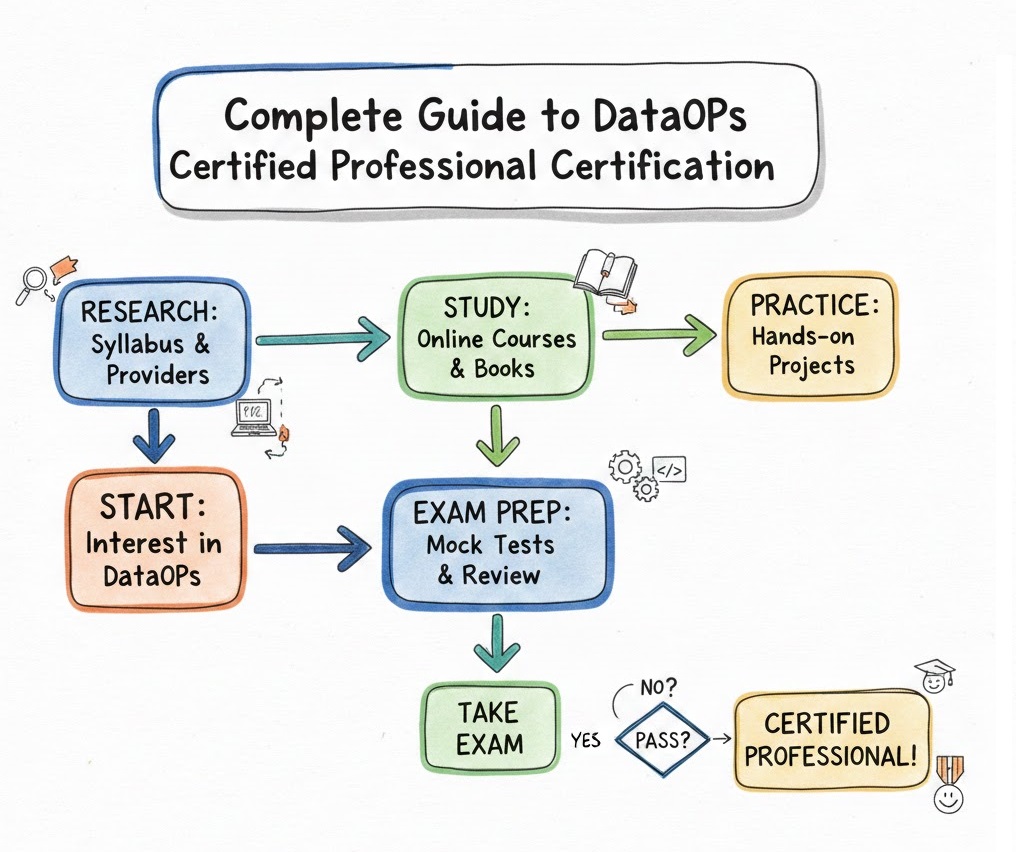
Preparation Plan
7-14 Days Plan
- Week 1: Start with the basics of DataOps. Understand the core concepts such as data pipelines, orchestration, and automation.
- Week 2: Begin working with tools like Apache Airflow and Kafka. Set up simple data pipelines and perform hands-on tasks to familiarize yourself with the tools.
30 Days Plan
- Week 1-2: Deepen your understanding of CI/CD in data workflows. Learn how to integrate Jenkins or GitLab CI for continuous data deployment.
- Week 3-4: Focus on data quality assurance frameworks. Implement hands-on projects using tools like dbt and Great Expectations.
60 Days Plan
- Weeks 1-4: Master advanced concepts such as data observability and governance. Build more complex data workflows and integrate them with cloud platforms.
- Weeks 5-8: Complete real-world projects involving monitoring, security, and compliance. Prepare for the exam by reviewing all concepts and revisiting your projects.
Common Mistakes to Avoid
While preparing for the DataOps Certified Professional exam, avoid these common mistakes:
- Skipping Hands-On Practice: DataOps is a practical field. Make sure to get plenty of hands-on experience with the tools and techniques.
- Overlooking Data Quality: Data quality is crucial. Skipping this step will lead to errors in your pipeline that could affect business outcomes.
- Ignoring Automation: DataOps heavily relies on automation. If you fail to grasp automation tools like Apache Airflow or Jenkins, you will struggle to implement scalable solutions.
- Lack of Collaboration: DataOps requires teamwork between engineers, data scientists, and business units. Not understanding the importance of cross-team collaboration can lead to bottlenecks.
Best Next Certification After This
After completing DataOps Certified Professional, here are some options for your next certification:
- Same Track: Master in DataOps Engineering
- Cross-Track: Master in DevOps Engineering
- Leadership: Certified DevOps Manager (CDM)
Each path builds on the knowledge you’ve gained, taking your expertise in DataOps to new heights.
Choose Your Path
After completing the DataOps Certified Professional (DOCP) certification, you can explore the following career tracks based on your interests and goals:
1. DevOps Path
Focus on automation, CI/CD, and containerization. Extend DevOps practices to data pipelines, integrating data workflows with development processes.
2. DevSecOps Path
Focus on securing data pipelines and ensuring compliance. Integrate security measures throughout the data operations to maintain data integrity and governance.
3. SRE Path
Focus on ensuring the reliability, performance, and scalability of data systems. Implement monitoring and resilience for data pipelines to meet high availability standards.
4. AIOps/MLOps Path
Integrate machine learning with DataOps practices. Focus on automating and deploying AI/ML models within data pipelines, ensuring smooth operations at scale.
5. DataOps Path
Concentrate on building and managing data pipelines, ensuring automation, quality assurance, and governance throughout the data lifecycle.
6. FinOps Path
Focus on cloud cost optimization for data platforms. Learn to manage financial resources while maintaining efficient and scalable data operations.
These learning paths provide structured career tracks that guide you towards specific expertise.
Role → Recommended Certifications
| Role | Recommended Certifications |
|---|---|
| DevOps Engineer | Master in DevOps Engineering, DataOps Certified Professional |
| SRE | Master in Site Reliability Engineering, DataOps Certified Professional |
| Platform Engineer | Master in DevOps Engineering, DataOps Certified Professional |
| Cloud Engineer | Master in Cloud Computing, DataOps Certified Professional |
| Security Engineer | Master in DevSecOps, DataOps Certified Professional |
| Data Engineer | DataOps Certified Professional, Master in DataOps Engineering |
| FinOps Practitioner | Master in FinOps, DataOps Certified Professional |
| Engineering Manager | Master in DevOps Engineering, Master in DataOps Engineering |
Comparison Table: DataOps Certified Professional vs Other Certifications
| Certification | Track | Level | Who It’s For | Prerequisites | Skills Covered | Recommended Order |
|---|---|---|---|---|---|---|
| DataOps Certified Professional (DOCP) | DataOps | Intermediate | Data Engineers, DevOps Engineers, Software Engineers | Experience in data engineering or DevOps is beneficial | Data pipeline automation, CI/CD, data quality assurance, governance, observability | Start with DOCP, move to Master in DataOps Engineering |
| Master in DevOps Engineering | DevOps | Advanced | DevOps Engineers, SREs, Cloud Engineers | Basic DevOps concepts | Infrastructure as code, automation, CI/CD, monitoring, container orchestration, scaling DevOps practices | Complete DOCP, then move to Master in DevOps Engineering |
| Master in DataOps Engineering | DataOps | Advanced | Data Engineers, Data Scientists, DevOps Engineers | Basic DataOps and DevOps knowledge | Advanced data pipeline management, orchestration, governance, CI/CD, machine learning integration | Recommended after DOCP |
| Master in DevSecOps | DevSecOps | Advanced | Security Engineers, DevOps Engineers | Knowledge of DevOps | Security automation, security for CI/CD pipelines, secure code development, vulnerability assessments | DevOps → DataOps → DevSecOps |
| Master in AIOps/MLOps | AIOps/MLOps | Advanced | Data Engineers, AI/ML Engineers, DevOps Engineers | Experience in DevOps or machine learning | Automating ML model deployment, ML monitoring, integrating machine learning into operations | DevOps → AIOps → DataOps |
| Master in FinOps | FinOps | Advanced | Cloud Engineers, Financial Engineers, DevOps Engineers | Understanding of cloud cost management | Financial optimization for cloud platforms, budgeting for cloud services, cost-effective infrastructure | DevOps → FinOps → DataOps |
FAQs on DataOps Certified Professional
- What is DataOps?
DataOps is a set of practices, tools, and technologies that automate and streamline the data pipeline lifecycle, focusing on integration, quality, governance, and deployment. - How difficult is the DataOps Certified Professional exam?
The exam is intermediate in difficulty and requires both theoretical knowledge and hands-on experience with DataOps tools. - What is the time commitment required for this certification?
On average, you can expect to spend 30 to 60 days preparing for the certification, depending on your prior experience with data tools. - Are there any prerequisites for this certification?
Prior experience in DevOps, data engineering, or software engineering is beneficial, but not mandatory. - What is the recommended sequence of certifications for DataOps?
Start with the DataOps Certified Professional, and progress to the Master in DataOps Engineering and Master in DevOps Engineering for deeper expertise. - What value does the certification provide?
This certification demonstrates your expertise in automating, managing, and optimizing data pipelines, helping organizations improve data flow, quality, and governance. - What are the career outcomes after earning the certification?
Certified professionals are equipped to work as DataOps engineers, data engineers, or in roles related to data management, automation, and governance. - What tools are included in the DataOps program?
Tools like Airflow, dbt, Talend, Apache Kafka, and Grafana are included in the training.
Top Institutions Offering DataOps Certification
Here’s a list of well‑known training and certification providers that help professionals prepare for the DataOps Certified Professional and related programs. Each institution offers hands‑on sessions, real‑world examples, expert instructors, and career support.
1. DevOpsSchool
A globally recognized training provider focused on DevOps, DataOps, and cloud certifications. Their programs include practical labs, real scenarios, and exam‑oriented modules. Great choice for both beginners and experienced engineers looking to deepen their DataOps skills.
2. Cotocus
Known for immersive training with project‑based learning. Cotocus blends foundational concepts with practical exercises in data pipeline management, automation, and governance. Their programs help learners build industry‑ready skills.
3. Scmgalaxy
Offers industry‑relevant courses with a focus on real use cases. Scmgalaxy’s DataOps training includes live sessions, tool demos, and hands‑on labs designed to prepare learners for certification and real workflows.
4. BestDevOps
A dedicated platform for DevOps and DataOps learning, BestDevOps provides flexible training options backed by experienced instructors. Their certifications focus on practical application and integration across teams.
5. devsecopsschool
Blends DataOps with security principles, so learners get a mix of data workflow automation and secure practices. Ideal for those who want to incorporate compliance, risk, and governance into data operations.
6. sreschool
Primarily focused on Site Reliability Engineering, sreschool also offers DataOps‑aligned content focusing on observability, performance, resilience, and monitoring of data pipelines. Good for reliability‑focused engineers.
7. aiopsschool
Combines DataOps concepts with AI‑driven operations. Training here focuses on automation, predictive analytics, and machine learning integration within data workflows—ideal for professionals aiming at AIOps and MLOps roles.
8. dataopsschool
A specialized learning platform dedicated to DataOps. Their programs drill deep into automation, monitoring, pipeline orchestration, quality checks, governance, and tool‑level mastery for DataOps roles.
9. finopsschool
Focuses on financial operations and cloud cost modeling alongside DataOps fundamentals. Good for professionals working at the intersection of data pipelines and financial governance in cloud environments.
FAQs on Master in DataOps Certified Professional
- What does the Master in DataOps Certified Professional cover?
The program covers advanced data management, automation, orchestration, quality assurance, governance, and advanced CI/CD concepts for data pipelines. You’ll also explore real-time monitoring and security best practices for data workflows. - How long does it take to complete the Master program?
The Master program typically takes 6-12 months, depending on the pace of the learner and prior experience. It involves both theoretical learning and hands-on practice. - What skills will I gain in the Master program?
You will gain advanced skills in managing large-scale data systems, automating data pipelines, ensuring data quality and governance, implementing data security practices, and deploying CI/CD pipelines for data workflows. - Can I complete the Master program online?
Yes, the program is available online with live sessions and practical labs that you can complete at your own pace. The courses are designed to be flexible to suit working professionals. - What tools will I learn in the Master program?
You’ll learn tools like Apache Airflow, dbt, Talend, Grafana, Prometheus, and Jenkins. These tools are essential for automating, monitoring, and managing data pipelines. - Is there any prerequisite for the Master in DataOps Certified Professional?
While there are no strict prerequisites, having prior experience in data engineering, DevOps, or software engineering will be beneficial. Understanding the basics of data pipelines, DevOps principles, and cloud computing is recommended. - What are the career outcomes after completing the Master program?
Graduates can pursue roles such as DataOps Engineer, Data Engineer, DevOps Engineer, Cloud Architect, Platform Engineer, and SRE (Site Reliability Engineer), specializing in data management and automation. - What is the difficulty level of the Master program?
The program is advanced and requires both theoretical understanding and practical application. You will work on complex data systems, making the program suitable for professionals with intermediate or advanced knowledge in related fields. - What is the sequence of certifications for DataOps professionals?
It’s recommended to start with the DataOps Certified Professional (DOCP) certification, followed by the Master in DataOps Engineering, and then consider the Master in DevOps Engineering for broader expertise. - How does the Master program help in real-world scenarios?
The program includes hands-on labs, real-world case studies, and industry simulations, allowing you to directly apply DataOps principles and tools to solve practical problems in data management. - What is the cost of the Master in DataOps Certified Professional program?
The cost can vary depending on the institution offering the course. It’s best to check the official website for exact pricing, discounts, and available payment plans. - What are the job prospects after earning the certification?
DataOps professionals are in high demand across industries such as finance, healthcare, technology, and manufacturing, where data-driven decisions are crucial. This certification opens up numerous job opportunities globally, especially in roles that combine data, automation, and cloud technologies.
Conclusion
The Master in DataOps Certified Professional program offers a comprehensive, in-depth understanding of managing and optimizing data pipelines. By earning this certification, you’ll gain advanced skills in data orchestration, automation, governance, and security, which are essential for any data-driven organization. Whether you’re aiming for a DataOps Engineer, Data Engineer, or an SRE role, this certification will equip you with the expertise to take your career to the next level.The rapidly growing demand for data-driven solutions means that professionals with expertise in DataOps will play a key role in shaping the future of how data is handled across industries. Start your journey today and become a leader in the evolving world of DataOps.automation, and governance. By mastering DataOps, you will not only enhance your technical skills but also add significant value to organizations by streamlining their data workflows and ensuring data quality. Start your journey today, and unlock new career opportunities in the rapidly growing field of DataOps!

Find Trusted Cardiac Hospitals
Compare heart hospitals by city and services — all in one place.
Explore Hospitals
This guide is really helpful for anyone considering the DataOps Certified Professional certification! It does a great job of explaining how the certification can enhance skills in streamlining data workflows, automating pipelines, and ensuring data quality. I love how it connects these skills to real-world applications, which makes it clear why DataOps is so important in today’s fast-paced tech world. If you’re looking to grow in data operations, this could definitely be the right step for your career!
This blog is very helpful for anyone who wants to understand the DataOps Certified Professional certification in a simple way. It clearly explains data pipelines, automation, data quality, governance, and study planning, so readers can learn both the basics and real career value. A good and easy guide for learners who want to grow in DataOps and data engineering.