Introduction
NoSQL Database Platforms are designed for flexible, scalable, and high-performance data storage, optimized for unstructured, semi-structured, or rapidly changing datasets. Unlike traditional relational databases, NoSQL systems use document, key-value, graph, or wide-column models, allowing applications to scale horizontally and support modern cloud-native workloads.
These platforms are critical for modern businesses that rely on real-time analytics, social media, IoT, gaming, and content-rich applications. Typical use cases include storing JSON documents for web applications, managing session data for microservices, supporting recommendation engines, processing real-time event streams, and handling graph-based relationships in social networks or fraud detection. Buyers should evaluate performance, data model flexibility, high availability, horizontal scalability, query capabilities, security and compliance, cloud and hybrid support, integrations with analytics and monitoring tools, ease of management, and cost.
Best for: Developers, data engineers, DevOps teams, startups, and enterprises needing high-speed, scalable, and flexible data storage for modern applications.
Not ideal for: Organizations with strictly structured datasets requiring ACID transactions and normalized schemas, where traditional RDBMS would suffice.
Key Trends in NoSQL Database Platforms
- AI-assisted query optimization and predictive performance tuning
- Fully managed cloud NoSQL databases for simplified operations
- Multi-cloud and hybrid deployment options
- Enhanced security, encryption, and compliance features
- Horizontal scaling and sharding for massive datasets
- Graph, document, and time-series specialization for modern workloads
- Integration with real-time analytics and streaming platforms
- Containerized deployment and Kubernetes-ready architectures
- Flexible subscription and usage-based pricing models
- DevOps and CI/CD pipeline integrations
How We Selected These Tools
- Market adoption and developer/enterprise mindshare
- Feature completeness including performance, scalability, and security
- Reliability and availability in production workloads
- Security posture and compliance certifications
- Integration ecosystem with cloud, analytics, BI, and DevOps tools
- Fit across SMB, mid-market, and enterprise organizations
- Vendor support quality, documentation, and community engagement
- Cost-effectiveness and flexible pricing
- Ease of deployment, administration, and operational management
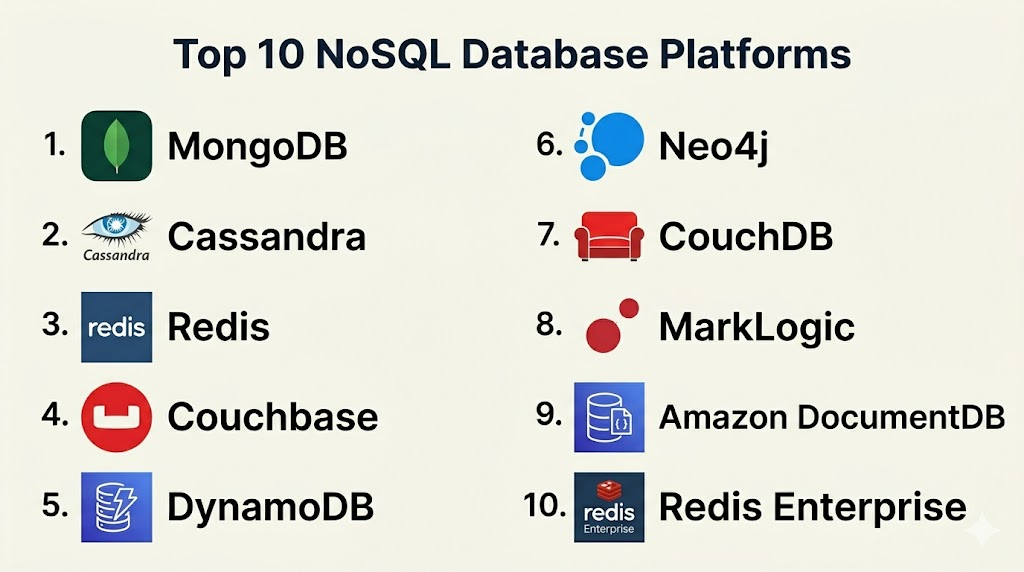
Top 10 NoSQL Database Platforms
#1 — MongoDB
Short description: MongoDB is a document-oriented NoSQL database storing data in JSON-like documents. Ideal for web, mobile, and cloud-native applications requiring flexibility and horizontal scalability.
Key Features
- Schema-less JSON document storage
- Horizontal scaling via sharding
- Aggregation framework for analytics
- Indexing and full-text search
- Replication and high availability
- Cloud and container deployment support
Pros
- Flexible schema for rapid development
- Broad adoption and strong community
Cons
- Complex joins require application logic
- Write-heavy workloads need careful optimization
Platforms / Deployment
- Windows / Linux / macOS
- Cloud / Self-hosted / Hybrid
Security & Compliance
- TLS encryption, RBAC, auditing
- SOC 2, ISO 27001, GDPR, HIPAA
Integrations & Ecosystem
- AWS, Azure, GCP
- Analytics, ETL, DevOps pipelines
- Multiple language drivers
Support & Community
Enterprise support, extensive documentation, active forums
#2 — Cassandra
Short description: Apache Cassandra is a wide-column NoSQL database built for distributed, high-availability, and massive datasets. Suitable for high-scale transactional and analytical workloads.
Key Features
- Peer-to-peer architecture
- Linear horizontal scaling
- Tunable consistency levels
- Multi-datacenter replication
- Wide-column storage model
Pros
- Handles large write-heavy workloads efficiently
- Highly fault-tolerant
Cons
- Steep learning curve
- Limited support for ad-hoc queries
Platforms / Deployment
- Windows / Linux / macOS
- Cloud / Self-hosted / Hybrid
Security & Compliance
- TLS encryption, RBAC, audit logging
- Not publicly stated
Integrations & Ecosystem
- Kafka, Spark, Hadoop
- Cloud provider integration
- Monitoring and management tools
Support & Community
Open-source community, enterprise support available
#3 — Redis
Short description: Redis is an in-memory key-value database providing ultra-low latency for caching, real-time analytics, and session management.
Key Features
- In-memory data structures (strings, lists, sets, hashes, streams)
- High availability with replication
- Pub/Sub messaging and data streaming
- Persistence options for durability
- Cluster support for horizontal scaling
Pros
- Extremely fast performance
- Supports real-time applications and caching
Cons
- Memory-intensive for large datasets
- Limited advanced query support
Platforms / Deployment
- Windows / Linux / macOS
- Cloud / Self-hosted / Hybrid
Security & Compliance
- TLS encryption, ACLs
- Not publicly stated
Integrations & Ecosystem
- Kafka, Elasticsearch, monitoring dashboards
- Cloud: AWS, Azure, GCP
- REST APIs for custom apps
Support & Community
Open-source community, commercial Redis Enterprise support
#4 — Couchbase
Short description: Couchbase is a distributed NoSQL database combining key-value and document models, optimized for low-latency interactive applications.
Key Features
- JSON document model with N1QL query language
- Memory-first architecture for low latency
- Cross-datacenter replication
- Integrated caching and full-text search
- Analytics and eventing framework
Pros
- Low-latency performance
- Multi-model flexibility
Cons
- Enterprise features require paid subscription
- Management complexity for large clusters
Platforms / Deployment
- Windows / Linux / macOS
- Cloud / Self-hosted / Hybrid
Security & Compliance
- TLS, RBAC, auditing
- SOC 2, ISO 27001
Integrations & Ecosystem
- Cloud platforms, analytics, DevOps pipelines
- BI tools, ETL integration
Support & Community
Enterprise support, professional services, active community
#5 — DynamoDB
Short description: AWS DynamoDB is a fully managed key-value and document database offering single-digit millisecond latency, ideal for cloud-native applications.
Key Features
- Serverless, fully managed service
- Auto-scaling throughput and storage
- Multi-region replication via Global Tables
- Streams for real-time data processing
- Integrated security and IAM controls
Pros
- Fully managed, minimal operations
- High scalability and availability
Cons
- AWS-exclusive
- Query flexibility is limited compared to SQL
Platforms / Deployment
- Cloud (AWS)
Security & Compliance
- Encryption at rest/in transit, IAM integration
- SOC 2, ISO 27001, GDPR, HIPAA
Integrations & Ecosystem
- AWS Lambda, Kinesis, CloudWatch
- BI and analytics platforms
Support & Community
AWS support tiers, active documentation, community
#6 — Neo4j
Short description: Neo4j is a graph database designed to store and analyze relationships between data points, ideal for social networks, recommendation engines, and fraud detection.
Key Features
- Graph data model and ACID transactions
- Cypher query language for complex relationships
- High-performance graph traversal
- Clustered deployment for high availability
- Integration with analytics pipelines
Pros
- Excellent for relationship-heavy datasets
- Real-time graph analytics
Cons
- Not ideal for key-value workloads
- Enterprise features require licensing
Platforms / Deployment
- Windows / Linux / macOS
- Cloud / Self-hosted / Hybrid
Security & Compliance
- TLS, RBAC, audit logging
- SOC 2, ISO 27001
Integrations & Ecosystem
- BI and analytics tools
- ETL pipelines, cloud integration
Support & Community
Enterprise support, documentation, active community
#7 — CouchDB
Short description: CouchDB is an open-source document database with multi-master replication, built for offline-first applications.
Key Features
- JSON document storage
- Multi-master replication and conflict resolution
- RESTful HTTP API interface
- Offline-first synchronization
- Lightweight and portable
Pros
- Easy replication and offline support
- Open-source and lightweight
Cons
- Not suitable for complex query requirements
- Scaling can be limited
Platforms / Deployment
- Windows / Linux / macOS
- Cloud / Self-hosted / Hybrid
Security & Compliance
- TLS, authentication
- Not publicly stated
Integrations & Ecosystem
- REST API for web and mobile apps
Support & Community
Open-source community, vendor support optional
#8 — MarkLogic
Short description: MarkLogic is an enterprise document database with integrated search, analytics, and multi-model support. Suitable for content-heavy and highly secure applications.
Key Features
- Multi-model: document + semantic graph
- ACID transactions
- Integrated search and indexing
- High availability and clustering
- Security and compliance features
Pros
- Strong analytics and content management
- Enterprise-ready with robust security
Cons
- Expensive licensing
- Complexity in deployment
Platforms / Deployment
- Windows / Linux / macOS
- Cloud / Self-hosted / Hybrid
Security & Compliance
- Encryption, RBAC, auditing
- SOC 2, ISO 27001, GDPR, HIPAA
Integrations & Ecosystem
- Analytics, BI, ETL pipelines
- Cloud and enterprise integrations
Support & Community
Enterprise support, professional services
#9 — Amazon DocumentDB
Short description: Amazon DocumentDB is a fully managed MongoDB-compatible document database designed for cloud-native workloads.
Key Features
- Fully managed, serverless
- MongoDB-compatible API
- Multi-AZ replication
- Automated backups and patching
- High availability
Pros
- Fully managed service
- Scalable with minimal operations
Cons
- AWS-specific
- Some MongoDB features unsupported
Platforms / Deployment
- Cloud (AWS)
Security & Compliance
- Encryption, IAM integration
- SOC 2, ISO 27001, GDPR, HIPAA
Integrations & Ecosystem
- AWS Lambda, analytics, ETL pipelines
Support & Community
AWS support tiers, documentation, community
#10 — Redis Enterprise
Short description: Redis Enterprise is a managed in-memory database supporting key-value storage, caching, and real-time analytics for high-performance applications.
Key Features
- In-memory data structures
- Persistence options for durability
- Multi-region clustering and replication
- Streams and Pub/Sub support
- High availability and scaling
Pros
- Ultra-low latency
- Supports real-time applications
Cons
- Memory-intensive for large datasets
- Enterprise features require subscription
Platforms / Deployment
- Windows / Linux / macOS
- Cloud / Self-hosted / Hybrid
Security & Compliance
- TLS, RBAC, audit logs
- SOC 2, ISO 27001
Integrations & Ecosystem
- Cloud providers (AWS, Azure, GCP)
- Analytics, BI, DevOps pipelines
Support & Community
Enterprise support, open-source community
Comparison Table
| Tool Name | Best For | Platform(s) Supported | Deployment | Standout Feature | Public Rating |
|---|---|---|---|---|---|
| MongoDB | Web & mobile apps | Windows, Linux, macOS | Cloud / Self-hosted / Hybrid | Flexible JSON document model | N/A |
| Cassandra | Distributed workloads | Windows, Linux, macOS | Cloud / Self-hosted / Hybrid | Linear scalability & fault-tolerance | N/A |
| Redis | Real-time caching | Windows, Linux, macOS | Cloud / Self-hosted / Hybrid | In-memory ultra-low latency | N/A |
| Couchbase | Interactive web apps | Windows, Linux, macOS | Cloud / Self-hosted / Hybrid | Key-value + document model | N/A |
| DynamoDB | Cloud-native apps | Cloud (AWS) | Cloud | Serverless, auto-scaling | N/A |
| Neo4j | Graph analytics | Windows, Linux, macOS | Cloud / Self-hosted / Hybrid | Graph traversal & Cypher queries | N/A |
| CouchDB | Offline-first apps | Windows, Linux, macOS | Cloud / Self-hosted / Hybrid | Multi-master replication | N/A |
| MarkLogic | Enterprise content | Windows, Linux, macOS | Cloud / Self-hosted / Hybrid | Document + semantic search | N/A |
| DocumentDB | AWS cloud-native | Cloud (AWS) | Cloud | MongoDB-compatible | N/A |
| Redis Enterprise | Real-time analytics | Windows, Linux, macOS | Cloud / Self-hosted / Hybrid | Managed in-memory performance | N/A |
Evaluation & Scoring of NoSQL Database Platforms
| Tool Name | Core (25%) | Ease (15%) | Integrations (15%) | Security (10%) | Performance (10%) | Support (10%) | Value (15%) | Weighted Total (0–10) |
|---|---|---|---|---|---|---|---|---|
| MongoDB | 9 | 8 | 9 | 8 | 9 | 8 | 8 | 8.6 |
| Cassandra | 9 | 7 | 8 | 8 | 9 | 7 | 7 | 8.0 |
| Redis | 8 | 9 | 7 | 7 | 10 | 8 | 8 | 8.3 |
| Couchbase | 8 | 8 | 8 | 8 | 9 | 7 | 7 | 8.0 |
| DynamoDB | 9 | 8 | 9 | 9 | 9 | 8 | 7 | 8.5 |
| Neo4j | 9 | 7 | 8 | 8 | 8 | 7 | 7 | 7.9 |
| CouchDB | 7 | 9 | 7 | 7 | 7 | 7 | 8 | 7.6 |
| MarkLogic | 9 | 7 | 8 | 9 | 9 | 8 | 6 | 8.0 |
| DocumentDB | 8 | 8 | 8 | 8 | 8 | 8 | 7 | 7.9 |
| Redis Enterprise | 9 | 8 | 8 | 8 | 10 | 8 | 7 | 8.4 |
Which NoSQL Database Platforms Tool Is Right for You?
Solo / Freelancer
- MongoDB, CouchDB, or Redis are suitable for small teams and lightweight applications.
- Managed cloud options reduce operational overhead.
SMB
- Couchbase, DynamoDB, and MongoDB Atlas provide scalability and ease of use.
- Balance performance with operational simplicity and support costs.
Mid-Market
- Cassandra, MarkLogic, Neo4j for larger data sets and analytics-driven applications.
- Ideal for multi-region replication and complex data relationships.
Enterprise
- MongoDB Enterprise, Cassandra, MarkLogic, and Redis Enterprise offer multi-cloud support, high availability, and enterprise-grade security.
Budget vs Premium
- Open-source: MongoDB, CouchDB, Redis
- Premium: MarkLogic, Redis Enterprise, DynamoDB, Neo4j
Feature Depth vs Ease of Use
- Neo4j, Cassandra, MarkLogic offer deep functionality but require expertise
- MongoDB, Couchbase, DynamoDB are easier to deploy and manage
Integrations & Scalability
- Cloud-native services provide seamless integration with analytics, DevOps pipelines, and monitoring tools
- Cassandra and Redis Enterprise offer horizontal scaling for high-volume workloads
Security & Compliance Needs
- Enterprise editions of MongoDB, DynamoDB, MarkLogic, Redis Enterprise provide robust compliance, encryption, and access control features
Frequently Asked Questions (FAQs)
1. What is a NoSQL Database Platform?
A NoSQL database stores unstructured or semi-structured data using flexible schemas, supporting document, key-value, wide-column, or graph models for scalability and performance.
2. How does NoSQL differ from RDBMS?
NoSQL provides flexible schemas and horizontal scalability, whereas RDBMS uses fixed schemas, ACID transactions, and normalized relational structures.
3. Are NoSQL databases suitable for small projects?
Yes, MongoDB, CouchDB, and Redis are lightweight and easy to deploy, making them ideal for small applications and prototypes.
4. Do these databases support cloud deployment?
Yes, most NoSQL platforms like DynamoDB, DocumentDB, MongoDB Atlas, and Redis Enterprise are cloud-native with multi-region support.
5. Are NoSQL databases secure?
Enterprise editions include encryption, RBAC, audit logging, and compliance with SOC 2, ISO 27001, GDPR, and HIPAA.
6. Can NoSQL databases handle analytics?
Yes, many support real-time analytics, aggregation frameworks, and integration with BI tools.
7. Which workloads are best for graph databases?
Neo4j is optimized for social networks, recommendation engines, fraud detection, and relationship-intensive datasets.
8. Do NoSQL databases support ACID transactions?
Some, like MongoDB and MarkLogic, support ACID transactions; many prioritize availability and horizontal scalability.
9. How difficult is migration between NoSQL databases?
Migration complexity depends on data model compatibility, query language, and cloud provider differences.
10. How should I choose the right NoSQL database?
Evaluate your data type, scale, performance, cloud strategy, compliance requirements, and operational expertise. Pilot testing is recommended.
Conclusion
NoSQL Database Platforms provide the flexibility, scalability, and performance necessary for modern applications handling unstructured or semi-structured data. Open-source platforms like MongoDB, CouchDB, and Redis suit small teams or agile projects, while managed cloud solutions such as DynamoDB, DocumentDB, and MongoDB Atlas simplify operations. Enterprises managing large-scale, high-velocity, or relationship-heavy workloads benefit from Cassandra, Neo4j, MarkLogic, and Redis Enterprise. The best approach is to shortlist two or three platforms aligned with your data model, scale, integrations, and operational needs, run pilot deployments, and validate performance, scalability, and security before final adoption.

Find Trusted Cardiac Hospitals
Compare heart hospitals by city and services — all in one place.
Explore Hospitals
NoSQL database platforms are most valuable when they help organizations store, manage, and process large volumes of diverse and rapidly changing data with flexible data models. By providing document, key-value, wide-column, or graph-based storage, horizontal scalability, high availability, distributed architecture, flexible schemas, replication, real-time data access, and integration with cloud-native applications and analytics platforms, these databases enable organizations to handle variable workloads, scale applications efficiently, reduce schema constraints, improve availability, and support modern data-driven applications.