Introduction
Time Series Database Platforms (TSDBs) are specialized databases optimized for storing, querying, and analyzing data indexed by time. These databases excel at handling high-volume, high-velocity datasets such as IoT sensor readings, application logs, financial tick data, and telemetry metrics. Unlike relational or NoSQL databases, TSDBs are optimized for time-stamped data and enable efficient storage, aggregation, and real-time analytics over temporal datasets.
In TSDBs are increasingly critical as organizations adopt IoT, real-time monitoring, and AI-driven analytics. Use cases include predictive maintenance for industrial equipment, application performance monitoring, financial market analysis, energy consumption tracking, and observability for cloud infrastructure. Buyers should evaluate ingestion rate, query latency, storage efficiency, scalability, built-in analytics functions, integration with visualization and alerting tools, cloud compatibility, security, and total cost of ownership.
Best for: Data engineers, DevOps teams, IoT and telemetry teams, financial analysts, and organizations requiring real-time analytics.
Not ideal for: Static datasets with low frequency updates or applications without temporal analysis needs.
Key Trends in Time Series Database Platforms
- AI-assisted anomaly detection and predictive analytics
- Fully managed, cloud-native TSDB services
- Integration with monitoring, observability, and alerting tools
- Horizontal scalability and multi-region deployments
- Support for high-velocity streaming data ingestion
- Advanced compression and storage optimization
- Real-time aggregation and analytics functions
- Hybrid deployment with edge and cloud support
- Flexible pricing models: pay-as-you-go, subscription, and open-source options
- Enhanced security, encryption, and compliance
How We Selected These Tools
- Market adoption and mindshare among monitoring, IoT, and analytics users
- Feature completeness, including ingestion, query, analytics, and visualization
- Reliability and performance under high-volume time series data
- Security posture and compliance certifications
- Integration with AI, visualization, and observability platforms
- Fit across SMB, mid-market, and enterprise organizations
- Documentation quality, support tiers, and community engagement
- Total cost of ownership and pricing flexibility
- Ease of deployment, administration, and monitoring
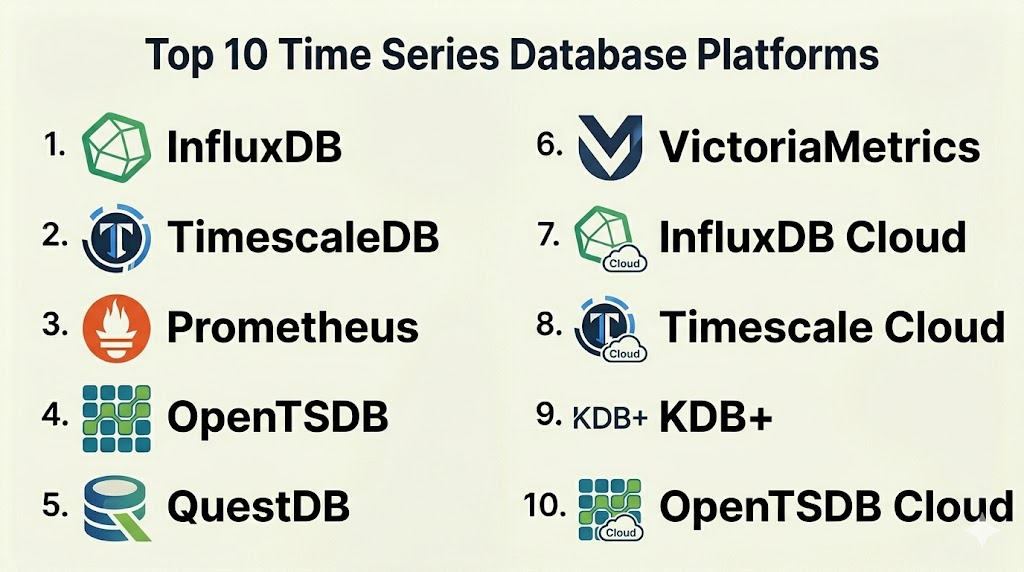
Top 10 Time Series Database Platforms
#1 — InfluxDB
Short description: InfluxDB is a high-performance time series database designed for real-time analytics, IoT, and monitoring workloads. Ideal for developers and DevOps teams.
Key Features
- High write and query throughput
- SQL-like InfluxQL and Flux query languages
- Data retention policies and compression
- Integrates with Grafana and Telegraf
- Cloud and self-hosted deployment
- Real-time alerting and analytics
Pros
- High-performance ingestion
- Mature ecosystem for observability and IoT
Cons
- Enterprise features require subscription
- Scaling large clusters may require tuning
Platforms / Deployment
- Linux / Windows / Cloud
- Cloud / Self-hosted / Hybrid
Security & Compliance
- TLS, RBAC, SSO/SAML
- SOC 2, GDPR
Integrations & Ecosystem
- Grafana, Telegraf, Kapacitor
- Python, Go, REST APIs
- Cloud monitoring and alerting
Support & Community
Enterprise support, documentation, active community
#2 — TimescaleDB
Short description: TimescaleDB is a PostgreSQL-based time series database combining relational capabilities with time-series optimizations for IoT, monitoring, and financial data.
Key Features
- Hypertables for time-partitioned data
- Full SQL support
- Continuous aggregates for real-time analytics
- Compression and retention policies
- Integration with PostgreSQL ecosystem
Pros
- Familiar SQL interface
- Strong analytics and relational support
Cons
- Write-heavy workloads may need tuning
- Some features require Timescale Enterprise edition
Platforms / Deployment
- Linux / macOS / Cloud
- Cloud / Self-hosted / Hybrid
Security & Compliance
- TLS, authentication, RBAC
- Not publicly stated
Integrations & Ecosystem
- Grafana, Python, Java, REST API
- PostgreSQL ecosystem tools
- Cloud services and DevOps pipelines
Support & Community
Open-source community, enterprise support available
#3 — Prometheus
Short description: Prometheus is an open-source monitoring and time series database widely used for metrics collection and alerting in cloud-native environments.
Key Features
- Pull-based metrics collection
- PromQL query language
- Multi-dimensional data model
- Alertmanager integration
- Kubernetes and container monitoring
Pros
- Ideal for observability and monitoring
- Open-source with large community
Cons
- Short-term storage focus
- Limited for high-volume historical analytics
Platforms / Deployment
- Linux / Cloud
- Self-hosted / Cloud
Security & Compliance
- TLS, authentication
- Not publicly stated
Integrations & Ecosystem
- Grafana, Alertmanager, Kubernetes
- REST API, client libraries
- Cloud observability tools
Support & Community
Large open-source community, active documentation
#4 — OpenTSDB
Short description: OpenTSDB is a scalable, distributed time series database built on top of HBase, suitable for large-scale metric storage and monitoring.
Key Features
- Scales horizontally on HBase
- High-volume metric ingestion
- Aggregation and downsampling
- REST API for ingestion and queries
- Integration with visualization tools
Pros
- Handles massive time series datasets
- Mature open-source solution
Cons
- Requires HBase setup
- Operational complexity for scaling
Platforms / Deployment
- Linux / Cloud
- Self-hosted / Hybrid
Security & Compliance
- TLS, authentication
- Not publicly stated
Integrations & Ecosystem
- Grafana, Kibana
- REST API, Java SDK
- ML/analytics pipelines
Support & Community
Open-source community, commercial support via partners
#5 — QuestDB
Short description: QuestDB is a high-performance open-source time series database optimized for financial, IoT, and streaming data.
Key Features
- SQL-based query engine
- Nanosecond precision timestamps
- Real-time ingestion and analytics
- Column-oriented storage and compression
- Web console and REST API
Pros
- High-performance and low-latency queries
- Easy-to-use SQL interface
Cons
- Smaller community than InfluxDB or Prometheus
- Enterprise features limited
Platforms / Deployment
- Linux / macOS / Cloud
- Cloud / Self-hosted / Hybrid
Security & Compliance
- TLS, authentication
- Not publicly stated
Integrations & Ecosystem
- Grafana, Python, REST API
- ML/analytics pipelines
- Cloud monitoring tools
Support & Community
Open-source community, documentation, optional enterprise support
#6 — VictoriaMetrics
Short description: VictoriaMetrics is a fast, cost-effective time series database for monitoring, alerting, and IoT applications with high ingestion rates.
Key Features
- High write throughput
- Compression and retention policies
- PromQL compatibility
- Clustering and multi-node support
- Integration with Grafana
Pros
- Lightweight and scalable
- Cost-effective for large datasets
Cons
- Limited enterprise features
- Smaller ecosystem
Platforms / Deployment
- Linux / Cloud
- Cloud / Self-hosted / Hybrid
Security & Compliance
- TLS, authentication
- Not publicly stated
Integrations & Ecosystem
- Grafana, Prometheus exporters
- REST API, Python SDK
- Cloud and DevOps tools
Support & Community
Open-source community, documentation
#7 — InfluxDB Cloud
Short description: InfluxDB Cloud is the managed version of InfluxDB, offering scalable, fully managed time series storage and real-time analytics.
Key Features
- Fully managed cloud service
- Auto-scaling and high availability
- Data retention policies and compression
- Integrations with Flux and InfluxQL
- Real-time dashboards and alerts
Pros
- Eliminates operational overhead
- Scalable for enterprise workloads
Cons
- Cloud-only
- Subscription-based pricing
Platforms / Deployment
- Cloud
- Managed service
Security & Compliance
- TLS, RBAC, audit logging
- SOC 2, GDPR
Integrations & Ecosystem
- Grafana, Telegraf, Python SDK
- REST API and ML integration
- Cloud observability pipelines
Support & Community
Enterprise support, documentation, active community
#8 — Timescale Cloud
Short description: Timescale Cloud is a managed TSDB built on TimescaleDB for SQL-based time series analytics with enterprise-grade capabilities.
Key Features
- Fully managed and scalable
- Continuous aggregates
- Compression and retention policies
- Integration with Grafana and BI tools
- SQL-based queries for easy adoption
Pros
- SQL interface simplifies adoption
- Fully managed and secure
Cons
- Cloud-only deployment
- Enterprise features require subscription
Platforms / Deployment
- Cloud
- Managed service
Security & Compliance
- TLS, authentication
- SOC 2, ISO 27001
Integrations & Ecosystem
- Grafana, Python, BI tools
- ML pipelines, REST API
- Cloud monitoring integration
Support & Community
Enterprise support, documentation, active community
#9 — KDB+
Short description: KDB+ is a high-performance columnar time series database widely used in finance for tick data and real-time analytics.
Key Features
- q query language for analytics
- High-speed ingestion and compression
- Real-time streaming and aggregation
- Time-partitioned storage
- Enterprise deployment support
Pros
- Extremely fast for financial tick data
- Mature and reliable for critical workloads
Cons
- Expensive licensing
- Steep learning curve for q language
Platforms / Deployment
- Linux / Cloud
- Cloud / Self-hosted / Hybrid
Security & Compliance
- TLS, authentication
- Not publicly stated
Integrations & Ecosystem
- Python, Java, REST API
- Analytics and ML integration
- Financial and observability tools
Support & Community
Enterprise support, documentation
#10 — OpenTSDB Cloud
Short description: OpenTSDB Cloud is a managed TSDB built on OpenTSDB/HBase, providing scalable time series analytics with minimal operational overhead.
Key Features
- Fully managed cluster
- High-volume metric ingestion
- Aggregation, downsampling, and retention policies
- REST API support
- Integration with Grafana
Pros
- Simplifies deployment and scaling
- Handles large time series datasets
Cons
- Limited to OpenTSDB features
- Self-hosted advanced customization may be needed
Platforms / Deployment
- Cloud
- Managed service
Security & Compliance
- TLS, authentication
- Not publicly stated
Integrations & Ecosystem
- Grafana, Python SDK
- ML pipelines, DevOps tools
- REST API
Support & Community
Managed support, documentation
Comparison Table
| Tool Name | Best For | Platform(s) Supported | Deployment | Standout Feature | Public Rating |
|---|---|---|---|---|---|
| InfluxDB | Real-time IoT & monitoring | Linux / Windows / Cloud | Cloud / Self-hosted / Hybrid | High-performance ingestion | N/A |
| TimescaleDB | SQL-based analytics | Linux / Cloud / macOS | Cloud / Self-hosted / Hybrid | Hypertables and continuous aggregates | N/A |
| Prometheus | Observability & metrics | Linux / Cloud | Self-hosted / Cloud | Real-time monitoring with PromQL | N/A |
| OpenTSDB | Large-scale metric storage | Linux / Cloud | Cloud / Self-hosted | Distributed HBase-based storage | N/A |
| QuestDB | Financial & IoT data | Linux / Cloud / macOS | Cloud / Self-hosted / Hybrid | Nanosecond precision & SQL interface | N/A |
| VictoriaMetrics | High-volume metrics | Linux / Cloud | Cloud / Self-hosted / Hybrid | Cost-effective scaling | N/A |
| InfluxDB Cloud | Enterprise IoT & monitoring | Cloud | Managed | Fully managed, scalable | N/A |
| Timescale Cloud | Enterprise SQL analytics | Cloud | Managed | Continuous aggregates | N/A |
| KDB+ | High-frequency financial data | Linux / Cloud | Cloud / Self-hosted / Hybrid | Columnar, ultra-fast analytics | N/A |
| OpenTSDB Cloud | Managed time series | Cloud | Managed | Scalable metrics ingestion | N/A |
Evaluation & Scoring of Time Series Database Platforms
| Tool Name | Core (25%) | Ease (15%) | Integrations (15%) | Security (10%) | Performance (10%) | Support (10%) | Value (15%) | Weighted Total |
|---|---|---|---|---|---|---|---|---|
| InfluxDB | 9 | 8 | 9 | 8 | 9 | 8 | 7 | 8.4 |
| TimescaleDB | 8 | 8 | 8 | 8 | 8 | 7 | 7 | 7.8 |
| Prometheus | 8 | 8 | 7 | 7 | 8 | 7 | 7 | 7.5 |
| OpenTSDB | 8 | 7 | 7 | 7 | 8 | 7 | 7 | 7.4 |
| QuestDB | 8 | 8 | 7 | 7 | 9 | 7 | 7 | 7.8 |
| VictoriaMetrics | 8 | 7 | 7 | 7 | 8 | 7 | 7 | 7.4 |
| InfluxDB Cloud | 9 | 8 | 8 | 9 | 9 | 8 | 7 | 8.4 |
| Timescale Cloud | 8 | 8 | 8 | 9 | 8 | 8 | 7 | 8.0 |
| KDB+ | 9 | 7 | 7 | 8 | 9 | 7 | 6 | 7.9 |
| OpenTSDB Cloud | 8 | 7 | 7 | 8 | 8 | 7 | 7 | 7.5 |
Interpretation: Higher scores indicate stronger overall capabilities for time series workloads. Comparative testing is recommended for specific workloads.
Which Time Series Database Platforms Tool Is Right for You?
Solo / Freelancer
- InfluxDB, QuestDB, or Prometheus are suitable for small-scale projects or experimentation.
SMB
- TimescaleDB, InfluxDB Cloud, or VictoriaMetrics offer scalability without heavy operational overhead.
Mid-Market
- InfluxDB Cloud, Timescale Cloud, OpenTSDB Cloud for high ingestion and real-time analytics.
Enterprise
- KDB+, InfluxDB Cloud, Timescale Cloud deliver enterprise-grade performance, security, and scalability.
Budget vs Premium
- Open-source: InfluxDB OSS, Prometheus, QuestDB
- Premium/managed: InfluxDB Cloud, Timescale Cloud, KDB+
Feature Depth vs Ease of Use
- KDB+ and OpenTSDB offer depth but require expertise
- InfluxDB Cloud and Timescale Cloud are easy to deploy and manage
Integrations & Scalability
- Managed cloud services integrate with ML pipelines, Grafana, alerting, and analytics
- Distributed TSDBs (OpenTSDB, VictoriaMetrics) scale horizontally
Security & Compliance Needs
- Enterprise-managed TSDBs provide TLS, RBAC, audit logging, and compliance certifications
- Open-source deployments require additional configuration for security
Frequently Asked Questions (FAQs)
1. What is a time series database?
A TSDB stores data indexed by timestamps, optimized for fast ingestion, queries, and analytics on temporal data.
2. How does a TSDB differ from a relational database?
TSDBs are optimized for high-velocity, time-stamped data and aggregations, unlike relational databases designed for structured transactional data.
3. Can TSDBs integrate with monitoring tools?
Yes, TSDBs often integrate with Grafana, Prometheus exporters, and cloud observability platforms.
4. Are managed TSDBs better for enterprises?
Managed services reduce operational overhead, provide auto-scaling, backups, and security features.
5. Which workloads are ideal for TSDBs?
IoT sensor data, financial tick data, application metrics, telemetry, and predictive analytics.
6. Can TSDBs handle high ingestion rates?
Yes, platforms like InfluxDB, VictoriaMetrics, and KDB+ handle millions of data points per second.
7. Are open-source TSDBs reliable?
Yes, with proper configuration, replication, and monitoring, they are production-ready.
8. Do TSDBs support real-time analytics?
Yes, many support continuous aggregates, queries, and streaming analytics.
9. How do I choose a TSDB?
Consider ingestion rate, query latency, data retention, integrations, and operational expertise.
10. Are TSDBs secure?
Managed and enterprise TSDBs provide TLS encryption, authentication, RBAC, and compliance with standards like SOC 2, ISO 27001, and GDPR.
Conclusion
Time Series Database Platforms are essential for organizations analyzing time-stamped data in real-time, such as IoT, telemetry, and financial applications. Open-source options like Prometheus, QuestDB, and VictoriaMetrics offer flexibility and cost-effectiveness, while managed solutions like InfluxDB Cloud, Timescale Cloud, and KDB+ provide enterprise-grade scalability, security, and operational simplicity. Choosing the right TSDB depends on data volume, query requirements, integrations, operational expertise, and security needs. Organizations should shortlist a few platforms, run pilot projects, and validate performance and scalability before full-scale adoption.

Find Trusted Cardiac Hospitals
Compare heart hospitals by city and services — all in one place.
Explore Hospitals
Time-series database platforms are most valuable when they help organizations efficiently store, query, analyze, and monitor data generated over time. By providing high-throughput ingestion, time-based data storage, optimized time-range queries, data retention policies, compression, aggregation, real-time monitoring, scalability, alerting, and integration with IoT, observability, analytics, and visualization platforms, these databases enable organizations to manage large volumes of time-stamped data, identify trends and anomalies, improve system monitoring, and support faster data-driven decisions.