Introduction
Web3 Node Infrastructure platforms provide the backend connectivity that decentralized applications need to communicate with blockchain networks. Instead of every developer running and maintaining their own blockchain nodes, these platforms offer hosted RPC endpoints, APIs, archive data access, WebSocket connections, indexing support, monitoring, and multi-chain connectivity. This matters now because Web3 applications are becoming more performance-sensitive, compliance-aware, and user-experience focused. Wallets, exchanges, NFT platforms, DeFi apps, gaming projects, analytics tools, and enterprise blockchain products all need reliable access to blockchain data without downtime or slow response times.
Real-world use cases include:
- dApp backend connectivity
- Wallet transaction broadcasting
- DeFi trading and liquidity applications
- NFT marketplace data access
- Blockchain analytics and monitoring
- Enterprise blockchain integrations
What buyers should evaluate:
- Supported blockchains and networks
- RPC speed and uptime
- Archive node access
- WebSocket and real-time event support
- API rate limits and pricing model
- Security controls and access management
- Developer documentation
- Monitoring and analytics
- Failover and region availability
- Support quality
Best for: Web3 Node Infrastructure platforms are best for blockchain developers, dApp teams, wallet companies, DeFi platforms, NFT marketplaces, gaming studios, fintech teams, data platforms, and enterprises building blockchain-connected applications.
Not ideal for: These platforms may not be necessary for hobby projects with very low traffic, teams that only need occasional blockchain lookups, or organizations that already operate their own full node infrastructure with strong DevOps capacity.
Key Trends in Web3 Node Infrastructure
- Multi-chain support is now expected: Developers increasingly want one provider that supports Ethereum, Polygon, Solana, Arbitrum, Optimism, Base, Avalanche, BNB Chain, and other major networks.
- Low-latency RPC is a product differentiator: Slow blockchain reads and failed transaction submissions can damage user experience, especially in DeFi, trading, and gaming apps.
- Archive data access is becoming more important: Analytics tools, auditors, tax tools, and historical transaction products need reliable access to older blockchain state.
- Decentralized RPC models are growing: Some teams prefer distributed node networks to reduce dependency on one centralized infrastructure provider.
- Developer tooling is expanding beyond basic nodes: Modern providers increasingly offer dashboards, enhanced APIs, transaction tools, NFT APIs, webhooks, alerts, and debugging features.
- Security controls are more important: API key management, allowlists, rate limits, team access controls, and monitoring are now standard evaluation criteria.
- Observability is becoming essential: Teams want usage analytics, latency metrics, error tracking, and real-time alerts to diagnose production issues quickly.
- Enterprise adoption is raising compliance expectations: Larger teams care about support contracts, SLAs, audit logs, regional infrastructure, and procurement-friendly documentation.
- Pricing transparency matters more: Request-based, compute-unit-based, and endpoint-based pricing models can create very different monthly costs.
- AI-assisted developer workflows are emerging: AI can help developers debug RPC issues, analyze transaction errors, generate queries, and improve blockchain data workflows, but core infrastructure reliability remains the priority.
How We Selected These Tools
The Top 10 Web3 Node Infrastructure tools were selected using a practical SaaS and developer infrastructure evaluation model:
- Market adoption and developer mindshare across Web3, DeFi, NFT, wallet, and blockchain analytics communities
- Feature completeness, including RPC access, archive nodes, WebSockets, APIs, analytics, and dashboards
- Multi-chain coverage across major EVM and non-EVM blockchain ecosystems
- Performance and reliability signals, including uptime positioning, global infrastructure, and production use cases
- Developer experience, including documentation, SDKs, dashboards, and onboarding simplicity
- Security posture signals, such as API key controls, access restrictions, monitoring, and enterprise support options
- Integration ecosystem, including compatibility with wallets, frameworks, data tools, and backend systems
- Customer fit across segments, from solo developers and startups to enterprise blockchain teams
- Pricing flexibility, including free tiers, usage-based plans, and enterprise options
- Long-term ecosystem relevance for modern Web3 application development
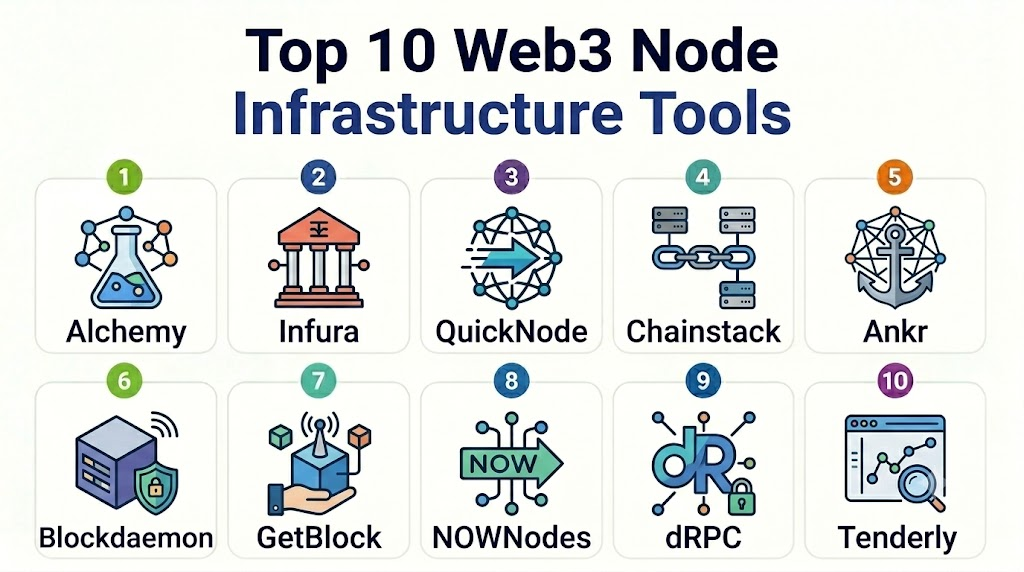
Top 10 Web3 Node Infrastructure Tools
1- Alchemy
Short description: Alchemy is a widely used Web3 developer platform that provides blockchain RPC infrastructure, APIs, monitoring, and developer tools. It is popular among dApp teams, NFT platforms, wallets, and enterprise Web3 builders.
Key Features
- Hosted RPC endpoints for major blockchain networks
- Enhanced APIs for NFTs, tokens, transactions, and blockchain data
- Developer dashboard with usage visibility
- Webhooks and notification capabilities
- Support for production dApps and high-volume projects
- Debugging and monitoring features
- Strong developer documentation and ecosystem presence
Pros
- Strong developer experience and onboarding flow
- Rich tooling beyond basic RPC endpoints
- Good fit for startups and production-scale dApps
Cons
- Advanced usage can become costly depending on traffic
- Some teams may prefer more decentralized infrastructure models
- Pricing and limits should be reviewed carefully before scaling
Platforms / Deployment
Web / Cloud
Security & Compliance
API key management, dashboard access controls, and infrastructure-level security features are commonly available. Specific enterprise compliance details should be verified during procurement.
Integrations & Ecosystem
Alchemy fits well into Web3 development stacks where teams need reliable node access plus developer tooling.
- Wallet applications
- NFT marketplaces
- DeFi applications
- Smart contract development workflows
- Backend services and analytics tools
- Webhooks and event-based systems
Support & Community
Alchemy has strong developer documentation, onboarding resources, and a large developer ecosystem. Support options may vary by plan and enterprise requirements.
2- Infura
Short description: Infura is a long-established blockchain infrastructure provider known for Ethereum and IPFS access. It is widely used by developers who need reliable hosted RPC endpoints and blockchain connectivity without running their own nodes.
Key Features
- Ethereum and EVM-compatible RPC access
- IPFS-related infrastructure capabilities
- WebSocket support for real-time blockchain updates
- Developer dashboard and API key management
- Support for wallets, dApps, and backend services
- Mature ecosystem recognition
- Useful for Ethereum-first application teams
Pros
- Strong reputation in Ethereum infrastructure
- Simple onboarding for developers
- Good fit for teams already building around Ethereum and MetaMask ecosystem patterns
Cons
- May not be the best fit for teams needing the broadest multi-chain coverage
- Usage limits and pricing should be reviewed carefully
- Some teams may want more advanced analytics or decentralized RPC options
Platforms / Deployment
Web / Cloud
Security & Compliance
API key controls and infrastructure security features are available. Specific compliance certifications and enterprise controls should be validated for the selected plan.
Integrations & Ecosystem
Infura is commonly used in Ethereum-based application stacks and wallet-connected workflows.
- Ethereum dApps
- Wallet integrations
- Smart contract applications
- IPFS-related workflows
- Backend blockchain services
- Developer frameworks and tools
Support & Community
Infura has mature documentation and strong recognition in the Ethereum developer ecosystem. Support options may vary by plan and business requirements.
3- QuickNode
Short description: QuickNode provides high-performance blockchain node infrastructure, RPC endpoints, analytics, add-ons, and multi-chain support. It is popular with teams that need speed, reliability, and production-ready Web3 infrastructure.
Key Features
- Fast RPC endpoints across multiple blockchain networks
- Multi-region infrastructure options
- WebSocket and archive node capabilities
- Add-on marketplace and developer tools
- Usage analytics and endpoint monitoring
- Multi-chain application support
- Enterprise-ready infrastructure options
Pros
- Strong performance-oriented positioning
- Broad multi-chain support
- Useful for production apps that need reliability and speed
Cons
- Advanced features may increase total cost
- Teams should understand pricing based on traffic and chain usage
- Some use cases may require configuration tuning
Platforms / Deployment
Web / Cloud
Security & Compliance
API key management, access controls, and infrastructure protection features are commonly available. Enterprise security and compliance details should be verified directly.
Integrations & Ecosystem
QuickNode integrates well with developer workflows where teams need fast blockchain data access and scalable RPC endpoints.
- DeFi apps
- Wallet platforms
- NFT marketplaces
- Web3 gaming apps
- Analytics products
- Multi-chain backend systems
Support & Community
QuickNode offers developer documentation, guides, dashboards, and support options. Enterprise teams should validate SLA, support response times, and account management availability.
4- Chainstack
Short description: Chainstack is a managed blockchain infrastructure platform that provides node deployment, RPC access, and multi-cloud blockchain connectivity. It is suitable for developers, enterprises, and teams that want managed infrastructure with flexibility.
Key Features
- Managed blockchain nodes
- Multi-cloud and multi-chain infrastructure
- RPC endpoints and archive node options
- Monitoring and infrastructure visibility
- Support for public and enterprise blockchain networks
- Flexible deployment options
- Useful for teams needing operational control with managed support
Pros
- Good balance of managed infrastructure and flexibility
- Strong fit for enterprise and serious production projects
- Supports multi-chain infrastructure planning
Cons
- May require more infrastructure understanding than simpler developer-first tools
- Pricing and deployment options should be reviewed carefully
- Some use cases may need technical configuration
Platforms / Deployment
Web / Cloud / Hybrid options may vary
Security & Compliance
Security controls vary by deployment and plan. Buyers should verify access controls, auditability, network security, data handling, and compliance requirements during evaluation.
Integrations & Ecosystem
Chainstack fits teams that need managed node access with more infrastructure flexibility.
- Enterprise blockchain systems
- DeFi applications
- Analytics platforms
- Multi-chain backend services
- Custom node deployments
- Blockchain data pipelines
Support & Community
Chainstack provides documentation and support resources. Enterprise teams should evaluate support tiers, deployment assistance, and operational guidance.
5- Ankr
Short description: Ankr provides Web3 infrastructure with RPC services, decentralized node access, staking-related services, and multi-chain support. It is useful for teams looking for broad blockchain access and decentralized infrastructure options.
Key Features
- Multi-chain RPC access
- Decentralized infrastructure positioning
- Support for multiple blockchain ecosystems
- Developer APIs and endpoint access
- Staking and validator-related services
- Useful for dApps, wallets, and Web3 platforms
- Options for scalable blockchain connectivity
Pros
- Broad ecosystem coverage
- Useful for teams interested in decentralized infrastructure models
- Offers more than basic RPC services
Cons
- Buyers should carefully validate performance by chain and region
- Some services may be more relevant to Web3-native teams than enterprises
- Pricing and feature packaging should be reviewed before scaling
Platforms / Deployment
Web / Cloud / Decentralized infrastructure model
Security & Compliance
Security details vary by service. Buyers should validate API protections, access control, infrastructure security, and compliance needs for their specific use case.
Integrations & Ecosystem
Ankr is often used by dApps and Web3 services needing multi-chain RPC and infrastructure access.
- Multi-chain dApps
- Wallets
- Staking-related workflows
- Web3 platforms
- Blockchain data services
- Developer backend systems
Support & Community
Ankr has strong Web3 ecosystem visibility and developer resources. Support levels may vary by product and plan.
6- Blockdaemon
Short description: Blockdaemon is an enterprise-focused blockchain infrastructure provider offering node operations, staking infrastructure, APIs, and institutional-grade blockchain services. It is suitable for businesses that need operationally mature blockchain infrastructure.
Key Features
- Enterprise blockchain node infrastructure
- Validator and staking infrastructure
- API access for blockchain data and operations
- Support for institutional and enterprise use cases
- Multi-chain infrastructure coverage
- Operational monitoring and managed services
- Strong fit for regulated or high-value blockchain operations
Pros
- Enterprise and institutional positioning
- Useful for teams needing managed node operations
- Strong fit for infrastructure-heavy blockchain businesses
Cons
- May be more than smaller developer teams need
- Pricing and procurement may be more enterprise-oriented
- Setup may require deeper technical and commercial evaluation
Platforms / Deployment
Web / Cloud / Managed infrastructure / Hybrid options may vary
Security & Compliance
Security and compliance details should be verified based on service scope. Enterprise buyers should review access controls, auditability, custody-related boundaries, key management, and support commitments.
Integrations & Ecosystem
Blockdaemon works well for organizations that need blockchain infrastructure as part of institutional operations.
- Node operations
- Validator infrastructure
- Staking workflows
- Enterprise blockchain products
- Institutional Web3 services
- API-driven blockchain operations
Support & Community
Blockdaemon is more enterprise-focused, so support is often aligned with business accounts and managed infrastructure needs. Buyers should validate SLA and dedicated support options.
7- GetBlock
Short description: GetBlock provides blockchain node access and RPC endpoints for multiple networks. It is useful for developers and businesses that need straightforward API access to blockchain nodes without managing infrastructure.
Key Features
- RPC access across multiple blockchain networks
- Shared and dedicated node options
- API endpoints for blockchain applications
- WebSocket support on supported networks
- Archive node access may be available depending on chain and plan
- Suitable for wallets, dApps, and data services
- Developer-friendly access model
Pros
- Simple approach to blockchain node connectivity
- Useful for teams needing quick RPC access
- Supports a range of blockchain networks
Cons
- Enterprise features may need plan-level verification
- Performance should be tested for target chains and regions
- Documentation and support depth should be reviewed for complex use cases
Platforms / Deployment
Web / Cloud
Security & Compliance
Not publicly stated for all enterprise compliance frameworks. Buyers should validate API security, access controls, data handling, and compliance posture before production use.
Integrations & Ecosystem
GetBlock is suitable for teams that need blockchain RPC endpoints for apps, analytics, or backend services.
- Wallet applications
- dApps
- Blockchain explorers
- Analytics platforms
- Backend data services
- Multi-chain products
Support & Community
GetBlock provides documentation and support channels. Support quality and response time should be tested during trial or pilot phases.
8- NOWNodes
Short description: NOWNodes provides access to blockchain nodes and explorers through API endpoints. It is useful for products that need broad blockchain connectivity, especially teams looking for straightforward node access across multiple networks.
Key Features
- Blockchain node API access
- Multi-chain support
- Explorer and blockchain data access options
- RPC endpoint connectivity
- Useful for wallets, exchanges, and analytics services
- Supports quick infrastructure onboarding
- Suitable for teams avoiding self-hosted node maintenance
Pros
- Broad blockchain access positioning
- Simple API-based infrastructure model
- Useful for products needing multiple chain connections
Cons
- Buyers should validate latency and reliability for their target networks
- Advanced developer tooling may be less extensive than some larger platforms
- Compliance and enterprise features should be checked directly
Platforms / Deployment
Web / Cloud
Security & Compliance
Not publicly stated for all compliance areas. Buyers should verify authentication, access controls, data handling, and enterprise security requirements.
Integrations & Ecosystem
NOWNodes fits products that need API access to many blockchain networks without running independent nodes.
- Crypto wallets
- Exchange platforms
- Blockchain analytics
- Portfolio tools
- Explorer-style applications
- Multi-chain backend services
Support & Community
Support and documentation are available, but buyers should test support responsiveness and integration guidance before production adoption.
9- dRPC
Short description: dRPC is a decentralized RPC infrastructure provider focused on reliable blockchain access through distributed node networks. It is suitable for teams that want alternatives to centralized RPC dependency.
Key Features
- Decentralized RPC infrastructure
- Multi-chain blockchain access
- Distributed node network model
- API endpoint access for dApps
- Useful for reliability and provider diversity
- Supports Web3 production workflows
- Helps reduce dependency on a single centralized provider
Pros
- Good fit for teams prioritizing decentralization
- Useful as primary or backup RPC infrastructure
- Can improve provider diversity in Web3 stacks
Cons
- Teams should test latency and consistency by chain and region
- Enterprise procurement details should be validated
- May require comparison against centralized providers for performance-critical apps
Platforms / Deployment
Web / Cloud / Decentralized infrastructure model
Security & Compliance
Not publicly stated for all enterprise compliance frameworks. Buyers should verify API security, network design, access control, monitoring, and compliance posture.
Integrations & Ecosystem
dRPC works well for dApps and Web3 platforms that want distributed blockchain access.
- Decentralized applications
- Wallet backends
- DeFi platforms
- Multi-chain infrastructure
- Backup RPC strategies
- Web3 data services
Support & Community
Support resources vary by plan and use case. Technical teams should test documentation, monitoring, and support before relying on it for critical workloads.
10- Tenderly
Short description: Tenderly is a Web3 development and observability platform known for smart contract monitoring, simulation, debugging, alerts, and transaction analysis. While not only a node provider, it is highly relevant for teams that need infrastructure visibility around blockchain operations.
Key Features
- Smart contract monitoring
- Transaction simulation and debugging
- Alerts and observability workflows
- Developer dashboards for blockchain applications
- Useful for production incident response
- Supports smart contract development and testing
- Helps teams understand transaction behavior before and after deployment
Pros
- Excellent fit for debugging and monitoring smart contract systems
- Useful for production Web3 operations
- Strong value beyond basic RPC access
Cons
- Not a pure RPC provider in the same way as Alchemy or Infura
- Teams may still need another node infrastructure provider
- Best value appears when paired with serious smart contract operations
Platforms / Deployment
Web / Cloud
Security & Compliance
Security and compliance details should be verified based on plan and deployment needs. Buyers should review team access controls, project permissions, and data handling.
Integrations & Ecosystem
Tenderly fits into Web3 engineering workflows where developers need debugging, simulations, monitoring, and alerts.
- Smart contract development
- Production monitoring
- Transaction simulation
- Incident response workflows
- DeFi application operations
- Developer collaboration workflows
Support & Community
Tenderly has strong developer-focused documentation and community recognition. Support options may vary by plan and enterprise needs.
Comparison Table
| Tool Name | Best For | Platform Supported | Deployment | Standout Feature | Public Rating |
|---|---|---|---|---|---|
| Alchemy | Developer-first Web3 apps | Web / API | Cloud | Enhanced APIs and developer tooling | N/A |
| Infura | Ethereum-first infrastructure | Web / API | Cloud | Mature Ethereum RPC access | N/A |
| QuickNode | High-performance multi-chain RPC | Web / API | Cloud | Fast RPC and add-on ecosystem | N/A |
| Chainstack | Managed node infrastructure | Web / API | Cloud / Hybrid varies | Flexible managed node deployment | N/A |
| Ankr | Multi-chain and decentralized infrastructure | Web / API | Cloud / Decentralized | Broad multi-chain RPC access | N/A |
| Blockdaemon | Enterprise blockchain operations | Web / API | Cloud / Managed | Institutional node and staking infrastructure | N/A |
| GetBlock | Straightforward node API access | Web / API | Cloud | Shared and dedicated node options | N/A |
| NOWNodes | Broad blockchain API access | Web / API | Cloud | Multi-chain node and explorer APIs | N/A |
| dRPC | Decentralized RPC access | Web / API | Decentralized / Cloud | Distributed RPC network model | N/A |
| Tenderly | Smart contract monitoring and debugging | Web / API | Cloud | Simulation and observability tools | N/A |
Evaluation and Scoring of Web3 Node Infrastructure
| Tool Name | Core 25% | Ease 15% | Integrations 15% | Security 10% | Performance 10% | Support 10% | Value 15% | Weighted Total 0-10 |
|---|---|---|---|---|---|---|---|---|
| Alchemy | 9 | 9 | 9 | 8 | 8 | 8 | 8 | 8.50 |
| Infura | 8 | 8 | 8 | 8 | 8 | 8 | 8 | 8.00 |
| QuickNode | 9 | 8 | 9 | 8 | 9 | 8 | 8 | 8.45 |
| Chainstack | 8 | 7 | 8 | 8 | 8 | 8 | 8 | 7.85 |
| Ankr | 8 | 8 | 8 | 7 | 8 | 7 | 8 | 7.80 |
| Blockdaemon | 9 | 7 | 8 | 9 | 8 | 9 | 7 | 8.10 |
| GetBlock | 7 | 8 | 7 | 7 | 7 | 7 | 8 | 7.30 |
| NOWNodes | 7 | 8 | 7 | 7 | 7 | 7 | 8 | 7.30 |
| dRPC | 8 | 7 | 7 | 7 | 8 | 7 | 8 | 7.50 |
| Tenderly | 8 | 8 | 8 | 8 | 8 | 8 | 8 | 8.00 |
Which Web3 Node Infrastructure Tool Is Right for You?
Solo / Freelancer
Solo developers should look for easy onboarding, free tiers, good documentation, and low configuration complexity. Alchemy, Infura, QuickNode, GetBlock, and NOWNodes are practical options for testing ideas, building prototypes, and launching early dApps.
For smart contract debugging or transaction simulation, Tenderly can be especially useful alongside an RPC provider.
SMB
Small and growing Web3 teams should prioritize reliability, predictable pricing, dashboards, and support. Alchemy, QuickNode, Chainstack, and Ankr are strong options depending on the required chains and traffic levels.
SMBs should avoid choosing purely on free-tier limits. The better approach is to estimate expected request volume, WebSocket usage, archive needs, and transaction broadcasting patterns.
Mid-Market
Mid-market teams often need better observability, multiple environments, dedicated endpoints, support SLAs, and chain-specific reliability. QuickNode, Alchemy, Chainstack, Blockdaemon, and Tenderly are strong candidates.
For higher resilience, mid-market teams may use one primary provider and one backup provider to reduce dependency risk.
Enterprise
Enterprises should evaluate Blockdaemon, Chainstack, Alchemy, QuickNode, and Infura based on security, procurement, support, uptime needs, and infrastructure governance. Enterprise teams should validate compliance documentation, access controls, SLAs, support response, and integration with internal monitoring.
If the business runs validator operations, staking infrastructure, or institutional blockchain services, Blockdaemon may be especially relevant.
Budget vs Premium
Budget-focused teams can begin with providers offering free or usage-based plans, but they should watch request limits and overage costs. GetBlock, NOWNodes, Ankr, and entry-level plans from larger providers may work well for early-stage projects.
Premium teams should evaluate advanced features like dedicated endpoints, archive access, enhanced APIs, monitoring, SLAs, and private infrastructure options.
Feature Depth vs Ease of Use
For the easiest developer experience, Alchemy, QuickNode, and Infura are strong options. For broader infrastructure control, Chainstack and Blockdaemon may be more suitable.
For smart contract operations, Tenderly adds debugging and observability depth that basic RPC tools may not provide.
Integrations and Scalability
Scalable Web3 products should look for provider support across frameworks, wallets, analytics systems, data pipelines, monitoring tools, and backend services. Alchemy, QuickNode, Chainstack, and Blockdaemon are strong choices for teams planning long-term growth.
Teams should test real production-like workloads before committing to one provider.
Security and Compliance Needs
Security-focused teams should evaluate API key controls, IP allowlisting, access permissions, team management, audit logs, incident history, uptime commitments, and enterprise support. They should also design fallback infrastructure to avoid single-provider dependency.
For regulated or institutional projects, vendor due diligence should include compliance documentation, data handling practices, and operational resilience.
Frequently Asked Questions
1- What is Web3 Node Infrastructure?
Web3 Node Infrastructure gives applications access to blockchain networks through hosted nodes, RPC endpoints, APIs, WebSockets, and data services. It helps developers build blockchain apps without running their own nodes.
2- Why do developers use node infrastructure providers?
Developers use node providers to save time, reduce operational complexity, improve uptime, and access multiple blockchains quickly. Running full nodes internally can require significant DevOps work.
3- What is an RPC endpoint?
An RPC endpoint is a connection point that allows an application to send requests to a blockchain network. It is used for reading blockchain data, submitting transactions, and interacting with smart contracts.
4- Which Web3 Node Infrastructure provider is best?
There is no single best provider for every team. Alchemy, Infura, QuickNode, Chainstack, Ankr, and Blockdaemon are strong options depending on chain support, performance, pricing, and enterprise needs.
5- What is the difference between shared and dedicated nodes?
Shared nodes are used by multiple customers and are usually easier and cheaper to start with. Dedicated nodes provide more control, isolation, and predictable performance for serious production workloads.
6- Do Web3 node providers support multiple blockchains?
Yes, many providers support multiple networks, but coverage varies. Buyers should confirm support for their exact chains, testnets, archive data, WebSocket methods, and transaction needs.
7- What are archive nodes?
Archive nodes store historical blockchain state, allowing applications to query older data. They are useful for analytics, compliance, tax tools, historical balances, and advanced blockchain research.
8- Are decentralized RPC providers better?
Decentralized RPC providers can reduce reliance on one centralized infrastructure operator. However, teams should still test speed, reliability, chain coverage, support, and production readiness.
9- What common mistakes should teams avoid?
Common mistakes include ignoring rate limits, underestimating traffic growth, not testing failover, skipping archive requirements, choosing only by price, and failing to monitor RPC errors in production.
10- How should teams compare pricing?
Teams should compare request limits, compute units, archive access, WebSocket pricing, dedicated endpoint costs, overage charges, and support tiers. The cheapest plan may not be the best value at scale.
Conclusion
Web3 Node Infrastructure is a critical foundation for modern blockchain applications. The right provider helps teams connect to blockchain networks reliably, reduce DevOps workload, improve application speed, and scale across multiple chains. Alchemy, Infura, QuickNode, Chainstack, Ankr, Blockdaemon, GetBlock, NOWNodes, dRPC, and Tenderly each serve different needs, from developer-first RPC access to enterprise node operations and smart contract observability. The best choice depends on chain coverage, latency, archive access, pricing, support, security, and long-term scalability. A practical next step is to shortlist two or three providers, run production-like tests, compare request costs, validate failover options, and choose the platform that fits your application’s real usage pattern.

Find Trusted Cardiac Hospitals
Compare heart hospitals by city and services — all in one place.
Explore Hospitals
A key consideration beyond feature comparisons is operational resilience during network congestion and chain upgrades. Teams should also assess observability, failover mechanisms, and multi-region deployment support to avoid downtime and maintain consistent application performance.