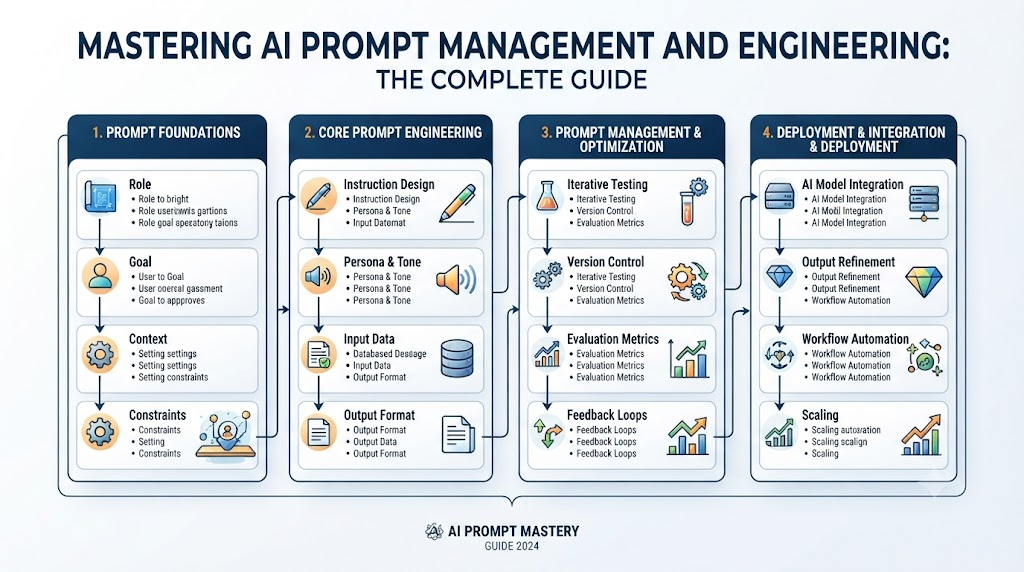
As artificial intelligence becomes deeply integrated into everyday workflows, the quality of your output relies entirely on the quality of your input. Whether you are generating marketing copy, writing code, or conducting academic research, interacting with large language models requires precision. However, many professionals struggle to keep track of their best instructions, often resorting to cluttered notes or scattered documents. This inefficiency highlights the growing need for a dedicated AI Promptosia management tool to streamline workflows, enhance consistency, and turn scattered text inputs into valuable digital assets.
What Is an AI Prompt Management Tool?
Definition
An AI prompt management tool is a centralized digital software platform designed to create, store, organize, edit, and deploy prompts used across various generative AI models. Instead of treating prompts as disposable chat inputs, these platforms treat them as reusable source code or structured assets.
Why Prompt Management Matters
Without a systematic approach to storing instructions, teams and individuals frequently rewrite successful commands from scratch. This leads to inconsistent outputs, wasted time, and lost knowledge. Effective management ensures that successful prompt patterns are preserved, shared, and continuously improved across projects.
Common Prompt Challenges
- Loss of successful prompts: Forgetting the exact phrasing that yielded exceptional AI results.
- Lack of collaboration: Inability for teams to share, review, and iterate on shared prompt libraries.
- Version chaos: Confusion over which prompt variation delivers the most accurate and reliable response.
Benefits of Organized Prompt Libraries
Utilizing a dedicated Prompt Library allows users to categorize instructions by project, tag them for rapid retrieval, and deploy them instantly. By establishing a structured workflow, organizations can scale their AI utilization efficiently while maintaining high standards of output quality.
Understanding Prompt Engineering
What Prompt Engineering Is
Prompt engineering is the practice of structuring text requests so that generative AI models understand context, constraints, and desired output formats clearly. According to documentation from leading AI providers like OpenAI documentation, crafting explicit instructions significantly minimizes hallucinations and irrelevant responses.
Prompt Components
A robust prompt typically contains several key structural elements:
- Context: Background information setting the stage for the AI.
- Instructions: Clear, direct commands outlining what the model must do.
- Variables: Dynamic placeholders (like
{{topic}}or{{audience}}) for reusable templates. - Output Formatting: Specifications for whether the response should be a table, bulleted list, or essay.
- Constraints: Clear boundaries on what the AI must not do.
To build structured instructions effectively, utilizing a dedicated prompt engineering platform helps developers and creators standardize their approach. Similar optimization principles are also detailed extensively in resources like Google AI documentation regarding model behavior tuning.
Building an Organized AI Prompt Library
Categories and Tags
Maintaining order within a large repository requires robust taxonomy. Grouping prompts by department—such as marketing, development, or legal—alongside granular tags ensures instantaneous retrieval.
Variables and Reusability
Building templates with dynamic variables transforms static text into flexible tools. Instead of rewriting a prompt for every new client, a user simply inputs variables into a standardized framework.
Search and Collections
An advanced AI prompt organizer enables users to filter through hundreds of variations using lightning-fast search tools, curating custom collections for specific tasks or team sprints.
AI Prompt Optimization
Improving Prompt Clarity
Ambiguity is the primary enemy of accurate AI generation. Optimization involves stripping away filler words, clarifying intent, and structuring commands logically.
Output Consistency and Role Definition
Assigning a specific persona—such as an expert copywriter or senior software architect—anchors the model’s tone. When paired with an AI prompt optimizer, users can automatically refine syntax for superior reliability. For technical syntax refinement, reference guidelines on Anthropic documentation regarding constitutional AI and prompt formatting.
AI Prompt Analysis
Prompt Structure and Goal Identification
Before deploying a prompt at scale, evaluating its structural integrity is vital. An AI prompt analyzer breaks down instructions to verify that goals align with expected model capabilities, ensuring safety and efficiency.
Prompt Quality Checking
Scoring Systems and Evaluation
A robust prompt quality checker evaluates clarity, contextual depth, and constraint safety, assigning a score that helps creators iteratively enhance their work before saving it to production libraries.
Version Control for AI Prompts
Why Version History Matters
Just like software code, prompts evolve through testing and refinement. A prompt version control tool tracks every iteration, allowing teams to roll back changes, compare output differences via Prompt Duels, and track collaborative improvements over time.
Testing AI Prompts
A/B Testing and Experiments
Deploying an AI prompt testing tool enables users to run parallel experiments against different model checkpoints, measuring output consistency and selecting the highest-performing variation.
Reusable AI Prompt Templates
By standardizing templates across writing, coding, marketing, and research, organizations ensure brand alignment and operational speed. Teams can also explore community-verified templates via Prompt Passports for instant inspiration.
Promptosia for Different User Types
Writers
Writers use structured templates to maintain consistent brand voice, generate outlines, and streamline editing workflows.
Developers
Developers manage system prompts, API instructions, and code generation templates with absolute version precision.
Marketers
Marketers rapidly deploy campaign copy frameworks, ad variations, and social media calendars using dynamic variables.
Students
Students organize research queries, study prompts, and summarization frameworks for academic success.
Researchers
Researchers maintain rigorous hypothesis-testing prompts and data extraction instructions for consistent scientific analysis.
Educators
Educators build lesson-planning templates, quiz generators, and interactive tutoring prompts for students.
Businesses
Enterprises secure internal AI knowledge bases, standardizing customer service and operational workflows.
Content Creators
Creators manage script outlines, video title generators, and brainstorming frameworks in one unified dashboard.
Agencies
Agencies collaborate across client accounts with shared prompt repositories and role-based permissions.
AI Professionals
AI engineers leverage advanced testing, analysis, and version tracking to optimize production-grade applications.
Best Practices for Prompt Management
- Save successful prompts immediately rather than letting them get lost in chat histories.
- Organize repositories by clear business or creative categories.
- Use descriptive titles that reflect the specific use case.
- Incorporate dynamic variables for maximum reusability.
- Test prompts regularly against model updates.
- Maintain comprehensive version history to track performance shifts.
- Document successful multi-step AI workflows for team alignment.
Common Prompt Engineering Mistakes
- Vague instructions: Expecting the AI to read your mind without specific constraints.
- Missing context: Omitting background data necessary for accurate generation.
- Overly long prompts: Combining too many unrelated tasks into a single command.
- Lack of testing: Assuming a prompt works universally without cross-model evaluation.
- No version tracking: Losing track of which prompt iteration produced the best results.
Feature Comparison
| Feature | Manual Prompt Storage | Promptosia |
| Organization | Basic folders or notes | Advanced tags, categories, and collections |
| Version Control | None (manual duplication) | Automated tracking and history via Version History |
| Search | Basic keyword lookup | Instant faceted search and filtering |
| Testing | Manual copy-pasting | Integrated testing and Prompt Duels |
| Quality Analysis | Subjective review | Automated analysis via Prompt Analyzer |
| Collaboration | Difficult or impossible | Seamless team sharing and community Passports |
The Future of Prompt Engineering
As generative models evolve, the industry is shifting toward prompt standardization, automated optimization, and collaborative asset management. Organizations that treat prompts as formal digital assets will achieve significantly higher productivity and reliability in their AI integrations.
How Promptosia Helps Users Build Better Prompts
Promptosia provides a comprehensive environment featuring a centralized Prompt Library, automated optimization tools, rigorous version control, and interactive community sharing via the About Page and Help Center. By bridging the gap between raw creativity and structured engineering, it empowers users to master their AI workflows.
Frequently Asked Questions (FAQ)
1.What is an AI prompt management tool?
An AI prompt management tool is a dedicated platform designed to store, organize, version, and share prompts. It helps individuals and teams move away from chaotic chat logs and build reusable libraries of high-performing AI instructions.
2.Why should I save AI prompts?
Saving prompts prevents you from losing successful instructions that produced exceptional results. It saves time, ensures output consistency, and allows you to build a personal or team asset library that grows more valuable over time.
3.What is prompt engineering?
Prompt engineering is the practice of structuring text commands so that generative AI models understand context, constraints, and formatting requirements clearly, resulting in much more accurate and reliable outputs.
4.How does prompt optimization work?
Prompt optimization involves refining syntax, removing ambiguity, adding precise role definitions, and structuring instructions logically to ensure the AI model delivers the exact response you need on the first try.
5.Why is prompt testing important?
Prompt testing is essential because AI models can behave differently across updates or parameters. Testing allows you to compare outputs, measure consistency, and ensure your instructions perform reliably under various conditions.
6.What is prompt version control?
Prompt version control tracks the evolution of your instructions over time. It allows you to view past iterations, compare changes side-by-side, and roll back updates if a newer variation underperforms.
7.How does an AI prompt analyzer help?
An AI prompt analyzer evaluates the structural integrity of your commands, identifying missing variables, potential safety considerations, and areas for clarity improvement before you deploy the prompt in production.
8.What makes a high-quality prompt?
A high-quality prompt features clear instructions, relevant context, well-defined variables, specific output formatting constraints, and an assigned persona that guides the AI’s tone and perspective accurately.
9.Can teams collaborate on prompt libraries?
Yes, modern platforms allow teams to share prompt repositories, review changes collaboratively, manage version histories, and standardize best practices across entire departments or creative agencies.
Conclusion
Mastering AI interaction is no longer just about writing a clever sentence; it requires structured organization, rigorous testing, and continuous optimization. By treating prompts as valuable digital assets, creators and developers can unlock unprecedented consistency and efficiency across all their AI workflows. Embracing systematic prompt management ensures that your generative AI tools work harder, smarter, and more reliably for every project you undertake.

Find Trusted Cardiac Hospitals
Compare heart hospitals by city and services — all in one place.
Explore Hospitals