Introduction
Crypto Custody Platforms help businesses securely store, manage, and control digital assets such as cryptocurrencies, tokenized assets, stablecoins, and blockchain-based financial instruments. Instead of relying on personal wallets or basic exchange storage, institutions use custody platforms to protect private keys, manage approvals, support governance, and reduce operational risk. Crypto custody matters because digital assets are now used by exchanges, asset managers, fintech companies, family offices, payment businesses, hedge funds, enterprises, and tokenization platforms. A strong custody platform helps protect funds, control transactions, manage compliance workflows, and support institutional-grade operations.
Common real-world use cases include:
- Secure storage of digital assets
- Institutional trading and settlement
- Treasury management for crypto businesses
- Tokenization and stablecoin operations
- Governance-based transaction approvals
- DeFi access with risk controls
Buyers should evaluate:
- Custody model
- Private key security
- MPC or multi-signature architecture
- Governance and approval workflows
- Supported assets and chains
- Insurance availability
- Regulatory posture
- APIs and integrations
- Reporting and audit controls
- Support and onboarding
Best for: Crypto Custody Platforms are best for institutional investors, crypto exchanges, Web3 companies, fintech teams, asset managers, banks, family offices, payment providers, and enterprises managing meaningful digital asset exposure.
Not ideal for: These platforms may not be necessary for casual retail users, very small crypto holders, or teams that only need a simple self-custody wallet. In those cases, hardware wallets or consumer wallets may be easier and more cost-effective.
Key Trends in Crypto Custody Platforms
- Institutional adoption is increasing: More banks, asset managers, fintechs, and enterprises are evaluating custody platforms as digital assets become part of broader financial infrastructure.
- MPC-based custody is becoming common: Multi-party computation helps reduce single private-key exposure by splitting signing responsibilities across secure environments.
- Governance is now as important as storage: Buyers want approval policies, transaction limits, role-based access, audit trails, and separation of duties.
- Tokenization is expanding custody requirements: Real-world assets, stablecoins, tokenized funds, and digital securities require custody systems that support more than basic crypto storage.
- Off-exchange settlement is gaining attention: Institutions want to reduce exchange counterparty risk while still accessing liquidity and trading venues.
- Insurance and regulatory posture matter more: Buyers increasingly ask about insurance, trust structures, licensing, compliance processes, and jurisdictional coverage.
- APIs are becoming central: Custody is no longer only a vault. Modern teams need APIs for treasury, payments, settlement, DeFi, reporting, and automation.
- DeFi access requires guardrails: Institutions want controlled access to decentralized finance while enforcing policies, risk checks, and approval rules.
- Operational resilience is a major evaluation factor: Uptime, incident response, disaster recovery, key recovery processes, and support quality are now critical.
- Custody platforms are becoming digital asset operating systems: Leading platforms now combine custody, governance, settlement, treasury, tokenization, reporting, and integration layers.
How We Selected These Tools
The tools in this list were selected using a practical SaaS and digital asset infrastructure evaluation model:
- Market adoption and institutional recognition
- Strength of custody and key-management architecture
- Support for institutional workflows
- Asset and blockchain coverage
- Governance and approval capabilities
- Security posture and operational controls
- Integration ecosystem and API maturity
- Support for trading, settlement, treasury, or tokenization workflows
- Fit across banks, fintechs, asset managers, exchanges, and Web3 companies
- Long-term relevance in digital asset custody infrastructure
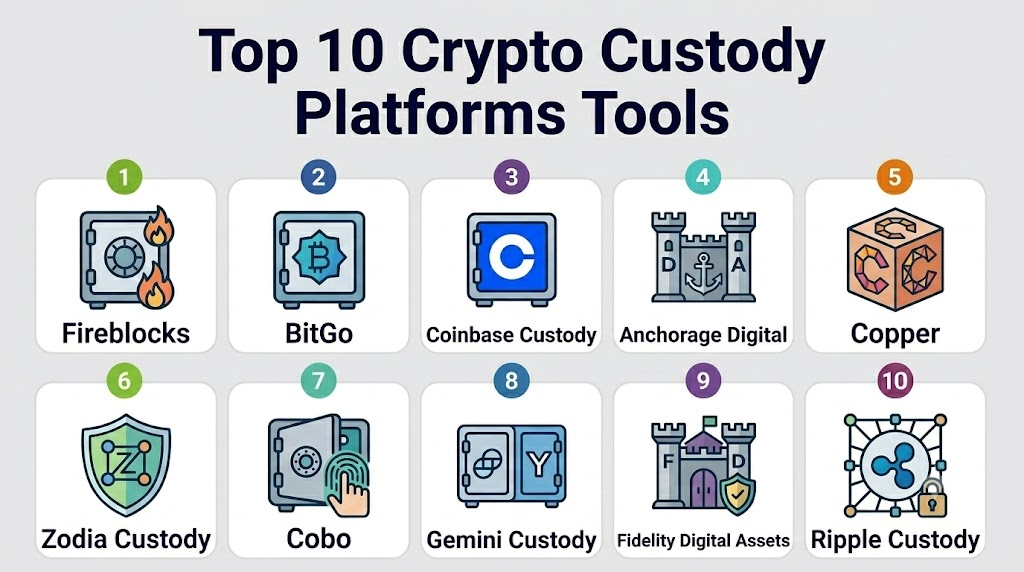
Top 10 Crypto Custody Platforms Tools
1- Fireblocks
Short description: Fireblocks is a digital asset infrastructure platform used by institutions for custody technology, treasury operations, settlement, tokenization, and secure asset movement. It is best suited for businesses that need more than storage and want operational workflows around digital assets.
Key Features
- MPC-based wallet infrastructure
- Policy-based transaction approvals
- Treasury and payment workflows
- Settlement and transfer controls
- API-driven digital asset operations
- DeFi and tokenization support
- Institutional governance features
Pros
- Strong fit for fintechs, exchanges, and Web3 businesses
- Advanced workflow and policy controls
- Broad ecosystem for asset movement and operations
Cons
- May be complex for smaller teams
- Pricing is typically enterprise-oriented
- Requires careful setup of governance policies
Platforms / Deployment
Web / Cloud / API-based infrastructure
Security & Compliance
Fireblocks is widely known for institutional MPC-based security and governance controls. Specific certifications, insurance terms, and compliance details should be verified during procurement.
Integrations & Ecosystem
Fireblocks is strong for organizations that need custody connected with operations, trading, settlement, and treasury workflows.
- Exchanges and liquidity venues
- Treasury systems
- Payment workflows
- DeFi access controls
- Tokenization platforms
- Developer APIs
Support & Community
Fireblocks provides enterprise-focused onboarding, documentation, and support options. Support quality may vary by plan and account level, so buyers should validate service-level expectations.
2- BitGo
Short description: BitGo is a major institutional digital asset custody and wallet infrastructure provider. It is commonly used by institutions that need regulated custody, wallet security, settlement support, and enterprise digital asset management.
Key Features
- Institutional custody services
- Multi-signature and wallet infrastructure
- Cold storage and hot wallet options
- Trading and settlement-related services
- Insurance availability may vary by arrangement
- Enterprise governance and controls
- Support for many digital assets
Pros
- Strong institutional custody reputation
- Useful for exchanges, funds, and digital asset businesses
- Good fit for regulated custody requirements
Cons
- May be more suitable for institutional clients than small teams
- Pricing and terms are usually not simple self-service
- Asset coverage and support terms should be verified
Platforms / Deployment
Web / Cloud / Managed custody
Security & Compliance
BitGo is known for institutional custody and security-focused infrastructure. Specific regulatory status, insurance coverage, audit controls, and compliance commitments should be validated directly for the buyer’s region and use case.
Integrations & Ecosystem
BitGo works well for companies that need secure custody connected with business operations.
- Exchange infrastructure
- Trading workflows
- Institutional wallets
- Settlement operations
- API-based custody workflows
- Reporting and account management
Support & Community
BitGo provides institutional support and documentation. Enterprise buyers should confirm account management, onboarding timelines, and support response expectations.
3- Coinbase Custody
Short description: Coinbase Custody is an institutional custody solution associated with Coinbase’s broader digital asset ecosystem. It is suitable for funds, institutions, and enterprises that want custody services connected with a recognized crypto infrastructure provider.
Key Features
- Institutional digital asset custody
- Cold storage-focused custody model
- Integration with Coinbase institutional ecosystem
- Support for major digital assets
- Reporting and account controls
- Institutional onboarding workflows
- Suitable for funds and asset managers
Pros
- Strong brand recognition in digital assets
- Useful for institutions seeking established custody infrastructure
- Good fit for investment and asset management use cases
Cons
- May be less flexible for teams needing highly customized infrastructure
- Region and asset support should be verified
- Pricing and service terms may be enterprise-driven
Platforms / Deployment
Web / Cloud / Managed custody
Security & Compliance
Security and compliance details should be reviewed during procurement. Buyers should verify custody structure, insurance, access controls, audit reporting, and regional regulatory coverage.
Integrations & Ecosystem
Coinbase Custody is valuable for institutions that want custody connected to a broader Coinbase institutional environment.
- Institutional trading workflows
- Asset management operations
- Reporting and account tools
- Digital asset investment workflows
- Coinbase ecosystem services
- Compliance-oriented custody processes
Support & Community
Coinbase provides institutional onboarding and support options. Buyers should validate support tier, account management, asset availability, and operational procedures.
4- Anchorage Digital
Short description: Anchorage Digital is an institutional crypto platform focused on custody, trading, staking, governance, and digital asset financial services. It is suitable for institutions requiring a regulated and security-focused digital asset partner.
Key Features
- Institutional crypto custody
- Trading and settlement support
- Governance and approval workflows
- Staking support for selected assets
- Institutional reporting
- Secure key management approach
- Support for digital asset financial operations
Pros
- Strong institutional positioning
- Useful for banks, funds, and regulated financial businesses
- Supports custody alongside broader digital asset services
Cons
- May be more enterprise-focused than startup-friendly
- Asset coverage and service availability should be confirmed
- Procurement and onboarding can require detailed review
Platforms / Deployment
Web / Cloud / Managed custody
Security & Compliance
Anchorage Digital is positioned for institutional custody and regulated digital asset services. Buyers should verify specific regulatory coverage, audit controls, insurance, and compliance commitments for their jurisdiction.
Integrations & Ecosystem
Anchorage Digital is useful for institutions that need custody connected with broader financial services.
- Institutional custody
- Trading workflows
- Staking operations
- Governance controls
- Asset management workflows
- Reporting and compliance operations
Support & Community
Support is institution-focused. Buyers should review onboarding support, relationship management, service levels, and operational escalation processes.
5- Copper
Short description: Copper is a digital asset custody and prime brokerage infrastructure platform known for institutional asset protection, settlement workflows, and trading connectivity. It is suitable for asset managers, hedge funds, and trading-focused institutions.
Key Features
- Institutional custody infrastructure
- Off-exchange settlement workflows
- Trading venue connectivity
- Asset movement governance
- Secure wallet and key management
- Institutional reporting
- Support for fund and trading operations
Pros
- Strong fit for trading and investment workflows
- Useful for reducing exchange counterparty exposure
- Designed for institutional digital asset operations
Cons
- May not be ideal for simple custody-only needs
- Pricing and access are usually institution-focused
- Supported services and regions should be verified
Platforms / Deployment
Web / Cloud / Managed custody
Security & Compliance
Copper is positioned around secure institutional custody and settlement. Buyers should verify specific certifications, insurance terms, access controls, and regulatory commitments during due diligence.
Integrations & Ecosystem
Copper is especially relevant for teams that need custody linked with trading workflows and settlement operations.
- Exchanges and trading venues
- Fund operations
- Settlement workflows
- Portfolio operations
- Treasury teams
- Institutional reporting
Support & Community
Copper offers institution-focused support and onboarding. Buyers should confirm service coverage, onboarding requirements, and support availability in their region.
6- Zodia Custody
Short description: Zodia Custody is an institutional digital asset custody provider backed by major financial industry experience. It is designed for institutions that need regulated, secure, and governance-driven custody for digital assets.
Key Features
- Institutional digital asset custody
- Secure asset storage
- Governance and operational controls
- Support for selected digital assets
- Institutional reporting
- Compliance-oriented workflows
- Focus on financial-sector custody needs
Pros
- Strong fit for institutions and regulated businesses
- Designed around custody governance and trust
- Useful for asset managers and financial firms
Cons
- May not suit small Web3 startups
- Asset availability may be more selective
- Buyers should validate regional service coverage
Platforms / Deployment
Web / Cloud / Managed custody
Security & Compliance
Zodia Custody is positioned as an institutional custody provider. Specific compliance certifications, insurance coverage, regulatory status, and audit controls should be confirmed during evaluation.
Integrations & Ecosystem
Zodia Custody can support institutional custody workflows where governance, reporting, and controlled asset access matter.
- Asset management workflows
- Institutional reporting
- Treasury operations
- Secure custody processes
- Compliance workflows
- Trading-related custody operations
Support & Community
Support is typically institution-oriented. Buyers should review onboarding process, support channels, service-level expectations, and asset support roadmap.
7- Cobo
Short description: Cobo is a digital asset custody and wallet infrastructure platform serving institutions, exchanges, Web3 businesses, and asset operators. It is suitable for teams that need custody, wallet operations, and digital asset management infrastructure.
Key Features
- Custody and wallet infrastructure
- MPC and wallet management capabilities
- Support for institutional digital asset operations
- API-based integration options
- Treasury and asset management workflows
- Multi-chain digital asset support
- Governance and operational controls
Pros
- Good fit for Web3 companies and digital asset operators
- Broad custody and wallet infrastructure positioning
- Useful for teams needing APIs and operational flexibility
Cons
- Enterprise security and compliance details should be verified
- Some features may require technical implementation
- Regional support and asset availability should be checked
Platforms / Deployment
Web / Cloud / API-based infrastructure
Security & Compliance
Cobo is known for institutional custody and wallet infrastructure. Buyers should validate certifications, access controls, key management, insurance, and compliance posture based on their region and use case.
Integrations & Ecosystem
Cobo fits teams needing custody and wallet infrastructure connected to operational workflows.
- Exchange wallets
- Web3 platforms
- Treasury systems
- Custody operations
- API-based asset management
- Multi-chain applications
Support & Community
Cobo provides documentation and business support options. Buyers should confirm onboarding assistance, API support, and enterprise service levels.
8- Gemini Custody
Short description: Gemini Custody provides institutional digital asset custody services connected with Gemini’s broader crypto platform. It is suitable for institutions looking for secure storage, account management, and custody support from a recognized crypto company.
Key Features
- Institutional custody services
- Cold storage options
- Account management workflows
- Support for selected digital assets
- Reporting capabilities
- Integration with broader Gemini services
- Custody-focused operational controls
Pros
- Recognized crypto platform brand
- Useful for institutions seeking custody and account support
- Good fit for secure storage use cases
Cons
- Asset and regional availability should be verified
- May be less flexible than custody infrastructure APIs
- Enterprise requirements should be reviewed carefully
Platforms / Deployment
Web / Cloud / Managed custody
Security & Compliance
Gemini Custody is positioned for institutional digital asset custody. Buyers should verify specific insurance coverage, compliance certifications, regulatory status, audit controls, and access policies.
Integrations & Ecosystem
Gemini Custody is useful for organizations that want custody services linked with Gemini’s broader digital asset environment.
- Institutional accounts
- Secure asset storage
- Reporting workflows
- Trading-related operations
- Compliance-oriented processes
- Digital asset account management
Support & Community
Support depends on institutional account type and service level. Buyers should confirm onboarding support, operational hours, and escalation procedures.
9- Fidelity Digital Assets
Short description: Fidelity Digital Assets provides institutional digital asset custody and trading services backed by a large traditional financial services organization. It is well suited for institutions that value established financial-market experience and custody discipline.
Key Features
- Institutional digital asset custody
- Trading support for selected assets
- Strong financial-services orientation
- Secure storage operations
- Institutional reporting
- Client servicing model
- Suitable for asset managers and financial institutions
Pros
- Strong traditional finance credibility
- Good fit for institutional investors
- Useful for organizations needing custody with financial-market discipline
Cons
- Asset support may be selective
- May not fit Web3-native teams needing broad multi-chain APIs
- Pricing and access are typically institution-oriented
Platforms / Deployment
Web / Cloud / Managed custody
Security & Compliance
Fidelity Digital Assets is positioned for institutional custody and financial services. Buyers should verify current regulatory status, controls, insurance, audit reporting, and service coverage.
Integrations & Ecosystem
Fidelity Digital Assets is most relevant for financial institutions and investment firms seeking custody and trading support.
- Institutional custody
- Asset management workflows
- Trading operations
- Investor reporting
- Financial services processes
- Compliance and governance workflows
Support & Community
Support is institution-focused and generally aligned with professional financial services. Buyers should validate onboarding, relationship management, and service-level details.
10- Ripple Custody
Short description: Ripple Custody provides digital asset custody infrastructure for banks, fintechs, and enterprises. It is suitable for organizations that need custody capabilities connected with tokenization, settlement, and institutional digital asset workflows.
Key Features
- Digital asset custody infrastructure
- Enterprise-grade wallet and asset management capabilities
- Support for tokenization workflows
- Policy and governance controls
- API-based integration options
- Suitable for banks and fintechs
- Digital asset operations support
Pros
- Strong fit for enterprise and fintech use cases
- Useful for tokenization and digital asset infrastructure strategies
- Can support regulated business workflows
Cons
- Buyers should validate exact asset support and regional availability
- May be less relevant for casual custody use cases
- Enterprise implementation can require planning
Platforms / Deployment
Web / Cloud / Enterprise custody infrastructure
Security & Compliance
Security and compliance details should be verified during procurement. Buyers should review access control, key management, audit logs, insurance availability, and regulatory alignment.
Integrations & Ecosystem
Ripple Custody is useful where custody must connect with enterprise digital asset products and tokenization workflows.
- Banking digital asset systems
- Fintech platforms
- Tokenization workflows
- Treasury operations
- Enterprise APIs
- Institutional asset management
Support & Community
Support is enterprise-oriented. Buyers should confirm implementation support, integration resources, account management, and service commitments.
Comparison Table
| Tool Name | Best For | Platform Supported | Deployment | Standout Feature | Public Rating |
|---|---|---|---|---|---|
| Fireblocks | Treasury, custody, and digital asset operations | Web / API | Cloud | MPC and policy-based operations | N/A |
| BitGo | Institutional custody and wallets | Web / API | Managed custody | Institutional custody infrastructure | N/A |
| Coinbase Custody | Funds and institutions | Web | Managed custody | Coinbase institutional ecosystem | N/A |
| Anchorage Digital | Regulated institutional digital asset services | Web | Managed custody | Custody plus trading and staking workflows | N/A |
| Copper | Trading-focused institutions | Web | Managed custody | Off-exchange settlement workflows | N/A |
| Zodia Custody | Financial institutions and asset managers | Web | Managed custody | Institution-focused custody governance | N/A |
| Cobo | Web3 companies and asset operators | Web / API | Cloud | Custody and wallet infrastructure | N/A |
| Gemini Custody | Secure institutional asset storage | Web | Managed custody | Gemini-connected custody services | N/A |
| Fidelity Digital Assets | Traditional financial institutions | Web | Managed custody | Financial-services custody discipline | N/A |
| Ripple Custody | Banks, fintechs, and tokenization teams | Web / API | Cloud | Enterprise custody infrastructure | N/A |
Evaluation and Scoring of Crypto Custody Platforms
| Tool Name | Core 25% | Ease 15% | Integrations 15% | Security 10% | Performance 10% | Support 10% | Value 15% | Weighted Total 0-10 |
|---|---|---|---|---|---|---|---|---|
| Fireblocks | 9 | 8 | 9 | 9 | 9 | 8 | 8 | 8.60 |
| BitGo | 9 | 8 | 8 | 9 | 8 | 8 | 8 | 8.35 |
| Coinbase Custody | 8 | 8 | 8 | 9 | 8 | 8 | 8 | 8.15 |
| Anchorage Digital | 9 | 7 | 8 | 9 | 8 | 8 | 7 | 8.10 |
| Copper | 8 | 7 | 8 | 8 | 8 | 8 | 7 | 7.75 |
| Zodia Custody | 8 | 7 | 7 | 9 | 8 | 8 | 7 | 7.75 |
| Cobo | 8 | 8 | 8 | 8 | 8 | 7 | 8 | 7.95 |
| Gemini Custody | 8 | 8 | 7 | 8 | 8 | 8 | 7 | 7.75 |
| Fidelity Digital Assets | 8 | 7 | 7 | 9 | 8 | 9 | 7 | 7.90 |
| Ripple Custody | 8 | 7 | 8 | 8 | 8 | 8 | 7 | 7.80 |
Which Crypto Custody Platform Tool Is Right for You?
Solo / Freelancer
Solo users usually do not need institutional custody platforms. A hardware wallet or reputable consumer wallet may be enough for small personal holdings.
However, freelancers working with client funds, Web3 treasury operations, or DAO finance may need stronger governance. In those cases, custody infrastructure such as Fireblocks, Cobo, or BitGo may be worth evaluating if transaction volume and risk justify the cost.
SMB
Small and growing crypto businesses should prioritize easy onboarding, strong security controls, API access, and clear transaction approval workflows. Fireblocks, Cobo, BitGo, and Gemini Custody can be practical options depending on region and business model.
SMBs should avoid choosing custody only by brand name. They should check asset support, approval workflows, pricing model, insurance, support speed, and operational recovery processes.
Mid-Market
Mid-market crypto companies often need custody connected with treasury, settlement, trading, tokenization, and reporting workflows. Fireblocks, BitGo, Copper, Cobo, and Ripple Custody are strong options for this type of need.
Mid-market teams should also evaluate internal controls such as role separation, policy rules, admin rights, spending limits, whitelisted addresses, and audit logs.
Enterprise
Enterprises, banks, asset managers, and institutions should evaluate Fireblocks, BitGo, Coinbase Custody, Anchorage Digital, Zodia Custody, Fidelity Digital Assets, and Ripple Custody. The final choice depends on jurisdiction, regulatory requirements, internal governance, service model, and supported assets.
Enterprise teams should involve legal, compliance, risk, treasury, information security, finance, and technology teams before final vendor selection.
Budget vs Premium
Budget-conscious teams may prefer simpler wallet infrastructure or limited custody plans, but they should not compromise on security. Custody failure can be far more expensive than custody fees.
Premium custody platforms are better for teams managing large balances, high transaction volume, regulated assets, or institutional clients. They usually offer stronger governance, support, reporting, and operational controls.
Feature Depth vs Ease of Use
Fireblocks, BitGo, Cobo, and Ripple Custody are strong for teams needing infrastructure depth and APIs. Coinbase Custody, Gemini Custody, Fidelity Digital Assets, Zodia Custody, and Anchorage Digital may be more suitable for institutions seeking managed custody and service-led workflows.
The right choice depends on whether the business needs a custody service, a wallet infrastructure platform, or a broader digital asset operating layer.
Integrations and Scalability
Teams expecting growth should select platforms with strong APIs, workflow automation, reporting, and integration support. Custody should connect cleanly with finance tools, trading venues, compliance systems, blockchain analytics, and internal approval workflows.
Scalability also means operational scalability. Buyers should test how the platform handles multiple users, business units, assets, wallets, approval rules, and reporting requirements.
Security and Compliance Needs
Security-focused buyers should review MPC or multi-signature design, cold storage approach, role-based access, transaction policies, recovery procedures, audit logs, insurance, regulatory status, and incident response.
Compliance teams should also review jurisdiction, KYC and AML support, reporting workflows, counterparty risk, data retention, and vendor risk documentation.
Frequently Asked Questions
1- What is a Crypto Custody Platform?
A Crypto Custody Platform helps institutions securely store and manage digital assets by protecting private keys, enforcing transaction controls, and supporting governance workflows. It is designed for higher security and operational control than basic wallets.
2- Why do institutions need crypto custody?
Institutions need custody because they manage larger balances, multiple stakeholders, compliance requirements, and operational risk. Custody platforms help protect assets while enabling controlled transfers, reporting, and governance.
3- What is MPC custody?
MPC custody uses multi-party computation to split signing responsibilities so that no single complete private key is exposed during transaction approval. It is commonly used in institutional digital asset security.
4- What is the difference between custody and self-custody?
In self-custody, the user controls private keys directly. In institutional custody, a platform or custodian helps secure keys, manage approvals, support governance, and reduce operational risk.
5- Which Crypto Custody Platform is best?
There is no single best platform for every organization. Fireblocks, BitGo, Coinbase Custody, Anchorage Digital, Copper, Zodia Custody, Cobo, Gemini Custody, Fidelity Digital Assets, and Ripple Custody serve different needs.
6- Are Crypto Custody Platforms insured?
Some custody providers may offer insurance arrangements, but coverage varies by provider, asset, jurisdiction, and contract. Buyers should verify policy details, exclusions, limits, and claim conditions directly.
7- Do custody platforms support DeFi?
Some platforms support controlled DeFi access, policy workflows, and secure transaction approval for decentralized applications. Buyers should validate supported protocols, risk controls, and governance features.
8- What are common mistakes when choosing a custody provider?
Common mistakes include ignoring jurisdiction, assuming all insurance is equal, skipping workflow testing, not checking asset support, underestimating integration work, and failing to review recovery processes.
9- How long does custody implementation take?
Implementation can range from a short onboarding process to a longer enterprise deployment. Timeline depends on compliance review, wallet setup, governance rules, API integration, asset support, and internal approvals.
10- Can custody platforms connect with exchanges?
Many institutional custody platforms support exchange connectivity, settlement workflows, or trading-related integrations. Buyers should verify supported venues, settlement model, approval rules, and counterparty risk controls.
Conclusion
Crypto Custody Platforms are essential for organizations that manage digital assets at meaningful scale. The right platform helps protect private keys, enforce governance, reduce operational risk, and support secure asset movement across trading, treasury, tokenization, and financial workflows. Fireblocks is strong for infrastructure and operational workflows, BitGo and Coinbase Custody are widely recognized institutional options, Anchorage Digital and Fidelity Digital Assets fit regulated financial institutions, Copper is strong for trading-oriented workflows, Zodia Custody serves institution-focused custody needs, Cobo supports wallet and asset infrastructure, Gemini Custody supports secure storage, and Ripple Custody fits enterprise and tokenization use cases. The best next step is to shortlist two or three providers, run a custody and transaction workflow pilot, validate security and compliance details, and confirm that the platform fits your asset coverage, jurisdiction, integration, and governance requirements.

Find Trusted Cardiac Hospitals
Compare heart hospitals by city and services — all in one place.
Explore Hospitals
One important factor often overlooked is disaster recovery and key management governance. As digital asset volumes grow, organizations should evaluate backup strategies, multi-signature controls, and operational procedures to reduce the risk of asset loss and improve long-term resilience.