Introduction
Data Lineage Tools are platforms that help organizations track the full lifecycle of data—from its origin, through transformations, to its final destination in reports, dashboards, or AI models. In simple terms, they answer the question: “Where did this data come from, what changed it, and where is it used?”
As modern enterprises rely heavily on cloud data platforms, AI pipelines, and real-time analytics, understanding data movement is no longer optional. Data lineage has become a critical pillar of data governance, compliance, debugging, and trust in analytics systems.
These tools are especially important in environments where data flows through multiple systems like ETL pipelines, data lakes, warehouses, and BI tools. Without lineage visibility, organizations risk broken pipelines, compliance failures, and unreliable reporting.
Real-world use cases include:
- Tracking how financial metrics are calculated across systems
- Debugging broken data pipelines in ETL workflows
- Ensuring regulatory compliance in audits (GDPR, HIPAA, etc.)
- Understanding AI/ML training data sources
- Impact analysis before modifying upstream datasets
What buyers should evaluate:
- End-to-end lineage visibility (source to consumption)
- Automated lineage extraction vs manual mapping
- Integration with data warehouses and ETL tools
- Real-time lineage updates
- Data governance and metadata management capabilities
- Scalability across cloud and hybrid environments
- Visualization and user experience
- API and extensibility support
- Security and access control
- AI-based lineage inference capabilities
Best for: Data engineers, data governance teams, analytics leaders, compliance teams, and enterprises managing complex data ecosystems
Not ideal for: Small organizations with simple databases or teams not using structured analytics pipelines
Key Trends in Data Lineage Tools
- AI-assisted lineage mapping and automatic dependency detection
- Real-time lineage tracking across streaming and batch pipelines
- Deep integration with modern data stacks (Snowflake, Databricks, BigQuery)
- Metadata-driven governance and unified data catalogs
- Cloud-native lineage platforms for multi-cloud ecosystems
- Graph-based lineage visualization for complex data flows
- Automated impact analysis for schema changes
- Increased focus on data observability and trust scoring
- Open standards for metadata exchange across tools
- Expansion of lineage into AI/ML pipelines and feature stores
How We Selected These Tools (Methodology)
- Evaluated global adoption across enterprise data teams
- Assessed depth of lineage tracking capabilities
- Reviewed automation level for metadata extraction
- Analyzed integration with ETL, BI, and data warehouse tools
- Considered scalability across cloud and hybrid environments
- Evaluated visualization and usability for technical and business users
- Checked security, governance, and compliance readiness
- Reviewed support, documentation, and community strength
- Considered AI/ML-based lineage intelligence capabilities
- Prioritized tools aligned with modern data architecture stacks
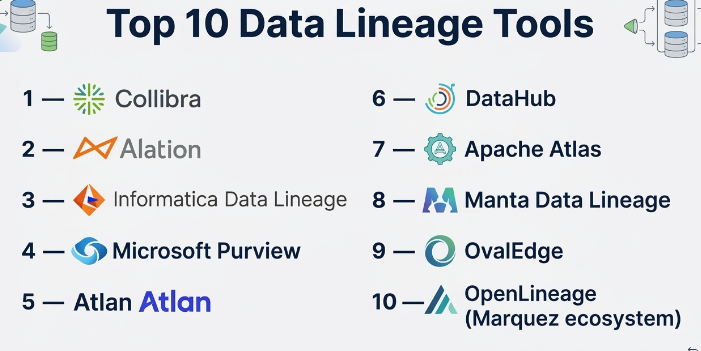
Top 10 Data Lineage Tools
#1 — Collibra
Short description:
Collibra is a leading enterprise data intelligence platform offering strong data lineage, governance, and metadata management capabilities. It is widely used in large organizations to maintain data trust and compliance across complex systems.
Key Features
- End-to-end data lineage tracking
- Metadata management and governance
- Business glossary integration
- Automated lineage discovery
- Data policy enforcement
- Impact analysis for data changes
Pros
- Strong enterprise governance capabilities
- Highly scalable for large organizations
Cons
- Complex setup and configuration
- High cost of ownership
Platforms / Deployment
- Web
- Cloud / Hybrid
Security & Compliance
- Role-based access control
- Encryption at rest and in transit
- Audit logging and compliance support
Integrations & Ecosystem
Integrates with enterprise data ecosystems and governance tools.
- Snowflake, Databricks, BigQuery
- ETL tools like Informatica and Talend
- BI tools such as Tableau and Power BI
Support & Community
Enterprise-grade documentation and support
#2 — Alation
Short description:
Alation is a widely adopted data catalog platform that also provides strong data lineage capabilities, enabling organizations to understand data flows and improve governance.
Key Features
- Automated data lineage tracking
- AI-assisted metadata discovery
- Business glossary and documentation
- Data search and discovery engine
- Collaboration tools for data teams
- Governance workflows
Pros
- Excellent data discovery experience
- Strong user adoption in enterprises
Cons
- Premium pricing model
- Requires onboarding for full usage
Platforms / Deployment
- Web
- Cloud / Hybrid
Security & Compliance
- RBAC and SSO support
- Encryption and audit logging
- Compliance-ready architecture
Integrations & Ecosystem
- Cloud data warehouses
- ETL and ELT tools
- BI and analytics platforms
Support & Community
Strong enterprise support and documentation
#3 — Informatica Data Lineage
Short description:
Informatica provides one of the most comprehensive data lineage solutions integrated into its enterprise data management ecosystem.
Key Features
- Automated end-to-end lineage tracking
- Metadata harvesting from multiple systems
- Data impact analysis
- Governance and compliance tools
- Visual lineage graphs
- AI-powered metadata enrichment
Pros
- Deep enterprise integration
- High accuracy in lineage mapping
Cons
- Complex configuration
- High licensing cost
Platforms / Deployment
- Web
- Cloud / On-prem / Hybrid
Security & Compliance
- Enterprise-grade encryption
- RBAC and audit logs
- Compliance certifications (varies by deployment)
Integrations & Ecosystem
- Informatica ecosystem
- Cloud data warehouses
- ETL and analytics platforms
Support & Community
Enterprise-level support and global documentation
#4 — Microsoft Purview
Short description:
Microsoft Purview is a unified data governance solution that includes strong lineage tracking across Azure and hybrid environments.
Key Features
- Automated data lineage visualization
- Data classification and cataloging
- Sensitivity labeling
- Governance policy enforcement
- Integration with Azure ecosystem
- Real-time metadata updates
Pros
- Strong Azure integration
- Unified governance platform
Cons
- Best suited for Microsoft ecosystem
- Limited flexibility outside Azure
Platforms / Deployment
- Web
- Cloud
Security & Compliance
- Microsoft security standards
- Encryption and RBAC
- Compliance certifications (varies)
Integrations & Ecosystem
- Azure Data Lake and Synapse
- Power BI integration
- Microsoft security tools
Support & Community
Microsoft enterprise support
#5 — Atlan
Short description:
Atlan is a modern data workspace that provides real-time lineage tracking and collaboration for data teams working in cloud-native environments.
Key Features
- Real-time data lineage visualization
- Metadata automation
- Collaboration workspace
- AI-powered data discovery
- Integration with modern data stacks
- Governance workflows
Pros
- Modern and intuitive interface
- Fast deployment
Cons
- Limited deep enterprise governance compared to legacy tools
- Premium pricing for scaling
Platforms / Deployment
- Web
- Cloud
Security & Compliance
- Role-based access control
- Encryption support
Integrations & Ecosystem
- Snowflake, Databricks, BigQuery
- BI tools like Tableau and Looker
- APIs for extensibility
Support & Community
Strong documentation and growing community
#6 — DataHub
Short description:
DataHub is an open-source metadata and lineage platform designed for modern data ecosystems and real-time metadata management.
Key Features
- Open-source lineage tracking
- Metadata ingestion pipelines
- Real-time updates
- Data discovery engine
- Event-driven architecture
- Extensible APIs
Pros
- Highly flexible and open-source
- Strong developer adoption
Cons
- Requires engineering setup
- Limited enterprise governance features
Platforms / Deployment
- Web
- Cloud / Self-hosted
Security & Compliance
- Depends on deployment configuration
- Role-based access control
Integrations & Ecosystem
- Snowflake, BigQuery, Databricks
- Apache Airflow and Spark
- APIs for custom integration
Support & Community
Strong open-source community support
#7 — Apache Atlas
Short description:
Apache Atlas is an open-source metadata management and lineage tool designed for Hadoop-based and big data ecosystems.
Key Features
- Data lineage tracking for Hadoop systems
- Metadata classification
- Governance framework
- Integration with big data tools
- API-based architecture
- Policy enforcement
Pros
- Open-source and widely used in Hadoop environments
- Strong governance capabilities
Cons
- Complex setup
- Limited modern UI
Platforms / Deployment
- Linux / Web
- Self-hosted
Security & Compliance
- RBAC support
- Audit logging
Integrations & Ecosystem
- Hadoop ecosystem tools
- ETL pipelines
- Big data frameworks
Support & Community
Community-driven support
#8 — Manta Data Lineage
Short description:
Manta is a specialized data lineage platform focused on automated, end-to-end lineage extraction across complex enterprise systems.
Key Features
- Automated lineage discovery
- Cross-platform data flow tracking
- Impact analysis
- ETL and SQL lineage extraction
- Visual lineage mapping
- Metadata integration
Pros
- High automation in lineage detection
- Strong enterprise accuracy
Cons
- Enterprise-focused pricing
- Requires onboarding effort
Platforms / Deployment
- Web
- Cloud / On-prem
Security & Compliance
- Encryption support
- Role-based access
Integrations & Ecosystem
- ETL tools and databases
- BI platforms
- Data warehouses
Support & Community
Enterprise support and documentation
#9 — OvalEdge
Short description:
OvalEdge is a data governance and lineage platform offering data cataloging, quality, and lineage tracking in a unified solution.
Key Features
- Data lineage visualization
- Data catalog integration
- Governance workflows
- Metadata management
- Data quality tracking
- Automated documentation
Pros
- Unified governance and lineage platform
- Good usability
Cons
- Smaller ecosystem
- Limited advanced AI features
Platforms / Deployment
- Web
- Cloud / On-prem
Security & Compliance
- RBAC and encryption
- Audit logging
Integrations & Ecosystem
- Cloud data warehouses
- BI tools
- ETL systems
Support & Community
Documentation and enterprise support
#10 — OpenLineage (Marquez ecosystem)
Short description:
OpenLineage is an open standard for data lineage collection, often used with Marquez for visualization and tracking in modern data pipelines.
Key Features
- Open standard lineage collection
- Pipeline-level tracking
- Integration with orchestration tools
- Event-based metadata tracking
- Extensible architecture
- Cloud-native compatibility
Pros
- Open standard flexibility
- Strong developer ecosystem
Cons
- Requires technical setup
- Limited UI out of the box
Platforms / Deployment
- Linux / Web
- Cloud / Self-hosted
Security & Compliance
- Depends on implementation
- Supports external security layers
Integrations & Ecosystem
- Airflow, Spark, dbt
- Data pipeline tools
- APIs and event systems
Support & Community
Open-source community support
Comparison Table (Top 10)
| Tool Name | Best For | Platform(s) Supported | Deployment | Standout Feature | Public Rating |
|---|---|---|---|---|---|
| Collibra | Enterprise governance | Web | Cloud/Hybrid | Governance workflows | N/A |
| Alation | Data discovery | Web | Cloud/Hybrid | AI metadata discovery | N/A |
| Informatica | Enterprise lineage | Web | Hybrid | Automated lineage extraction | N/A |
| Microsoft Purview | Azure ecosystems | Web | Cloud | Native Azure integration | N/A |
| Atlan | Modern data teams | Web | Cloud | Real-time lineage | N/A |
| DataHub | Developers | Web | Cloud/Self-hosted | Open-source metadata | N/A |
| Apache Atlas | Hadoop ecosystems | Web | Self-hosted | Big data lineage | N/A |
| Manta | Enterprise lineage | Web | Hybrid | Automated lineage mapping | N/A |
| OvalEdge | Governance teams | Web | Hybrid | Unified governance + lineage | N/A |
| OpenLineage | Engineering teams | Web | Cloud/Self-hosted | Open lineage standard | N/A |
Evaluation & Scoring of Data Lineage Tools
| Tool Name | Core (25%) | Ease (15%) | Integrations (15%) | Security (10%) | Performance (10%) | Support (10%) | Value (15%) | Weighted Total |
|---|---|---|---|---|---|---|---|---|
| Collibra | 10 | 7 | 10 | 10 | 9 | 9 | 7 | 8.7 |
| Alation | 9 | 8 | 9 | 9 | 9 | 9 | 8 | 8.6 |
| Informatica | 10 | 7 | 10 | 10 | 9 | 9 | 7 | 8.8 |
| Microsoft Purview | 9 | 8 | 10 | 10 | 9 | 9 | 8 | 8.9 |
| Atlan | 9 | 9 | 9 | 9 | 9 | 8 | 8 | 8.7 |
| DataHub | 8 | 8 | 9 | 8 | 8 | 8 | 9 | 8.3 |
| Apache Atlas | 8 | 7 | 8 | 8 | 8 | 7 | 9 | 7.9 |
| Manta | 9 | 7 | 9 | 9 | 9 | 8 | 7 | 8.4 |
| OvalEdge | 8 | 8 | 8 | 8 | 8 | 8 | 8 | 8.1 |
| OpenLineage | 8 | 8 | 9 | 8 | 8 | 8 | 9 | 8.2 |
Which Data Lineage Tool Is Right for You?
Solo / Freelancer
DataHub or OpenLineage for lightweight lineage tracking and experimentation
SMB
Atlan or OvalEdge for easy-to-use lineage and governance
Mid-Market
Manta or Atlan for scalable lineage visualization and automation
Enterprise
Collibra, Informatica, Microsoft Purview for full governance and compliance
Budget vs Premium
Budget: DataHub, OpenLineage, Apache Atlas
Premium: Collibra, Informatica, Manta
Feature Depth vs Ease of Use
Depth: Collibra, Informatica, Manta
Ease: Atlan, DataHub
Integrations & Scalability
Microsoft Purview, Atlan, Informatica for enterprise ecosystems
Security & Compliance Needs
RBAC, encryption, audit logging, GDPR/HIPAA readiness
Frequently Asked Questions (FAQs)
1. What is data lineage?
Data lineage tracks the flow of data from source systems to final outputs, showing transformations along the way.
2. Why is data lineage important?
It ensures transparency, compliance, and trust in analytics and reporting systems.
3. Are these tools only for enterprises?
No, open-source tools like DataHub and OpenLineage are suitable for smaller teams.
4. Do they support cloud platforms?
Yes, most tools integrate with Snowflake, BigQuery, Databricks, and AWS.
5. What is automated lineage?
Automated lineage detects data flows without manual mapping using metadata extraction.
6. Can lineage tools help with compliance?
Yes, they support audit readiness for GDPR, HIPAA, and financial regulations.
7. Are open-source lineage tools reliable?
Yes, but they require engineering effort and customization.
8. Do they integrate with ETL tools?
Yes, most tools integrate with Airflow, dbt, and other ETL systems.
9. Do they support real-time tracking?
Modern tools increasingly support real-time lineage updates.
10. What is the biggest benefit?
Improved transparency and trust in data pipelines and analytics.
Conclusion
Data Lineage Tools are essential for understanding, governing, and trusting modern data ecosystems. Platforms like Collibra, Informatica, and Microsoft Purview deliver enterprise-grade governance, while tools like DataHub and OpenLineage enable flexibility and developer-friendly lineage tracking.

Find Trusted Cardiac Hospitals
Compare heart hospitals by city and services — all in one place.
Explore Hospitals
Data lineage tools are most valuable when they help organizations track, visualize, and understand how data flows and changes across systems throughout its lifecycle. By providing end-to-end lineage mapping, source-to-target tracing, data flow visualization, transformation tracking, dependency analysis, impact assessment, metadata management, governance support, compliance reporting, and integration with ETL, data warehouse, data catalog, and BI platforms, these tools enable organizations to improve data transparency, troubleshoot issues faster, assess downstream impacts, strengthen governance, and build greater trust in enterprise data.