Introduction
Data Observability Tools help organizations monitor, troubleshoot, and maintain the health, reliability, freshness, quality, and performance of modern data pipelines and analytics ecosystems. These platforms provide visibility into data movement, schema changes, anomalies, lineage, pipeline failures, and operational reliability across warehouses, ETL systems, streaming platforms, and BI environments. As businesses increasingly depend on AI, real-time analytics, cloud-native architectures, and automated decision-making, data downtime and unreliable pipelines can directly impact revenue, compliance, customer experience, and operational trust. Traditional monitoring approaches are no longer sufficient for distributed modern data stacks. Modern data observability platforms now combine AI-assisted anomaly detection, metadata intelligence, lineage visibility, root-cause analysis, and automated alerting to improve enterprise-wide data reliability.
Common Real-world use cases include:
- Detecting broken data pipelines and failed ETL jobs
- Monitoring cloud warehouse reliability
- Tracking schema drift and freshness issues
- Improving trust in analytics and AI systems
- Accelerating root-cause analysis and incident response
Key Evaluation criteria buyers should consider:
- Automated anomaly detection
- Freshness and volume monitoring
- Schema change detection
- Lineage and impact analysis
- Cloud warehouse compatibility
- AI-assisted root-cause analysis
- Integration ecosystem breadth
- Security and governance controls
- Scalability across distributed environments
- Alerting and incident management capabilities
Best for: Data engineers, analytics teams, governance teams, cloud-native enterprises, financial institutions, healthcare organizations, SaaS companies, and organizations operating large-scale modern data ecosystems.
Not ideal for: Very small businesses with limited analytics operations or organizations without centralized data pipelines and observability requirements.
Key Trends in Data Observability Tools
- AI-driven anomaly detection is becoming a core platform capability.
- Real-time observability is replacing traditional batch monitoring.
- Data quality and observability platforms are increasingly converging.
- Active metadata and lineage integrations are expanding rapidly.
- Cloud-native observability architectures are dominating enterprise adoption.
- Root-cause analysis automation is improving incident response speed.
- Data observability is becoming critical for AI governance initiatives.
- Open-source observability ecosystems are growing significantly.
- Multi-cloud observability visibility is becoming an enterprise requirement.
- Usage-based pricing models are becoming more common across vendors.
How We Selected These Tools Methodology
The tools in this list were evaluated using the following methodology:
- Enterprise adoption and market recognition
- Breadth of observability functionality
- AI-assisted anomaly detection capabilities
- Reliability and scalability across modern architectures
- Integration ecosystem maturity
- Security and governance readiness
- Metadata and lineage visibility support
- Ease of onboarding and operational usability
- Incident response and troubleshooting capabilities
- Customer fit across SMB, mid-market, and enterprise environments
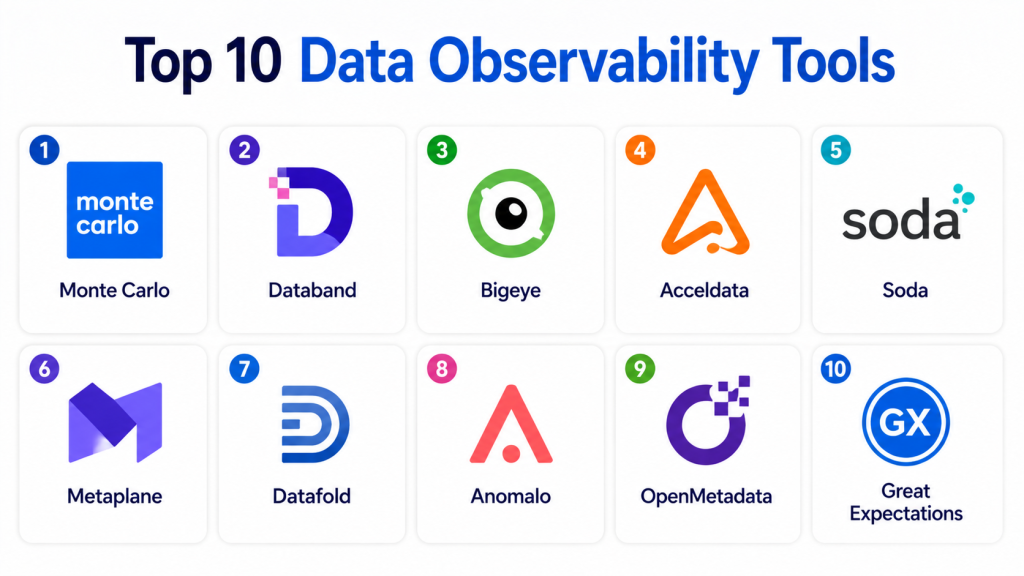
Top 10 Data Observability Tools
1 — Monte Carlo
Short description: Monte Carlo is one of the leading enterprise data observability platforms focused on monitoring data reliability, freshness, lineage, and anomaly detection across cloud-native environments.
Key Features
- AI-driven anomaly detection
- Freshness monitoring
- Lineage visualization
- Schema drift detection
- Incident management workflows
- Automated alerting
- Root-cause analysis support
Pros
- Strong automation capabilities
- Excellent cloud-native integrations
- Mature observability workflows
Cons
- Enterprise pricing can be expensive
- Advanced customization requires expertise
- Primarily optimized for modern cloud environments
Platforms / Deployment
- Web
- Cloud
Security & Compliance
Supports SSO/SAML, MFA, RBAC, encryption, and audit logging.
Integrations & Ecosystem
Monte Carlo integrates with cloud warehouses, orchestration tools, and BI platforms.
- Snowflake
- Databricks
- BigQuery
- Airflow
- dbt
- Looker
Support & Community
Strong enterprise onboarding and observability-focused support ecosystem.
2 — Databand
Short description: Databand focuses on pipeline observability, operational monitoring, and data reliability for modern analytics and engineering teams.
Key Features
- Pipeline health monitoring
- Job failure detection
- Metadata-driven observability
- Automated alerting
- SLA monitoring
- Root-cause analysis
- Incident response workflows
Pros
- Strong operational monitoring workflows
- Good integration flexibility
- Effective troubleshooting visibility
Cons
- Enterprise onboarding complexity
- Advanced analytics may require customization
- Premium enterprise pricing
Platforms / Deployment
- Web / Linux
- Cloud / Hybrid
Security & Compliance
Supports RBAC, encryption, SSO, and enterprise authentication workflows.
Integrations & Ecosystem
Databand integrates with orchestration, warehouse, and analytics ecosystems.
- Airflow
- Spark
- Snowflake
- Databricks
- Kafka
- dbt
Support & Community
Enterprise-focused onboarding and operational support services available.
3 — Bigeye
Short description: Bigeye provides automated data monitoring, anomaly detection, and observability workflows for analytics and cloud data environments.
Key Features
- Automated anomaly detection
- Freshness monitoring
- Data quality tracking
- Lineage visibility
- Alert management
- Root-cause investigation
- Usage analytics
Pros
- Strong automation capabilities
- Good usability for analytics teams
- Effective cloud warehouse integrations
Cons
- Smaller ecosystem than major competitors
- Advanced workflows require operational planning
- Premium enterprise positioning
Platforms / Deployment
- Web
- Cloud
Security & Compliance
Supports SSO, RBAC, encryption, and audit controls.
Integrations & Ecosystem
Bigeye integrates with modern analytics engineering ecosystems.
- Snowflake
- BigQuery
- Databricks
- Redshift
- dbt
- Tableau
Support & Community
Growing enterprise observability ecosystem with onboarding support available.
4 — Acceldata
Short description: Acceldata combines data observability, infrastructure monitoring, and pipeline reliability management for enterprise analytics environments.
Key Features
- Data pipeline monitoring
- Infrastructure observability
- AI-assisted anomaly detection
- Root-cause analysis
- Operational analytics
- Performance optimization
- Multi-cloud monitoring
Pros
- Strong enterprise scalability
- Broad observability visibility
- Infrastructure and data monitoring combination
Cons
- Enterprise implementation complexity
- Premium pricing structure
- Requires operational expertise
Platforms / Deployment
- Web / Linux
- Cloud / Hybrid
Security & Compliance
Supports SSO/SAML, RBAC, encryption, and governance workflows.
Integrations & Ecosystem
Acceldata integrates with analytics, infrastructure, and orchestration platforms.
- Hadoop
- Snowflake
- Spark
- Kafka
- Databricks
- AWS
Support & Community
Enterprise-focused support and implementation ecosystem available.
5 — Soda
Short description: Soda is a modern data quality and observability platform designed for warehouse-native monitoring and analytics engineering workflows.
Key Features
- SQL-based observability checks
- Freshness monitoring
- Automated anomaly detection
- Data quality validation
- Warehouse-native architecture
- Real-time alerting
- Open-source tooling
Pros
- Strong usability for analytics engineers
- Lightweight deployment approach
- Excellent warehouse compatibility
Cons
- Enterprise governance depth still evolving
- Advanced workflows require SQL expertise
- Smaller ecosystem compared to legacy vendors
Platforms / Deployment
- Web / Linux / macOS
- Cloud / Hybrid / Self-hosted
Security & Compliance
Supports RBAC, encryption, and enterprise authentication features.
Integrations & Ecosystem
Soda integrates with modern cloud warehouses and orchestration platforms.
- Snowflake
- BigQuery
- PostgreSQL
- Databricks
- Airflow
- dbt
Support & Community
Growing open-source and analytics engineering community adoption.
6 — Metaplane
Short description: Metaplane provides automated anomaly detection and warehouse-native observability focused on analytics reliability.
Key Features
- Automated anomaly monitoring
- Warehouse-native architecture
- Freshness and volume checks
- Schema drift detection
- Root-cause analysis
- Incident management
- AI-assisted monitoring
Pros
- Modern user experience
- Strong anomaly detection capabilities
- Lightweight cloud deployment
Cons
- Smaller enterprise ecosystem
- Limited broader governance functionality
- Advanced operational workflows still evolving
Platforms / Deployment
- Web
- Cloud
Security & Compliance
Supports SSO, encryption, RBAC, and secure cloud deployments.
Integrations & Ecosystem
Metaplane integrates with cloud analytics and warehouse ecosystems.
- Snowflake
- BigQuery
- Redshift
- dbt
- Looker
- Tableau
Support & Community
Growing observability-focused support ecosystem.
7 — Datafold
Short description: Datafold specializes in data reliability engineering, regression testing, and observability for analytics pipelines.
Key Features
- Data diff testing
- CI/CD observability workflows
- Regression monitoring
- Pipeline validation
- Warehouse-native architecture
- Monitoring dashboards
- Root-cause visibility
Pros
- Strong developer-focused workflows
- Excellent analytics testing capabilities
- Lightweight deployment architecture
Cons
- Narrower scope than enterprise observability suites
- Smaller governance ecosystem
- Advanced enterprise workflows limited
Platforms / Deployment
- Web
- Cloud
Security & Compliance
Supports encryption, RBAC, SSO, and enterprise authentication.
Integrations & Ecosystem
Datafold integrates with modern analytics engineering workflows.
- dbt
- Snowflake
- BigQuery
- Databricks
- GitHub
- Airflow
Support & Community
Strong analytics engineering community adoption.
8 — Anomalo
Short description: Anomalo focuses on automated data quality monitoring and anomaly detection for cloud-native analytics environments.
Key Features
- AI-driven anomaly detection
- Freshness monitoring
- Data validation automation
- Alerting workflows
- Root-cause analysis
- Warehouse-native architecture
- Incident visibility
Pros
- Strong automation focus
- Good usability for analytics teams
- Effective cloud-native integrations
Cons
- Smaller ecosystem compared to larger vendors
- Advanced governance functionality limited
- Enterprise pricing varies
Platforms / Deployment
- Web
- Cloud
Security & Compliance
Supports SSO, RBAC, encryption, and secure deployment workflows.
Integrations & Ecosystem
Anomalo integrates with analytics engineering and warehouse ecosystems.
- Snowflake
- Databricks
- BigQuery
- Redshift
- dbt
- Tableau
Support & Community
Growing enterprise support ecosystem focused on cloud analytics operations.
9 — OpenMetadata
Short description: OpenMetadata is an open-source metadata, observability, lineage, and governance platform for modern data ecosystems.
Key Features
- Open-source observability workflows
- Metadata management
- Lineage visualization
- Data quality monitoring
- Collaboration capabilities
- Usage analytics
- Extensible APIs
Pros
- Strong open-source flexibility
- Active metadata ecosystem
- Modern architecture design
Cons
- Enterprise governance may require customization
- Operational overhead for self-managed deployments
- Advanced workflows require engineering expertise
Platforms / Deployment
- Linux / macOS
- Cloud / Hybrid / Self-hosted
Security & Compliance
Supports authentication, RBAC, and secure deployment configurations.
Integrations & Ecosystem
OpenMetadata integrates with modern analytics engineering ecosystems.
- Kafka
- Airflow
- Snowflake
- dbt
- BigQuery
- Looker
Support & Community
Large and growing open-source contributor community.
10 — Great Expectations
Short description: Great Expectations is a widely adopted open-source data validation and observability framework for analytics and engineering teams.
Key Features
- Rule-based validation
- Data profiling
- Automated documentation
- Pipeline testing workflows
- Open-source extensibility
- Monitoring dashboards
- Warehouse compatibility
Pros
- Strong open-source ecosystem
- Highly customizable validation logic
- Excellent modern data stack integrations
Cons
- Requires technical expertise
- Enterprise governance depth limited
- Large-scale deployments require operational planning
Platforms / Deployment
- Windows / Linux / macOS
- Cloud / Hybrid / Self-hosted
Security & Compliance
Supports secure deployment configurations and authentication integrations.
Integrations & Ecosystem
Great Expectations integrates with orchestration and warehouse ecosystems.
- Snowflake
- Databricks
- Spark
- Airflow
- dbt
- BigQuery
Support & Community
Large open-source community with strong developer adoption.
Comparison Table
| Tool Name | Best For | Platform(s) Supported | Deployment | Standout Feature | Public Rating |
|---|---|---|---|---|---|
| Monte Carlo | Enterprise observability | Web | Cloud | AI-driven anomaly detection | N/A |
| Databand | Pipeline monitoring | Web, Linux | Cloud, Hybrid | Operational monitoring workflows | N/A |
| Bigeye | Automated monitoring | Web | Cloud | Analytics reliability visibility | N/A |
| Acceldata | Infrastructure and data observability | Web, Linux | Cloud, Hybrid | Infrastructure plus data monitoring | N/A |
| Soda | Warehouse-native monitoring | Web, Linux, macOS | Cloud, Hybrid | SQL-based observability checks | N/A |
| Metaplane | Warehouse-native anomaly detection | Web | Cloud | Lightweight anomaly monitoring | N/A |
| Datafold | Analytics testing workflows | Web | Cloud | Data diff testing | N/A |
| Anomalo | Automated data monitoring | Web | Cloud | AI-driven monitoring workflows | N/A |
| OpenMetadata | Open-source observability | Linux, macOS | Hybrid, Self-hosted | Metadata and observability integration | N/A |
| Great Expectations | Open-source validation | Windows, Linux, macOS | Hybrid, Self-hosted | Expectation-based validation | N/A |
Evaluation & Scoring of Data Observability Tools
| Tool Name | Core 25% | Ease 15% | Integrations 15% | Security 10% | Performance 10% | Support 10% | Value 15% | Weighted Total |
|---|---|---|---|---|---|---|---|---|
| Monte Carlo | 9.5 | 8 | 9 | 8.5 | 9 | 8.5 | 7 | 8.6 |
| Databand | 8.5 | 7.5 | 8.5 | 8 | 8.5 | 8 | 7.5 | 8.1 |
| Bigeye | 8.5 | 8 | 8 | 8 | 8 | 7.5 | 7.5 | 8.0 |
| Acceldata | 9 | 7 | 8.5 | 8.5 | 9 | 8 | 7 | 8.1 |
| Soda | 8 | 8.5 | 8 | 7.5 | 8 | 7.5 | 8.5 | 8.0 |
| Metaplane | 8 | 8.5 | 7.5 | 7.5 | 8 | 7.5 | 8 | 7.9 |
| Datafold | 8 | 8 | 8 | 8 | 8 | 7.5 | 8.5 | 8.0 |
| Anomalo | 8 | 8 | 7.5 | 8 | 8 | 7.5 | 8 | 7.9 |
| OpenMetadata | 8 | 7.5 | 8.5 | 7.5 | 8 | 8 | 9 | 8.1 |
| Great Expectations | 8.5 | 7 | 8.5 | 7 | 8 | 8 | 9 | 8.1 |
These scores are comparative evaluations intended to help buyers understand relative strengths across monitoring depth, usability, integrations, security, and operational value. Enterprise-focused platforms generally score higher in automation and observability depth, while open-source tools often provide stronger flexibility and cost efficiency. Buyers should prioritize categories aligned with operational maturity, engineering resources, and observability complexity.
Which Data Observability Tool Is Right for You?
Solo / Freelancer
Great Expectations and OpenMetadata are attractive for technical teams seeking flexible open-source observability workflows without large licensing costs.
SMB
Soda and Metaplane provide lightweight deployment approaches, strong usability, and manageable operational complexity for growing organizations.
Mid-Market
Bigeye and Datafold balance automation, observability visibility, and analytics engineering workflows for expanding teams.
Enterprise
Monte Carlo, Databand, and Acceldata are better suited for large-scale enterprise observability, operational monitoring, and incident management requirements.
Budget vs Premium
Open-source tools reduce licensing costs but may require stronger engineering management. Premium enterprise platforms deliver broader automation, support, and operational scalability.
Feature Depth vs Ease of Use
Metaplane and Soda emphasize usability and lightweight monitoring, while Monte Carlo and Acceldata prioritize deep enterprise observability capabilities.
Integrations & Scalability
Organizations managing distributed cloud ecosystems should prioritize metadata automation, orchestration compatibility, and warehouse-native scalability.
Security & Compliance Needs
Highly regulated industries should prioritize RBAC, encryption, audit logging, lineage visibility, and governance-integrated observability workflows.
Frequently Asked Questions FAQs
1. What are Data Observability Tools?
Data observability tools help organizations monitor the health, reliability, freshness, and performance of data pipelines, warehouses, and analytics systems.
2. Why are observability platforms important for AI and analytics?
AI models and analytics systems depend on reliable and accurate data. Observability tools help detect anomalies, schema drift, and pipeline failures before they impact operations.
3. What is the difference between data observability and data quality?
Data quality focuses on validating correctness, while observability focuses on monitoring operational reliability, freshness, lineage, and anomaly detection across systems.
4. Are open-source observability tools suitable for enterprises?
Yes. Platforms like OpenMetadata and Great Expectations are widely used in enterprise environments, though they may require additional customization and operational management.
5. Which industries benefit most from observability platforms?
Financial services, healthcare, SaaS, retail, telecommunications, and organizations operating cloud-native analytics systems benefit significantly from observability capabilities.
6. How does observability improve incident response?
Observability platforms help teams identify root causes faster by monitoring pipeline health, lineage relationships, freshness issues, and operational anomalies in real time.
7. What are common observability implementation mistakes?
Common mistakes include incomplete monitoring coverage, weak alert tuning, poor ownership definitions, and ignoring metadata or lineage integrations during deployment.
8. Do observability platforms support cloud-native architectures?
Most modern observability platforms are optimized for cloud-native, warehouse-native, hybrid, and multi-cloud analytics environments.
9. Can observability tools integrate with orchestration platforms?
Yes. Most modern tools integrate with orchestration and analytics engineering platforms like Airflow, dbt, Spark, and Kafka.
10. How should organizations evaluate pricing?
Organizations should evaluate monitored data volume, pipeline scale, integration breadth, alerting complexity, and long-term operational costs before selecting a platform.
Conclusion
Data Observability Tools have become critical infrastructure for organizations operating modern analytics, AI, and cloud-native data ecosystems. As businesses increasingly depend on real-time decision-making and automated analytics workflows, maintaining pipeline reliability, freshness visibility, anomaly detection, and operational trust is essential for reducing downtime and improving business continuity. The best observability platform depends heavily on organizational maturity, cloud strategy, operational complexity, and engineering resources. Enterprise organizations may prioritize Monte Carlo or Acceldata for large-scale automation and reliability management, while modern analytics teams may prefer Soda or OpenMetadata for flexibility and warehouse-native workflows. The smartest next step is to shortlist two or three platforms, validate integrations with existing orchestration and warehouse systems, run pilot observability workflows using production datasets, and then scale gradually across the broader analytics ecosystem.

Find Trusted Cardiac Hospitals
Compare heart hospitals by city and services — all in one place.
Explore Hospitals
This article clearly explains how data observability tools help teams monitor data quality, detect issues early, and maintain trust in their data pipelines and analytics systems.