Introduction
Data Lake Platforms are centralized storage and processing environments that allow organizations to collect, store, manage, and analyze large volumes of raw and processed data. Unlike traditional databases or data warehouses, data lakes can handle structured data, semi-structured data, and unstructured data such as logs, images, documents, clickstreams, IoT data, and machine-generated events. Data lake platforms matter because modern businesses generate data from many sources: applications, devices, cloud services, customer interactions, AI systems, and operational tools. A well-designed data lake helps teams store this data cost-effectively, prepare it for analytics, support machine learning pipelines, and create a foundation for data governance.
Common Real-world use cases include:
- Centralized enterprise data storage
- AI and machine learning data preparation
- Log and event data analysis
- Customer behavior analytics
- IoT and industrial sensor analytics
- Compliance and long-term data retention
When Evaluating Data Lake Platforms, buyers should consider:
- Storage scalability
- Data governance and cataloging
- Security and access controls
- Integration with analytics tools
- Support for structured and unstructured data
- Data lifecycle management
- AI and machine learning readiness
- Cost optimization
- Cloud and hybrid deployment flexibility
- Ease of administration
Best for: Data engineers, analytics teams, AI teams, cloud architects, enterprise IT teams, data governance leaders, and organizations managing large-scale multi-source data.
Not ideal for: Small teams with simple reporting needs, businesses without large data volumes, or organizations that only need a traditional relational database or basic spreadsheet-based reporting.
Key Trends in Data Lake Platforms
- AI-ready data foundations are becoming a major focus as companies prepare data lakes for generative AI, machine learning, and advanced analytics.
- Data governance is now essential because raw data without access controls, lineage, and quality management can quickly become difficult to trust.
- Lakehouse convergence is increasing as data lakes, warehouses, and analytics engines become more connected.
- Open table formats are improving interoperability between data lakes, query engines, and analytics platforms.
- Real-time data ingestion is becoming more important for fraud detection, monitoring, personalization, and operational analytics.
- Cloud-native object storage continues to dominate modern data lake architecture because of scalability and flexible pricing.
- Hybrid and multi-cloud data lakes are growing as enterprises manage workloads across different cloud and on-premises systems.
- Data cataloging and metadata management are becoming core capabilities rather than optional add-ons.
- Security automation is improving through policy-based access control, encryption, masking, and audit logging.
- Cost governance is now a priority as large-scale data lakes can become expensive without retention policies and storage optimization.
How We Selected These Tools
The tools in this list were selected based on practical buyer-focused evaluation criteria:
- Market adoption and enterprise mindshare
- Strength of storage, processing, and analytics ecosystem
- Scalability for large data volumes
- Security and governance capabilities
- Support for AI, machine learning, and analytics workflows
- Cloud-native and hybrid deployment flexibility
- Integration with BI, ETL, ELT, and data engineering tools
- Documentation, support, and community maturity
- Fit across SMB, mid-market, and enterprise use cases
- Ability to support modern data lake and lakehouse architecture patterns
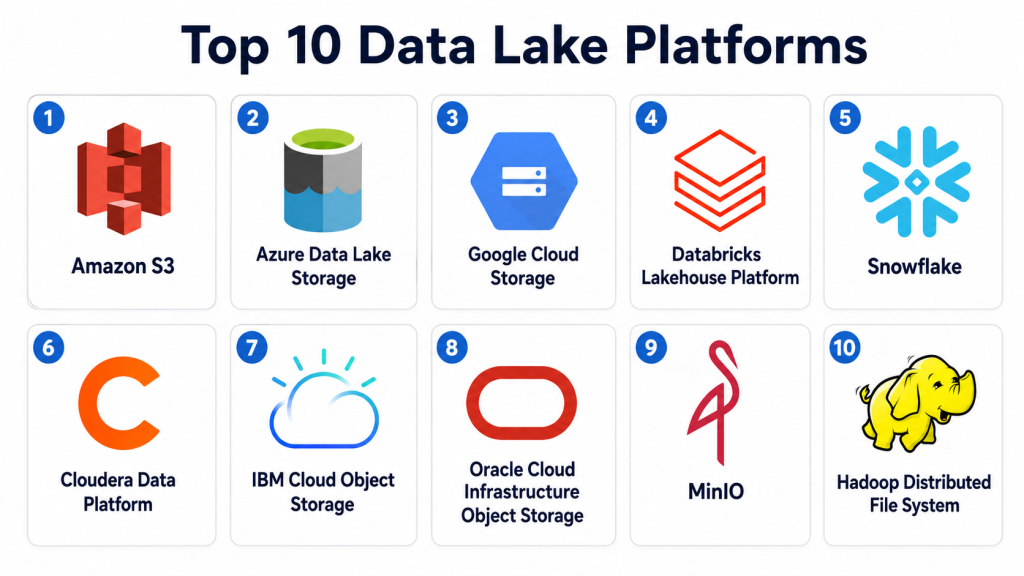
Top 10 Data Lake Platforms Tools
1 — Amazon S3
Short description: Amazon S3 is a highly scalable object storage service widely used as the foundation for cloud data lakes. It is best for organizations building AWS-based analytics, AI, backup, and long-term storage architectures.
Key Features
- Scalable object storage for large data volumes
- Storage classes for lifecycle and cost optimization
- Integration with AWS analytics and AI services
- Data lake foundation for structured and unstructured data
- Versioning and replication capabilities
- Access control through AWS identity services
- Support for event-driven workflows
Pros
- Highly scalable and widely adopted
- Strong AWS analytics ecosystem
- Flexible storage pricing options
Cons
- Requires additional services for full data lake governance
- Cost management can become complex at scale
- Best suited for AWS-centric teams
Platforms / Deployment
Cloud
Security & Compliance
Encryption, IAM-based access control, bucket policies, audit logging through AWS services, and access management capabilities are available. Compliance support depends on the AWS account configuration and region.
Integrations & Ecosystem
Amazon S3 integrates with a broad set of AWS and third-party data tools, making it a common foundation for modern data lakes.
- AWS Glue
- Amazon Athena
- Amazon Redshift
- Amazon EMR
- Amazon SageMaker
- Apache Spark
Support & Community
Amazon S3 has extensive documentation, enterprise support through AWS, and a very large cloud architecture community.
2 — Azure Data Lake Storage
Short description: Azure Data Lake Storage is Microsoft’s cloud data lake storage platform built for big data analytics, enterprise security, and integration with Azure analytics services. It is best for organizations using Microsoft Azure and Power BI ecosystems.
Key Features
- Scalable cloud storage for analytics workloads
- Hierarchical namespace support
- Integration with Azure Synapse and Microsoft Fabric
- Fine-grained access controls
- Optimized for big data processing
- Data lifecycle management
- Support for structured and unstructured data
Pros
- Strong fit for Microsoft and Azure users
- Good enterprise security integration
- Works well with analytics and BI workloads
Cons
- Best value is within the Azure ecosystem
- Advanced governance needs careful setup
- Pricing depends on storage, access, and transaction patterns
Platforms / Deployment
Cloud
Security & Compliance
Encryption, Azure role-based access control, Microsoft Entra ID integration, audit logging, and access policy support are available. Compliance details depend on Azure configuration and region.
Integrations & Ecosystem
Azure Data Lake Storage connects deeply with Microsoft data, analytics, and AI services.
- Azure Synapse Analytics
- Microsoft Fabric
- Power BI
- Azure Data Factory
- Azure Databricks
- Microsoft Purview
Support & Community
Microsoft provides strong documentation, enterprise support, training resources, and a large partner ecosystem.
3 — Google Cloud Storage
Short description: Google Cloud Storage is a scalable object storage platform commonly used to build data lakes on Google Cloud. It is best for teams using BigQuery, Vertex AI, and Google Cloud analytics services.
Key Features
- Scalable object storage for data lake workloads
- Integration with Google Cloud analytics tools
- Multiple storage classes for cost control
- Strong global infrastructure support
- Event-driven data processing options
- Lifecycle management policies
- Support for AI and ML data pipelines
Pros
- Strong integration with BigQuery and Vertex AI
- Flexible storage options
- Good fit for analytics-heavy Google Cloud users
Cons
- Best suited for Google Cloud environments
- Governance requires additional cloud services
- Multi-cloud strategies may require extra planning
Platforms / Deployment
Cloud
Security & Compliance
Encryption, IAM-based access control, audit logging, access policies, and identity integration are available through Google Cloud services. Compliance varies by configuration and region.
Integrations & Ecosystem
Google Cloud Storage works well with data engineering, analytics, and AI services in the Google ecosystem.
- BigQuery
- Vertex AI
- Dataflow
- Dataproc
- Looker
- Cloud Composer
Support & Community
Google Cloud offers enterprise support, strong technical documentation, and active cloud-native analytics resources.
4 — Databricks Lakehouse Platform
Short description: Databricks Lakehouse Platform combines data lake storage, analytics, machine learning, and governance capabilities into a unified platform. It is best for organizations building advanced AI, ML, and data engineering workflows.
Key Features
- Unified data engineering, analytics, and AI workflows
- Delta Lake support for reliable data management
- Collaborative notebooks
- Streaming and batch processing
- Data governance through Unity Catalog
- MLflow integration
- Multi-cloud deployment support
Pros
- Strong AI and machine learning ecosystem
- Excellent for data engineering teams
- Supports both lake and warehouse-style workloads
Cons
- Requires skilled technical teams
- Cost governance needs active monitoring
- Advanced configurations may be complex
Platforms / Deployment
Cloud / Hybrid
Security & Compliance
RBAC, encryption, SSO/SAML, audit logging, and governance features are available. Compliance details vary by cloud provider and deployment configuration.
Integrations & Ecosystem
Databricks integrates with modern cloud, BI, data engineering, and machine learning tools.
- Apache Spark
- Delta Lake
- MLflow
- Power BI
- Tableau
- AWS, Azure, and Google Cloud
Support & Community
Databricks has strong enterprise support, extensive documentation, and a large community of data engineers and AI practitioners.
5 — Snowflake
Short description: Snowflake is a cloud data platform that supports data warehouse, data lake, data sharing, and analytics workloads. It is best for organizations that want managed analytics with strong scalability and governance.
Key Features
- Cloud-native data platform architecture
- Support for structured and semi-structured data
- Separation of storage and compute
- Data sharing capabilities
- Snowpark for developer workloads
- Governance and access controls
- Integration with AI and BI ecosystems
Pros
- Easy to use for analytics teams
- Strong performance and scalability
- Mature ecosystem for BI and data sharing
Cons
- Costs can increase with heavy compute usage
- Not a pure open data lake storage layer
- Requires governance discipline for large workloads
Platforms / Deployment
Cloud
Security & Compliance
RBAC, encryption, MFA, SSO/SAML, audit logging, and governance capabilities are available. Compliance support varies by region, edition, and deployment configuration.
Integrations & Ecosystem
Snowflake connects with a wide range of modern data stack tools.
- dbt
- Fivetran
- Matillion
- Tableau
- Power BI
- AWS, Azure, and Google Cloud
Support & Community
Snowflake has strong enterprise support, extensive documentation, and a mature partner marketplace.
6 — Cloudera Data Platform
Short description: Cloudera Data Platform is an enterprise data platform for hybrid data lakes, analytics, data engineering, and machine learning. It is best for large organizations managing complex and regulated data environments.
Key Features
- Hybrid cloud data lake architecture
- Data engineering and analytics support
- Machine learning capabilities
- Security and governance tooling
- Workload management
- Support for large-scale enterprise data
- Integration with open-source data technologies
Pros
- Strong fit for hybrid enterprise environments
- Mature governance and data management capabilities
- Useful for regulated industries
Cons
- Implementation can be complex
- Requires experienced data platform teams
- Enterprise pricing may be high
Platforms / Deployment
Cloud / Self-hosted / Hybrid
Security & Compliance
RBAC, encryption, access controls, audit logging, and governance capabilities are available. Compliance depends on deployment configuration.
Integrations & Ecosystem
Cloudera integrates with enterprise data engineering, analytics, and machine learning ecosystems.
- Apache Spark
- Apache Hive
- Apache Kafka
- Kubernetes
- BI tools
- Cloud object storage
Support & Community
Cloudera provides enterprise support, professional services, documentation, and mature guidance for large-scale data environments.
7 — IBM Cloud Object Storage
Short description: IBM Cloud Object Storage is a scalable object storage platform often used as the foundation for enterprise data lake architectures. It is best for organizations using IBM Cloud, hybrid cloud, and governed analytics ecosystems.
Key Features
- Scalable object storage
- Data durability and lifecycle management
- Integration with IBM analytics and AI tools
- Support for unstructured and structured data
- Security and access control capabilities
- Hybrid cloud support
- Cost optimization through storage classes
Pros
- Strong fit for IBM enterprise environments
- Useful for governed data and AI workloads
- Supports hybrid cloud strategies
Cons
- Best suited for IBM-aligned organizations
- Smaller mainstream mindshare than AWS, Azure, or Google Cloud storage
- Advanced setup may require IBM ecosystem expertise
Platforms / Deployment
Cloud / Hybrid
Security & Compliance
Encryption, access controls, identity integration, and governance capabilities are available. Compliance details vary by deployment and IBM Cloud configuration.
Integrations & Ecosystem
IBM Cloud Object Storage integrates with IBM’s analytics, AI, and data governance ecosystem.
- IBM watsonx
- IBM Cloud Pak for Data
- Spark
- Presto
- BI tools
- Enterprise applications
Support & Community
IBM provides enterprise support, professional services, and documentation for large organizations.
8 — Oracle Cloud Infrastructure Object Storage
Short description: Oracle Cloud Infrastructure Object Storage provides scalable storage for data lake, analytics, backup, and AI workloads. It is best for organizations using Oracle Cloud and Oracle enterprise systems.
Key Features
- Scalable cloud object storage
- Data lake support for analytics workloads
- Integration with Oracle analytics services
- Lifecycle management
- Enterprise identity integration
- High durability architecture
- Support for structured and unstructured data
Pros
- Strong fit for Oracle customers
- Good enterprise integration with Oracle services
- Suitable for regulated and business-critical workloads
Cons
- Best suited for Oracle-centric environments
- Smaller data lake ecosystem compared with larger hyperscalers
- Requires Oracle Cloud architecture knowledge
Platforms / Deployment
Cloud / Hybrid
Security & Compliance
Encryption, identity integration, access controls, and audit capabilities are available through Oracle Cloud. Compliance support varies by deployment and configuration.
Integrations & Ecosystem
Oracle Object Storage works with Oracle database, analytics, and application ecosystems.
- Oracle Autonomous Database
- Oracle Analytics
- Oracle Data Integration
- Oracle Cloud Infrastructure
- Enterprise applications
- AI services
Support & Community
Oracle provides enterprise support, documentation, and consulting services for cloud and database customers.
9 — MinIO
Short description: MinIO is a high-performance, S3-compatible object storage platform often used for private cloud, hybrid cloud, and self-hosted data lake architectures. It is best for teams that need control, portability, and object storage flexibility.
Key Features
- S3-compatible object storage
- Self-hosted and Kubernetes-friendly deployment
- High-performance object storage engine
- Multi-cloud and hybrid use cases
- Erasure coding and replication features
- Object lifecycle management
- Strong fit for private data lakes
Pros
- Good option for self-hosted data lakes
- S3 compatibility supports broad ecosystem integration
- Useful for hybrid and private cloud strategies
Cons
- Requires operational expertise
- Enterprise support may be needed for large deployments
- Governance features may depend on architecture design
Platforms / Deployment
Self-hosted / Hybrid / Cloud
Security & Compliance
Encryption, identity integration, access policies, and audit capabilities are available depending on deployment. Compliance depends on infrastructure and configuration.
Integrations & Ecosystem
MinIO integrates with many tools because of its S3-compatible interface.
- Kubernetes
- Apache Spark
- Presto
- Trino
- Kafka
- AI and ML pipelines
Support & Community
MinIO has strong developer adoption, documentation, and enterprise support options for production deployments.
10 — Hadoop Distributed File System
Short description: Hadoop Distributed File System, commonly known as HDFS, is a distributed storage system historically used for big data and enterprise data lake architectures. It is best for organizations maintaining legacy Hadoop environments or large on-premises data platforms.
Key Features
- Distributed file storage
- Large-scale data processing support
- Integration with Hadoop ecosystem tools
- Fault-tolerant architecture
- Batch analytics support
- Support for large datasets
- Open-source ecosystem foundation
Pros
- Proven large-scale data storage model
- Strong fit for legacy big data environments
- Open-source ecosystem compatibility
Cons
- Operationally complex compared with modern cloud storage
- Less attractive for new cloud-native data lake projects
- Requires experienced Hadoop administrators
Platforms / Deployment
Self-hosted / Hybrid
Security & Compliance
Security depends on Hadoop ecosystem configuration. Kerberos, access controls, encryption, and audit features may be used depending on implementation.
Integrations & Ecosystem
HDFS integrates with traditional big data processing and analytics tools.
- Apache Hadoop
- Apache Hive
- Apache Spark
- Apache Pig
- Apache HBase
- Apache Ranger
Support & Community
HDFS has a long-standing open-source community, but many organizations now use it mainly in legacy or hybrid big data environments.
Comparison Table
| Tool Name | Best For | Platform(s) Supported | Deployment | Standout Feature | Public Rating |
|---|---|---|---|---|---|
| Amazon S3 | AWS-based data lakes | Web | Cloud | Scalable object storage foundation | N/A |
| Azure Data Lake Storage | Microsoft and Azure analytics | Web | Cloud | Hierarchical namespace and Azure integration | N/A |
| Google Cloud Storage | Google Cloud analytics | Web | Cloud | BigQuery and Vertex AI integration | N/A |
| Databricks Lakehouse Platform | AI and data engineering | Web | Cloud / Hybrid | Unified data and AI workflows | N/A |
| Snowflake | Managed analytics and data sharing | Web | Cloud | Scalable cloud data platform | N/A |
| Cloudera Data Platform | Hybrid enterprise data lakes | Web / Linux | Cloud / Self-hosted / Hybrid | Enterprise hybrid data management | N/A |
| IBM Cloud Object Storage | IBM and governed cloud data lakes | Web | Cloud / Hybrid | Enterprise object storage for AI and analytics | N/A |
| Oracle OCI Object Storage | Oracle cloud data lakes | Web | Cloud / Hybrid | Oracle ecosystem integration | N/A |
| MinIO | Private and hybrid object storage | Linux / Kubernetes | Self-hosted / Hybrid / Cloud | S3-compatible self-hosted storage | N/A |
| Hadoop Distributed File System | Legacy big data environments | Linux | Self-hosted / Hybrid | Distributed Hadoop storage | N/A |
Evaluation & Scoring of Data Lake Platforms
| Tool Name | Core 25% | Ease 15% | Integrations 15% | Security 10% | Performance 10% | Support 10% | Value 15% | Weighted Total |
|---|---|---|---|---|---|---|---|---|
| Amazon S3 | 9 | 8 | 10 | 9 | 9 | 9 | 8 | 8.8 |
| Azure Data Lake Storage | 9 | 8 | 9 | 9 | 9 | 9 | 8 | 8.7 |
| Google Cloud Storage | 9 | 8 | 9 | 9 | 9 | 8 | 8 | 8.6 |
| Databricks Lakehouse Platform | 9 | 7 | 9 | 9 | 9 | 9 | 7 | 8.4 |
| Snowflake | 8 | 9 | 9 | 9 | 9 | 9 | 7 | 8.5 |
| Cloudera Data Platform | 8 | 6 | 8 | 9 | 8 | 9 | 7 | 7.8 |
| IBM Cloud Object Storage | 8 | 7 | 8 | 9 | 8 | 8 | 7 | 7.8 |
| Oracle OCI Object Storage | 8 | 7 | 8 | 9 | 8 | 8 | 7 | 7.8 |
| MinIO | 8 | 7 | 8 | 8 | 8 | 7 | 9 | 7.9 |
| Hadoop Distributed File System | 7 | 5 | 8 | 7 | 7 | 7 | 8 | 7.0 |
These scores are comparative and should be interpreted based on use case, cloud strategy, and operational maturity. Hyperscaler platforms score strongly because they combine scalable storage with broad analytics ecosystems. Self-hosted tools like MinIO and HDFS can offer flexibility and cost control, but they require stronger operational expertise. Platforms such as Databricks and Snowflake are valuable when buyers want analytics, AI, and governance capabilities beyond raw storage.
Which Data Lake Platforms Tool Is Right for You?
Solo / Freelancer
Solo users usually do not need a large enterprise data lake unless they are working on analytics, AI, or cloud architecture projects. For learning and experimentation, Google Cloud Storage, Amazon S3, or MinIO can be practical choices. MinIO is useful for local or self-hosted testing, while cloud object storage is better for managed experimentation.
SMB
SMBs should prioritize ease of setup, predictable pricing, and integration with existing tools. Amazon S3, Azure Data Lake Storage, and Google Cloud Storage are strong options if the business already uses one of those cloud providers. Snowflake can also be suitable if the goal is analytics-first data management without building every component manually.
Mid-Market
Mid-market organizations often need stronger governance, analytics integration, and scalable data pipelines. Azure Data Lake Storage works well for Microsoft-oriented teams, Amazon S3 is strong for AWS ecosystems, and Google Cloud Storage is useful for Google analytics and AI workloads. Databricks and Snowflake become important when teams need advanced analytics, AI, and data collaboration.
Enterprise
Enterprises should focus on governance, security, data residency, scalability, metadata management, and integration with existing platforms. Amazon S3, Azure Data Lake Storage, Google Cloud Storage, Cloudera Data Platform, Databricks, and Snowflake are strong candidates depending on cloud strategy. Regulated enterprises should validate audit logs, encryption, access control, retention, lineage, and compliance requirements before making a platform decision.
Budget vs Premium
Budget-conscious teams may prefer MinIO, Hadoop Distributed File System, or cloud object storage with strict lifecycle policies. Premium managed platforms such as Snowflake and Databricks reduce operational burden but require careful cost governance. The right decision depends on whether the organization wants to minimize cloud spend, reduce engineering overhead, or accelerate analytics outcomes.
Feature Depth vs Ease of Use
Amazon S3, Azure Data Lake Storage, and Google Cloud Storage provide strong raw storage foundations, but they require surrounding services for cataloging, governance, transformation, and analytics. Databricks and Snowflake offer more integrated analytics experiences. Cloudera provides enterprise depth but usually requires more expertise to implement and manage.
Integrations & Scalability
AWS-heavy organizations should consider Amazon S3 with AWS Glue, Athena, Redshift, and SageMaker. Microsoft-heavy organizations should consider Azure Data Lake Storage with Fabric, Synapse, Purview, and Power BI. Google Cloud teams should consider Google Cloud Storage with BigQuery, Vertex AI, and Dataflow. Hybrid teams may prefer MinIO, Cloudera, or IBM-aligned architectures.
Security & Compliance Needs
Security-focused buyers should prioritize encryption, access controls, IAM integration, RBAC, audit logging, lifecycle policies, data classification, and governance tools. Data lakes can quickly become risky if permissions and metadata are not managed properly. Enterprises should create clear policies for ownership, retention, sensitive data handling, and access reviews.
Frequently Asked Questions
1. What is a data lake platform?
A data lake platform stores large amounts of raw and processed data in one central environment. It can hold structured, semi-structured, and unstructured data for analytics, AI, reporting, and long-term storage.
2. How is a data lake different from a data warehouse?
A data warehouse is optimized for structured reporting and analytics, while a data lake is designed to store many types of data in raw or flexible formats. Many organizations use both together.
3. What is the main benefit of a data lake?
The main benefit is flexibility. A data lake allows teams to collect data from many sources and decide later how to process, analyze, govern, and use it.
4. Are data lakes useful for AI and machine learning?
Yes. Data lakes are commonly used to store training data, logs, documents, events, and large datasets that support machine learning and AI pipelines.
5. What are common data lake implementation mistakes?
Common mistakes include poor governance, no metadata catalog, unclear ownership, weak access controls, and storing too much unused data without lifecycle policies.
6. Are data lake platforms expensive?
Costs vary based on storage volume, data access frequency, compute usage, retention policies, and cloud provider pricing. Good lifecycle management can reduce unnecessary spending.
7. Can small businesses use data lake platforms?
Yes, but small businesses should start simple. A managed cloud storage platform with basic governance and analytics integrations is usually enough at the beginning.
8. What security features should buyers prioritize?
Important features include encryption, IAM or RBAC, audit logging, access policies, data classification, lifecycle controls, and integration with governance tools.
9. Can a data lake replace a data warehouse?
In some cases, a lakehouse architecture can reduce the need for a separate warehouse. However, many companies still use data lakes and warehouses together for different workloads.
10. Which data lake platform is best for cloud-native teams?
The best choice usually depends on the cloud ecosystem. AWS teams often choose Amazon S3, Microsoft teams choose Azure Data Lake Storage, and Google Cloud teams choose Google Cloud Storage.
Conclusion
Data Lake Platforms are essential for organizations that need a flexible and scalable foundation for analytics, AI, machine learning, compliance, and long-term data management. The best platform depends on cloud strategy, data volume, governance needs, analytics goals, and internal technical skills. Amazon S3, Azure Data Lake Storage, and Google Cloud Storage are strong choices for cloud-native data lakes, while Databricks and Snowflake add richer analytics and AI capabilities. Cloudera, IBM, Oracle, MinIO, and HDFS are useful for hybrid, enterprise, private cloud, or legacy environments. Instead of selecting a tool only by popularity, buyers should shortlist two or three platforms, test them with real workloads, validate integrations and security controls, estimate long-term cost, and choose the platform that best supports their data strategy.

Find Trusted Cardiac Hospitals
Compare heart hospitals by city and services — all in one place.
Explore Hospitals
Nice article. It gives clear information about different data lake platforms and helps in understanding their features.