Introduction
Machine Learning Platforms provide the infrastructure, tools, and workflows needed to build, train, deploy, monitor, and manage machine learning models at scale. These platforms help organizations streamline AI development by combining data preparation, model training, experiment tracking, deployment pipelines, monitoring, and governance into unified environments. As organizations continue investing heavily in AI-driven operations in machine learning platforms have evolved into strategic business infrastructure. Enterprises now require scalable platforms that support generative AI, large language models, distributed training, MLOps automation, GPU acceleration, cloud-native deployment, and AI governance. Modern machine learning platforms increasingly integrate vector databases, feature stores, orchestration frameworks, observability tooling, and AI-assisted development capabilities.
Common Real-world use cases include:
- Predictive analytics and forecasting
- Fraud detection and anomaly monitoring
- Recommendation systems and personalization
- Generative AI application development
- Computer vision and natural language processing
Key Evaluation criteria buyers should consider:
- Model training and deployment capabilities
- MLOps automation support
- Scalability and distributed infrastructure
- GPU and accelerator support
- AI governance and observability
- Integration ecosystem breadth
- Cloud-native deployment flexibility
- Security and compliance readiness
- Experiment tracking and reproducibility
- Ease of collaboration and usability
Best for: Enterprises, AI startups, data science teams, fintech organizations, healthcare providers, SaaS companies, cloud-native engineering teams, and research institutions.
Not ideal for: Small organizations without dedicated AI workloads or businesses requiring only lightweight reporting and analytics tools.
Key Trends in Machine Learning Platforms
- Generative AI and LLM integrations are becoming core platform capabilities.
- AI governance and responsible AI tooling are increasingly important.
- GPU orchestration and accelerator optimization continue expanding.
- Unified MLOps pipelines are becoming standard expectations.
- Vector database integrations are growing rapidly.
- Hybrid and multi-cloud AI deployments are increasing.
- AI observability and model monitoring requirements are becoming stricter.
- Low-code and no-code ML workflows are improving accessibility.
- Real-time inference and feature engineering are gaining importance.
- AI security and compliance expectations are increasing across industries.
How We Selected These Tools
The machine learning platforms in this list were evaluated using the following methodology:
- Enterprise adoption and market mindshare
- Feature completeness across ML and MLOps workflows
- Scalability and distributed training capabilities
- Security and governance readiness
- Integration ecosystem maturity
- Cloud-native deployment flexibility
- AI and generative AI workflow support
- Performance and reliability signals
- Customer fit across SMB, mid-market, and enterprise environments
- Documentation quality, support, and community strength
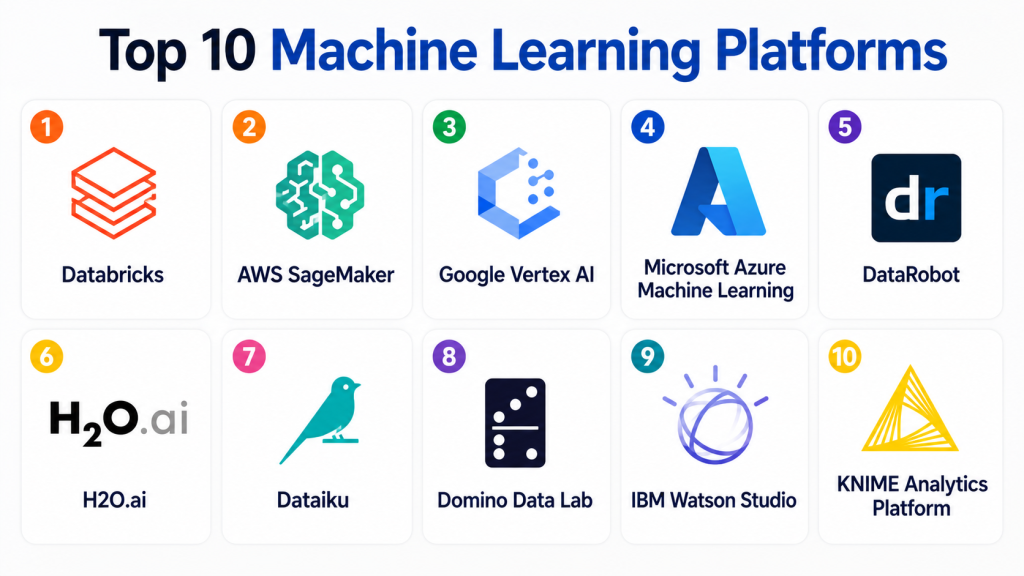
Top 10 Machine Learning Platforms
1- Databricks
Databricks is a cloud-native AI and analytics platform built around lakehouse architecture, distributed computing, and scalable machine learning operations. It is widely used for enterprise AI development and large-scale analytics workflows.
Key Features
- Distributed machine learning
- Unified lakehouse architecture
- MLflow integration
- GPU-enabled infrastructure
- Real-time analytics support
- Collaborative notebooks
- Generative AI workflow integrations
Pros
- Excellent scalability for enterprise AI workloads
- Strong analytics and AI ecosystem integration
- Unified engineering and ML workflows
Cons
- Premium enterprise pricing
- Requires engineering expertise
- Advanced optimization may be necessary
Platforms / Deployment
- Web
- Linux
- Cloud
Security & Compliance
Supports SSO, MFA, RBAC, encryption, audit logging, and governance workflows.
Integrations & Ecosystem
Databricks integrates deeply with modern analytics and AI ecosystems.
- Spark
- Snowflake
- dbt
- AWS
- Azure
- MLflow
Support & Community
Strong enterprise ecosystem with extensive onboarding and cloud-native support resources.
2- AWS SageMaker
AWS SageMaker is a fully managed machine learning platform designed for scalable AI development, distributed training, deployment automation, and operational monitoring.
Key Features
- Managed ML infrastructure
- Distributed model training
- AutoML capabilities
- MLOps automation
- Real-time inference
- GPU acceleration
- Experiment tracking
Pros
- Strong AWS ecosystem integration
- Excellent scalability for AI workloads
- Managed infrastructure simplicity
Cons
- Best optimized for AWS environments
- Pricing complexity at scale
- Advanced workflows may require expertise
Platforms / Deployment
- Web
- Cloud
Security & Compliance
Supports RBAC, MFA, encryption, SSO, audit logging, and governance workflows.
Integrations & Ecosystem
SageMaker integrates deeply with AWS cloud and AI services.
- S3
- Bedrock
- Lambda
- Redshift
- Kubernetes
- CloudWatch
Support & Community
Strong enterprise ecosystem backed by AWS support services.
3- Google Vertex AI
Google Vertex AI provides unified machine learning workflows, generative AI tooling, model deployment infrastructure, and AI lifecycle management for cloud-native environments.
Key Features
- Managed AI infrastructure
- Generative AI integrations
- AutoML support
- Distributed training
- MLOps pipelines
- Feature store support
- Real-time inference
Pros
- Excellent AI and LLM integrations
- Strong cloud-native scalability
- Unified AI development workflows
Cons
- Best optimized for Google Cloud
- Enterprise pricing complexity
- Multi-cloud flexibility limited
Platforms / Deployment
- Web
- Cloud
Security & Compliance
Supports MFA, RBAC, encryption, SSO, and governance workflows.
Integrations & Ecosystem
Vertex AI integrates strongly with Google Cloud ecosystems.
- BigQuery
- Kubernetes
- Gemini
- TensorFlow
- Dataflow
- Looker
Support & Community
Strong AI ecosystem with extensive cloud-native documentation.
4- Microsoft Azure Machine Learning
Azure Machine Learning provides enterprise-grade AI development, distributed training, responsible AI tooling, and MLOps automation within Microsoft cloud ecosystems.
Key Features
- Enterprise MLOps pipelines
- Distributed training
- Responsible AI tooling
- GPU infrastructure support
- AutoML capabilities
- Hybrid cloud AI workflows
- Model deployment automation
Pros
- Strong Microsoft ecosystem integration
- Excellent governance tooling
- Good hybrid deployment support
Cons
- Complex enterprise configuration
- Pricing may scale quickly
- Advanced workflows require expertise
Platforms / Deployment
- Web
- Cloud
- Hybrid
Security & Compliance
Supports RBAC, MFA, SSO, encryption, audit logging, and governance controls.
Integrations & Ecosystem
Azure ML integrates deeply with Microsoft analytics and AI ecosystems.
- Power BI
- Synapse Analytics
- Azure OpenAI
- Kubernetes
- SQL Server
- GitHub
Support & Community
Strong enterprise support ecosystem backed by Microsoft cloud infrastructure.
5- DataRobot
DataRobot provides enterprise AI automation, predictive analytics, and machine learning lifecycle management for organizations seeking accelerated AI adoption.
Key Features
- AutoML workflows
- Predictive analytics
- AI lifecycle management
- Explainable AI support
- MLOps automation
- Model deployment tools
- AI governance controls
Pros
- Strong automation capabilities
- Good usability for business teams
- Accelerates model development
Cons
- Premium pricing
- Advanced customization may be limited
- Less flexible than developer-first platforms
Platforms / Deployment
- Web
- Cloud
- Hybrid
Security & Compliance
Supports RBAC, encryption, SSO, audit logging, and governance workflows.
Integrations & Ecosystem
DataRobot integrates broadly with enterprise analytics ecosystems.
- Snowflake
- Databricks
- AWS
- Azure
- Tableau
- Kubernetes
Support & Community
Strong enterprise onboarding and AI support ecosystem.
6- H2O.ai
H2O.ai provides distributed machine learning, AI automation, predictive analytics, and explainable AI tooling for enterprises and data science teams.
Key Features
- AutoML workflows
- Explainable AI
- Distributed training
- GPU acceleration support
- Predictive analytics
- Hybrid deployment support
- AI model deployment
Pros
- Strong AutoML capabilities
- Good scalability for predictive analytics
- Flexible deployment support
Cons
- Enterprise configuration complexity
- Advanced customization learning curve
- Smaller ecosystem than hyperscalers
Platforms / Deployment
- Web
- Linux
- Windows
- Cloud
- Hybrid
- Self-hosted
Security & Compliance
Supports RBAC, encryption, authentication workflows, and governance tooling.
Integrations & Ecosystem
H2O.ai integrates with AI and distributed analytics ecosystems.
- Spark
- Snowflake
- Kubernetes
- Python
- Tableau
- Hadoop
Support & Community
Strong enterprise AI ecosystem with active open-source community adoption.
7- Dataiku
Dataiku provides collaborative AI development, analytics automation, and governance tooling designed for enterprise-scale machine learning operations.
Key Features
- Collaborative AI workflows
- Visual ML pipelines
- AutoML support
- MLOps orchestration
- Governance controls
- Generative AI integrations
- Hybrid deployment support
Pros
- Strong usability across technical and business users
- Excellent governance capabilities
- Broad enterprise AI support
Cons
- Premium enterprise pricing
- Advanced customization requires expertise
- Large deployments may become operationally complex
Platforms / Deployment
- Web
- Linux
- Windows
- Cloud
- Hybrid
- Self-hosted
Security & Compliance
Supports RBAC, MFA, encryption, SSO, and governance workflows.
Integrations & Ecosystem
Dataiku integrates broadly with enterprise AI ecosystems.
- Snowflake
- Databricks
- AWS
- Azure
- Kubernetes
- Tableau
Support & Community
Strong onboarding ecosystem with enterprise-focused support resources.
8- Domino Data Lab
Domino Data Lab focuses on collaborative data science, experiment reproducibility, AI governance, and enterprise-scale machine learning operations.
Key Features
- Collaborative AI workspaces
- Experiment tracking
- Reproducible workflows
- Governance tooling
- Hybrid infrastructure support
- GPU orchestration
- Model deployment support
Pros
- Strong governance and compliance capabilities
- Excellent collaboration workflows
- Good hybrid infrastructure support
Cons
- Premium enterprise pricing
- Smaller ecosystem than hyperscalers
- Advanced customization may require expertise
Platforms / Deployment
- Web
- Linux
- Cloud
- Hybrid
- Self-hosted
Security & Compliance
Supports RBAC, MFA, SSO, encryption, audit logging, and governance workflows.
Integrations & Ecosystem
Domino integrates with enterprise AI infrastructure ecosystems.
- Databricks
- Snowflake
- Kubernetes
- MLflow
- GitHub
- Jupyter
Support & Community
Enterprise-focused onboarding and support ecosystem.
9- IBM Watson Studio
IBM Watson Studio provides collaborative AI development, machine learning automation, governance tooling, and hybrid cloud AI lifecycle management.
Key Features
- Collaborative notebooks
- AutoAI support
- MLOps automation
- AI governance tooling
- Hybrid cloud deployment
- Model monitoring
- Enterprise AI lifecycle management
Pros
- Strong enterprise governance capabilities
- Good hybrid deployment support
- Integrated AI lifecycle workflows
Cons
- Enterprise pricing complexity
- Smaller modern AI ecosystem momentum
- Advanced workflows may require expertise
Platforms / Deployment
- Web
- Linux
- Cloud
- Hybrid
Security & Compliance
Supports RBAC, MFA, encryption, SSO, audit logging, and governance workflows.
Integrations & Ecosystem
Watson Studio integrates with IBM and enterprise AI ecosystems.
- Red Hat OpenShift
- Kubernetes
- Db2
- Spark
- Python
- Jupyter
Support & Community
Strong enterprise onboarding and support infrastructure.
10- KNIME Analytics Platform
KNIME Analytics Platform is a low-code analytics and machine learning platform designed for workflow automation, predictive analytics, and AI experimentation.
Key Features
- Visual workflow builder
- Low-code AI pipelines
- Predictive analytics support
- Workflow automation
- Data preparation tooling
- Open-source extensibility
- AI integrations
Pros
- Strong usability for non-technical teams
- Flexible workflow automation
- Good open-source ecosystem
Cons
- Enterprise scaling limitations
- Advanced distributed AI less mature
- UI complexity for large workflows
Platforms / Deployment
- Windows
- macOS
- Linux
- Cloud
- Self-hosted
- Hybrid
Security & Compliance
Supports authentication workflows and enterprise deployment security controls.
Integrations & Ecosystem
KNIME integrates with analytics and AI tooling ecosystems.
- Python
- R
- Spark
- TensorFlow
- Snowflake
- Tableau
Support & Community
Large open-source community with strong analytics workflow adoption.
Comparison Table
| Tool Name | Best For | Platforms Supported | Deployment | Standout Feature | Public Rating |
|---|---|---|---|---|---|
| Databricks | Enterprise AI and analytics | Web, Linux | Cloud | Unified lakehouse architecture | N/A |
| AWS SageMaker | Cloud-native AI operations | Web | Cloud | Managed ML infrastructure | N/A |
| Google Vertex AI | Generative AI development | Web | Cloud | Unified Google AI ecosystem | N/A |
| Azure Machine Learning | Enterprise MLOps | Web | Hybrid | Responsible AI tooling | N/A |
| DataRobot | AI automation | Web | Hybrid | AutoML workflows | N/A |
| H2O.ai | Predictive analytics | Web, Linux, Windows | Hybrid | Explainable AI support | N/A |
| Dataiku | Collaborative enterprise AI | Web, Linux, Windows | Hybrid | Visual AI workflows | N/A |
| Domino Data Lab | Governed AI collaboration | Web, Linux | Hybrid | Reproducible workflows | N/A |
| IBM Watson Studio | Hybrid enterprise AI | Web, Linux | Hybrid | AI lifecycle governance | N/A |
| KNIME Analytics Platform | Low-code machine learning | Windows, macOS, Linux | Hybrid | Visual workflow automation | N/A |
Evaluation & Scoring of Machine Learning Platforms
| Tool Name | Core | Ease | Integrations | Security | Performance | Support | Value | Weighted Total |
|---|---|---|---|---|---|---|---|---|
| Databricks | 9.5 | 8 | 9.5 | 8.5 | 9.5 | 9 | 7.5 | 8.9 |
| AWS SageMaker | 9 | 8 | 9 | 8.5 | 9 | 8.5 | 7.5 | 8.5 |
| Google Vertex AI | 9 | 8 | 8.5 | 8.5 | 9 | 8.5 | 7.5 | 8.5 |
| Azure Machine Learning | 8.5 | 7.5 | 9 | 8.5 | 8.5 | 8.5 | 7.5 | 8.3 |
| DataRobot | 8.5 | 8.5 | 8 | 8 | 8.5 | 8 | 7 | 8.0 |
| H2O.ai | 8.5 | 8 | 8 | 8 | 8.5 | 8 | 8 | 8.1 |
| Dataiku | 9 | 8.5 | 8.5 | 8.5 | 8.5 | 8.5 | 7 | 8.4 |
| Domino Data Lab | 8.5 | 8 | 8 | 9 | 8.5 | 8 | 7 | 8.0 |
| IBM Watson Studio | 8 | 7.5 | 8 | 8.5 | 8 | 8 | 7 | 7.8 |
| KNIME Analytics Platform | 8 | 8.5 | 7.5 | 7.5 | 7.5 | 8 | 9 | 8.0 |
These scores are comparative evaluations designed to help buyers understand relative strengths across usability, integrations, governance, scalability, and operational value. Enterprise-focused platforms generally score higher in governance, distributed infrastructure, and AI lifecycle management, while low-code and open-source platforms often provide stronger accessibility and affordability. Buyers should prioritize scoring categories aligned with organizational AI maturity, infrastructure strategy, and operational complexity.
Which Machine Learning Platform Is Right for You?
Solo / Freelancer
KNIME Analytics Platform and H2O.ai are attractive for independent experimentation, predictive analytics, and AI prototyping with manageable operational overhead.
SMB
DataRobot and Dataiku provide strong automation, usability, and collaboration workflows for growing AI teams and analytics operations.
Mid-Market
Azure Machine Learning and H2O.ai balance governance, scalability, and operational flexibility for expanding organizations.
Enterprise
Databricks, SageMaker, and Vertex AI are better suited for large-scale AI infrastructure, distributed machine learning, and governed enterprise MLOps workflows.
Budget vs Premium
Open-source and low-code platforms reduce infrastructure and licensing costs but may require additional operational tooling. Premium enterprise platforms simplify orchestration and governance while increasing infrastructure expenses.
Feature Depth vs Ease of Use
DataRobot and KNIME emphasize usability and workflow simplicity, while Databricks and SageMaker prioritize advanced distributed AI infrastructure capabilities.
Integrations & Scalability
Organizations operating modern AI ecosystems should prioritize distributed compute support, GPU orchestration, API interoperability, vector database compatibility, and MLOps integrations.
Security & Compliance Needs
Highly regulated industries should prioritize encryption, RBAC, audit logging, governance workflows, responsible AI tooling, and secure cloud-native deployment architectures.
Frequently Asked Questions
1. What are Machine Learning Platforms?
Machine Learning Platforms provide infrastructure and tools for building, training, deploying, monitoring, and managing AI and machine learning workflows.
2. Why are Machine Learning Platforms important today?
Modern organizations increasingly rely on predictive analytics, generative AI, automation, and machine learning systems that require scalable and governed AI infrastructure.
3. What is the difference between Machine Learning Platforms and analytics tools?
Analytics tools primarily focus on reporting and dashboards, while machine learning platforms support AI model development, deployment, training, monitoring, and MLOps workflows.
4. Are open-source machine learning platforms suitable for enterprises?
Yes. Many enterprises use open-source ecosystems such as MLflow, Jupyter, Spark, and KNIME alongside enterprise AI infrastructure tooling.
5. Which industries benefit most from Machine Learning Platforms?
Financial services, healthcare, telecommunications, retail, logistics, SaaS, manufacturing, and AI-driven organizations benefit heavily from machine learning platforms.
6. How do generative AI capabilities affect platform selection?
Generative AI support is becoming increasingly important because organizations now require LLM orchestration, vector search integrations, prompt workflows, and AI governance tooling.
7. What are common machine learning implementation mistakes?
Common mistakes include weak governance planning, underestimating infrastructure costs, insufficient observability, fragmented AI tooling, and poor MLOps automation strategies.
8. Do Machine Learning Platforms support cloud-native AI infrastructure?
Most modern platforms support Kubernetes, distributed training, GPU orchestration, cloud object storage, and hybrid AI deployment architectures.
9. Can Machine Learning Platforms integrate with analytics ecosystems?
Yes. Modern machine learning platforms integrate with Snowflake, Power BI, Tableau, Databricks, Kubernetes, vector databases, and cloud analytics ecosystems.
10. How should organizations evaluate pricing?
Organizations should evaluate GPU consumption pricing, managed infrastructure costs, orchestration overhead, licensing complexity, scalability requirements, and operational maintenance expenses.
Conclusion
Machine Learning Platforms have become foundational infrastructure for modern AI-driven organizations. As enterprises continue expanding generative AI initiatives, predictive analytics operations, and cloud-native AI architectures, these platforms now play a critical role in enabling scalable, governed, and production-ready machine learning systems. The best platform depends heavily on organizational size, cloud strategy, AI maturity, governance requirements, and engineering expertise. Enterprises may prioritize Databricks, SageMaker, or Vertex AI for large-scale distributed AI infrastructure, while smaller teams may prefer KNIME or H2O.ai for accessibility and workflow simplicity. The smartest next step is to shortlist two or three platforms, validate integrations with existing analytics and AI ecosystems, run pilot workloads using production-like datasets, and then scale gradually across operational environments.

Find Trusted Cardiac Hospitals
Compare heart hospitals by city and services — all in one place.
Explore Hospitals
This article gives a clear overview of machine learning platforms and helps readers understand how different tools support model building, deployment, and faster AI development.