Introduction
AutoML Platforms automate many of the complex steps involved in building machine learning models, including data preparation, feature engineering, model selection, hyperparameter tuning, deployment, and monitoring. These platforms help organizations accelerate AI adoption without requiring every team member to be a deep machine learning expert. AutoML matters more than ever because enterprises are under pressure to operationalize AI faster while dealing with growing talent shortages, governance requirements, and infrastructure complexity. Modern AutoML tools now include generative AI integrations, MLOps automation, explainability features, and low-code workflows that reduce time-to-production.
Common Real-world use cases include:
- Customer churn prediction
- Fraud detection and risk scoring
- Demand forecasting
- Predictive maintenance
- Marketing campaign optimization
- Document classification and NLP automation
Buyers Evaluating AutoML platforms should consider:
- Ease of use for non-technical users
- Advanced model customization options
- MLOps and deployment capabilities
- Scalability and infrastructure flexibility
- Integration ecosystem
- Governance and explainability
- Security and compliance support
- Pricing transparency
- Real-time inference capabilities
- Multi-cloud or hybrid deployment support
Best for: Enterprises, data science teams, analytics leaders, AI product teams, and mid-sized organizations seeking faster machine learning deployment with reduced engineering overhead.
Not ideal for: Organizations requiring extremely custom research-grade ML pipelines, highly specialized algorithm development, or teams that already maintain mature in-house ML infrastructure with advanced engineering expertise.
Key Trends in AutoML Platforms
- Generative AI-assisted model building is becoming standard, with copilots helping users generate pipelines, SQL queries, and model explanations.
- Integrated MLOps capabilities now include deployment, monitoring, drift detection, retraining, and governance inside a single platform.
- Hybrid and multi-cloud AI architectures are increasingly common as enterprises avoid vendor lock-in.
- Responsible AI tooling such as explainability, fairness analysis, and audit logging is becoming mandatory in regulated industries.
- Low-code and no-code AI workflows continue expanding adoption among business analysts and operational teams.
- Foundation model integration is appearing in AutoML platforms for NLP, recommendation systems, and multimodal AI workflows.
- Real-time inference optimization is gaining importance for fraud detection, IoT, and edge AI applications.
- Cost optimization and GPU efficiency are now major differentiators due to rising AI infrastructure costs.
- Open-source interoperability with frameworks like TensorFlow, PyTorch, MLflow, and Kubernetes is becoming expected.
- Industry-specific AI templates are growing for healthcare, retail, manufacturing, telecom, and financial services.
How We Selected These Tools (Methodology)
The tools in this list were evaluated using a practical enterprise-focused methodology:
- Market adoption and long-term industry relevance
- Breadth of AutoML functionality and workflow coverage
- Ease of onboarding for technical and non-technical users
- Deployment flexibility across cloud and hybrid environments
- MLOps maturity and lifecycle management capabilities
- Integration ecosystem and API extensibility
- Support for explainable AI and governance workflows
- Security posture and enterprise readiness indicators
- Community adoption and developer ecosystem strength
- Fit across SMB, mid-market, and enterprise environments
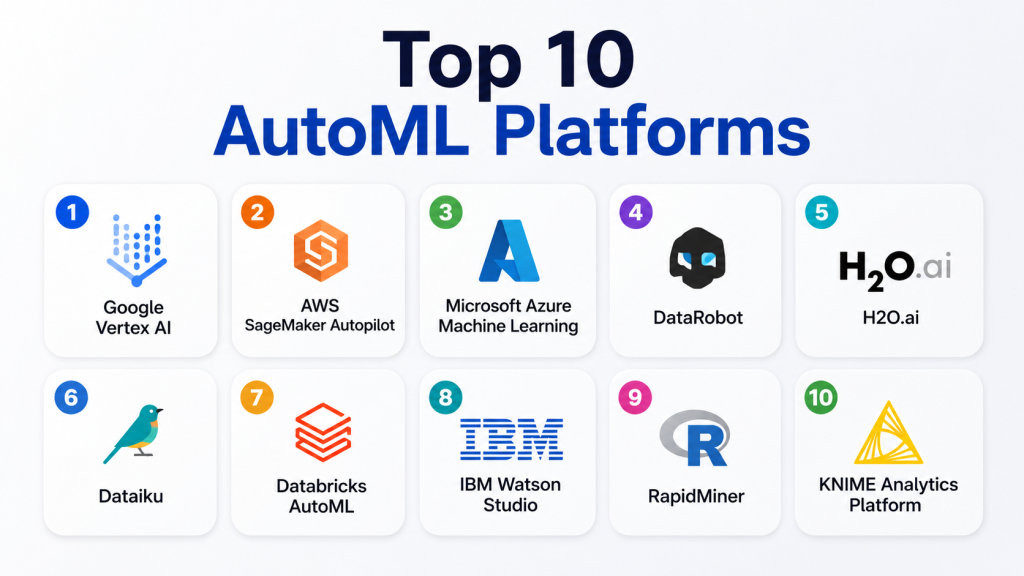
Top 10 AutoML Platforms Tools
1- Google Vertex AI
Short description: Google Vertex AI is a cloud-native AI platform that combines AutoML, MLOps, data pipelines, and generative AI services. It is widely used by enterprises building scalable machine learning applications on Google Cloud.
Key Features
- AutoML for tabular, image, video, text, and forecasting models
- Integrated notebook and pipeline orchestration
- Feature Store and model registry
- Built-in MLOps monitoring and drift detection
- Generative AI and foundation model support
- Explainable AI capabilities
- GPU and TPU acceleration
Pros
- Strong integration with Google Cloud ecosystem
- Excellent scalability for enterprise AI workloads
- Mature MLOps and deployment tooling
Cons
- Best experience requires deep Google Cloud adoption
- Pricing complexity for large-scale workloads
- Advanced customization may require engineering expertise
Platforms / Deployment
- Web
- Cloud
Security & Compliance
Supports IAM, RBAC, encryption, audit logging, MFA, GDPR capabilities, and enterprise security controls. Additional compliance varies by Google Cloud service.
Integrations & Ecosystem
Vertex AI integrates deeply with BigQuery, Kubernetes, TensorFlow, and Google Cloud analytics services. The ecosystem is especially strong for organizations already invested in Google infrastructure.
- BigQuery
- TensorFlow
- Kubernetes
- Looker
- MLflow
- Google Cloud Storage
Support & Community
Strong enterprise documentation, training resources, and global support availability. Large developer ecosystem and active AI community.
2- AWS SageMaker Autopilot
Short description: AWS SageMaker Autopilot automates machine learning model development inside the broader SageMaker ecosystem. It is designed for enterprises and developers already operating within AWS environments.
Key Features
- Automated feature engineering
- Automated model selection and tuning
- Integrated model deployment
- Built-in monitoring and governance
- Distributed training support
- Real-time and batch inference
- Extensive infrastructure scalability
Pros
- Deep AWS ecosystem integration
- Strong enterprise scalability
- Mature cloud-native deployment tooling
Cons
- AWS ecosystem complexity can overwhelm beginners
- Cost management may require careful monitoring
- Less approachable for non-technical business users
Platforms / Deployment
- Web
- Cloud
Security & Compliance
Supports IAM, encryption, audit logging, VPC isolation, SSO, and enterprise AWS compliance programs.
Integrations & Ecosystem
SageMaker integrates with nearly every AWS analytics and infrastructure service, making it attractive for cloud-native enterprises.
- Amazon S3
- Redshift
- Lambda
- ECS/EKS
- CloudWatch
- MLflow
Support & Community
Excellent enterprise support ecosystem and large AWS developer community with extensive learning resources.
3- Microsoft Azure Machine Learning
Short description: Azure Machine Learning offers AutoML capabilities alongside enterprise AI governance, MLOps, and hybrid cloud infrastructure support. It is commonly adopted by organizations using Microsoft enterprise tooling.
Key Features
- Automated model training and selection
- Drag-and-drop ML designer
- Responsible AI dashboards
- Model monitoring and lifecycle management
- Integration with Microsoft Fabric and Power BI
- Hybrid AI deployment support
- Large language model integration
Pros
- Strong enterprise governance tooling
- Excellent Microsoft ecosystem integration
- Hybrid deployment flexibility
Cons
- Interface complexity for beginners
- Advanced workflows may require Azure expertise
- Pricing can scale rapidly with compute usage
Platforms / Deployment
- Web
- Cloud / Hybrid
Security & Compliance
Supports RBAC, MFA, encryption, audit logging, Microsoft Entra integration, and enterprise compliance frameworks.
Integrations & Ecosystem
Azure ML integrates deeply with Microsoft’s enterprise analytics, DevOps, and data services.
- Power BI
- Azure Synapse
- GitHub
- Kubernetes
- Databricks
- Microsoft Fabric
Support & Community
Strong enterprise support options and extensive documentation. Large ecosystem among enterprise IT teams.
4- DataRobot
Short description: DataRobot is a mature enterprise AutoML platform focused on predictive analytics, MLOps, and AI governance. It is widely used in financial services, healthcare, and large enterprise environments.
Key Features
- Automated model building and tuning
- AI governance and explainability
- Time-series forecasting support
- MLOps and monitoring
- Low-code AI workflows
- Generative AI integrations
- Industry-focused AI accelerators
Pros
- Strong governance and explainability features
- Business-friendly user experience
- Mature enterprise AI lifecycle tooling
Cons
- Premium enterprise pricing
- May be excessive for small teams
- Less attractive for highly custom ML research workflows
Platforms / Deployment
- Web
- Cloud / Hybrid / Self-hosted
Security & Compliance
Supports SSO, RBAC, encryption, audit trails, and enterprise governance controls. Additional compliance varies by deployment.
Integrations & Ecosystem
DataRobot supports integration with cloud providers, enterprise data warehouses, and MLOps frameworks.
- Snowflake
- Databricks
- AWS
- Azure
- Google Cloud
- MLflow
Support & Community
Strong enterprise onboarding and consulting support. Community smaller than hyperscaler ecosystems but highly enterprise-focused.
5- H2O.ai
Short description: H2O.ai provides open-source and enterprise AI automation tools focused on scalable machine learning, explainability, and AI acceleration for enterprises and developers.
Key Features
- Automated machine learning workflows
- Open-source AI framework support
- Explainable AI tooling
- Driverless AI automation
- GPU acceleration
- Time-series and NLP support
- Feature engineering automation
Pros
- Strong open-source ecosystem
- Good balance of automation and flexibility
- Competitive explainability capabilities
Cons
- Enterprise features may require premium licensing
- UI less polished than some competitors
- Advanced deployment may require engineering expertise
Platforms / Deployment
- Web / Linux / Windows
- Cloud / Hybrid / Self-hosted
Security & Compliance
Supports enterprise authentication, RBAC, encryption, and governance tooling. Compliance details vary by deployment.
Integrations & Ecosystem
H2O.ai integrates with open-source data science ecosystems and major cloud providers.
- Python
- R
- Spark
- Kubernetes
- AWS
- Azure
Support & Community
Large open-source community and strong enterprise support options for commercial users.
6- Dataiku
Short description: Dataiku is a collaborative AI and analytics platform combining AutoML, data engineering, governance, and business analytics workflows in a unified environment.
Key Features
- Visual AutoML workflows
- Collaborative data science environment
- Built-in governance and lineage tracking
- MLOps automation
- Generative AI integration
- Low-code and no-code workflows
- Enterprise deployment flexibility
Pros
- Strong collaboration features
- Excellent balance between technical and business users
- Mature governance capabilities
Cons
- Enterprise pricing may be high for SMBs
- Can require infrastructure planning
- Advanced features have learning curve
Platforms / Deployment
- Web
- Cloud / Hybrid / Self-hosted
Security & Compliance
Supports SSO, RBAC, audit logging, encryption, and enterprise governance controls.
Integrations & Ecosystem
Dataiku integrates with cloud warehouses, notebooks, and enterprise analytics systems.
- Snowflake
- Databricks
- Hadoop
- Spark
- AWS
- Azure
Support & Community
Strong enterprise support and growing global user community with extensive training resources.
7- Databricks AutoML
Short description: Databricks AutoML simplifies model development within the Databricks Lakehouse ecosystem. It is especially popular among data engineering and analytics teams already using Spark and Delta Lake.
Key Features
- Automated model experimentation
- Notebook generation for transparency
- Native Spark integration
- Lakehouse architecture support
- Feature engineering automation
- MLflow integration
- Unified analytics and AI workflows
Pros
- Excellent for large-scale data environments
- Strong open ecosystem alignment
- Transparent notebook-based workflows
Cons
- Requires familiarity with Databricks ecosystem
- Less business-user friendly than low-code competitors
- Enterprise pricing can be significant
Platforms / Deployment
- Web
- Cloud
Security & Compliance
Supports enterprise security controls including RBAC, encryption, audit logging, and SSO integrations.
Integrations & Ecosystem
Databricks integrates strongly with modern data engineering and analytics platforms.
- Apache Spark
- MLflow
- Delta Lake
- Snowflake
- AWS
- Azure
Support & Community
Very strong developer ecosystem with active data engineering and machine learning communities.
8- IBM Watson Studio
Short description: IBM Watson Studio provides enterprise AI development, AutoML, and governance tooling with strong focus on regulated industries and hybrid deployments.
Key Features
- Automated model creation
- AI governance workflows
- Explainability dashboards
- Hybrid cloud AI deployment
- Integrated data preparation
- NLP and conversational AI support
- MLOps lifecycle management
Pros
- Strong governance and compliance focus
- Hybrid deployment flexibility
- Enterprise AI lifecycle tooling
Cons
- Interface can feel enterprise-heavy
- Smaller community than hyperscaler ecosystems
- Some advanced workflows may require IBM expertise
Platforms / Deployment
- Web
- Cloud / Hybrid / Self-hosted
Security & Compliance
Supports enterprise authentication, encryption, governance controls, and audit logging capabilities.
Integrations & Ecosystem
IBM Watson Studio integrates with enterprise infrastructure and analytics environments.
- Red Hat OpenShift
- Cloud Pak for Data
- Spark
- Kubernetes
- IBM Cloud
- DataStage
Support & Community
Strong enterprise consulting and support capabilities with global enterprise customer base.
9- RapidMiner
Short description: RapidMiner focuses on low-code data science and AutoML workflows for analysts, business teams, and mid-sized organizations seeking accessible machine learning capabilities.
Key Features
- Visual workflow designer
- Automated machine learning
- Data preparation tools
- Explainable AI features
- Predictive analytics workflows
- Team collaboration tools
- Reusable pipeline templates
Pros
- Beginner-friendly environment
- Strong visual workflow design
- Accessible for business analysts
Cons
- Less scalable for very large enterprise workloads
- Limited flexibility compared to developer-centric platforms
- Advanced customization may feel constrained
Platforms / Deployment
- Web / Windows / Linux
- Cloud / Self-hosted
Security & Compliance
Basic enterprise security features supported. Additional compliance details not publicly stated.
Integrations & Ecosystem
RapidMiner integrates with common business analytics and data platforms.
- Python
- R
- Tableau
- Hadoop
- SQL databases
- REST APIs
Support & Community
Good onboarding resources and active analytics-focused community.
10- KNIME Analytics Platform
Short description: KNIME Analytics Platform is an open and extensible analytics platform that includes AutoML capabilities, workflow automation, and strong support for data science experimentation.
Key Features
- Visual workflow-based automation
- AutoML extensions
- Open-source architecture
- Extensive data connectors
- Reusable analytics pipelines
- Python and R integration
- Collaboration tooling
Pros
- Strong open-source flexibility
- Excellent workflow transparency
- Good integration ecosystem
Cons
- UI may feel dated to some users
- Enterprise governance less mature than premium platforms
- Advanced scaling requires planning
Platforms / Deployment
- Windows / macOS / Linux
- Cloud / Self-hosted
Security & Compliance
Varies by deployment. Enterprise governance capabilities available in commercial offerings.
Integrations & Ecosystem
KNIME integrates broadly with data science ecosystems and enterprise databases.
- Python
- R
- Spark
- SQL databases
- AWS
- Azure
Support & Community
Large open-source community and extensive educational resources.
Comparison Table (Top 10)
| Tool Name | Best For | Platform(s) Supported | Deployment | Standout Feature | Public Rating |
|---|---|---|---|---|---|
| Google Vertex AI | Enterprise AI teams | Web | Cloud | Integrated generative AI + MLOps | N/A |
| AWS SageMaker Autopilot | AWS-native enterprises | Web | Cloud | Deep AWS ecosystem integration | N/A |
| Azure Machine Learning | Microsoft-centric organizations | Web | Cloud / Hybrid | Responsible AI tooling | N/A |
| DataRobot | Enterprise predictive analytics | Web | Cloud / Hybrid / Self-hosted | Governance and explainability | N/A |
| H2O.ai | Open-source enterprise AI | Web, Windows, Linux | Cloud / Hybrid / Self-hosted | Driverless AI automation | N/A |
| Dataiku | Collaborative AI teams | Web | Cloud / Hybrid / Self-hosted | Business and technical collaboration | N/A |
| Databricks AutoML | Data engineering teams | Web | Cloud | Lakehouse-native AI workflows | N/A |
| IBM Watson Studio | Regulated industries | Web | Cloud / Hybrid / Self-hosted | Enterprise governance focus | N/A |
| RapidMiner | Analysts and SMBs | Web, Windows, Linux | Cloud / Self-hosted | Visual workflow automation | N/A |
| KNIME Analytics Platform | Open-source workflow automation | Windows, macOS, Linux | Cloud / Self-hosted | Workflow transparency | N/A |
Evaluation & Scoring of AutoML Platforms
| Tool Name | Core (25%) | Ease (15%) | Integrations (15%) | Security (10%) | Performance (10%) | Support (10%) | Value (15%) | Weighted Total |
|---|---|---|---|---|---|---|---|---|
| Google Vertex AI | 9.5 | 8.0 | 9.5 | 9.0 | 9.5 | 9.0 | 8.0 | 8.95 |
| AWS SageMaker Autopilot | 9.5 | 7.5 | 9.5 | 9.5 | 9.5 | 9.0 | 7.5 | 8.93 |
| Azure Machine Learning | 9.0 | 8.0 | 9.0 | 9.5 | 9.0 | 9.0 | 8.0 | 8.73 |
| DataRobot | 9.0 | 9.0 | 8.5 | 9.0 | 8.5 | 8.5 | 7.0 | 8.43 |
| H2O.ai | 8.5 | 7.5 | 8.5 | 8.0 | 8.5 | 8.0 | 8.5 | 8.18 |
| Dataiku | 8.5 | 8.5 | 8.5 | 8.5 | 8.5 | 8.5 | 7.5 | 8.35 |
| Databricks AutoML | 9.0 | 7.5 | 9.5 | 9.0 | 9.5 | 8.5 | 7.5 | 8.73 |
| IBM Watson Studio | 8.5 | 7.0 | 8.0 | 9.0 | 8.0 | 8.5 | 7.5 | 8.00 |
| RapidMiner | 7.5 | 9.0 | 7.5 | 7.5 | 7.5 | 8.0 | 8.5 | 7.95 |
| KNIME Analytics Platform | 8.0 | 8.0 | 8.5 | 7.5 | 8.0 | 8.0 | 9.0 | 8.18 |
These scores are comparative and intended to help buyers evaluate relative strengths across the market. Enterprise-focused platforms often score higher in governance, scalability, and integrations, while open-source or SMB-oriented tools may deliver stronger value scores. Organizations should prioritize criteria differently depending on budget, technical expertise, compliance requirements, and deployment complexity. A slightly lower overall score does not necessarily mean a tool is a poor fit for a specific use case.
Which AutoML Tool Is Right for You?
Solo / Freelancer
Individual analysts, consultants, and independent developers often benefit most from tools with low setup complexity and affordable entry points. KNIME, RapidMiner, and H2O.ai are strong options because they provide accessible workflows without requiring large infrastructure investments.
SMB
Small and mid-sized businesses usually need fast deployment, low operational overhead, and straightforward interfaces. Dataiku, RapidMiner, and Azure Machine Learning can work well depending on technical maturity and existing cloud investments.
Mid-Market
Mid-market organizations often require a balance between governance, collaboration, and scalability. DataRobot, Dataiku, and Databricks AutoML provide strong collaboration and MLOps capabilities without the operational burden of building AI infrastructure internally.
Enterprise
Large enterprises typically prioritize governance, security, scalability, and hybrid deployment flexibility. Vertex AI, SageMaker Autopilot, Azure Machine Learning, and IBM Watson Studio are strong enterprise candidates.
Budget vs Premium
Budget-conscious teams may prefer KNIME, H2O.ai, or RapidMiner due to open-source flexibility and lower entry barriers. Premium enterprise platforms such as DataRobot and Vertex AI deliver broader governance and operational automation at higher cost.
Feature Depth vs Ease of Use
RapidMiner and Dataiku emphasize accessibility and visual workflows, while Databricks and SageMaker offer deeper infrastructure flexibility for advanced technical teams.
Integrations & Scalability
Organizations deeply invested in AWS, Azure, or Google Cloud should generally prioritize native ecosystem alignment to reduce integration complexity and operational overhead.
Security & Compliance Needs
Highly regulated industries should evaluate governance tooling, explainability, RBAC, audit logging, and hybrid deployment support carefully. DataRobot, IBM Watson Studio, and Azure Machine Learning are particularly strong in governance-oriented environments.
Frequently Asked Questions (FAQs)
What is an AutoML platform?
An AutoML platform automates many machine learning tasks such as feature engineering, model selection, training, tuning, and deployment. It helps organizations build AI solutions faster with less manual coding.
Are AutoML platforms only for non-technical users?
No. Many AutoML platforms support both business users and advanced data scientists. Technical teams often use AutoML to accelerate experimentation and production deployment workflows.
Can AutoML replace data scientists?
AutoML reduces repetitive work but does not fully replace experienced data scientists. Human expertise is still essential for data quality, business context, governance, and advanced modeling decisions.
What industries use AutoML the most?
Financial services, healthcare, manufacturing, retail, telecom, logistics, and SaaS companies are among the largest adopters of AutoML technologies.
Are AutoML platforms expensive?
Pricing varies widely. Cloud-native platforms typically use consumption-based pricing, while enterprise platforms may require annual licensing agreements. Open-source options can reduce entry costs.
How long does AutoML implementation take?
Basic proof-of-concept deployments can be completed within days or weeks. Enterprise-wide AI operationalization may take several months depending on governance and integration complexity.
What are the biggest mistakes organizations make with AutoML?
Common mistakes include poor data quality, unclear business objectives, underestimating governance needs, and assuming automation eliminates the need for ML expertise.
Do AutoML platforms support generative AI?
Many modern AutoML platforms now include generative AI capabilities such as AI copilots, foundation model integrations, NLP automation, and prompt-based workflow generation.
Can AutoML platforms run on-premises?
Some platforms support self-hosted or hybrid deployments, especially enterprise-focused tools like DataRobot, IBM Watson Studio, H2O.ai, and Dataiku.
How important is MLOps in AutoML?
MLOps is critical because organizations need monitoring, retraining, governance, deployment automation, and model lifecycle management after initial model creation.
What integrations should buyers prioritize?
Organizations should prioritize integrations with cloud infrastructure, data warehouses, BI tools, Kubernetes, identity management systems, and analytics platforms already in use internally.
Is open-source AutoML a good option?
Open-source AutoML can provide excellent flexibility and cost efficiency, especially for technically capable teams. However, enterprises may still require commercial governance and support capabilities.
Conclusion
AutoML platforms have evolved from simple machine learning automation tools into comprehensive AI operationalization environments that combine data engineering, model development, deployment, governance, and monitoring. In 2026 and beyond, organizations are increasingly selecting platforms not only for model accuracy, but also for scalability, explainability, cloud flexibility, and long-term operational efficiency. Enterprise buyers should evaluate how well a platform aligns with existing infrastructure, compliance requirements, and internal technical maturity rather than chasing a single “best” solution. For hyperscale cloud-native AI strategies, Google Vertex AI, AWS SageMaker Autopilot, and Azure Machine Learning remain dominant choices. Organizations prioritizing governance and enterprise collaboration may prefer DataRobot, Dataiku, or IBM Watson Studio. Teams seeking open-source flexibility and cost efficiency should closely evaluate H2O.ai and KNIME. The best next step is to shortlist two or three platforms, run a pilot using real business data, validate integration and security requirements, and measure operational impact before committing to large-scale adoption.

Find Trusted Cardiac Hospitals
Compare heart hospitals by city and services — all in one place.
Explore Hospitals
This article explains AutoML platforms in a simple way. The comparison helps understand their features, pros, and cons for different machine learning needs.