Introduction
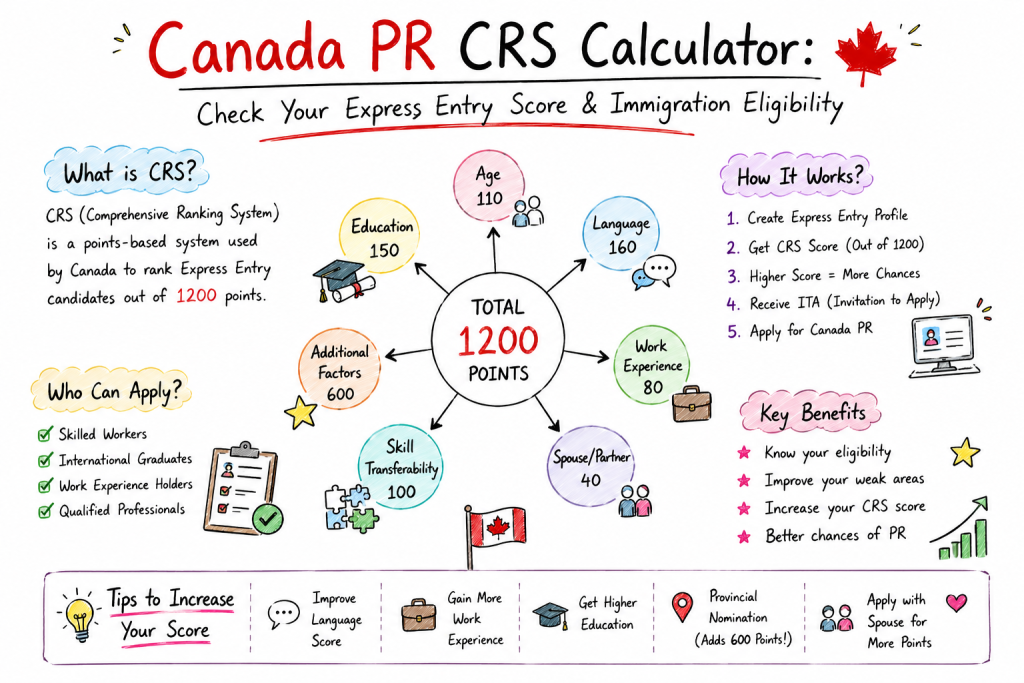
The Canada PR points calculator is one of the most important tools for anyone planning to immigrate to Canada through Express Entry. It helps you estimate your CRS score, understand where you stand, and see how competitive your profile may be in the pool. For many people, Canada is more than a destination. It represents career growth, better opportunities, and a stable future for family life. That is why checking your score early matters: it gives you a realistic picture before you spend time and money on the full application process. Canada uses a points-based system because it wants to invite people who are most likely to succeed economically and settle well. The CRS system ranks candidates based on factors such as age, education, language ability, work experience, spouse factors, and additional points. This guide explains the calculator in simple English, with practical examples, tables, and improvement tips. If you are a student, skilled worker, or first-time PR applicant, this article will help you understand the system and plan your next step with confidence.
What Is a PR Points Calculator?
A PR points calculator is a tool that estimates your immigration score based on the rules of a country’s permanent residency system. In Canada, this usually means calculating your CRS score for Express Entry.
The purpose is simple:
- See whether you may qualify.
- Understand how strong your profile is.
- Identify what can improve your chances.
- Compare your current score with recent invitation trends.
The calculator usually asks for:
- Age.
- Education.
- Language test results.
- Work experience.
- Spouse or partner details.
- Canadian education or work history.
- Provincial nomination or other bonus factors.
Eligibility score vs invitation score
These two ideas are often confused.
- Eligibility score means the score needed to enter or qualify for a program.
- Invitation score means the score needed to receive an Invitation to Apply in a draw.
Canada does not use one permanent passing score for Express Entry. The cut-off changes from draw to draw, and it depends on the type of round and current immigration priorities.
How Canada PR Scoring Works
Canada’s CRS system is built to rank candidates who are likely to succeed in the labor market. The total CRS score is 1,200 points, and it is made up of human capital factors, spouse factors, skill transferability, and additional points.
CRS structure
| CRS Category | Maximum Points | What It Includes |
|---|---|---|
| Core human capital factors | 500 | Age, education, language, Canadian work experience |
| Spouse or common-law partner factors | 40 | Spouse’s education, language, work experience |
| Skill transferability | 100 | Combinations of education, work experience, language |
| Additional points | 600 | Provincial nomination, French, Canadian study, sibling, and related bonuses |
The calculator on the Canada page also shows a breakdown for age, education, first official language, second official language, and Canadian work experience .
Why age matters
Age is one of the most influential factors in Canada’s CRS system because the immigration program is built to attract candidates who can contribute to the workforce for many years. Younger applicants usually receive stronger points since they have a longer potential working life ahead of them, and that can make a meaningful difference in a competitive draw. As age increases, points gradually decline, which is why many applicants try to submit their profile at the right time rather than waiting too long. Even a strong education or language score may not fully offset the drop in age points, so timing becomes an important part of strategy.
Why education matters
Education matters because it shows the level of training, specialization, and professional readiness a candidate brings to Canada. A recognized degree, diploma, or certificate can significantly improve a profile, especially when it is officially assessed through an ECA. Higher education often works as a signal that the applicant can adapt more easily to skilled work, higher-level responsibilities, and long-term career growth. In many cases, education also increases transferability points when combined with strong language results or relevant work experience.
Why language matters
Language is one of the biggest score boosters because communication affects nearly every part of life in Canada, from work and study to settlement and daily interaction. Strong IELTS, CELPIP, or French results can add direct CRS points and also strengthen transferability points when combined with education or work experience. This is why many applicants focus heavily on language preparation, since improving a test score can sometimes raise the total more than expected. For many profiles, language improvement is the fastest and most cost-effective way to become more competitive.
Why work experience matters
Work experience is important because it proves that you can apply your skills in a real workplace and contribute to the economy from day one. Skilled experience is especially valuable when it matches the occupation you are applying under, since immigration systems want candidates whose background is relevant to labor market needs. Canadian work experience is often even more powerful because it shows direct familiarity with the country’s work environment, standards, and expectations. In short, the stronger and more relevant your experience is, the better your profile usually becomes.
Why spouse factors matter
Spouse factors matter because immigration is often evaluated as a family profile, not just an individual one. A spouse or partner may contribute points through education, language ability, or work experience, and in some cases this can make the difference between a weak and a competitive profile. That is why couples should plan together and not assume only the principal applicant’s score matters. When both profiles are strong, the total result can improve in a more balanced and strategic way.
CRS score breakdown
The CRS score breakdown helps you understand exactly how your total score is formed, which is useful because the system is not based on one single factor. The main sections are Core human capital, Spouse factors, Skill transferability, and Additional points, and each section plays a different role in the final total. Core human capital covers the foundation of the profile, while skill transferability rewards strong combinations such as education plus language or work experience plus language. Additional points can be decisive because they may come from sources like provincial nomination, French ability, or other bonus factors, making the overall profile much stronger.
Table 1: CRS Score Breakdown
| CRS Factor | What It Measures | Why It Matters |
|---|---|---|
| Age | Applicant’s age at profile creation | Younger applicants usually receive more points |
| Education | Highest completed qualification | Higher education can improve CRS score |
| First official language | IELTS, CELPIP, or equivalent score | Strong language results boost competitiveness |
| Second official language | French or another accepted second language | Can add extra points if strong enough |
| Canadian work experience | Skilled work completed in Canada | Valuable for Express Entry competitiveness |
| Spouse factors | Spouse’s education, language, and experience | Can increase the total CRS score |
| Skill transferability | Combined value of education, language, and work | Rewards strong overall profile combinations |
| Additional points | Provincial nomination, French, sibling in Canada, etc. | Can significantly raise the score |
How to read this table
This table matters because it helps beginners see that the CRS is not based on just one thing. A weak language score or missing Canadian work experience can reduce the total, even if the applicant has a strong degree.
Important Bonus Factors
These bonus points can make a real difference to your CRS score. The most important ones include provincial nomination, Canadian study experience, French language ability, and a sibling in Canada. The calculator page also notes that arranged employment points are no longer listed in the CRS grid, based on the IRCC update from April 2, 2025. That means applicants should focus on the bonus options that are still active and relevant today.
Express Entry and Invitations
Express Entry is Canada’s main system for managing applications under the Federal Skilled Worker Program, Federal Skilled Trades Program, and Canadian Experience Class. It is not just a calculator; it is a ranking system that compares your profile with other candidates. After entering the pool, you receive a CRS score and then wait for an invitation. The final cut-off changes based on the draw and the number of candidates in the pool.
Different Draw Types
Canada uses different kinds of Express Entry rounds. These include general rounds, program-specific rounds, and category-based rounds. Each draw type can focus on a different group of applicants, so the score needed for an invitation may change from one round to another. That is why a profile can be competitive in one draw but not in the next.
Why Cut-Offs Change
A CRS score that looks strong today may still not be enough in every draw. The cut-off changes because of immigration targets, draw type, and how many candidates are competing in the pool. This is why many applicants do more than just check eligibility. They also work on improving their profile before they submit it.
How to Improve Your CRS
Improving your CRS score is often the smartest step in the entire process. The calculator page highlights several useful ways to strengthen your profile, including improving your language score, adding French if possible, gaining Canadian work experience, earning Canadian study credentials, seeking a provincial nomination, improving spouse factors, getting a certificate of qualification for trades, and declaring a qualifying sibling in Canada if eligible. Even one strong improvement can make your profile much more competitive.
Best strategies
- Retake language tests and aim for CLB 9 or higher.
- Add French scores if possible.
- Complete another credential and update your ECA.
- Gain one year or more of Canadian work experience.
- Earn Canadian study credentials.
- Seek a provincial nomination.
- Improve spouse factors.
- Get a certificate of qualification if you are in a trade.
- Declare a qualifying sibling in Canada if eligible.
Why CLB 9 Matters
CLB 9 matters because it often unlocks stronger transferability points in the CRS system. For many applicants, this is one of the most practical ways to improve their score without changing careers, moving provinces, or adding a new degree. It is a high-impact target because even a small language improvement can create a noticeable result in the final score.
Why Provincial Nomination Is Powerful
Provincial nomination is one of the strongest boosts available in Canada PR. It can add 600 points, which is often enough to turn a weak or average profile into a highly competitive one. For many applicants, this becomes the difference between waiting in the pool and receiving an invitation to apply.
Why French Can Help
French can improve your result in two important ways. It can add direct points to your CRS score, and it can also make your profile stronger in French-focused draws. Even if your French is not perfect, moderate progress can still be valuable if it matches the right immigration pathway.
Step-by-Step Canada PR Path
The Canada PR process becomes much easier when you follow it step by step. First, check whether you qualify for one of the main Express Entry programs: Federal Skilled Worker, Federal Skilled Trades, or Canadian Experience Class. Next, complete your language test and ECA if required, then calculate your CRS score to understand your current position. If your score is below recent cut-offs, work on improving language, education, provincial nomination, or other bonus options. Once your profile is ready, create your Express Entry profile and enter the pool. If your CRS is competitive enough, you may receive an Invitation to Apply. After that, submit the full permanent residence application with all supporting documents.
Table 2: Example Profile Calculation
| Profile Detail | Example Value | Impact on Score |
|---|---|---|
| Age | 29 years | Strong age points |
| Marital status | Single | Simpler CRS calculation |
| Education | Master’s degree | High education points |
| English ability | CLB 9 | Very strong language points |
| Canadian work experience | None | No points from this section |
| Foreign work experience | 4 years | Helps transferability |
| French | None | No extra second-language points |
| Provincial nomination | No | No bonus points added |
This example profile is strong because it combines youth, education, and high language ability.
Example Profile Explanation
Let’s break that example down in plain English.
A 29-year-old single applicant with a master’s degree and CLB 9 English has a profile that is usually much stronger than average. The reason is simple: the person scores well in the three biggest areas that matter most in many CRS-based cases:
- Age.
- Education.
- Language.
The weakness is that this applicant has no Canadian work experience and no bonus points. That means the score may still need improvement to become highly competitive in some draws.
What this applicant should do next
- Try French language testing.
- Look for a provincial nomination opportunity.
- Consider gaining Canadian experience.
- Retake language tests if any band is below target.
Real-World Example
A 29-year-old software engineer from India had a strong degree and four years of skilled work experience. His English score was good, but not high enough to make his Canada PR profile highly competitive. He also did not have Canadian work experience or a provincial nomination. To improve his chances, he retook the language test and worked on increasing his score. He also explored nomination options that could add extra points to his profile. This showed that even a few smart improvements can make a big difference in a PR application.
Example: IT professional
- Age: 31.
- Education: Bachelor’s in computer science.
- English: Good, but not perfect.
- Foreign work experience: 5 years.
- Spouse: Has moderate language skills.
- Canadian experience: None.
- Provincial nomination: None.
This profile is good, but not necessarily excellent. The applicant is skilled and experienced, but may still need to improve language or seek nomination to become more competitive.
Strengths
- Good education.
- Solid work history.
- Potential spouse contribution.
Weaknesses
- No Canadian experience.
- No bonus points.
- Language not optimized.
Smart next steps
- Improve English results.
- Explore PNP streams.
- See whether spouse points can be strengthened.
- Build a French profile if eligible.
Common Mistakes to Avoid
- Using outdated CRS or PR rules.
- Entering the wrong age, education, or work experience details.
- Confusing eligibility score with invitation score.
- Ignoring spouse or partner points.
- Not getting an Education Credential Assessment when required.
- Overlooking language test validity or expiry dates.
- Counting unqualified or unrelated work experience.
- Choosing the wrong occupation code.
- Depending only on one online calculator without checking official rules.
- Assuming a job offer always gives the same points in every program.
- Failing to prepare documents early.
- Not improving the profile before submitting if the score is too low.
Avoid these errors
Why This Matters
A small mistake in the calculator can lead to a very different CRS score, and that can change your entire immigration plan. If the score is wrong, you may assume your profile is stronger or weaker than it really is, which can lead to poor decisions and false expectations.
- A wrong score can affect your eligibility planning.
- You may target the wrong immigration pathway.
- You could waste time on the wrong improvements.
- It may create false confidence about receiving an invitation.
- Your document strategy may not match your real profile.
- It can delay your PR preparation unnecessarily.
Good Habit
A smart habit is to compare your estimated score with the latest official IRCC rules and recent draw patterns. This helps you stay realistic and avoid relying on outdated information.
Why This Tool Is Useful
A Canada PR points calculator helps you plan with much more confidence. Instead of guessing whether you are eligible, you get a measurable score and a clearer strategy for your next move.
It also helps you decide whether to apply now, improve your profile first, target a specific province, add French or Canadian study plans, or wait for a better draw trend.
That is why the calculator is so popular with skilled workers, students, and first-time applicants.
Frequently Asked Questions (FAQs)
1. What is a PR points calculator?
It is a tool that estimates your immigration score based on factors like age, education, language ability, work experience, and spouse details. It helps you understand whether you may be eligible for PR before applying.
2. What is a good CRS score?
A good CRS score depends on the current Express Entry draw trends and the type of program you are targeting. In general, a higher score gives you a better chance of receiving an invitation.
3. Can I improve my score later?
Yes, many applicants improve their score by retaking language tests, gaining more skilled work experience, completing higher education, or applying for provincial nomination. Even small improvements can make a big difference.
4. Does age affect PR eligibility?
Yes, age is an important factor in most points-based immigration systems. Younger applicants usually receive more points, while points may reduce as age increases.
5. How accurate are online calculators?
Online calculators are useful for estimates, but they may not capture every detail of your profile. Always verify the final score using official immigration rules before applying.
6. Which country is easiest for PR?
There is no single easiest country for everyone because eligibility depends on your profile. The best country is the one where your education, work experience, and language score match the immigration system well.
7. Do I need a job offer for PR?
Not always, because some PR pathways do not require a job offer. However, in certain immigration programs, a valid job offer can improve your chances or add extra points.
8. Can a spouse increase my PR score?
Yes, in many systems a spouse’s education, language score, or work experience can add points. This can improve your overall eligibility and make your profile stronger.
9. What is the difference between eligibility score and invitation score?
Eligibility score is the minimum needed to qualify for a program, while invitation score is the score needed to receive an invitation. You may qualify but still need a higher score to be invited.
10. Is language test improvement worth it?
Yes, language score improvement is one of the most effective ways to raise your PR points. A better result can improve both direct points and transferability points.
11. Do all countries use the same PR points system?
No, each country has its own rules, scoring method, and selection process. Canada, Australia, and New Zealand all use points, but their systems are different.
12. What should I do if my score is low?
If your score is low, focus on practical improvements like language testing, gaining more experience, higher education, spouse points, or nomination options. It is often better to strengthen your profile before applying.
Conclusion
The Canada PR Points Calculator is a helpful first step for anyone planning to apply for permanent residency through Express Entry. It gives you a clear idea of where your profile stands and what factors are helping or reducing your score. By understanding age, education, language, work experience, and bonus points, you can plan your application more strategically. If your score is not strong enough right now, you can still improve it through language tests, more experience, or nomination pathways. A well-prepared profile always has a better chance of success. Starting early and staying informed can make your PR journey much smoother.

Find Trusted Cardiac Hospitals
Compare heart hospitals by city and services — all in one place.
Explore Hospitals
This article explains the Canada PR points system in a simple way. It helps understand CRS scores and Express Entry eligibility more clearly.