Introduction
Voice AI Agent Platforms help businesses build AI-powered phone, voice, and conversational agents that can speak with customers, answer questions, qualify leads, book appointments, route calls, update systems, and support human agents in real time. Unlike traditional IVR systems that force callers through fixed menus, modern voice AI agents use speech recognition, natural language understanding, large language models, text-to-speech, workflow automation, and integrations to create more natural conversations. This category matters now because customers expect faster support, businesses need scalable service operations, and AI voice quality has improved significantly. Common use cases include customer support automation, appointment scheduling, sales qualification, debt collection reminders, insurance intake, healthcare front desk assistance, order status updates, and contact center deflection. Buyers should evaluate latency, voice quality, call handling accuracy, telephony support, workflow automation, analytics, security, CRM integrations, compliance controls, pricing model, and human handoff quality.
Real-World Use Cases
- Customer Support Automation: AI agents handle high-volume inbound support calls, answer FAQs, and reduce wait times while escalating complex issues to human agents.
- Sales Qualification and Lead Capture: Outbound voice agents pre-qualify leads, schedule demos, and gather key customer data before handing off to sales teams.
- Appointment Scheduling and Reminders: Healthcare, finance, and service industries use AI agents to schedule appointments, send reminders, and reduce no-shows.
- Debt Collection and Payment Reminders: Finance and utility companies automate reminder calls, payment collection, and overdue notifications with conversational AI.
- Order Status and Tracking Updates: E-commerce and logistics businesses provide real-time order updates, shipment notifications, and delivery scheduling through voice agents.
- Contact Center Deflection: Enterprises reduce human agent load by routing routine calls to AI, enabling humans to focus on high-value interactions.
- Internal IT / HR Helpdesk: AI voice agents assist employees in troubleshooting, policy queries, and routine HR tasks, improving internal productivity.
Evaluation Criteria for Buyers
- Voice Quality and Latency: Agents must sound natural, handle accents, and respond quickly to maintain conversational flow.
- Call Handling Accuracy: The platform should correctly interpret intents, manage multi-turn dialogues, and minimize errors in responses.
- Telephony & Channel Support: Supports inbound/outbound calls, SMS, web, mobile, and other channels where voice AI will operate.
- Workflow Automation & Integration: Ability to connect with CRM, ERP, scheduling tools, and internal APIs for end-to-end automation.
- Human Handoff and Escalation: Smooth transfer to human agents for complex or sensitive calls.
- Analytics & Reporting: Detailed metrics, conversation logs, sentiment analysis, and operational KPIs for monitoring and optimization.
- Security & Compliance: SSO, RBAC, encryption, audit logs, call recording management, GDPR/HIPAA/ISO/SOC compliance where required.
- Deployment Flexibility: Cloud, hybrid, or self-hosted options based on enterprise or SMB needs.
- Ease of Use: No-code/visual builder for business teams vs API/SDK options for technical teams.
- Pricing & Total Cost of Ownership: Transparent cost model considering call minutes, telephony fees, AI usage, support, and scaling needs.
Best for: contact centers, sales teams, healthcare providers, financial services, SaaS companies, agencies, BPOs, support teams, and enterprises that handle high call volumes.
Not ideal for: very small teams with low call volume, businesses with highly sensitive conversations that require human judgment, or companies that only need simple voicemail, chatbot, or help desk automation.
Key Trends in Voice AI Agent Platforms
- Low-latency conversations are becoming essential: Buyers now expect voice agents to respond quickly enough to feel natural during live calls.
- Multimodal agents are growing: Platforms are moving beyond phone calls into chat, email, WhatsApp, SMS, web apps, and embedded product experiences.
- Human handoff is a core requirement: The best platforms do not replace every agent; they escalate complex calls with context, transcripts, and summaries.
- Compliance expectations are rising: Enterprises increasingly look for SSO, RBAC, audit logs, encryption, data redaction, call recording controls, and regional data handling.
- No-code and developer-first platforms are splitting the market: Non-technical teams prefer visual builders, while engineering teams want APIs, SDKs, webhooks, and custom orchestration.
- AI testing and simulation are becoming important: Teams need to test edge cases, interruptions, accents, silence, tool failures, and compliance-sensitive responses before launch.
- Usage-based pricing is common: Many platforms charge by call minute, agent usage, included telephony, or enterprise contract, so buyers must estimate real call volume carefully.
- Voice agents are integrating deeply with CRMs and business systems: Strong platforms connect to Salesforce, HubSpot, Zendesk, ServiceNow, Twilio, Slack, internal APIs, scheduling tools, and payment systems.
- Agent observability is becoming a buyer priority: Analytics, call scoring, intent tracking, drop-off analysis, sentiment signals, and failure logs help teams improve production quality.
- Verticalized voice agents are expanding: Healthcare, banking, insurance, real estate, logistics, retail, and hospitality teams are adopting industry-specific flows and compliance patterns.
How We Selected These Tools
- We considered platforms that are widely recognized in voice AI, conversational AI, contact center automation, or AI agent development.
- We included a balanced mix of developer-first tools, no-code platforms, enterprise contact center platforms, and voice-specialized AI vendors.
- We looked for products that support real-time voice conversations rather than only text chatbots or basic voice transcription.
- We prioritized platforms with practical business use cases such as support automation, sales qualification, appointment booking, routing, and customer service.
- We considered integration depth, including telephony, CRM, help desk, workflow automation, APIs, and webhooks.
- We reviewed whether each platform appears suitable for different buyer segments, including startups, SMBs, mid-market teams, and enterprises.
- We avoided guessing public ratings, certifications, or pricing details where they are not confidently known.
- We considered security posture signals such as enterprise access controls, compliance positioning, and deployment flexibility.
- We included platforms that support either full-stack voice agents or voice-enabled conversational AI workflows.
- We scored tools comparatively, meaning the ratings reflect relative fit for this category rather than a universal product ranking.
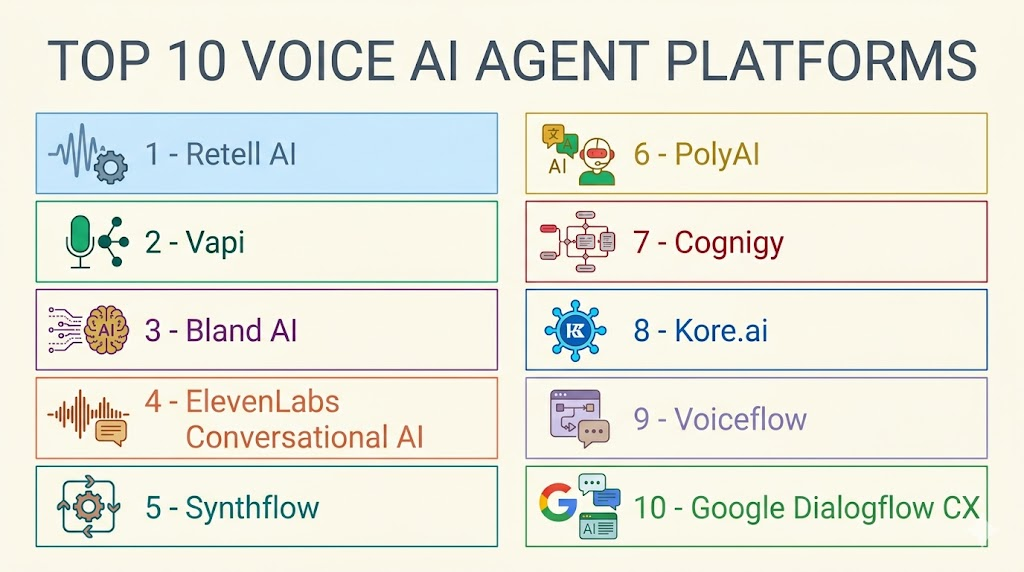
Top 10 Voice AI Agent Platforms Tools
1 — Retell AI
Short description: Retell AI is a voice AI agent platform designed for building, testing, deploying, and monitoring AI phone agents. It is well suited for teams that want production-ready voice automation with call testing, analytics, and business workflow integration.
Key Features
- AI voice agents for inbound and outbound phone automation.
- Call simulation and testing capabilities for validating agent behavior.
- Real-time voice interaction with low-latency conversation flows.
- Call analytics, monitoring, and performance review tools.
- Integrations for CRM, scheduling, support, and business workflows.
- Support for custom agent behavior, prompts, actions, and escalation paths.
- Useful for support, sales, operations, and contact center automation.
Pros
- Strong fit for teams that want to move from prototype to production quickly.
- Good balance between usability, voice quality, testing, and operational monitoring.
- Practical for businesses that need measurable call performance and workflow automation.
Cons
- Advanced customization may still require technical setup.
- Pricing can depend heavily on call volume and usage patterns.
- Buyers should test performance with real accents, noisy calls, and complex workflows.
Platforms / Deployment
Cloud / Web
Security & Compliance
Security details vary by plan. Enterprise controls such as access management, monitoring, and data handling should be validated directly during procurement. Specific certifications should be treated as “Not publicly stated” unless confirmed in the buyer’s contract.
Integrations & Ecosystem
Retell AI is designed to connect voice agents with business workflows so calls can trigger actions, update records, and hand off to humans when needed.
- CRM integrations
- Scheduling tools
- Telephony workflows
- Webhooks and APIs
- Call analytics systems
- Support and sales workflows
Support & Community
Retell AI offers platform documentation and business-oriented onboarding resources. Enterprise support availability may vary by plan, so buyers should confirm onboarding, SLA, technical support, and implementation assistance before deployment.
2 — Vapi
Short description: Vapi is a developer-first Voice AI platform for building advanced voice agents with flexible control over voice pipelines, telephony, models, tools, and integrations. It is best for engineering teams that want API-level customization.
Key Features
- Developer-focused voice agent infrastructure.
- APIs and SDKs for building custom voice experiences.
- Real-time voice orchestration across speech recognition, LLMs, and text-to-speech.
- Support for custom tools, webhooks, and backend actions.
- Telephony support for phone-based AI agents.
- Monitoring and configuration options for production workflows.
- Flexible architecture for teams building custom agent products.
Pros
- Excellent for technical teams that want control over the voice stack.
- Flexible enough for custom workflows, product embedding, and advanced call logic.
- Strong choice for startups and developers building voice AI applications.
Cons
- Less ideal for non-technical teams that want a fully guided no-code experience.
- Requires engineering ownership for best results.
- Production quality depends heavily on implementation, prompt design, and backend reliability.
Platforms / Deployment
Cloud / Web / API
Security & Compliance
Security posture should be validated during procurement. Enterprise controls may vary by plan. Specific compliance certifications are “Not publicly stated” unless confirmed directly by the vendor.
Integrations & Ecosystem
Vapi is integration-friendly because it is built for developers who want to connect voice agents with external systems and custom applications.
- REST APIs
- Webhooks
- Custom backend tools
- Telephony providers
- CRM and support systems through custom integration
- LLM, speech-to-text, and text-to-speech providers
Support & Community
Vapi has developer documentation and a growing ecosystem around voice AI builders. Support quality may depend on plan level, technical complexity, and whether the buyer needs self-serve or enterprise implementation help.
3 — Bland AI
Short description: Bland AI is an enterprise voice AI platform focused on AI phone agents for inbound and outbound calling. It is suitable for companies that need scalable call automation, campaign workflows, and developer-controlled voice operations.
Key Features
- AI phone agents for real-time business conversations.
- Inbound and outbound calling support.
- Voice agent monitoring and operational controls.
- Workflow automation for sales, support, scheduling, and follow-ups.
- Custom prompts and business logic.
- Telephony and CRM-oriented use cases.
- Designed for high-volume phone automation.
Pros
- Strong option for teams focused specifically on phone call automation.
- Useful for outbound campaigns, lead qualification, reminders, and operational calls.
- Developer-friendly enough for businesses with technical resources.
Cons
- May require careful governance for outbound calling compliance.
- Not always the simplest option for non-technical teams.
- Buyers should test agent transparency, escalation, and call quality before scaling.
Platforms / Deployment
Cloud / Web / API
Security & Compliance
Bland AI positions itself for enterprise use, but buyers should directly validate SSO, RBAC, audit logs, encryption, data retention, regional hosting, and compliance certifications. Where not contractually confirmed, details should be treated as “Not publicly stated.”
Integrations & Ecosystem
Bland AI supports business process automation by connecting phone agents with operational tools and internal systems.
- CRM workflows
- Scheduling tools
- Call transfer workflows
- Webhooks and APIs
- Outbound campaign systems
- Internal business applications
Support & Community
Support appears business-focused and may vary by contract size. Enterprise buyers should confirm onboarding, call tuning assistance, compliance guidance, support response times, and production escalation channels.
4 — ElevenLabs Conversational AI
Short description: ElevenLabs Conversational AI extends high-quality AI voice technology into voice and chat-based agents. It is best for companies that care deeply about natural-sounding voice, multilingual experiences, and embedded conversational applications.
Key Features
- Human-like voice generation and conversational agent capabilities.
- Voice and chat interaction support.
- Multilingual voice experience support.
- Agent configuration, deployment, and monitoring tools.
- APIs and SDKs for developer integration.
- Suitable for branded voice experiences and product-embedded agents.
- Useful for customer service, onboarding, media, education, and app experiences.
Pros
- Strong voice quality and natural speech experience.
- Good fit for multilingual and branded voice experiences.
- Useful for businesses building voice inside apps, websites, and customer journeys.
Cons
- Telephony-first contact center workflows may need additional setup.
- Buyers should evaluate workflow depth beyond voice quality.
- Enterprise governance and compliance needs must be validated carefully.
Platforms / Deployment
Cloud / Web / API
Security & Compliance
ElevenLabs describes enterprise-grade security, but buyers should validate plan-specific controls such as SSO, RBAC, audit logs, data handling, and compliance certifications. Where not directly confirmed, certifications should be marked “Not publicly stated.”
Integrations & Ecosystem
ElevenLabs is strong for developers and product teams that want to embed voice experiences across applications and customer touchpoints.
- APIs and SDKs
- Voice and chat agents
- Web and app embedding
- Product workflows
- Customer service use cases
- Multilingual voice experiences
Support & Community
ElevenLabs has strong documentation and broad awareness among developers, creators, and AI teams. Enterprise support, onboarding, and governance assistance should be validated by plan.
5 — Synthflow
Short description: Synthflow is a no-code Voice AI platform built for creating and deploying AI phone agents without heavy engineering work. It is a good option for sales, support, agencies, and operations teams that want faster deployment.
Key Features
- No-code voice agent builder.
- Inbound and outbound call automation.
- Appointment booking and follow-up workflows.
- CRM and business system integrations.
- Multi-language voice automation support.
- Call logs, analytics, and performance monitoring.
- Useful for agencies, sales teams, support teams, and service businesses.
Pros
- Easier for non-technical teams compared with developer-first platforms.
- Good for fast pilots and business-led voice automation.
- Useful for repeatable call workflows such as booking, qualification, and reminders.
Cons
- Advanced custom logic may be more limited than developer-first tools.
- Buyers should test flexibility for complex enterprise workflows.
- Usage costs can rise with high call volume.
Platforms / Deployment
Cloud / Web
Security & Compliance
Security and compliance should be validated by plan and contract. Some compliance-related features may be available for business or enterprise customers, but unconfirmed certifications should be written as “Not publicly stated.”
Integrations & Ecosystem
Synthflow is designed to connect no-code voice agents with common business tools used by revenue and service teams.
- CRM integrations
- Calendar and scheduling tools
- Telephony workflows
- Webhooks
- SMS follow-ups
- Support and sales tools
Support & Community
Synthflow is suitable for teams that want guided setup and business-focused onboarding. Support tiers, implementation services, and response times may vary by plan.
6 — PolyAI
Short description: PolyAI is an enterprise voice AI platform focused on natural customer-led conversations in contact centers. It is best for large organizations that want polished voice automation for customer service at scale.
Key Features
- Enterprise voice AI agents for customer service.
- Natural language call handling with multi-turn conversations.
- Contact center-focused deployment model.
- Human handoff and customer service workflow support.
- Brand-aligned conversational experiences.
- Analytics and optimization for service operations.
- Suitable for high-volume inbound support environments.
Pros
- Strong fit for enterprise contact centers and customer service teams.
- Designed around natural caller experiences rather than rigid menu flows.
- Useful for complex service journeys such as bookings, order updates, and account support.
Cons
- May be more enterprise-oriented than needed for small teams.
- Implementation may require planning, conversation design, and operational alignment.
- Pricing and deployment details are often enterprise-specific.
Platforms / Deployment
Cloud / Hybrid
Security & Compliance
Enterprise security capabilities should be confirmed during procurement. Buyers should validate SSO, RBAC, encryption, audit logs, data retention, call recording controls, and relevant compliance requirements.
Integrations & Ecosystem
PolyAI typically fits into contact center and enterprise service environments where voice agents must work with existing systems.
- Contact center platforms
- CRM systems
- Order management systems
- Booking platforms
- Telephony infrastructure
- Customer support workflows
Support & Community
PolyAI is enterprise-focused, so support is likely strongest through managed implementation, customer success, and professional services. Public community details are limited compared with developer-first platforms.
7 — Cognigy
Short description: Cognigy is an enterprise conversational AI platform with strong voice AI agent and contact center automation capabilities. It is best for organizations that need omnichannel AI, voice gateways, agent assist, and enterprise-grade orchestration.
Key Features
- Voice AI agents for contact centers.
- Omnichannel conversational AI across voice and digital channels.
- Visual conversation design and workflow automation.
- Agent assist and handoff capabilities.
- Translation, localization, and data redaction features.
- Enterprise integrations and extensibility.
- Suitable for large-scale customer service automation.
Pros
- Strong enterprise fit for complex CX environments.
- Supports voice, chat, automation, and agent assist in one ecosystem.
- Good for teams that need governance, scalability, and orchestration.
Cons
- May be too complex for small teams or simple voice agent use cases.
- Implementation can require specialized skills and planning.
- Enterprise pricing and configuration may not suit low-volume users.
Platforms / Deployment
Cloud / Hybrid
Security & Compliance
Cognigy supports enterprise-oriented security and governance features, but buyers should validate exact controls and certifications in the procurement process. Data privacy, access control, redaction, and audit requirements should be reviewed carefully.
Integrations & Ecosystem
Cognigy has a broad enterprise ecosystem for contact center, customer service, and workflow automation use cases.
- Contact center platforms
- CRM systems
- Service desk tools
- Voice gateways
- APIs and extensions
- Agent assist workflows
Support & Community
Cognigy provides enterprise documentation, implementation support, and partner ecosystem resources. Support levels may vary by enterprise plan and deployment model.
8 — Kore.ai
Short description: Kore.ai is an enterprise agentic AI and conversational AI platform for customer and employee experiences. It is best for organizations that need AI agents across service, work, HR, IT, banking, healthcare, retail, and other enterprise functions.
Key Features
- Enterprise AI agent platform for customer and employee use cases.
- Voice and digital conversational AI capabilities.
- Pre-built applications and marketplace templates.
- Workflow automation across service and internal operations.
- Industry-focused solutions for regulated and high-volume environments.
- Human agent support and shared context capabilities.
- Model, application, and enterprise integration flexibility.
Pros
- Strong fit for large organizations with multiple AI agent use cases.
- Useful for both customer-facing and employee-facing automation.
- Broad ecosystem for enterprise applications and workflows.
Cons
- May be too broad for teams that only need a simple voice calling bot.
- Implementation complexity can be higher than lightweight voice-only platforms.
- Buyers should validate voice-specific performance for their call scenarios.
Platforms / Deployment
Cloud / Hybrid
Security & Compliance
Kore.ai serves enterprise and regulated industry use cases, but buyers should confirm exact security controls, compliance certifications, data handling, and access governance by contract.
Integrations & Ecosystem
Kore.ai fits enterprise environments where voice AI is part of a wider automation and service strategy.
- Enterprise applications
- CRM and service platforms
- HR and IT systems
- Marketplace agents and templates
- APIs and workflow tools
- Contact center and support ecosystems
Support & Community
Kore.ai provides enterprise support, implementation resources, and marketplace-based ecosystem support. Support details may vary by plan, region, and deployment scope.
9 — Voiceflow
Short description: Voiceflow is a collaborative platform for designing, building, and managing AI agents across chat and voice experiences. It is well suited for product teams, conversation designers, CX teams, and companies that want visual control over agent design.
Key Features
- Visual AI agent builder for chat and voice workflows.
- Collaboration tools for designers, product teams, and developers.
- API tools and function tools for connecting external systems.
- Support for workflows, playbooks, and knowledge-based agent behavior.
- Prototyping and testing features for conversational experiences.
- Integrations with CRM, support, and automation tools.
- Useful for designing agent experiences before production launch.
Pros
- Strong collaboration experience for conversation design teams.
- Easier for non-engineers than purely API-first platforms.
- Good for prototyping, documenting, and iterating agent behavior.
Cons
- Voice telephony depth may depend on setup and integrations.
- Not always the best fit for teams wanting a fully managed contact center solution.
- Complex production voice use cases may require technical support.
Platforms / Deployment
Cloud / Web
Security & Compliance
Security and compliance details vary by plan. Buyers should validate SSO, workspace permissions, data controls, audit logs, and enterprise compliance needs directly.
Integrations & Ecosystem
Voiceflow is strong for teams that need agent design, prototyping, and integration workflows in one workspace.
- Salesforce
- HubSpot
- Zendesk
- Twilio
- REST APIs
- Function tools and custom logic
Support & Community
Voiceflow has strong documentation, educational resources, and an active builder community. Enterprise support and onboarding should be confirmed by plan.
10 — Google Dialogflow CX
Short description: Google Dialogflow CX is a conversational AI platform for building virtual agents across voice and chat channels. It is best for teams already invested in Google Cloud or enterprises that need structured conversation flows with contact center integration.
Key Features
- Advanced conversational flow design.
- Voice and chat virtual agent support.
- Integration with Google Cloud ecosystem.
- Intent detection, entity handling, and conversation state management.
- Contact center and telephony integration options.
- Suitable for structured customer service automation.
- Analytics and testing tools for agent improvement.
Pros
- Strong fit for Google Cloud customers.
- Good for structured, enterprise-grade conversational flows.
- Useful for teams that need scalable virtual agents across multiple channels.
Cons
- Can feel complex for beginners.
- More configuration-heavy than newer no-code voice platforms.
- Voice naturalness may depend on full architecture, speech setup, and implementation quality.
Platforms / Deployment
Cloud / Web / Google Cloud
Security & Compliance
Google Cloud provides enterprise security capabilities, but buyers should validate the specific Dialogflow CX configuration, data handling, region, access controls, and compliance requirements for their use case.
Integrations & Ecosystem
Dialogflow CX fits well into Google Cloud and enterprise architecture where teams need structured agent control and backend integration.
- Google Cloud services
- Contact center platforms
- Telephony integrations
- Webhooks
- APIs
- Analytics and monitoring tools
Support & Community
Dialogflow CX benefits from Google Cloud documentation, enterprise support options, partner ecosystem, and developer resources. Support experience depends on Google Cloud plan and implementation partner.
Comparison Table
| Tool Name | Best For | Platform(s) Supported | Deployment | Standout Feature | Public Rating |
|---|---|---|---|---|---|
| Retell AI | Production-ready AI phone agents | Web / API | Cloud | Call testing and monitoring | N/A |
| Vapi | Developer-first voice AI apps | Web / API | Cloud | Flexible voice agent orchestration | N/A |
| Bland AI | High-volume AI phone automation | Web / API | Cloud | Inbound and outbound phone agents | N/A |
| ElevenLabs Conversational AI | Natural voice and embedded agents | Web / API | Cloud | High-quality AI voice experience | N/A |
| Synthflow | No-code voice automation | Web | Cloud | Drag-and-drop voice agent builder | N/A |
| PolyAI | Enterprise contact center voice AI | Web | Cloud / Hybrid | Customer-led voice conversations | N/A |
| Cognigy | Enterprise CX automation | Web | Cloud / Hybrid | Omnichannel voice and agent assist | N/A |
| Kore.ai | Enterprise agentic AI workflows | Web | Cloud / Hybrid | Broad enterprise AI agent platform | N/A |
| Voiceflow | Conversation design and AI agent building | Web | Cloud | Collaborative visual agent design | N/A |
| Google Dialogflow CX | Google Cloud virtual agents | Web / Google Cloud | Cloud | Structured conversational flow design | N/A |
Evaluation & Scoring of Voice AI Agent Platforms
| Tool Name | Core (25%) | Ease (15%) | Integrations (15%) | Security (10%) | Performance (10%) | Support (10%) | Value (15%) | Weighted Total (0–10) |
|---|---|---|---|---|---|---|---|---|
| Retell AI | 9 | 8 | 8 | 7 | 9 | 8 | 8 | 8.25 |
| Vapi | 9 | 7 | 9 | 7 | 9 | 7 | 8 | 8.15 |
| Bland AI | 8 | 7 | 8 | 7 | 8 | 7 | 8 | 7.70 |
| ElevenLabs Conversational AI | 8 | 8 | 8 | 7 | 9 | 8 | 8 | 8.05 |
| Synthflow | 8 | 9 | 8 | 7 | 8 | 8 | 8 | 8.05 |
| PolyAI | 9 | 7 | 8 | 8 | 9 | 9 | 7 | 8.20 |
| Cognigy | 9 | 7 | 9 | 9 | 8 | 9 | 7 | 8.30 |
| Kore.ai | 9 | 7 | 9 | 9 | 8 | 9 | 7 | 8.30 |
| Voiceflow | 8 | 9 | 8 | 7 | 7 | 8 | 8 | 7.95 |
| Google Dialogflow CX | 8 | 7 | 9 | 9 | 8 | 8 | 8 | 8.05 |
Which Voice AI Agent Platforms Tool Is Right for You?
Solo / Freelancer
Solo professionals should avoid overbuilding. If the goal is to answer basic calls, qualify leads, book appointments, or provide simple after-hours support, a no-code or easy setup platform is usually better than a complex enterprise solution. Synthflow, ElevenLabs Conversational AI, and Voiceflow can be practical starting points because they reduce the need for heavy engineering.
Solo users should focus on simple flows, transparent AI disclosure, calendar integration, call summaries, and fallback to voicemail or human callback. The best choice is the one that can be launched quickly without requiring a full contact center setup.
SMB
SMBs usually need a balance of usability, pricing control, and operational value. Good use cases include appointment booking, lead qualification, missed-call recovery, order status updates, customer FAQs, and service reminders. Retell AI, Synthflow, Bland AI, and ElevenLabs Conversational AI can be strong options depending on technical skill and call volume.
An SMB should prioritize ease of use, CRM integration, call recording controls, clear pricing, and simple analytics. The platform should help reduce repetitive calls without creating a frustrating customer experience.
Mid-Market
Mid-market teams often need more structured workflows, stronger reporting, multiple departments, and better human handoff. Retell AI, Vapi, Bland AI, Voiceflow, and Google Dialogflow CX can fit this segment depending on whether the organization is business-led or engineering-led.
Mid-market buyers should evaluate multi-agent management, role-based permissions, QA workflows, escalation paths, API flexibility, and integration with CRM or help desk platforms. They should also test reliability across peak call periods and different customer accents.
Enterprise
Enterprises need scalability, compliance, governance, contact center integration, analytics, data controls, and change management. Cognigy, Kore.ai, PolyAI, Google Dialogflow CX, and Retell AI are strong candidates for enterprise evaluation.
Enterprise buyers should not choose based only on demo voice quality. They should validate security reviews, data retention, call recording policy, human escalation, agent monitoring, regional hosting, audit logs, vendor support, and integration with existing CX architecture.
Budget vs Premium
Budget-conscious buyers should start with a small pilot and estimate total cost based on real call minutes, phone numbers, telephony fees, AI model usage, transcription, text-to-speech, integrations, and support. No-code platforms may appear easier, while developer platforms may reduce limitations but require engineering time.
Premium platforms are more suitable when call volume is high, compliance is strict, workflows are complex, or customer experience risk is significant. Enterprises should evaluate total operational value rather than only per-minute cost.
Feature Depth vs Ease of Use
If ease of use is the priority, Synthflow and Voiceflow are attractive because they support visual building and faster iteration. If feature depth and custom control matter more, Vapi, Retell AI, Bland AI, Cognigy, and Dialogflow CX may be better options.
The right trade-off depends on who will own the platform. If operations owns it, choose simplicity. If engineering owns it, choose flexibility. If CX owns it, choose analytics, testing, handoff, and conversation quality.
Integrations & Scalability
Voice AI agents become valuable when they can take action, not just talk. Buyers should confirm whether the platform can connect to CRM records, support tickets, calendars, payment systems, order databases, authentication flows, and internal APIs.
For scalability, test concurrent calls, fallback behavior, failed API calls, human escalation, and call analytics. A platform that works in a demo may still struggle if backend systems are slow or customer journeys are poorly designed.
Security & Compliance Needs
Security-sensitive industries such as healthcare, banking, insurance, legal, and government should treat compliance as a primary buying criterion. Buyers should validate encryption, access controls, SSO, RBAC, audit logs, data redaction, call recording controls, retention policies, and regional data handling.
Do not assume that a tool is compliant just because it supports enterprise customers. Compliance depends on the vendor, plan, configuration, contract, data flow, and how your organization deploys the system.
Frequently Asked Questions
1. What is a Voice AI Agent Platform?
A Voice AI Agent Platform helps businesses build AI agents that can speak with customers over phone, web, app, or connected voice channels. These agents can answer questions, collect information, perform actions, route calls, and hand off to humans when needed.
2. How is a voice AI agent different from an IVR system?
Traditional IVR systems usually depend on fixed menus and keypad choices. Voice AI agents understand natural language, manage multi-turn conversations, connect with business systems, and can respond more flexibly than “press one, press two” menus.
3. How much do Voice AI Agent Platforms cost?
Pricing varies widely. Many platforms use usage-based pricing based on call minutes, phone numbers, AI model usage, or enterprise contracts. Buyers should calculate total cost using expected call volume, integrations, support, and implementation needs.
4. How long does implementation usually take?
Simple pilots can be launched quickly when the use case is narrow, such as appointment booking or lead qualification. Enterprise rollouts can take longer because they require security review, integration work, testing, call flow design, and compliance validation.
5. What are common mistakes when adopting voice AI agents?
Common mistakes include automating too many call types at once, skipping human handoff, ignoring edge cases, not testing accents or noisy calls, and failing to connect the agent to real business systems. Teams should start small and improve through call analytics.
6. Are Voice AI Agent Platforms secure?
They can be secure when configured correctly, but security depends on the platform, plan, data handling, access controls, and deployment model. Buyers should validate encryption, SSO, RBAC, audit logs, retention policies, and compliance requirements before production use.
7. Can voice AI agents integrate with CRM and help desk tools?
Yes, many platforms integrate with CRM, help desk, calendar, telephony, and internal systems. However, integration depth varies. Buyers should test whether the agent can read, update, create, and escalate records accurately.
8. Can voice AI agents replace human support agents?
Voice AI agents are best used for repetitive, structured, and high-volume interactions. They should not fully replace human agents for sensitive, emotional, complex, or high-risk conversations. The strongest deployments combine automation with smooth human escalation.
9. What industries benefit most from voice AI agents?
Industries with high call volume benefit the most, including healthcare, financial services, insurance, real estate, logistics, retail, travel, hospitality, education, and SaaS. The value is highest when calls follow repeatable workflows.
10. How should a company switch from an old IVR to a voice AI platform?
Start with one or two high-volume call intents, map the customer journey, define escalation rules, connect required systems, test with real call samples, and monitor outcomes. Avoid replacing the entire IVR before proving reliability in a controlled pilot.
11. What alternatives exist to Voice AI Agent Platforms?
Alternatives include traditional IVR systems, live answering services, call center outsourcing, chatbots, help desk automation, SMS workflows, and human-only support teams. The right alternative depends on call volume, complexity, budget, and customer expectations.
12. What should buyers test before signing a contract?
Buyers should test voice quality, latency, interruptions, accents, noisy backgrounds, CRM updates, failed API handling, compliance scripts, human handoff, analytics, call recording controls, and total cost. A real pilot is more useful than a polished demo.
Conclusion
Voice AI Agent Platforms are becoming a practical layer in modern customer service, sales, operations, and contact center automation, but the best platform depends on business size, technical maturity, call volume, compliance needs, and integration depth. Retell AI, Vapi, Bland AI, ElevenLabs Conversational AI, and Synthflow are strong choices for teams that want modern voice automation with different levels of technical control. PolyAI, Cognigy, Kore.ai, and Dialogflow CX are better suited for enterprise-scale service environments where governance, contact center integration, and orchestration matter. Voiceflow is a strong option for teams that need collaborative agent design and workflow control. The smartest next step is to shortlist two or three platforms, run a limited pilot with real call scenarios, validate integrations and security requirements, compare total cost, and scale only after the agent performs reliably in production-like conditions.

Find Trusted Cardiac Hospitals
Compare heart hospitals by city and services — all in one place.
Explore Hospitals
Voice AI agent platforms are most effective when they enable AI-powered voice assistants to handle customer conversations naturally and efficiently across phone channels. By combining speech recognition, natural language understanding, text-to-speech, workflow automation, CRM integration, and real-time analytics, these platforms help organizations automate customer support, improve response times, reduce operational costs, and deliver consistent, high-quality voice interactions at scale.