Introduction
The health of your kidneys and urinary system is fundamental to your overall well-being. These organs play a critical role in filtering waste from your blood, balancing fluids, and supporting essential functions like blood pressure regulation. Because the symptoms of kidney and urinary issues can sometimes be subtle or mistaken for minor ailments, having access to specialized medical expertise is vital for timely intervention and effective management.Choosing the right facility is one of the most important decisions a patient or caregiver can make. When dealing with complex conditions, specialized kidney and urology hospitals offer the distinct advantage of a multidisciplinary approach, combining cutting-edge diagnostic technology with the expertise of seasoned professionals. As the demand for advanced nephrology and urology services continues to grow, navigating the healthcare landscape can feel overwhelming. This guide aims to simplify that process by providing a clear framework for understanding care options. For further assistance in navigating these choices, you can explore resources at MyHospitalNow. Throughout this guide, we will explore the specialties, treatments, and standards of excellence that define top-tier kidney and urology hospitals.
Understanding Kidney & Urology Care
Many patients often wonder about the distinction between nephrology and urology. While both specialties focus on the urinary system, their areas of expertise are unique but highly complementary.
Nephrology is the medical subspecialty of internal medicine that focuses specifically on the kidneys. Nephrologists manage conditions that affect the kidney’s ability to function correctly, such as chronic kidney disease (CKD), high blood pressure related to kidney function, and fluid-electrolyte imbalances. They are the specialists who oversee long-term management strategies like dialysis and prepare patients for potential kidney transplants.
Urology, on the other hand, is the surgical specialty that focuses on the entire urinary tract—including the kidneys, bladder, ureters, and urethra—as well as the male reproductive system. Urologists are trained to perform surgical interventions to address issues like kidney stones, prostate enlargement, bladder cancer, and congenital urinary tract anomalies.
Multidisciplinary Care is the cornerstone of a top-tier hospital. Often, a patient’s condition may involve both medical management (nephrology) and surgical intervention (urology). A specialized hospital ensures these teams collaborate seamlessly, providing comprehensive care plans that address the whole patient.
Why Specialized Kidney & Urology Hospitals Matter
Specialized hospitals dedicate significant resources to create an environment tailored to the complex needs of renal and urological patients. Here is why choosing such a facility makes a difference:
- Expert Specialists: These institutions house teams of nephrologists and urologists who have deep, focused experience in treating rare and complex conditions.
- Advanced Diagnostic Facilities: They invest in high-end imaging and laboratory equipment that allow for precise identification of issues in their earliest stages.
- Integrated Dialysis Units: Having a well-managed, high-capacity dialysis department ensures that patients receive consistent, safe, and comfortable treatment.
- Comprehensive Transplant Programs: A dedicated kidney transplant program requires a vast support network, including transplant surgeons, immunologists, and specialized nursing staff.
- Robotic and Minimally Invasive Surgery: Modern top-tier hospitals prioritize surgical techniques that reduce pain, lower the risk of infection, and shorten recovery times.
- Long-term Patient Management: They provide ongoing support, including dietary counseling, patient education, and follow-up care, which are crucial for maintaining kidney function.
Hospital Comparison Table
| Hospital Name | Location | Nephrology | Urology | Kidney Transplant | Dialysis Services | Robotic Surgery |
| Metro Renal Center | Metropolitan Area | Advanced | Comprehensive | Full Program | Inpatient/Outpatient | Available |
| Global Urology Hub | Urban Center | Specialized | Expert | Referral Based | Outpatient Focus | Advanced |
| Apex Kidney Institute | Research Park | Expert | Advanced | Primary Center | Comprehensive | State-of-the-art |
| City General Urology | Downtown | Standard | Specialized | Supported | Routine | Available |
Top Kidney & Urology Hospitals
Metro Renal Center
- Hospital Overview: A premier institution known for its integrated approach to renal health, balancing intensive care with patient education.
- Location: Central Metropolitan District.
- Kidney Care Department: Equipped with dedicated wards for acute and chronic conditions.
- Urology Department: Features a high-volume surgical unit focusing on minimally invasive techniques.
- Specialized Treatments: Advanced filtration therapies and complex stone removal.
- Diagnostic Facilities: Latest generation ultrasound and dynamic imaging.
- Dialysis Services: Offers both hemodialysis and peritoneal dialysis with 24/7 monitoring.
- Kidney Transplant Program: A highly successful program with high survival rates and robust follow-up care.
- International Patient Services: Provides dedicated coordinators for travel, language support, and lodging.
- Why Patients Choose This: The seamless transition between nephrology and urology teams.
- Major Strengths: High expertise in complex pediatric renal cases and chronic management.
Global Urology Hub
- Hospital Overview: A facility that places an emphasis on surgical precision and rapid recovery.
- Location: Downtown Urban Center.
- Kidney Care Department: Focuses on preservation and early-stage disease management.
- Urology Department: Renowned for its expertise in robotic-assisted prostate and bladder surgeries.
- Specialized Treatments: Laser lithotripsy for complex stone cases.
- Diagnostic Facilities: Full-spectrum urodynamic testing labs.
- Dialysis Services: Reliable outpatient dialysis center with convenient scheduling.
- Kidney Transplant Program: Collaborative program with expert surgical teams.
- International Patient Services: Comprehensive visa assistance and tele-consultation capabilities.
- Why Patients Choose This: Its focus on reducing hospital stay durations through modern techniques.
- Major Strengths: Unmatched expertise in robotic urology and laser procedures.
Common Kidney Diseases Treated
Understanding the common conditions managed by these facilities is the first step in patient awareness.
- Chronic Kidney Disease (CKD): A long-term condition where the kidneys gradually lose function over time.
- Acute Kidney Injury (AKI): A sudden episode of kidney failure or kidney damage that happens within a few hours or days.
- Kidney Stones: Hard deposits made of minerals and salts that form inside the kidneys.
- Polycystic Kidney Disease: A genetic disorder that causes numerous cysts to grow in the kidneys.
- Kidney Failure (ESRD): The final stage of CKD where the kidneys can no longer function on their own.
- Glomerulonephritis: Inflammation of the tiny filters in the kidneys (glomeruli).
- Urinary Tract Infections (UTIs): Infections that occur anywhere along the urinary tract, including the bladder and kidneys.
- Enlarged Prostate (BPH): A common condition in men that can cause uncomfortable urinary symptoms.
- Bladder Disorders: Issues such as overactive bladder or interstitial cystitis that impact daily life.
Common Conditions Table
| Condition | Common Symptoms | Treatment Options |
| Chronic Kidney Disease | Fatigue, swelling, changes in urination | Diet control, medication, dialysis |
| Kidney Stones | Severe back/side pain, blood in urine | Fluids, medication, laser surgery |
| Kidney Failure | Nausea, confusion, fluid retention | Dialysis, kidney transplant |
| Urinary Tract Infection | Burning, frequency, cloudy urine | Antibiotics, hydration |
| Enlarged Prostate | Weak flow, frequent urge to urinate | Medication, minimally invasive surgery |
| Bladder Disorders | Pain, frequency, urgency | Bladder training, medication |
Advanced Kidney & Urology Treatments
Modern hospitals use a combination of medical, surgical, and supportive therapies to ensure the best possible outcomes.
- Hemodialysis: A process where a machine filters waste, salts, and fluid from the blood when the kidneys are no longer healthy enough to do so.
- Peritoneal Dialysis: A treatment that uses the lining of your abdomen to filter blood inside your body.
- Kidney Transplantation: The surgical placement of a healthy kidney from a donor into a patient with kidney failure.
- Robotic Urological Surgery: The use of robotic systems to perform complex surgeries with greater precision, smaller incisions, and less blood loss.
- Laser Stone Removal: Using high-energy laser technology to break kidney or bladder stones into small, passable fragments.
- Endoscopic Urology Procedures: Minimally invasive procedures using a thin, flexible tube to view and treat the inside of the urinary tract.
- Reconstructive Urology: Surgical procedures to restore the structure and function of the urinary tract.
- Kidney Cancer Surgery: Targeted surgical interventions to remove tumors while sparing as much healthy kidney tissue as possible.
Treatment Comparison Table
| Treatment | Purpose | Best For |
| Hemodialysis | Blood filtration via external machine | Patients with ESRD needing frequent cleaning |
| Peritoneal Dialysis | Blood filtration via abdominal lining | Patients seeking home-based flexibility |
| Kidney Transplant | Restoring kidney function | Suitable patients with irreversible failure |
| Laser Stone Surgery | Fragmentation of hard stones | Patients with painful, large stones |
| Robotic Surgery | Precision tissue removal | Complex cancers and reconstructions |
| Endoscopy | Visual inspection and minor treatment | Diagnosing and treating blockages/small stones |
Diagnostic Technologies Used
Accurate diagnosis is the foundation of effective treatment. Specialized hospitals employ a variety of tools to get a clear picture of renal and urinary health.
- Blood Tests: Measures substances like creatinine and urea nitrogen to gauge how well the kidneys are filtering waste.
- Urine Analysis: Checks for proteins, blood, or bacteria that could indicate kidney or bladder issues.
- Kidney Function Tests: Specialized panels to assess the glomerular filtration rate (GFR).
- Ultrasound: Uses sound waves to visualize the structure and size of the kidneys and bladder.
- CT Scan: Provides detailed cross-sectional images to detect stones, tumors, or anatomical abnormalities.
- MRI: Offers high-resolution imaging, useful for examining soft tissues and identifying tumors.
- Cystoscopy: Allows the doctor to look directly inside the bladder and urethra using a camera-equipped scope.
- Urodynamic Studies: Tests that assess how well the bladder and urethra are storing and releasing urine.
Diagnostic Tests Table
| Test | Purpose | Benefit |
| Blood Test | Measure waste products | Indicates current filtering efficiency |
| Urine Test | Detect infection/protein leak | Early sign of kidney stress |
| Ultrasound | Visualize kidney structure | Non-invasive and radiation-free |
| CT Scan | Detailed anatomical view | High precision for stones/tumors |
| MRI | Soft tissue analysis | No ionizing radiation |
| Cystoscopy | Direct visual of bladder | Immediate diagnosis of bladder issues |
Who Should Visit a Kidney or Urology Specialist?
You should consult a specialist if you experience:
- Persistent changes in frequency or color of urination.
- Visible blood in your urine (hematuria).
- Recurring, sharp pain in your back or side (flank pain).
- Difficulty or pain during urination.
- Unexplained swelling in the legs or around the eyes.
- High blood pressure that is difficult to manage.
- A family history of polycystic kidney disease or kidney failure.
- Recurrent urinary tract infections that do not resolve with standard care.
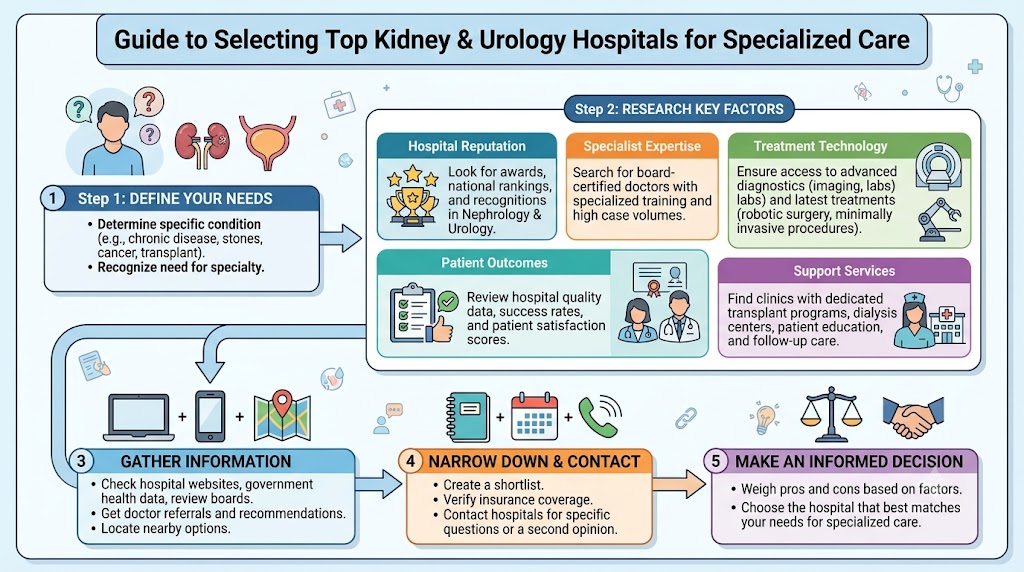
How to Choose the Right Kidney Hospital
When searching for the best hospital, keep these factors in mind:
- Specialist Expertise: Look for board-certified nephrologists and urologists.
- Dialysis Accessibility: If needed, confirm the center has flexible hours and safe protocols.
- Transplant Facilities: Check if they have a dedicated transplant team and long-term success metrics.
- Emergency Readiness: Ensure 24/7 care for acute issues like kidney stone attacks.
- Hospital Reputation: Read about their history, patient safety scores, and clinical standards.
- Advanced Technology: Inquire about availability of robotic surgery and modern imaging.
- Patient Support: Look for hospitals that provide nutritional guidance, social support, and financial counseling.
Benefits of Specialized Kidney Care
- Earlier Diagnosis: Specialists are better at detecting “silent” symptoms of kidney disease.
- Better Treatment Planning: Coordinated care between nephrology and urology prevents fragmented treatment.
- Comprehensive Care: Focus on both the underlying disease and the resulting complications.
- Reduced Complications: Expert management of blood pressure and electrolytes prevents further kidney damage.
- Improved Quality of Life: Effective management of symptoms allows patients to maintain daily activities.
Real-Life Patient Scenarios
- Kidney Stone Management: A patient experiencing severe flank pain visits a hospital, receives an ultrasound, and undergoes laser stone removal, returning to work within days.
- Dialysis Care: A patient with ESRD benefits from a structured hemodialysis program, receiving nutritional education and blood monitoring that stabilizes their health.
- Kidney Transplant Journey: A candidate undergoes thorough pre-transplant testing and, following a successful operation, receives comprehensive immunosuppression management.
Common Mistakes Patients Make
- Ignoring Urinary Symptoms: Assuming that burning or frequency will go away on its own.
- Delaying Specialist Consultation: Waiting until kidney function is severely impaired before seeking a nephrologist.
- Poor Hydration: Not drinking enough water, which can contribute to stone formation and kidney strain.
- Skipping Follow-ups: Missing routine blood tests, which are essential for monitoring kidney disease progression.
- Uncontrolled Chronic Conditions: Failing to manage diabetes or high blood pressure, which are the leading causes of kidney failure.
- Self-medicating: Taking over-the-counter pain relievers frequently, which can be toxic to the kidneys.
Future of Kidney & Urology Care
The landscape of renal health is evolving rapidly through technology and innovation.
- AI-Assisted Diagnostics: AI algorithms are now helping radiologists detect kidney abnormalities on scans with greater speed.
- Robotic Surgery: Becoming more precise, allowing for surgeries that were once impossible.
- Wearable Monitoring: Smart devices that can monitor vital signs and potentially alert patients to changes in fluid retention.
- Precision Medicine: Tailoring treatments based on a patient’s genetic profile.
- Tele-nephrology: Increasing access for patients in remote areas to consult with top specialists.
Future of Kidney Care Table
| Innovation | Potential Benefit |
| AI Diagnostics | Quicker and more accurate imaging interpretation |
| Robotic Surgery | Faster healing and minimal scarring |
| Precision Medicine | Highly effective, personalized drug therapies |
| Telemedicine | Reduced travel for routine consultations |
| Wearable Monitoring | Early intervention before emergencies occur |
| Smart Dialysis | Real-time adjustment of treatment parameters |
FAQs
- What is nephrology?
It is the branch of medicine focused on diagnosing and treating kidney-related diseases. - What is urology?
It is the surgical specialty focused on the urinary tract and the male reproductive system. - What are common kidney diseases?
These include CKD, kidney stones, AKI, and glomerulonephritis. - What causes kidney stones?
They are often caused by dehydration, diet, and metabolic conditions. - When is dialysis required?
When kidneys can no longer filter waste products effectively to maintain life. - Who needs a kidney transplant?
Patients with end-stage kidney failure may be candidates for a transplant. - What is robotic urology surgery?
Surgery performed by a surgeon using a robot to assist in high-precision tasks. - How can kidney disease be prevented?
By managing blood pressure, diabetes, staying hydrated, and avoiding smoking. - What foods support kidney health?
Generally, diets low in sodium and processed foods are beneficial. - When should I see a urologist?
When you have recurrent UTIs, blood in urine, or symptoms of prostate issues. - How long does a kidney transplant last?
Success varies, but many transplants provide many years of healthy function. - Is dialysis painful?
Most patients find the procedure itself painless, though they may feel tired afterward. - Can kidney stones be prevented?
Yes, by increasing fluid intake and making specific dietary adjustments. - What is the difference between AKI and CKD?
AKI is a sudden, often reversible injury; CKD is a chronic, long-term condition. - How does hypertension affect kidneys?
High blood pressure damages blood vessels, preventing the kidneys from filtering properly.
Final Thoughts
Prioritizing your kidney and urinary health is one of the most proactive steps you can take for your long-term wellness. From early screening and lifestyle adjustments to receiving care from highly specialized nephrologists and urologists, understanding your options is essential. Specialized hospitals provide not just treatment, but a pathway to improved quality of life through advanced technology and expert care. We encourage you to consult with medical professionals at the first sign of symptoms and maintain regular screenings to catch issues before they escalate. For more information, expert comparisons, and guidance on navigating top-tier care, feel free to explore the resources available at MyHospitalNow.

Find Trusted Cardiac Hospitals
Compare heart hospitals by city and services — all in one place.
Explore Hospitals