Introduction
IVR Design Tools help businesses create automated voice menus and call-routing systems that guide customers to the right information or support team without needing a live agent for every interaction. These platforms are widely used in customer service, sales operations, healthcare scheduling, banking support, logistics, and appointment management. As customer expectations continue to rise, modern IVR platforms now focus heavily on AI-powered voice automation, omnichannel integrations, low-code workflow builders, analytics, and conversational experiences. Businesses are no longer looking for simple “Press 1 for support” systems. They want intelligent, scalable, and personalized customer communication platforms that reduce wait times and improve resolution rates.
Real-world use cases include:
- Customer support call routing
- Appointment booking automation
- Payment and billing self-service
- Lead qualification and sales routing
- Multi-language customer interaction systems
What buyers should evaluate:
- Ease of IVR workflow creation
- AI and conversational voice support
- CRM and helpdesk integrations
- Omnichannel communication capabilities
- Scalability and call reliability
- Analytics and reporting depth
- Security and compliance features
- Deployment flexibility
- API and developer ecosystem
- Pricing transparency and operational costs
Best for: Enterprises, call centers, telecom teams, healthcare providers, banking organizations, SaaS businesses, and customer support operations that need scalable customer interaction workflows.
Not ideal for: Very small businesses with minimal inbound call volume or organizations that only need basic voicemail and forwarding functionality.
Key Trends in IVR Design Tools
- AI-powered conversational IVR is replacing traditional touch-tone-only systems.
- Natural language processing is becoming standard for customer intent detection.
- Low-code and no-code IVR builders are reducing dependency on telecom engineers.
- Omnichannel routing now connects voice, SMS, WhatsApp, email, and chat workflows.
- Voice biometrics and fraud prevention are gaining traction in finance and healthcare.
- Real-time analytics and sentiment analysis are becoming competitive differentiators.
- Cloud-native IVR deployment is dominating over legacy on-premise PBX systems.
- AI voice agents are increasingly handling tier-1 support interactions autonomously.
- Multi-language and regional voice support is expanding rapidly for global businesses.
- API-first IVR platforms are enabling tighter CRM and workflow automation integration.
How We Selected These Tools (Methodology)
The tools in this list were selected using a practical evaluation framework focused on real-world IVR deployment needs.
- Evaluated market adoption and enterprise usage trends
- Assessed feature completeness for IVR workflow design
- Reviewed AI and conversational voice capabilities
- Compared scalability for SMB and enterprise environments
- Examined integration ecosystems and APIs
- Considered security, compliance, and access controls
- Analyzed deployment flexibility and infrastructure maturity
- Reviewed usability for both technical and non-technical teams
- Considered reporting, analytics, and operational visibility
- Balanced enterprise-grade platforms with SMB-friendly solutions
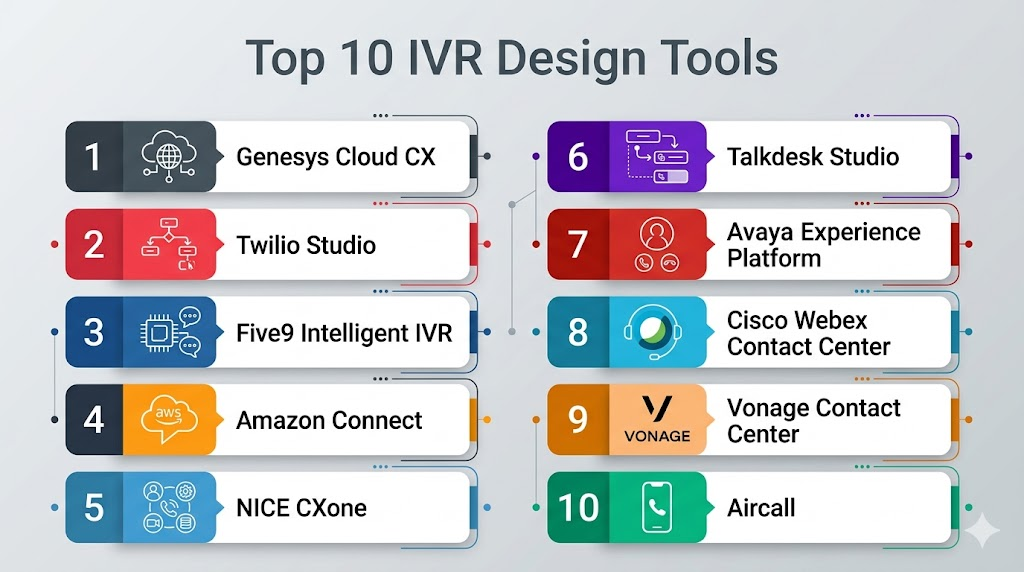
Top 10 IVR Design Tools
1- Genesys Cloud CX
Short description: Genesys Cloud CX is an enterprise-grade contact center platform with advanced IVR orchestration, conversational AI, and omnichannel customer engagement capabilities. It is widely used by large enterprises and global support organizations.
Key Features
- Drag-and-drop IVR workflow builder
- AI-powered voice bots and virtual agents
- Omnichannel customer interaction support
- Advanced call routing and queue management
- Real-time analytics and reporting
- CRM integrations and APIs
- Workforce engagement management
Pros
- Highly scalable enterprise platform
- Strong AI and automation capabilities
- Deep analytics and customer journey insights
Cons
- Higher pricing for smaller organizations
- Advanced setup may require specialist expertise
- Some features have a learning curve
Platforms / Deployment
- Web
- Cloud
Security & Compliance
- SSO/SAML
- MFA
- RBAC
- Encryption
- GDPR support
- SOC 2 support
Integrations & Ecosystem
Genesys Cloud CX supports broad enterprise integrations and developer extensibility for customer service operations.
- Salesforce
- Microsoft Dynamics
- Zendesk
- ServiceNow
- APIs and SDKs
- CRM and workforce tools
Support & Community
Strong enterprise onboarding, extensive documentation, professional services, and an active partner ecosystem.
2- Twilio Studio
Short description: Twilio Studio is a developer-focused visual workflow platform for building IVR systems, voice automation, and programmable communication workflows using APIs and low-code tools.
Key Features
- Visual flow builder
- Programmable voice APIs
- AI voice and conversational integrations
- Multi-channel communication support
- Serverless execution workflows
- Real-time call controls
- Extensive developer documentation
Pros
- Extremely flexible platform
- Excellent developer ecosystem
- Strong API-first architecture
Cons
- Can become expensive at scale
- Requires technical expertise for advanced use
- Complex enterprise deployments may need custom engineering
Platforms / Deployment
- Web
- Cloud
Security & Compliance
- Encryption
- MFA
- RBAC
- GDPR support
- SOC 2 support
Integrations & Ecosystem
Twilio integrates well with cloud applications, CRMs, and AI services through APIs and marketplace integrations.
- Salesforce
- HubSpot
- AWS
- Google Cloud
- OpenAI integrations
- Custom APIs
Support & Community
Very strong developer community, extensive tutorials, and large integration ecosystem.
3- Five9 Intelligent IVR
Short description: Five9 offers AI-enhanced IVR and cloud contact center capabilities designed for customer service teams seeking scalable automation and intelligent routing.
Key Features
- Intelligent call routing
- AI-powered virtual agents
- Speech recognition
- CRM integration
- Real-time analytics dashboards
- Omnichannel customer engagement
- Workflow automation
Pros
- Strong enterprise contact center functionality
- Reliable cloud infrastructure
- Good AI-assisted routing capabilities
Cons
- Premium pricing for advanced features
- Customization complexity for some workflows
- Smaller businesses may find it feature-heavy
Platforms / Deployment
- Web
- Cloud
Security & Compliance
- Encryption
- SSO
- Audit logs
- GDPR support
- HIPAA support
Integrations & Ecosystem
Five9 integrates with major customer service ecosystems and enterprise applications.
- Salesforce
- Zendesk
- Oracle
- Microsoft Dynamics
- ServiceNow
- APIs
Support & Community
Enterprise-grade support with onboarding assistance and implementation services.
4- Amazon Connect
Short description: Amazon Connect is AWS’s cloud contact center platform offering scalable IVR creation, AI integration, and deep cloud-native customization.
Key Features
- Cloud-native IVR workflows
- AI-powered Amazon Lex integration
- Dynamic call routing
- Contact center analytics
- Voice and chat support
- Pay-as-you-go pricing
- AWS ecosystem integration
Pros
- Highly scalable infrastructure
- Strong AI integration options
- Flexible pricing model
Cons
- Requires AWS familiarity
- Advanced configurations can be technical
- Interface may feel complex for non-technical teams
Platforms / Deployment
- Web
- Cloud
Security & Compliance
- Encryption
- IAM-based access controls
- Audit logging
- GDPR support
- HIPAA eligibility
Integrations & Ecosystem
Amazon Connect fits naturally into AWS-centric infrastructures and developer workflows.
- AWS Lambda
- Amazon Lex
- Salesforce
- ServiceNow
- APIs
- CloudWatch
Support & Community
Strong AWS documentation and enterprise support ecosystem.
5- NICE CXone
Short description: NICE CXone is a unified customer experience platform offering advanced IVR, AI automation, analytics, and workforce optimization features.
Key Features
- Omnichannel IVR design
- Conversational AI support
- Advanced reporting and analytics
- Intelligent call routing
- Workforce optimization tools
- Quality monitoring
- CRM connectivity
Pros
- Comprehensive enterprise feature set
- Strong analytics and reporting
- Good AI automation capabilities
Cons
- Can be expensive for SMBs
- Implementation may require consultants
- Interface complexity for new users
Platforms / Deployment
- Web
- Cloud
Security & Compliance
- Encryption
- SSO
- MFA
- Audit logs
- GDPR support
Integrations & Ecosystem
NICE CXone supports extensive enterprise integration and workflow connectivity.
- Salesforce
- Zendesk
- Oracle
- Microsoft Teams
- APIs
- CRM integrations
Support & Community
Enterprise-level support with implementation and training services.
6- Talkdesk Studio
Short description: Talkdesk Studio is a visual IVR and call flow builder designed for modern cloud contact centers focused on usability and automation.
Key Features
- Drag-and-drop call flow design
- AI-powered self-service tools
- Intelligent routing
- Real-time analytics
- Omnichannel communications
- CRM integrations
- Low-code automation
Pros
- User-friendly workflow designer
- Fast cloud deployment
- Good balance between usability and features
Cons
- Some advanced features cost extra
- Enterprise customization can become complex
- Reporting customization limitations
Platforms / Deployment
- Web
- Cloud
Security & Compliance
- SSO
- Encryption
- RBAC
- GDPR support
- SOC 2 support
Integrations & Ecosystem
Talkdesk integrates with popular customer support and CRM platforms.
- Salesforce
- Zendesk
- Slack
- Microsoft Teams
- APIs
- Service platforms
Support & Community
Good onboarding resources and cloud support experience.
7- Avaya Experience Platform
Short description: Avaya provides enterprise communication and IVR solutions focused on customer engagement, unified communications, and large-scale deployments.
Key Features
- Advanced IVR routing
- Voice self-service
- Omnichannel engagement
- AI-assisted automation
- Call recording and analytics
- Workforce management
- Hybrid deployment support
Pros
- Strong enterprise telephony heritage
- Flexible deployment models
- Robust communication features
Cons
- Legacy complexity in some environments
- Interface modernization varies
- Licensing can be complex
Platforms / Deployment
- Web
- Cloud / Hybrid / Self-hosted
Security & Compliance
- Encryption
- Access controls
- Audit logging
- Varies / N/A for some compliance details
Integrations & Ecosystem
Avaya integrates with enterprise telephony and customer support environments.
- Salesforce
- Microsoft Teams
- CRM systems
- SIP infrastructure
- APIs
- Contact center tools
Support & Community
Large enterprise support ecosystem and long-standing partner network.
8- Cisco Webex Contact Center
Short description: Cisco Webex Contact Center combines IVR capabilities with cloud contact center infrastructure, analytics, and collaboration integrations.
Key Features
- AI-assisted IVR
- Intelligent call routing
- Voice analytics
- Omnichannel engagement
- Collaboration integration
- Workflow automation
- Real-time reporting
Pros
- Strong enterprise networking integration
- Reliable infrastructure
- Good collaboration ecosystem
Cons
- Enterprise-focused pricing
- Some setup complexity
- Smaller businesses may not need full platform depth
Platforms / Deployment
- Web
- Cloud / Hybrid
Security & Compliance
- Encryption
- MFA
- SSO
- GDPR support
- Enterprise access controls
Integrations & Ecosystem
Cisco benefits organizations already using Webex and Cisco collaboration products.
- Webex
- Microsoft Teams
- Salesforce
- APIs
- CRM systems
- Collaboration tools
Support & Community
Strong enterprise documentation and certified partner support.
9- Vonage Contact Center
Short description: Vonage Contact Center offers cloud-based IVR and customer communication tools designed for businesses seeking flexible communication workflows.
Key Features
- Visual call flow management
- Intelligent routing
- CRM integrations
- Voice analytics
- Omnichannel communication
- Call recording
- API support
Pros
- Flexible cloud communications platform
- Good CRM integration options
- Suitable for growing SMBs
Cons
- Some advanced AI features are limited
- Reporting depth varies
- Enterprise customization can require additional services
Platforms / Deployment
- Web
- Cloud
Security & Compliance
- Encryption
- SSO
- GDPR support
- Varies / N/A for some certifications
Integrations & Ecosystem
Vonage supports common CRM and communication workflow integrations.
- Salesforce
- Microsoft Dynamics
- Zendesk
- APIs
- Communication tools
- Collaboration platforms
Support & Community
Reliable cloud support and onboarding resources for SMB and mid-market customers.
10- Aircall
Short description: Aircall is a cloud phone and IVR platform designed primarily for SMB customer support and sales teams needing simple deployment and CRM connectivity.
Key Features
- Easy IVR configuration
- Call routing automation
- CRM synchronization
- Shared call inbox
- Analytics dashboards
- AI-assisted call summaries
- Quick deployment
Pros
- Easy to deploy and manage
- Strong CRM ecosystem
- Good usability for non-technical teams
Cons
- Limited enterprise-grade customization
- Advanced AI features are still evolving
- Large-scale call centers may outgrow it
Platforms / Deployment
- Web / Windows / macOS / iOS / Android
- Cloud
Security & Compliance
- Encryption
- SSO
- GDPR support
- RBAC
Integrations & Ecosystem
Aircall focuses heavily on CRM and customer support workflows.
- HubSpot
- Salesforce
- Zendesk
- Slack
- APIs
- Helpdesk tools
Support & Community
Good onboarding experience and accessible documentation for SMB users.
Comparison Table (Top 10)
| Tool Name | Best For | Platform(s) Supported | Deployment | Standout Feature | Public Rating |
|---|---|---|---|---|---|
| Genesys Cloud CX | Enterprise contact centers | Web | Cloud | AI-powered customer journeys | N/A |
| Twilio Studio | Developers and APIs | Web | Cloud | Programmable communication workflows | N/A |
| Five9 Intelligent IVR | AI customer service automation | Web | Cloud | Intelligent routing | N/A |
| Amazon Connect | AWS-based organizations | Web | Cloud | Native AWS scalability | N/A |
| NICE CXone | Enterprise CX operations | Web | Cloud | Advanced analytics | N/A |
| Talkdesk Studio | Mid-market contact centers | Web | Cloud | Low-code IVR builder | N/A |
| Avaya Experience Platform | Hybrid enterprise environments | Web | Cloud / Hybrid / Self-hosted | Enterprise telephony ecosystem | N/A |
| Cisco Webex Contact Center | Cisco-based enterprises | Web | Cloud / Hybrid | Collaboration integration | N/A |
| Vonage Contact Center | SMB and mid-market teams | Web | Cloud | Flexible cloud communication | N/A |
| Aircall | SMB support teams | Web / Desktop / Mobile | Cloud | Ease of deployment | N/A |
Evaluation & Scoring of IVR Design Tools
| Tool Name | Core (25%) | Ease (15%) | Integrations (15%) | Security (10%) | Performance (10%) | Support (10%) | Value (15%) | Weighted Total |
|---|---|---|---|---|---|---|---|---|
| Genesys Cloud CX | 9.6 | 8.0 | 9.5 | 9.2 | 9.4 | 9.0 | 7.8 | 8.93 |
| Twilio Studio | 9.0 | 7.5 | 9.8 | 8.8 | 9.1 | 8.8 | 8.0 | 8.72 |
| Five9 Intelligent IVR | 9.0 | 8.2 | 8.8 | 9.0 | 9.1 | 8.7 | 7.9 | 8.61 |
| Amazon Connect | 9.1 | 7.4 | 9.3 | 9.2 | 9.5 | 8.5 | 8.6 | 8.75 |
| NICE CXone | 9.4 | 7.9 | 9.0 | 9.1 | 9.2 | 8.9 | 7.7 | 8.73 |
| Talkdesk Studio | 8.8 | 8.8 | 8.7 | 8.8 | 8.9 | 8.5 | 8.5 | 8.67 |
| Avaya Experience Platform | 8.9 | 7.2 | 8.5 | 8.6 | 9.0 | 8.7 | 7.5 | 8.22 |
| Cisco Webex Contact Center | 8.8 | 7.8 | 8.9 | 9.1 | 9.1 | 8.6 | 7.8 | 8.49 |
| Vonage Contact Center | 8.2 | 8.5 | 8.4 | 8.2 | 8.5 | 8.3 | 8.6 | 8.38 |
| Aircall | 7.9 | 9.2 | 8.5 | 8.1 | 8.2 | 8.4 | 8.9 | 8.39 |
Which IVR Design Tool Is Right for You?
Solo / Freelancer
Aircall and Vonage Contact Center are practical choices for smaller operations that need easy deployment and CRM connectivity without enterprise-level complexity.
SMB
Talkdesk Studio and Aircall provide strong usability, fast deployment, and balanced feature sets for growing support teams and customer service operations.
Mid-Market
Five9 and Vonage Contact Center offer scalable automation and analytics without the operational overhead often associated with larger enterprise platforms.
Enterprise
Genesys Cloud CX, NICE CXone, Cisco Webex Contact Center, and Avaya Experience Platform are better suited for large organizations with complex routing, compliance, and omnichannel engagement requirements.
Budget vs Premium
Aircall and Amazon Connect can provide better operational value depending on call volume and infrastructure needs. Genesys and NICE CXone target premium enterprise deployments with broader functionality.
Feature Depth vs Ease of Use
Twilio Studio and Amazon Connect provide exceptional flexibility but may require technical expertise. Talkdesk and Aircall focus more on usability and low-code workflow management.
Integrations & Scalability
Twilio Studio and Amazon Connect stand out for API flexibility and developer extensibility. Genesys and Cisco offer deeper enterprise ecosystem integrations.
Security & Compliance Needs
Healthcare, banking, and regulated industries should prioritize enterprise-grade platforms with mature access controls, audit logging, encryption, and compliance support.
Frequently Asked Questions (FAQs)
1. What is an IVR Design Tool?
An IVR Design Tool helps businesses create automated voice response systems that guide callers through menus, routing workflows, and self-service interactions. Modern IVR platforms also include AI voice automation, analytics, and CRM integrations.
2. Are IVR platforms only for large enterprises?
No. Many modern cloud IVR solutions are designed specifically for SMBs and startups. Platforms like Aircall and Vonage offer easier onboarding and lower operational complexity for smaller teams.
3. What is the difference between traditional IVR and AI IVR?
Traditional IVR systems rely mainly on keypad menu selections, while AI IVR systems use speech recognition and natural language understanding to interpret customer intent more naturally.
4. How much do IVR platforms usually cost?
Pricing varies widely depending on call volume, AI features, integrations, and deployment scale. Some platforms use pay-as-you-go pricing, while others require enterprise subscriptions.
5. Can IVR systems integrate with CRMs?
Yes. Most modern IVR platforms integrate with popular CRM systems like Salesforce, HubSpot, Zendesk, and Microsoft Dynamics to improve customer context and workflow automation.
6. What security features should businesses look for?
Organizations should evaluate encryption, RBAC, MFA, audit logs, SSO support, and compliance alignment depending on industry requirements and customer data sensitivity.
7. Is cloud IVR better than on-premise IVR?
Cloud IVR platforms generally offer easier scalability, faster deployment, and lower infrastructure management overhead. However, some enterprises still prefer hybrid or self-hosted models for regulatory or operational reasons.
8. How difficult is IVR implementation?
Implementation complexity depends on workflow depth, integrations, and customization requirements. SMB-focused platforms may deploy within days, while enterprise systems can require longer implementation cycles.
9. Can AI voice agents fully replace human agents?
AI voice agents are increasingly capable of handling repetitive tier-1 support interactions, but most organizations still rely on human agents for complex, emotional, or high-risk conversations.
10. What are common mistakes when selecting an IVR platform?
Common mistakes include ignoring integration requirements, underestimating scaling costs, overlooking analytics capabilities, and selecting overly complex platforms for small operational needs.
Conclusion
IVR Design Tools have evolved far beyond simple touch-tone phone trees and now serve as critical components of modern customer experience infrastructure. Businesses increasingly expect AI-assisted automation, omnichannel orchestration, analytics, and deep CRM integration from their IVR platforms. Enterprise organizations may prioritize scalability, security, and advanced automation through platforms like Genesys Cloud CX, NICE CXone, or Cisco Webex Contact Center, while SMBs may find stronger operational value in Talkdesk, Aircall, or Vonage Contact Center. Developer-focused organizations may prefer API-first flexibility from Twilio Studio or Amazon Connect. Ultimately, the best IVR platform depends on operational scale, technical expertise, compliance requirements, and customer engagement goals. The most effective approach is to shortlist two or three platforms, run pilot workflows, validate integrations and reporting capabilities, and then scale deployment based on real business outcomes.

Find Trusted Cardiac Hospitals
Compare heart hospitals by city and services — all in one place.
Explore Hospitals