Introduction
Music distribution platforms help artists, labels, producers, and music businesses release songs, albums, EPs, and catalogues across streaming services, digital stores, and social music platforms. In simple words, these platforms act as the bridge between the music creator and global listeners by delivering tracks to platforms such as streaming apps, download stores, short-video apps, and content monetization channels.Music distribution matters now because independent artists and labels no longer depend only on traditional record deals to reach global audiences. Streaming growth, social media discovery, creator monetization, playlist culture, short-form video, and direct fan engagement have made digital distribution a core part of modern music business operations.
Real-world use cases include:
- Independent artists releasing singles and albums worldwide
- Record labels managing large catalogues across multiple stores
- Producers and DJs distributing electronic music releases
- Music marketers tracking performance across streaming channels
- Artist managers monitoring royalties, metadata, and release schedules
What buyers should evaluate:
- Supported streaming and store network
- Royalty collection and payment transparency
- Pricing model and commission structure
- Release speed and approval process
- Analytics and audience insights
- Publishing administration support
- YouTube Content ID and social monetization
- Metadata accuracy and catalog management
- Customer support quality
- Label and multi-artist account features
Best for: Music distribution platforms are best for independent artists, record labels, music producers, artist managers, DJs, publishers, and creator teams that want to release music globally while tracking royalties, analytics, and catalog performance.
Not ideal for: These platforms may not be ideal for hobby creators who only share music privately or artists who already have an exclusive label distribution deal. In those cases, direct upload options, label-managed distribution, or private sharing platforms may be more suitable.
Key Trends in Music Distribution Platforms
- AI-powered release optimization: Platforms are increasingly using AI-assisted insights to help artists choose better release timing, metadata improvements, audience targeting, and promotion strategies.
- Short-form video monetization: Distribution now extends beyond traditional streaming platforms into short-video apps, social audio discovery, and creator-driven content channels.
- More transparent royalty dashboards: Artists expect clearer breakdowns of streams, revenue, territory performance, platform-level earnings, and payout status.
- Integrated marketing tools: Pre-save links, smart links, playlist pitching, campaign tracking, and fan data tools are becoming standard expectations.
- Publishing and neighboring rights support: More distributors are adding royalty collection services beyond master recording revenue.
- Label-focused account management: Multi-artist dashboards, catalog permissions, royalty splits, and team roles are important for small and mid-sized labels.
- Faster release workflows: Artists expect faster approvals, easier takedowns, quick edits, and better delivery tracking.
- Data-driven artist growth: Analytics now influence marketing, touring, fan engagement, advertising, and playlist strategy.
- Flexible pricing models: Distribution platforms continue to compete with subscription, commission-based, per-release, and hybrid pricing options.
- Security and payment protection: Since platforms manage music assets, royalty data, and payment details, buyers are paying more attention to access controls and account protection.
How We Selected These Tools
- We prioritized platforms widely recognized in independent music, label distribution, and digital release workflows.
- We considered how well each platform supports global delivery to major streaming services and digital stores.
- We evaluated royalty management, payout transparency, and revenue reporting capabilities.
- We looked at artist-friendly features such as pre-save tools, YouTube Content ID, analytics, and release scheduling.
- We included options for solo artists, independent labels, growing music businesses, and more selective professional distribution models.
- We considered ease of use for beginners as well as catalog management depth for labels.
- We reviewed integration potential with social platforms, analytics tools, publishing services, and marketing workflows.
- We avoided guessing public ratings, certifications, or security claims where details are not clearly stated.
- We considered pricing flexibility, value, and suitability for different release volumes.
- We balanced free, subscription-based, commission-based, and service-led platforms to support multiple buyer scenarios.
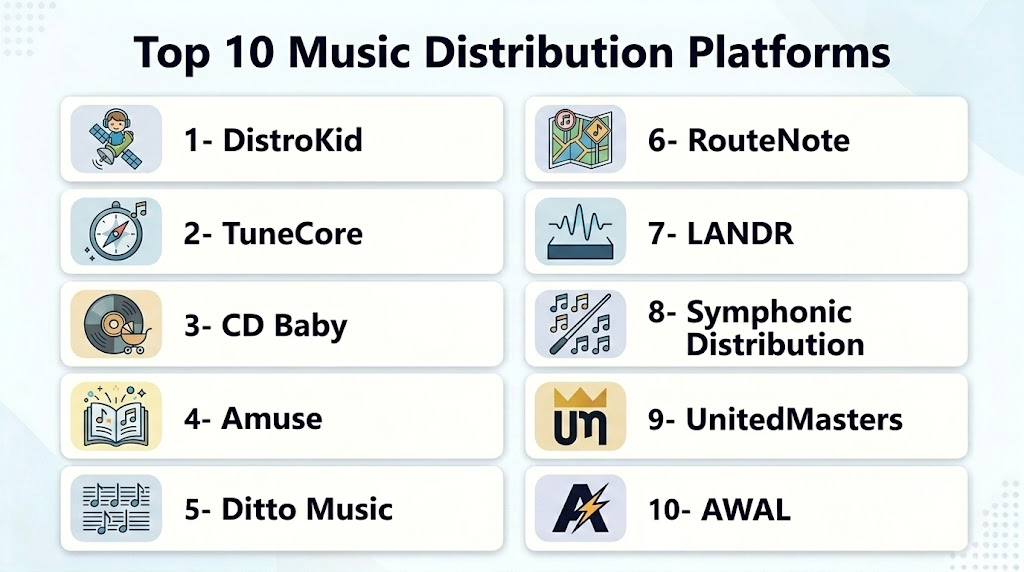
Top 10 Music Distribution Platforms
1- DistroKid
Short description: DistroKid is a popular music distribution platform known for fast uploads and unlimited releases under subscription-based plans. It is especially useful for independent artists who release music frequently and want a simple dashboard.
Key Features
- Unlimited song and album uploads depending on plan
- Distribution to major streaming platforms and digital stores
- Automatic royalty split support for collaborators
- YouTube Content ID and social monetization options
- Release scheduling and store delivery controls
- Artist profile tools and streaming service support
- Basic analytics and earnings dashboard
Pros
- Easy to use for independent artists and beginners
- Good value for artists releasing music frequently
- Fast release workflow compared with many traditional options
Cons
- Some useful features may require higher-tier plans or add-ons
- Not ideal for labels needing deep enterprise catalog controls
- Support experience may vary depending on issue complexity
Platforms / Deployment
Web / Cloud / iOS / Android
Security & Compliance
Not publicly stated. Buyers should verify MFA, account protection, payment security, access control, and data privacy practices before using it for high-value catalogs.
Integrations & Ecosystem
DistroKid connects artists with major streaming stores and provides useful tools around music promotion, monetization, and collaborator payments.
- Streaming platform delivery
- YouTube Content ID options
- Social music platform delivery
- Royalty split workflows
- Artist profile support
- Basic promotional tools
Support & Community
DistroKid has a large user base, help resources, and artist-focused documentation. Community discussion is strong because many independent artists use the platform, though direct support quality may depend on the request type and account level.
2- TuneCore
Short description: TuneCore is a music distribution and artist services platform that supports global music delivery, royalty collection, publishing administration, and promotional tools. It is suitable for serious independent artists, managers, and labels.
Key Features
- Global distribution to major streaming and download platforms
- Royalty collection and reporting dashboard
- Publishing administration options
- YouTube and social monetization support
- Release scheduling and metadata management
- Artist services for promotion and career growth
- Multi-release and catalog management
Pros
- Strong mix of distribution and publishing support
- Suitable for artists who want more than basic release delivery
- Useful for managing music earnings across multiple sources
Cons
- Pricing structure may be more complex than simple free platforms
- Beginners may need time to understand all services
- Some advanced services may require additional fees or eligibility
Platforms / Deployment
Web / Cloud / iOS / Android
Security & Compliance
Not publicly stated. Buyers should validate authentication, payment security, privacy controls, and access management if handling multiple artists or label accounts.
Integrations & Ecosystem
TuneCore works across major digital music channels and offers additional services around publishing, monetization, and promotion.
- Streaming service delivery
- Digital download store delivery
- Publishing administration workflows
- YouTube monetization
- Social platform monetization
- Artist service ecosystem
Support & Community
TuneCore provides help content, artist education, and customer support resources. It has strong recognition among independent musicians and managers, making it easier to find general usage guidance.
3- CD Baby
Short description: CD Baby is a long-established music distribution platform supporting digital distribution, royalty collection, physical music options, and sync licensing opportunities. It is often used by independent artists who want broad music business support.
Key Features
- Digital distribution to major streaming and download platforms
- Physical music distribution options where applicable
- Sync licensing opportunities for eligible music
- Royalty collection and reporting
- YouTube monetization support
- Artist account and catalog management
- Music promotion and education resources
Pros
- Strong reputation among independent artists
- Offers both digital and physical distribution support
- Useful for artists interested in sync licensing possibilities
Cons
- Per-release pricing may not suit artists releasing very frequently
- Less ideal for users who prefer unlimited subscription uploads
- Some workflows can feel traditional compared with newer platforms
Platforms / Deployment
Web / Cloud
Security & Compliance
Not publicly stated. Artists and labels should verify account security, payment protection, and data handling practices before managing large catalogs.
Integrations & Ecosystem
CD Baby supports a broad music distribution ecosystem that includes streaming platforms, download stores, monetization services, and artist support resources.
- Streaming and download platform delivery
- YouTube monetization workflows
- Sync licensing opportunities
- Royalty reporting tools
- Physical music support
- Artist education resources
Support & Community
CD Baby has extensive artist resources and a long-standing independent musician community. Support is generally structured around help articles, account assistance, and artist service guidance.
4- Amuse
Short description: Amuse is a music distribution platform offering free and paid distribution options for independent artists. It is useful for new artists who want to start releasing music with lower upfront barriers.
Key Features
- Free and premium music distribution options
- Delivery to major streaming platforms
- Royalty tracking and payout support
- Mobile-friendly artist management
- Release scheduling tools
- Analytics for streaming performance
- Upgrade options for faster delivery and added services
Pros
- Good entry point for emerging artists
- Mobile-friendly experience for simple release management
- Free tier can help beginners test digital distribution
Cons
- Free tier may have limitations compared with paid plans
- Advanced label and marketing services may not fit every user
- Professional teams may need more detailed catalog controls
Platforms / Deployment
Web / Cloud / iOS / Android
Security & Compliance
Not publicly stated. Users should verify account security, payout protection, privacy controls, and access features before relying on it for high-value releases.
Integrations & Ecosystem
Amuse connects artists to major streaming platforms and supports mobile-first release management.
- Streaming platform distribution
- Artist dashboard
- Royalty reporting
- Mobile app workflows
- Release scheduling
- Upgrade-based service options
Support & Community
Amuse offers support resources and guidance for artists using its distribution workflow. Community awareness is strong among new and independent musicians.
5- Ditto Music
Short description: Ditto Music provides global music distribution, label services, chart registration support in selected contexts, royalty tracking, and promotional tools. It is suitable for independent artists and small labels needing more structured release support.
Key Features
- Global distribution to streaming and digital stores
- Royalty tracking and payment support
- Label services for growing artists and teams
- Pre-save and promotional tools
- Release scheduling and metadata management
- Multi-artist account support
- Analytics for release performance
Pros
- Good fit for artists and small labels
- Offers promotional and label service options
- Supports multiple releases and growing catalogs
Cons
- Support quality may vary depending on plan and request type
- Some advanced services may involve additional cost
- Less suitable for very large enterprise catalog operations
Platforms / Deployment
Web / Cloud
Security & Compliance
Not publicly stated. Buyers should confirm payment security, account controls, authentication, and data protection policies before managing label catalogs.
Integrations & Ecosystem
Ditto Music supports distribution and promotional workflows for artists and labels looking to manage releases and audience growth.
- Streaming platform delivery
- Digital store distribution
- Pre-save campaigns
- Royalty dashboards
- Label service workflows
- Marketing support options
Support & Community
Ditto provides artist support resources, platform guidance, and label-focused services. It has strong visibility among independent musicians and DIY labels.
6- RouteNote
Short description: RouteNote is a distribution platform offering both free and premium models for independent artists and labels. It is useful for creators who want flexible pricing and access to global distribution channels.
Key Features
- Free and premium distribution models
- Global delivery to streaming platforms and stores
- Royalty reporting dashboard
- YouTube Content ID options
- Release scheduling and metadata controls
- Label and artist account support
- Monetization support across selected channels
Pros
- Flexible option for budget-conscious artists
- Good for testing releases without high upfront cost
- Useful for independent labels with smaller catalogs
Cons
- Free model may involve revenue sharing
- Support speed may vary depending on account and workload
- Interface may not feel as polished as some premium competitors
Platforms / Deployment
Web / Cloud
Security & Compliance
Not publicly stated. Users should verify authentication, payment protection, file security, and account access controls.
Integrations & Ecosystem
RouteNote supports broad digital delivery and monetization workflows for independent artists and labels.
- Streaming service delivery
- Digital store delivery
- YouTube Content ID
- Royalty reporting
- Release management
- Free and premium monetization models
Support & Community
RouteNote provides help resources and support for independent creators. It has an active user base, especially among artists seeking flexible distribution pricing.
7- LANDR
Short description: LANDR combines music distribution with creative tools such as mastering, samples, collaboration, and artist services. It is ideal for independent musicians who want production support and distribution in one platform.
Key Features
- Music distribution to major platforms
- AI-powered mastering tools
- Release scheduling and metadata management
- Royalty tracking and reporting
- Collaboration and creative workflow tools
- Samples and production resources
- Artist promotion and learning resources
Pros
- Combines distribution with production tools
- Useful for independent musicians managing releases end to end
- Good fit for artists who also need mastering support
Cons
- Full value may require paid plans
- Not focused only on distribution, which may be unnecessary for some users
- Labels with complex catalog structures may need deeper royalty tools
Platforms / Deployment
Web / Cloud / Windows / macOS / iOS / Android
Security & Compliance
Not publicly stated. Buyers should verify account security, payment protection, file handling, and access controls.
Integrations & Ecosystem
LANDR supports an ecosystem around music creation, mastering, collaboration, and distribution.
- Streaming platform delivery
- Mastering workflow
- Production tools and samples
- Collaboration features
- Royalty reporting
- Artist education resources
Support & Community
LANDR has educational content, support resources, and a strong creator community. It is especially useful for artists who want a broader production-to-release workflow.
8- Symphonic Distribution
Short description: Symphonic Distribution provides music distribution, royalty management, marketing services, and label-focused tools. It is well suited for professional independent artists, managers, and labels that need a more service-oriented distribution partner.
Key Features
- Global music distribution
- Royalty reporting and payment support
- Marketing and promotional services
- Playlist pitching support where available
- Neighboring rights and publishing-related service options
- Label and catalog management tools
- Analytics and campaign performance insights
Pros
- Strong fit for labels and professional artists
- Offers more than basic delivery through marketing and services
- Useful for teams needing distribution plus growth support
Cons
- May be more selective or service-driven than beginner platforms
- Pricing and eligibility may vary by service
- New artists may find simpler tools easier to start with
Platforms / Deployment
Web / Cloud
Security & Compliance
Not publicly stated. Buyers should confirm account permissions, payment security, data access controls, and privacy practices.
Integrations & Ecosystem
Symphonic supports distribution plus a wider music business ecosystem for labels and artists.
- Streaming and store delivery
- Marketing campaign workflows
- Royalty reporting
- Label services
- Publishing-related service options
- Analytics and promotional support
Support & Community
Symphonic provides professional support resources, educational content, and service guidance for artists and labels. It is better suited for users who need more hands-on music business support.
9- UnitedMasters
Short description: UnitedMasters is a music distribution and artist services platform focused on independent artists, brand opportunities, and creator growth. It is suitable for artists who want distribution along with marketing and partnership possibilities.
Key Features
- Music distribution to major platforms
- Artist analytics and performance insights
- Brand partnership opportunities where available
- Royalty tracking and payment support
- Mobile-friendly artist dashboard
- Release management tools
- Promotional and fan-growth features
Pros
- Strong focus on independent artist growth
- Useful for artists interested in brand and partnership opportunities
- Modern mobile-friendly experience
Cons
- Some opportunities may depend on eligibility and platform selection
- Not ideal for every label requiring deep backend catalog controls
- Advanced rights and royalty workflows may be limited compared with enterprise tools
Platforms / Deployment
Web / Cloud / iOS / Android
Security & Compliance
Not publicly stated. Artists should verify account protection, payment security, and privacy settings before managing releases.
Integrations & Ecosystem
UnitedMasters connects distribution with artist growth, analytics, and selected partnership opportunities.
- Streaming platform delivery
- Artist analytics
- Brand partnership workflows
- Royalty reporting
- Mobile app management
- Promotional tools
Support & Community
UnitedMasters provides artist resources, platform support, and community visibility among independent creators. Support and opportunity access may vary by plan and artist eligibility.
10- AWAL
Short description: AWAL is a selective music distribution and artist services platform designed for independent artists and labels with growth potential. It combines distribution with marketing, analytics, funding support, and professional music business services.
Key Features
- Global music distribution
- Royalty reporting and analytics
- Marketing and campaign support
- Playlist pitching and audience growth services
- Label and artist services
- Data-driven performance insights
- Professional support for selected artists
Pros
- Strong fit for serious independent artists and boutique labels
- Offers deeper services than basic self-serve distributors
- Useful for artists needing growth, marketing, and strategy support
Cons
- Selective access may not be available to every artist
- Not as simple as open self-serve platforms
- Contract and service terms may require careful review
Platforms / Deployment
Web / Cloud / iOS / Android
Security & Compliance
Not publicly stated. Buyers should validate access controls, payment data protection, privacy policies, and rights management practices.
Integrations & Ecosystem
AWAL supports professional distribution and artist development workflows for selected creators and labels.
- Streaming and store delivery
- Royalty analytics
- Marketing campaign workflows
- Playlist pitching support
- Artist and label services
- Performance reporting tools
Support & Community
AWAL support is more service-oriented and focused on selected artists and label partners. Community visibility is strong among professional independent music circles.
Comparison Table
| Tool Name | Best For | Platform(s) Supported | Deployment | Standout Feature | Public Rating |
|---|---|---|---|---|---|
| DistroKid | Frequent independent releases | Web, iOS, Android | Cloud | Unlimited release model | N/A |
| TuneCore | Artists needing distribution and publishing support | Web, iOS, Android | Cloud | Publishing administration options | N/A |
| CD Baby | Independent artists wanting broad music services | Web | Cloud | Digital plus physical distribution support | N/A |
| Amuse | Emerging artists and beginners | Web, iOS, Android | Cloud | Free and paid distribution options | N/A |
| Ditto Music | Independent artists and small labels | Web | Cloud | Label services and promotional tools | N/A |
| RouteNote | Budget-conscious artists and labels | Web | Cloud | Free and premium distribution models | N/A |
| LANDR | Artists needing mastering and distribution | Web, Windows, macOS, iOS, Android | Cloud | AI mastering plus distribution | N/A |
| Symphonic Distribution | Professional artists and labels | Web | Cloud | Distribution plus marketing services | N/A |
| UnitedMasters | Independent artists focused on growth | Web, iOS, Android | Cloud | Brand and partnership opportunities | N/A |
| AWAL | Select independent artists and boutique labels | Web, iOS, Android | Cloud | Selective professional artist services | N/A |
Evaluation & Scoring of Music Distribution Platforms
| Tool Name | Core (25%) | Ease (15%) | Integrations (15%) | Security (10%) | Performance (10%) | Support (10%) | Value (15%) | Weighted Total (0–10) |
|---|---|---|---|---|---|---|---|---|
| DistroKid | 9.0 | 9.0 | 8.0 | 7.0 | 8.5 | 7.5 | 9.0 | 8.35 |
| TuneCore | 8.8 | 8.0 | 8.0 | 7.0 | 8.3 | 8.0 | 8.0 | 8.08 |
| CD Baby | 8.2 | 7.8 | 7.5 | 7.0 | 8.0 | 8.0 | 7.8 | 7.83 |
| Amuse | 7.8 | 8.8 | 7.0 | 7.0 | 7.8 | 7.0 | 8.8 | 7.88 |
| Ditto Music | 8.0 | 8.0 | 7.5 | 7.0 | 8.0 | 7.5 | 8.0 | 7.80 |
| RouteNote | 7.5 | 8.0 | 7.0 | 7.0 | 7.5 | 7.0 | 8.5 | 7.58 |
| LANDR | 8.0 | 8.3 | 7.5 | 7.0 | 8.0 | 7.5 | 8.0 | 7.85 |
| Symphonic Distribution | 8.8 | 7.5 | 8.0 | 7.0 | 8.3 | 8.0 | 7.8 | 8.03 |
| UnitedMasters | 8.0 | 8.5 | 7.5 | 7.0 | 8.0 | 7.5 | 8.0 | 7.90 |
| AWAL | 9.0 | 7.2 | 8.0 | 7.0 | 8.5 | 8.2 | 7.5 | 8.05 |
Which Music Distribution Platform Is Right for You?
Solo / Freelancer
Solo artists should focus on ease of use, pricing, speed, and royalty transparency. DistroKid, Amuse, RouteNote, and UnitedMasters are practical options for creators who want to release music without complex label workflows.
SMB
Small music teams, artist managers, and independent labels need better catalog control, payout tracking, and release planning. TuneCore, Ditto Music, LANDR, and CD Baby are useful when distribution needs go beyond a single artist account.
Mid-Market
Mid-market music companies should prioritize analytics, marketing support, multi-artist workflows, and reliable royalty reporting. Symphonic Distribution, TuneCore, LANDR, and Ditto Music can work well for growing catalogs and professional release planning.
Enterprise
Enterprise and selective professional teams need distribution plus services, reporting, partnership support, and stronger operational structure. AWAL and Symphonic Distribution are better suited for serious artist development, boutique labels, and professional music businesses.
Budget vs Premium
Budget-focused artists can compare Amuse, RouteNote, and DistroKid based on release volume and revenue model. Premium users should review AWAL, Symphonic Distribution, TuneCore, and LANDR if they need marketing, publishing, or deeper services.
Feature Depth vs Ease of Use
For simple releases, choose a platform with a clean upload flow and transparent payout process. For deeper services, choose platforms with publishing support, marketing tools, playlist pitching, multi-artist controls, and advanced analytics.
Integrations & Scalability
Artists with growing catalogs should look for strong metadata tools, analytics exports, social monetization, YouTube Content ID, payment workflows, and team access. Labels should also validate whether the platform can handle multiple artists, multiple releases, and royalty splits.
Security & Compliance Needs
Music distribution platforms manage valuable intellectual property, revenue data, payment information, and artist identity details. Always confirm account protection, authentication, payment security, takedown processes, data privacy, and support responsiveness before selecting a platform.
Frequently Asked Questions
1- What is a music distribution platform?
A music distribution platform helps artists and labels deliver songs to streaming services, download stores, and social music platforms. It also helps manage release metadata, royalties, analytics, and payout reporting.
2- Do independent artists need a music distributor?
Yes, most independent artists need a distributor to get music onto major streaming and digital platforms. The distributor acts as the delivery partner between the artist and the stores.
3- How much do music distribution platforms cost?
Pricing varies by platform. Some offer free plans with revenue sharing, some charge subscriptions, and others use per-release or service-based pricing. Always compare payout terms before choosing.
4- Which platform is best for beginners?
Beginners often prefer simple and affordable options such as DistroKid, Amuse, RouteNote, or UnitedMasters. The best option depends on how often you release music and whether you need marketing tools.
5- Can music distribution platforms collect royalties?
Yes, these platforms collect master recording revenue from streaming and digital stores. Some also offer publishing administration, YouTube monetization, or additional royalty collection services depending on the plan.
6- What mistakes should artists avoid?
Common mistakes include poor metadata, wrong artist profiles, weak release planning, unclear split agreements, and not checking royalty terms. Artists should review every field before submitting a release.
7- Can I switch from one distributor to another?
Yes, but switching requires careful planning. You must protect metadata, ISRCs, release history, playlist placements, royalty records, and takedown timing to avoid disruption.
8- Are music distribution platforms secure?
Security varies by provider. Artists should check account protection, payment security, authentication options, data privacy, and support processes before uploading important catalog assets.
9- Do these platforms help with promotion?
Some platforms offer pre-save links, playlist pitching, marketing tools, analytics, and campaign support. Others focus mainly on delivery, so artists may need separate marketing tools.
10- What are alternatives to music distribution platforms?
Alternatives include label distribution deals, direct platform relationships where available, music aggregators, or private release channels. For most independent artists, a distributor remains the easiest option.
Conclusion
Music distribution platforms help artists and labels release music globally, manage royalties, track analytics, and build professional release workflows. The best platform depends on your release frequency, catalog size, budget, marketing needs, and royalty expectations. Independent artists may prefer DistroKid, Amuse, RouteNote, or UnitedMasters for speed and simplicity. Growing labels and professional teams may benefit from TuneCore, CD Baby, LANDR, Ditto Music, Symphonic Distribution, or AWAL. Before choosing, shortlist two or three platforms, test one release, review payout terms, and validate analytics, support, and monetization options. A small pilot release is the safest way to confirm the right fit before moving your full catalog.

Find Trusted Cardiac Hospitals
Compare heart hospitals by city and services — all in one place.
Explore Hospitals
Music distribution platforms are most valuable when they make it easy for artists to release their work across major streaming services while maintaining control over their rights and earnings. Features such as royalty tracking, global distribution, analytics, and promotional tools help musicians expand their reach, monitor performance, and grow their careers more effectively.