Introduction
Claims Fraud Detection Tools are specialized software platforms designed to identify, prevent, and manage fraudulent insurance claims. These tools leverage data analytics, machine learning, and rules-based systems to flag suspicious patterns and anomalies, helping insurers reduce financial losses and improve operational efficiency. the importance of claims fraud detection has intensified due to the rise of digital insurance transactions, telematics-driven claims, and increasingly sophisticated fraud schemes.
Real-world use cases include:
- Detecting staged or exaggerated auto insurance claims.
- Identifying suspicious healthcare billing patterns in medical insurance.
- Monitoring property claims for duplication or inflated damages.
- Analyzing historical claims data to proactively flag high-risk claims.
- Supporting regulatory compliance by maintaining audit trails and reporting suspicious activity.
When evaluating a claims fraud detection tool, buyers should consider:
- Accuracy and false positive rates of fraud detection algorithms.
- Integration with existing claims management systems.
- Real-time monitoring versus batch processing.
- AI and machine learning capabilities.
- Reporting, dashboards, and analytics depth.
- Compliance with data privacy regulations.
- Deployment flexibility (cloud, on-premise, hybrid).
- Scalability for different claim volumes.
- Vendor support and community strength.
- Pricing model and total cost of ownership.
Best for: Insurance carriers, third-party administrators, and risk management teams seeking to reduce fraudulent payouts and optimize claims operations.
Not ideal for: Small insurers with very low claim volumes, or companies looking for basic claims management without advanced fraud detection needs.
Key Trends in Claims Fraud Detection
- Increasing adoption of AI and machine learning to detect complex fraud patterns.
- Real-time claims analysis using telematics, IoT devices, and connected data sources.
- Integration of multi-insurance data for cross-claim pattern detection.
- Expansion of predictive analytics to prevent fraud before claims are filed.
- Cloud-based platforms enabling scalability and rapid deployment.
- Automated alerts and case management for investigation teams.
- Enhanced regulatory compliance features including GDPR, HIPAA, and ISO-aligned reporting.
- Low-code/no-code configuration for creating custom detection rules.
- Collaboration tools for investigators and auditors within the platform.
- Pricing models shifting toward usage-based or SaaS subscription frameworks.
How We Selected These Tools (Methodology)
- Evaluated market adoption and industry mindshare.
- Reviewed feature completeness including AI and rules-based detection.
- Analyzed reliability, performance, and system uptime signals.
- Assessed security posture including encryption, access controls, and audit capabilities.
- Examined integration capabilities with claims management, ERP, and CRM systems.
- Considered customer fit across enterprise, SMB, and specialized insurance sectors.
- Prioritized platforms offering scalability for high-volume claims.
- Considered vendor support, training, and community engagement.
- Evaluated transparency of AI models and explainability for investigators.
- Factored in flexibility of deployment and pricing models.
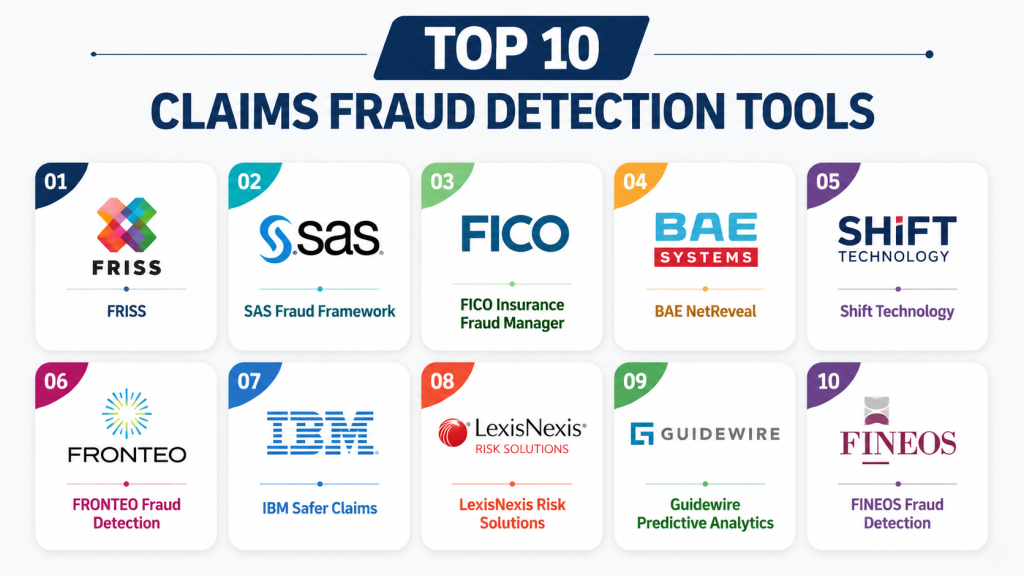
Top 10 Claims Fraud Detection Tools
1- FRISS
Short description: FRISS delivers AI-driven fraud detection for insurers, focusing on property, casualty, and health claims. It is suitable for enterprise insurance carriers seeking risk mitigation.
Key Features
- AI and ML-powered fraud scoring.
- Real-time claims screening.
- Customer risk profiling.
- Automated alerts for suspicious claims.
- Integration with policy and claims management systems.
- Case management for investigators.
Pros
- High detection accuracy for complex fraud patterns.
- Strong integration with core insurance systems.
- Intuitive dashboards and reporting.
Cons
- Requires initial configuration and data training.
- Enterprise-focused pricing may be high for small carriers.
- Some features may be underutilized without dedicated analysts.
Platforms / Deployment
- Web / Windows
- Cloud / Hybrid
Security & Compliance
- Not publicly stated
Integrations & Ecosystem
- APIs for claims and policy management.
- Connectors for CRM and ERP systems.
- Customizable integration rules.
Support & Community
- Vendor offers onboarding, documentation, and support tiers.
- Community forums available.
2- SAS Fraud Framework
Short description: SAS Fraud Framework provides analytics-driven fraud detection for insurance and banking claims, leveraging advanced AI and predictive models.
Key Features
- Predictive modeling for claim fraud.
- Rules-based and anomaly detection.
- Multi-channel claims analysis.
- Case management and workflow automation.
- Real-time scoring engine.
- Regulatory reporting support.
Pros
- Highly configurable and scalable for large insurers.
- Strong analytics and reporting capabilities.
- Supports both batch and real-time detection.
Cons
- Implementation can be resource-intensive.
- Requires in-house expertise to optimize models.
- Higher total cost of ownership.
Platforms / Deployment
- Web / Windows / Linux
- Cloud / On-premise / Hybrid
Security & Compliance
- Not publicly stated
Integrations & Ecosystem
- Connects to ERP, CRM, and core claims platforms.
- Offers APIs for custom extensions.
- Supports integration with external data sources.
Support & Community
- Extensive documentation, training, and support tiers.
- Active professional community.
3- FICO Insurance Fraud Manager
Short description: FICO provides predictive analytics and AI models to detect suspicious insurance claims, widely used across P&C insurers.
Key Features
- AI-driven predictive scoring.
- Case management dashboards.
- Integration with claims processing systems.
- Automated alerts and reporting.
- Social network analysis for fraud rings.
- Real-time claim evaluation.
Pros
- Strong AI and predictive modeling capabilities.
- Scalable for enterprise-level operations.
- Detects complex multi-claim patterns.
Cons
- Steeper learning curve for new users.
- Premium pricing structure.
- Customization may require consulting support.
Platforms / Deployment
- Web / Windows
- Cloud / On-premise / Hybrid
Security & Compliance
- Not publicly stated
Integrations & Ecosystem
- API-based connectors.
- Supports data from multiple insurance lines.
- Extensible for additional analytics tools.
Support & Community
- Comprehensive support services.
- User community and knowledge base.
4- BAE NetReveal
Short description: BAE NetReveal focuses on advanced detection of fraudulent insurance claims and organized fraud rings using AI and analytics.
Key Features
- AI and network analytics for fraud detection.
- Real-time claim monitoring.
- Case management with audit trails.
- Integration with claims and policy systems.
- Visual analytics for pattern recognition.
- Multi-channel detection (phone, web, email).
Pros
- Excellent at uncovering complex fraud networks.
- Visual analytics aid investigative work.
- Scalable enterprise deployment.
Cons
- Implementation complexity.
- Requires trained fraud analysts.
- Licensing costs may be high.
Platforms / Deployment
- Web / Windows
- Cloud / On-premise
Security & Compliance
- Not publicly stated
Integrations & Ecosystem
- ERP and claims system connectors.
- API support for external data.
- Extensible fraud analytics modules.
Support & Community
- Strong vendor support and training.
- Active professional forums.
5- Shift Technology
Short description: Shift Technology delivers AI-based fraud detection for insurance claims, targeting P&C and health sectors, with automated decision support.
Key Features
- Machine learning fraud scoring.
- Automated decision support.
- Case management dashboards.
- Predictive analytics for claims risk.
- Real-time claim evaluation.
- Integration with claim processing systems.
Pros
- Rapid implementation.
- Reduces manual investigation workload.
- Real-time AI scoring for operational efficiency.
Cons
- May require data standardization.
- Focused primarily on P&C and health insurance.
- Some advanced features need analyst tuning.
Platforms / Deployment
- Web
- Cloud
Security & Compliance
- Not publicly stated
Integrations & Ecosystem
- API integrations with claims management systems.
- Connects to CRM and ERP platforms.
- Supports custom rule creation.
Support & Community
- Vendor-provided onboarding and support.
- Varies / Not publicly stated for community.
6- FRONTEO Fraud Detection
Short description: FRONTEO leverages AI and natural language processing to detect fraudulent insurance claims in multiple industries.
Key Features
- NLP for unstructured data analysis.
- Machine learning fraud models.
- Case prioritization and alerts.
- Integration with claims systems.
- Reporting and analytics.
- Multi-language support.
Pros
- Excels in analyzing text-heavy claims.
- Early detection of complex fraud scenarios.
- Supports global deployment.
Cons
- Smaller community presence.
- May require configuration for local regulations.
- Premium enterprise pricing.
Platforms / Deployment
- Web
- Cloud / Hybrid
Security & Compliance
- Not publicly stated
Integrations & Ecosystem
- API access to claims and policy data.
- Connects with ERP and CRM.
- Extensible NLP models.
Support & Community
- Vendor-provided support and onboarding.
- Varies / Not publicly stated.
7- IBM Safer Claims
Short description: IBM Safer Claims provides fraud detection using AI and analytics for property, casualty, and health insurance claims.
Key Features
- AI-based predictive models.
- Real-time claims evaluation.
- Case management and workflow.
- Analytics dashboards.
- Integration with claims and ERP systems.
- Compliance reporting.
Pros
- Strong AI and analytics backbone.
- Enterprise-scale deployment.
- Continuous model improvement.
Cons
- Configuration can be resource-intensive.
- Requires dedicated analysts.
- Higher total cost for smaller insurers.
Platforms / Deployment
- Web / Windows
- Cloud / Hybrid
Security & Compliance
- Not publicly stated
Integrations & Ecosystem
- APIs for integration with claims management.
- Connects to ERP and CRM systems.
- Supports custom rule definitions.
Support & Community
- Vendor support, training, and documentation.
- Professional user community.
8- LexisNexis Risk Solutions
Short description: LexisNexis Risk Solutions offers insurance fraud detection through predictive analytics and multi-source data insights.
Key Features
- Data-driven fraud scoring.
- Real-time claims monitoring.
- Cross-claims analytics.
- Case management dashboards.
- Alerts and automated workflows.
- Regulatory compliance support.
Pros
- Leverages rich third-party data.
- Reduces false positives.
- Strong analytical insights for investigators.
Cons
- Licensing costs may be high.
- Integration complexity for legacy systems.
- Some modules require analyst training.
Platforms / Deployment
- Web
- Cloud / Hybrid
Security & Compliance
- Not publicly stated
Integrations & Ecosystem
- API connectors for claims and policy systems.
- Extensible analytics platform.
- Supports CRM and ERP integration.
Support & Community
- Vendor support available.
- Varies / Not publicly stated for community.
9- Guidewire Predictive Analytics
Short description: Guidewire Predictive Analytics combines machine learning with claims data to proactively detect fraudulent claims for P&C insurers.
Key Features
- Predictive scoring for claims.
- AI and ML model customization.
- Integration with Guidewire ClaimCenter.
- Case management and workflow.
- Dashboards and analytics.
- Automated alerts.
Pros
- Seamless integration with Guidewire suite.
- Customizable predictive models.
- Real-time fraud detection capabilities.
Cons
- Best suited for Guidewire users.
- Requires data preparation and cleaning.
- Training required for non-technical staff.
Platforms / Deployment
- Web
- Cloud / Hybrid
Security & Compliance
- Not publicly stated
Integrations & Ecosystem
- Deep integration with Guidewire products.
- API support for external systems.
- Extensible for analytics modules.
Support & Community
- Vendor documentation and support tiers.
- Active professional user community.
10- FINEOS Fraud Detection
Short description: FINEOS provides claims fraud detection for life, accident, and health insurers, focusing on AI-assisted analytics and workflow automation.
Key Features
- AI-based fraud scoring.
- Workflow automation for investigations.
- Multi-line insurance support.
- Dashboards and alerts.
- Case management tools.
- Regulatory compliance reporting.
Pros
- Reduces manual investigative workload.
- Multi-line insurance support.
- Cloud-native platform with scalability.
Cons
- Implementation can take time.
- Best suited for existing FINEOS users.
- Analyst training required for advanced features.
Platforms / Deployment
- Web
- Cloud
Security & Compliance
- Not publicly stated
Integrations & Ecosystem
- API integrations with claims and policy systems.
- Connects with ERP platforms.
- Extensible analytics modules.
Support & Community
- Vendor support and documentation available.
- Varies / Not publicly stated.
Comparison Table (Top 10)
| Tool Name | Best For | Platform(s) Supported | Deployment | Standout Feature | Public Rating |
|---|---|---|---|---|---|
| FRISS | Enterprise P&C/Health | Web / Windows | Cloud / Hybrid | Real-time AI scoring | N/A |
| SAS Fraud Framework | Large insurers | Web / Windows / Linux | Cloud / On-premise / Hybrid | Predictive modeling | N/A |
| FICO Insurance Fraud Manager | Enterprise P&C | Web / Windows | Cloud / On-premise / Hybrid | AI & predictive analytics | N/A |
| BAE NetReveal | Complex fraud networks | Web / Windows | Cloud / On-premise | Network analytics | N/A |
| Shift Technology | P&C & Health | Web | Cloud | Automated decision support | N/A |
| FRONTEO Fraud Detection | Multi-language, text-heavy claims | Web | Cloud / Hybrid | NLP-based fraud detection | N/A |
| IBM Safer Claims | Enterprise insurers | Web / Windows | Cloud / Hybrid | AI predictive models | N/A |
| LexisNexis Risk Solutions | Cross-insurance analytics | Web | Cloud / Hybrid | Third-party data enrichment | N/A |
| Guidewire Predictive Analytics | Guidewire users | Web | Cloud / Hybrid | Seamless Guidewire integration | N/A |
| FINEOS Fraud Detection | Life & Health insurers | Web | Cloud | Multi-line AI fraud scoring | N/A |
Evaluation & Scoring of Claims Fraud Detection Tools
| Tool Name | Core (25%) | Ease (15%) | Integrations (15%) | Security (10%) | Performance (10%) | Support (10%) | Value (15%) | Weighted Total (0–10) |
|---|---|---|---|---|---|---|---|---|
| FRISS | 9 | 8 | 8 | 7 | 8 | 8 | 7 | 8.2 |
| SAS Fraud Framework | 10 | 7 | 9 | 8 | 9 | 8 | 6 | 8.3 |
| FICO Insurance Fraud Manager | 10 | 7 | 8 | 8 | 9 | 8 | 6 | 8.1 |
| BAE NetReveal | 9 | 6 | 8 | 7 | 8 | 7 | 6 | 7.6 |
| Shift Technology | 8 | 8 | 7 | 7 | 8 | 7 | 7 | 7.7 |
| FRONTEO Fraud Detection | 8 | 7 | 7 | 7 | 7 | 7 | 6 | 7.2 |
| IBM Safer Claims | 9 | 6 | 8 | 7 | 8 | 7 | 6 | 7.6 |
| LexisNexis Risk Solutions | 8 | 7 | 7 | 7 | 7 | 6 | 6 | 7.0 |
| Guidewire Predictive Analytics | 9 | 7 | 8 | 7 | 8 | 7 | 6 | 7.7 |
| FINEOS Fraud Detection | 8 | 7 | 7 | 7 | 7 | 6 | 6 | 7.0 |
Which Claims Fraud Detection Tool Is Right for You?
Solo / Freelancer
- Likely limited need for sophisticated fraud detection.
- Consider lighter SaaS options like Shift Technology with straightforward deployment.
SMB
- Need reliable AI detection without high complexity.
- FRISS or Shift Technology offer cloud-based, scalable solutions suitable for growing insurers.
Mid-Market
- Require integrated fraud scoring and reporting.
- FICO Insurance Fraud Manager or Guidewire Predictive Analytics provide robust capabilities with flexible integration.
Enterprise
- Demand high-volume analytics, multi-line support, and advanced AI.
- SAS Fraud Framework, BAE NetReveal, or IBM Safer Claims deliver comprehensive fraud detection and investigative support.
Budget vs Premium
- Budget-conscious teams may favor Shift Technology or FRONTEO.
- Premium buyers requiring advanced analytics should consider SAS, FICO, or BAE NetReveal.
Feature Depth vs Ease of Use
- Enterprise tools excel in depth but require training.
- SaaS-focused platforms prioritize ease of use and faster onboarding.
Integrations & Scalability
- Mid-market and enterprise insurers should focus on tools with APIs and connectors to claims, policy, CRM, and ERP systems.
- Cloud-native deployments enhance scalability.
Security & Compliance Needs
- Ensure the platform aligns with GDPR, HIPAA, or local insurance regulations.
- Look for SSO, MFA, audit logs, and encryption where possible.
Frequently Asked Questions (FAQs)
1- How do claims fraud detection tools charge?
Most operate on SaaS subscription models; pricing may depend on claim volume, number of users, or feature tiers. Enterprise deployments often include custom pricing.
2- Can these tools integrate with existing claims systems?
Yes, most provide APIs or pre-built connectors for popular claims and policy management platforms, ensuring seamless workflow integration.
3- How long does implementation take?
Implementation varies from a few weeks for cloud SaaS tools to several months for enterprise systems requiring data mapping and model training.
4- Do they use AI or only rules?
Leading tools combine AI, machine learning, and rules-based engines to detect both known and emerging fraud patterns.
5- Can they detect complex fraud rings?
Yes, advanced platforms like BAE NetReveal and FICO use network analytics and multi-claim pattern detection for sophisticated fraud networks.
6- Are these tools suitable for small insurers?
Smaller insurers may benefit from SaaS-based options like Shift Technology, while large enterprises require more comprehensive platforms.
7- What kind of reporting is available?
Dashboards typically include fraud scores, alerts, case summaries, and audit trails for regulatory compliance and internal analysis.
8- Can fraud detection reduce manual investigations?
Yes, automated scoring and alerting significantly reduce the time investigators spend reviewing claims manually.
9- Are they compliant with regulations?
Vendors generally design systems to support compliance, but insurers must validate alignment with GDPR, HIPAA, ISO, or local insurance regulations.
10- Can I switch vendors easily?
Switching requires careful migration of historical data and integration mapping; most vendors offer professional services to assist with transitions.
Conclusion
Claims fraud detection tools are critical for insurers to reduce financial losses and enhance operational efficiency. Selecting the right platform depends on company size, claim volume, and integration needs. AI-powered scoring and predictive analytics are now central to effective fraud prevention. Cloud and hybrid deployments offer scalability and faster time-to-value. Strong integration with claims and policy systems ensures seamless workflow. Buyers should balance feature depth, ease of use, and cost when choosing a solution. The recommended approach is to shortlist 2–3 tools, run a pilot, and validate integrations and security before full deployment.

Find Trusted Cardiac Hospitals
Compare heart hospitals by city and services — all in one place.
Explore Hospitals
Claims fraud detection is most effective when technology supports investigators instead of replacing their judgment. Combining behavioral analytics, historical claim patterns, and explainable AI can improve detection accuracy while helping legitimate claims move through the process without unnecessary delays.