Introduction
Confidential Computing Platforms are specialized environments designed to protect data while it is in use. Unlike traditional encryption, which secures data at rest and in transit, confidential computing ensures that sensitive information remains encrypted even while being processed in memory. This is increasingly vital as organizations face tighter data privacy regulations, sophisticated cyber threats, and the need to safely perform AI, analytics, and multi-party collaboration on sensitive datasets.
Real-world use cases include:
- Financial institutions performing risk modeling on confidential client data.
- Healthcare providers analyzing patient records while maintaining HIPAA compliance.
- Enterprises leveraging AI and ML on sensitive datasets without exposing raw data.
- Government agencies collaborating on classified datasets for research and analytics.
- Cloud-native businesses deploying multi-tenant applications with encrypted in-memory processing.
Key evaluation criteria for buyers:
- Encryption in use and memory isolation strength
- Compliance certifications (HIPAA, GDPR, SOC 2, ISO 27001)
- Access control granularity and identity management
- Performance and scalability for AI/analytics workloads
- Integration with cloud services, data lakes, and ML platforms
- Ease of deployment and management
- Audit logging, monitoring, and reporting
- Pricing models and flexibility
- Multi-cloud and hybrid support
- API and developer support
Best for: Organizations in regulated industries such as healthcare, finance, and government; enterprises using sensitive datasets for AI, analytics, and cross-organizational collaboration.
Not ideal for: Small businesses or teams handling non-sensitive data where conventional cloud storage and analytics tools are sufficient.
Key Trends in Confidential Computing Platforms
- Widespread adoption of hardware-based confidential computing: Intel SGX, AMD SEV, and ARM TrustZone are increasingly supported across clouds.
- AI-driven security monitoring: Platforms now include anomaly detection for suspicious access within enclaves.
- Hybrid and multi-cloud deployment support: Confidential workloads are no longer limited to a single cloud provider.
- Federated learning integration: Enables AI model training across multiple parties without sharing raw data.
- Zero-trust architectures: Enclaves are increasingly integrated with identity-first, strict verification systems.
- Policy-driven automated compliance: Platforms offer real-time reporting for HIPAA, SOC 2, and GDPR requirements.
- Real-time collaboration: Secure multi-party analytics is becoming standard for research and enterprise projects.
- API standardization: Integration with analytics, ML, and orchestration pipelines is improving.
- Flexible consumption models: Pay-as-you-go, temporary enclave provisioning, and enterprise subscriptions are available.
- Confidential cloud-native AI workflows: Platforms optimize GPU/TPU workloads within secure environments.
How We Selected These Tools (Methodology)
- Evaluated market adoption and industry recognition.
- Assessed feature completeness, including encryption-in-use and secure computation support.
- Reviewed performance and reliability signals for large-scale analytics and AI.
- Examined security posture, including access control and audit capabilities.
- Analyzed integration ecosystem with cloud, AI, and analytics tools.
- Determined customer fit across SMB, mid-market, and enterprise segments.
- Verified regulatory compliance capabilities for sensitive workloads.
- Considered ease of use and documentation for deployment and management.
- Prioritized scalability and multi-cloud support.
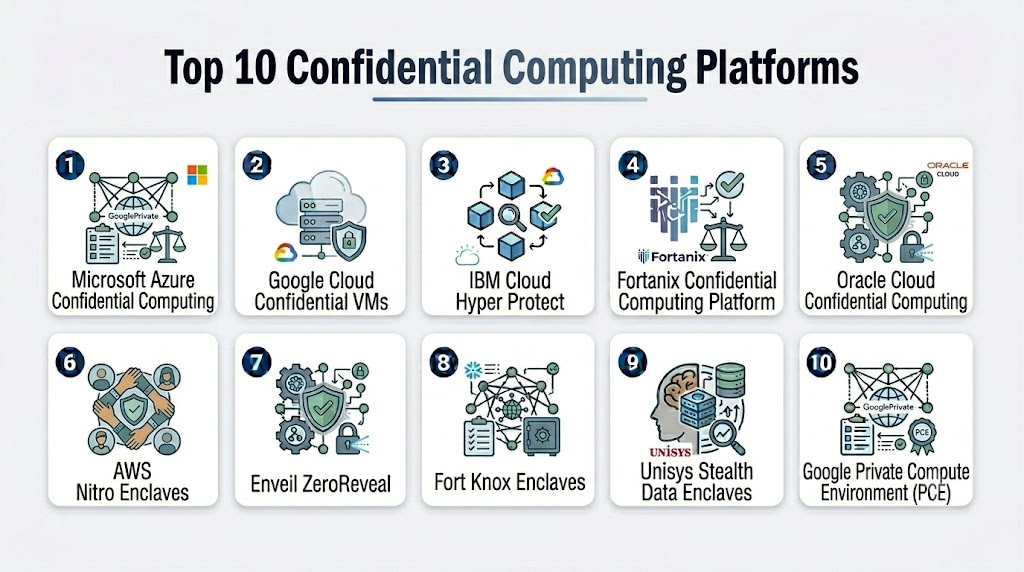
Top 10 Confidential Computing Platforms Tools
1- Microsoft Azure Confidential Computing
Short description: Provides secure enclaves and encrypted VMs for processing sensitive workloads in Azure cloud, ideal for enterprises in regulated industries.
Key Features
- Intel SGX hardware-based memory encryption
- Integration with Azure ML, Databricks, and analytics services
- Fine-grained role-based access control
- Compliance reporting and audit logging
- Hybrid cloud deployment support
Pros
- Seamless integration with Microsoft ecosystem
- Enterprise-grade scalability and reliability
Cons
- Higher cost for large-scale workloads
- Steep learning curve for enclave configuration
Platforms / Deployment
- Web / Windows / Linux
- Cloud
Security & Compliance
- SSO/SAML, MFA, RBAC
- Not publicly stated: SOC 2, ISO 27001, HIPAA
Integrations & Ecosystem
- Azure ML, Databricks, Power BI, Custom APIs
Support & Community
- Strong enterprise support tiers, extensive documentation
2- Google Cloud Confidential VMs
Short description: Offers VMs with memory encryption for sensitive data processing, suitable for AI and analytics workloads.
Key Features
- AMD SEV-based memory encryption
- Integration with BigQuery and Vertex AI
- IAM-based fine-grained access control
- Real-time audit logging
- Multi-region deployment
Pros
- Scalable and high-performance cloud platform
- Strong integration with Google Cloud services
Cons
- Limited third-party analytics integrations
- Requires cloud expertise
Platforms / Deployment
- Web / Linux
- Cloud
Security & Compliance
- RBAC, encryption, audit logs
- Not publicly stated: HIPAA, ISO 27001
Integrations & Ecosystem
- BigQuery, Vertex AI, Cloud Storage, Kubernetes
Support & Community
- Comprehensive documentation and Google Cloud support
3- IBM Cloud Hyper Protect
Short description: Enterprise-focused confidential computing solution for secure AI, analytics, and database workloads.
Key Features
- Hardware-based memory encryption
- Watson AI integration
- Fine-grained access policies
- Audit-ready compliance reporting
- Multi-cloud and hybrid support
Pros
- High compliance for regulated industries
- Enterprise-level scalability and security
Cons
- Complex deployment and configuration
- Cost-prohibitive for SMBs
Platforms / Deployment
- Web / Linux
- Cloud / Hybrid
Security & Compliance
- SSO, RBAC, MFA
- HIPAA, Not publicly stated: SOC 2, ISO 27001
Integrations & Ecosystem
- IBM Watson, Db2, Kubernetes, Analytics APIs
Support & Community
- Enterprise support available, strong technical documentation
4- Fortanix Confidential Computing Platform
Short description: Software-defined enclave solution for secure computation across multi-cloud and hybrid environments.
Key Features
- Hardware-agnostic secure enclaves
- Key management and encryption lifecycle
- AI/ML model training in encrypted environment
- Multi-tenant access control
- Audit and compliance monitoring
Pros
- Flexible across cloud providers
- Focus on AI/analytics workloads
Cons
- Integration requires technical expertise
- Limited consumer-focused features
Platforms / Deployment
- Web / Linux
- Cloud / Hybrid
Security & Compliance
- Encryption, RBAC, audit logs
- Not publicly stated: SOC 2, ISO 27001, HIPAA
Integrations & Ecosystem
- ML frameworks, data lakes, Kubernetes, APIs
Support & Community
- Technical support, developer forums available
5- Oracle Cloud Confidential Computing
Short description: Provides SGX-enabled VMs and secure compute for analytics and enterprise workloads.
Key Features
- Intel SGX-based VM encryption
- Integration with Oracle Autonomous Database
- Role-based access control
- Compliance auditing and monitoring
- Multi-region support
Pros
- Strong integration with Oracle services
- Enterprise-grade security and reliability
Cons
- Oracle-centric ecosystem may limit flexibility
- Cost can be high
Platforms / Deployment
- Web / Linux
- Cloud
Security & Compliance
- RBAC, audit logs
- Not publicly stated: HIPAA, ISO 27001
Integrations & Ecosystem
- Oracle Database, Oracle Analytics, ML APIs
Support & Community
- Enterprise support, documentation available
6- AWS Nitro Enclaves
Short description: Isolated AWS compute environments for sensitive workloads with strong integration to cloud services.
Key Features
- Hardware-enforced isolation with Nitro
- Key management service integration
- Integration with SageMaker, S3, and CloudWatch
- Fine-grained access control
- Temporary enclave provisioning
Pros
- Deep AWS ecosystem integration
- Highly scalable
Cons
- Requires AWS-specific expertise
- No direct host access inside enclave
Platforms / Deployment
- Web / Linux
- Cloud
Security & Compliance
- RBAC, encryption, audit logs
- Not publicly stated: SOC 2, ISO 27001, HIPAA
Integrations & Ecosystem
- SageMaker, S3, KMS, CloudWatch
Support & Community
- AWS support tiers, active community
7- Enveil ZeroReveal
Short description: Privacy-focused platform enabling analytics on encrypted data without exposing sensitive information.
Key Features
- Encryption-in-use for analytics
- Privacy-preserving ML support
- Role-based access control
- API-driven integration
- Compliance monitoring
Pros
- Strong privacy focus
- Suitable for AI and analytics workloads
Cons
- Limited public documentation
- Requires specialized configuration
Platforms / Deployment
- Web / Linux
- Cloud / Hybrid
Security & Compliance
- Encryption, RBAC
- Not publicly stated: SOC 2, ISO 27001
Integrations & Ecosystem
- Data warehouses, ML frameworks, APIs
Support & Community
- Technical support, limited community
8- Fort Knox Enclaves
Short description: Enterprise-grade secure compute environment with compliance-oriented features.
Key Features
- Data isolation and encryption
- Fine-grained user access
- Audit-ready logging
- Multi-cloud support
- APIs for analytics integration
Pros
- Compliance-focused
- Supports hybrid and multi-cloud deployments
Cons
- Limited adoption data
- Documentation varies
Platforms / Deployment
- Web / Linux
- Cloud / Hybrid
Security & Compliance
- Not publicly stated
Integrations & Ecosystem
- Analytics APIs, hybrid cloud connectors
Support & Community
- Varies / Not publicly stated
9- Unisys Stealth Data Enclaves
Short description: Enterprise-focused solution with micro-segmentation and secure collaboration features.
Key Features
- Hardware-based encryption
- Role-based access control and micro-segmentation
- Audit logging and monitoring
- Secure remote collaboration
- API integrations
Pros
- Strong enterprise security
- Supports cross-location projects
Cons
- Complex setup
- Cost-prohibitive for SMBs
Platforms / Deployment
- Web / Windows / Linux
- Cloud / Hybrid
Security & Compliance
- RBAC, MFA
- Not publicly stated: ISO 27001
Integrations & Ecosystem
- APIs for analytics and ML
- Cloud connectors
Support & Community
- Enterprise support available, limited public community
10- Google Private Compute Environment (PCE)
Short description: Private enclave solution for secure AI and analytics workloads in Google Cloud.
Key Features
- Hardware-enforced isolation
- Encryption-in-use
- Integration with AI/ML pipelines
- Compliance auditing
- Identity-based access control
Pros
- Tight Google Cloud integration
- Strong security for AI workloads
Cons
- Limited support outside Google ecosystem
- Requires cloud expertise
Platforms / Deployment
- Web / Linux
- Cloud
Security & Compliance
- RBAC, encryption, audit logs
- Not publicly stated: HIPAA, ISO 27001
Integrations & Ecosystem
- BigQuery, Vertex AI, Cloud Storage APIs
Support & Community
- Google Cloud support, documentation available
Comparison Table (Top 10)
| Tool Name | Best For | Platform(s) Supported | Deployment | Standout Feature | Public Rating |
|---|---|---|---|---|---|
| Microsoft Azure Confidential Computing | Enterprise | Web, Windows, Linux | Cloud | Intel SGX VMs | N/A |
| Google Cloud Confidential VMs | Developers & Enterprise | Web, Linux | Cloud | AMD SEV encryption | N/A |
| IBM Cloud Hyper Protect | Enterprise | Web, Linux | Cloud / Hybrid | Watson AI integration | N/A |
| Fortanix Confidential Computing Platform | Multi-cloud AI workloads | Web, Linux | Cloud / Hybrid | Hardware-agnostic enclaves | N/A |
| Oracle Cloud Confidential Computing | Oracle enterprise users | Web, Linux | Cloud | SGX-enabled VMs | N/A |
| AWS Nitro Enclaves | AWS cloud workloads | Web, Linux | Cloud | Enclave isolation | N/A |
| Enveil ZeroReveal | Privacy-focused analytics | Web, Linux | Cloud / Hybrid | Analytics on encrypted data | N/A |
| Fort Knox Enclaves | Compliance-driven enterprises | Web, Linux | Cloud / Hybrid | Multi-cloud security | N/A |
| Unisys Stealth Data Enclaves | Large enterprises | Web, Windows, Linux | Cloud / Hybrid | Micro-segmentation | N/A |
| Google Private Compute Environment | AI/ML workloads | Web, Linux | Cloud | Private enclaves | N/A |
Evaluation & Scoring of Confidential Computing Platforms
| Tool Name | Core (25%) | Ease (15%) | Integrations (15%) | Security (10%) | Performance (10%) | Support (10%) | Value (15%) | Weighted Total |
|---|---|---|---|---|---|---|---|---|
| Microsoft Azure Confidential Computing | 9 | 8 | 9 | 8 | 9 | 8 | 7 | 8.6 |
| Google Cloud Confidential VMs | 8 | 8 | 8 | 8 | 9 | 8 | 7 | 8.2 |
| IBM Cloud Hyper Protect | 9 | 7 | 8 | 9 | 8 | 8 | 6 | 8.1 |
| Fortanix Confidential Computing Platform | 8 | 7 | 8 | 8 | 8 | 7 | 7 | 7.8 |
| Oracle Cloud Confidential Computing | 8 | 7 | 7 | 8 | 8 | 7 | 6 | 7.5 |
| AWS Nitro Enclaves | 8 | 7 | 8 | 8 | 9 | 7 | 7 | 7.9 |
| Enveil ZeroReveal | 7 | 7 | 7 | 8 | 8 | 6 | 6 | 7.1 |
| Fort Knox Enclaves | 7 | 6 | 7 | 8 | 7 | 6 | 6 | 6.9 |
| Unisys Stealth Data Enclaves | 8 | 6 | 7 | 8 | 8 | 7 | 6 | 7.3 |
| Google Private Compute Environment | 7 | 7 | 7 | 8 | 8 | 7 | 6 | 7.2 |
Which Confidential Computing Platform Is Right for You?
Solo / Freelancer
- Likely do not need enterprise-grade enclaves; Google Cloud Confidential VMs or Enveil ZeroReveal may suffice.
SMB
- Fortanix or AWS Nitro Enclaves provide flexible and cost-effective options with pay-as-you-go models.
Mid-Market
- Azure Confidential Computing or IBM Hyper Protect offer scalable and secure options for regulated workloads.
Enterprise
- Oracle Cloud, IBM Hyper Protect, or Unisys Stealth provide robust compliance, multi-cloud support, and high scalability.
Budget vs Premium
- Budget: lighter cloud-native solutions with limited features
- Premium: full enterprise-grade compliance, AI/ML integration, and multi-cloud support
Feature Depth vs Ease of Use
- Fortanix and Enveil: advanced features for AI/analytics
- Azure and AWS: easy deployment in familiar cloud ecosystems
Integrations & Scalability
- Mid-market and enterprise should choose platforms supporting multi-cloud analytics and AI pipelines like Fortanix, IBM Hyper Protect
Security & Compliance Needs
- Regulated industries require platforms with strong encryption, audit logging, HIPAA/SOC2 capabilities
Frequently Asked Questions (FAQs)
1- What is the pricing model for confidential computing platforms?
Pricing varies from pay-as-you-go cloud services to enterprise subscriptions based on compute, memory, and usage duration.
2- How long does onboarding take?
Cloud-native platforms may be configured in days; enterprise hybrid deployments may take weeks.
3- Can confidential computing platforms handle AI workloads?
Yes, most platforms now support ML frameworks with encrypted in-memory processing.
4- Are these solutions compliant with regulations?
Many provide HIPAA, GDPR, and SOC 2 support, but verification is essential for each deployment.
5- How scalable are these platforms?
Cloud-based solutions offer horizontal scalability; hybrid solutions provide flexible capacity for large datasets.
6- What integrations are available?
Integrations include cloud analytics, ML pipelines, APIs, and orchestration tools.
7- Can I switch providers easily?
Migration is complex due to encryption and data isolation; vendor support is critical.
8- What are common mistakes?
Misconfiguring access controls, underestimating compliance requirements, and ignoring monitoring logs.
9- Do these platforms support multi-cloud environments?
Some platforms support multi-cloud, but feature parity may vary.
10- Are there alternatives?
Yes: traditional encrypted storage, VPN-secured access, or confidential computing hardware for specific workloads.
Conclusion
Confidential computing platforms are critical for organizations managing sensitive or regulated data, enabling secure AI and analytics workloads. Selection depends on deployment preferences, compliance needs, and organizational scale. Enterprises benefit from multi-cloud and hybrid options, while SMBs may prioritize cost and ease of use. Security, integration, and audit capabilities are essential criteria for evaluation. Buyers should shortlist 2–3 tools, run a pilot, and validate security and compliance before scaling. Proper implementation ensures data protection, regulatory adherence, and secure collaboration across teams. With careful evaluation, organizations can leverage confidential computing for innovation without compromising privacy.

Find Trusted Cardiac Hospitals
Compare heart hospitals by city and services — all in one place.
Explore Hospitals
A practical consideration often missed is attestation lifecycle management and cross-platform interoperability. As confidential computing deployments expand, organizations should also plan for monitoring, compliance validation, and the operational overhead of maintaining trusted execution environments at scale.