Introduction
Decentralized Identity DID platforms help organizations issue, manage, verify, and exchange digital credentials without depending only on centralized identity databases. In simple terms, these platforms allow people, employees, customers, students, partners, or devices to prove something about themselves using cryptographically verifiable credentials. This matters because identity verification is becoming more privacy-sensitive, compliance-heavy, and ecosystem-driven. Businesses want faster onboarding, reduced fraud, reusable credentials, and better control over personal data. DID platforms are used for workforce identity, customer onboarding, digital education certificates, healthcare credentials, financial KYC, travel identity, Web3 access, and government-backed digital ID programs.
Real-world use cases include:
- Reusable identity verification for customers and citizens
- Employee and contractor credentialing across enterprises
- Education certificates and professional licenses
- Healthcare identity and consent-based data sharing
- Web3, wallet, and blockchain-based identity flows
What buyers should evaluate:
- Credential issuance and verification capabilities
- Support for open standards
- Wallet compatibility
- API quality and developer experience
- Privacy and consent controls
- Enterprise identity integration
- Compliance readiness
- Scalability and ecosystem maturity
- Support and implementation services
- Deployment flexibility
Best for: DID platforms are best for enterprises, governments, education providers, healthcare networks, fintech companies, Web3 builders, identity architects, compliance teams, and product teams that need trusted digital credentials across multiple systems.
Not ideal for: DID platforms may not be necessary for small teams that only need basic login, passwordless authentication, or simple customer identity management. In those cases, traditional IAM, CIAM, or identity verification tools may be easier to deploy.
Key Trends in Decentralized Identity DID Platforms
- Verifiable credentials are becoming enterprise-ready: More organizations are exploring credentials for workforce access, compliance records, education certificates, and reusable customer verification.
- Wallet-based identity is gaining traction: Users increasingly expect to store and control credentials in digital wallets instead of repeatedly submitting documents.
- Interoperability is now a major buying factor: Buyers are looking for platforms that work across DID methods, credential formats, wallets, and identity ecosystems.
- Privacy-preserving verification is becoming important: Selective disclosure, minimal data sharing, and consent-led identity exchange are key requirements for regulated industries.
- Government and public-sector digital ID programs are influencing adoption: National and regional digital identity initiatives are pushing more organizations to prepare for credential-based verification.
- Enterprise IAM integration is critical: DID platforms are more valuable when they can connect with identity providers, access systems, HR platforms, compliance workflows, and customer onboarding tools.
- Developer-first APIs are separating mature platforms from experimental projects: Teams want reliable SDKs, clear documentation, sandbox environments, and flexible issuance and verification APIs.
- AI and automation are entering credential workflows: AI may help with document review, fraud pattern detection, onboarding automation, and risk scoring, but buyers should carefully validate accuracy and governance.
- Open-source identity infrastructure remains important: Projects such as Hyperledger Indy and Hyperledger Aries continue to influence SSI architecture, agent frameworks, and ecosystem standards.
- Compliance and auditability are becoming board-level concerns: Enterprises want better audit trails, governance controls, credential lifecycle management, and proof of identity without unnecessary data exposure.
How We Selected These Tools
The tools in this list were selected using a practical SaaS and product evaluation approach:
- Market visibility and adoption: Preference was given to platforms recognized in decentralized identity, verifiable credentials, SSI, or enterprise identity ecosystems.
- Feature completeness: Tools were evaluated for issuance, verification, credential management, wallet support, APIs, and ecosystem readiness.
- Enterprise and developer fit: The list balances enterprise platforms, developer-first infrastructure, open-source frameworks, and credential verification solutions.
- Standards alignment: Preference was given to platforms associated with DIDs, verifiable credentials, open identity standards, or interoperable credential exchange.
- Security posture signals: Tools were assessed based on identity controls, cryptographic verification, governance features, and available security information.
- Integration readiness: Platforms with APIs, SDKs, identity provider compatibility, or workflow integration potential were prioritized.
- Use-case diversity: The list includes tools for workforce identity, reusable KYC, education credentials, Web3 identity, public-sector identity, and compliance workflows.
- Long-term ecosystem relevance: Open-source frameworks and platforms with active identity ecosystem relevance were included where appropriate.
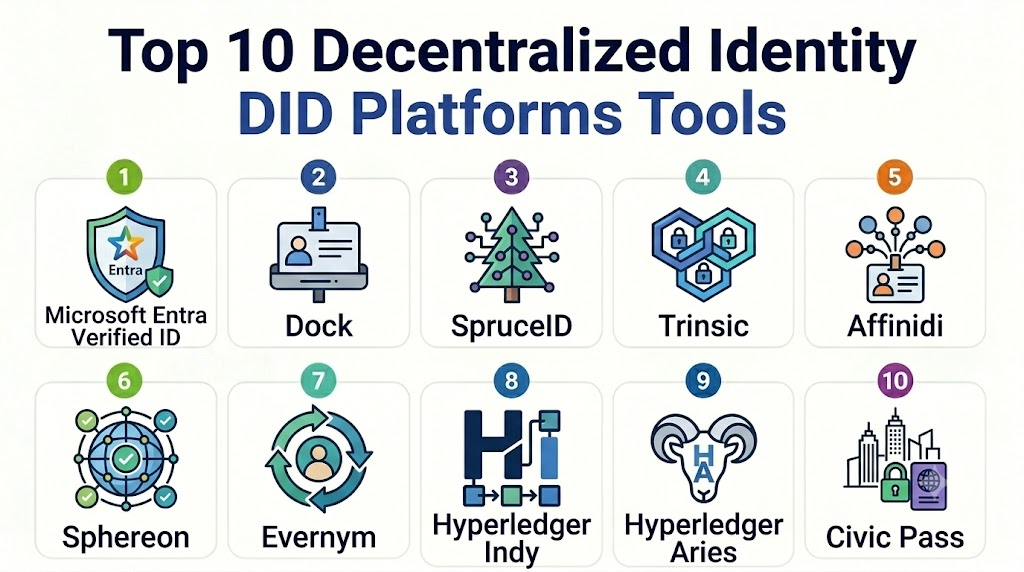
Top 10 Decentralized Identity DID Platforms Tools
1- Microsoft Entra Verified ID
Short description: Microsoft Entra Verified ID is an enterprise-focused decentralized identity and verifiable credential platform. It is designed for organizations that want to issue and verify credentials while integrating with broader Microsoft identity environments.
Key Features
- Verifiable credential issuance and verification
- Strong fit for enterprise identity environments
- Integration with Microsoft Entra ecosystem
- Support for credential-based identity verification flows
- Useful for workforce, partner, and customer identity scenarios
- Designed for organizations already using Microsoft identity tools
- Supports credential verification use cases through APIs and identity workflows
Pros
- Strong enterprise positioning for Microsoft-centric organizations
- Useful for workforce credentialing and trusted access scenarios
- Good fit for organizations modernizing identity verification
Cons
- May be less flexible for teams outside the Microsoft ecosystem
- Implementation requires understanding of verifiable credentials and DID concepts
- Some advanced use cases may need technical configuration and integration support
Platforms / Deployment
Web / Cloud
Security & Compliance
Microsoft identity environments commonly support enterprise-grade identity controls such as MFA, conditional access, and access governance, but specific compliance details should be verified for the exact deployment.
Integrations & Ecosystem
Microsoft Entra Verified ID is most valuable when connected with Microsoft identity, access, and enterprise application environments.
- Microsoft Entra ecosystem
- Identity and access management workflows
- Workforce and partner verification flows
- API-driven issuance and verification
- Enterprise onboarding and access systems
Support & Community
Support depends on Microsoft enterprise plans, documentation, identity partner ecosystem, and implementation support options. Organizations with existing Microsoft identity expertise may find adoption easier.
2- Dock
Short description: Dock is a decentralized identity and verifiable credential platform focused on reusable digital identity, credential issuance, and verification. It is suitable for teams building credential-based onboarding, workforce identity, and trust networks.
Key Features
- Verifiable credential issuance
- Credential verification workflows
- Reusable digital identity support
- Developer-friendly APIs
- Identity wallet and credential ecosystem support
- Useful for KYC, workforce, education, and compliance use cases
- Focus on privacy and credential portability
Pros
- Strong focus on reusable credentials and decentralized identity
- Useful for organizations building identity trust networks
- Developer-friendly approach for credential workflows
Cons
- May require technical implementation planning
- Ecosystem compatibility should be validated before deployment
- Enterprise buyers should verify support, compliance, and regional requirements
Platforms / Deployment
Web / Cloud / API-based deployment
Security & Compliance
Not publicly stated for all enterprise compliance frameworks. Buyers should verify encryption, audit logs, access controls, data residency, and compliance requirements directly during procurement.
Integrations & Ecosystem
Dock can be used in credential-based identity systems where businesses need to issue, verify, and manage reusable credentials.
- Verifiable credential workflows
- Digital identity applications
- APIs and developer integrations
- KYC and onboarding flows
- Workforce credentialing systems
Support & Community
Dock provides identity-focused documentation and product resources. Support availability may vary based on plan, implementation scope, and business requirements.
3- SpruceID
Short description: SpruceID provides decentralized identity infrastructure for verifiable credentials, wallet-based identity, and standards-aligned identity workflows. It is a strong fit for organizations that need developer-first identity infrastructure and privacy-preserving credential exchange.
Key Features
- Verifiable credential infrastructure
- Wallet-based identity support
- Developer-focused identity tooling
- Standards-oriented approach
- Credential issuance and verification support
- Useful for public-sector, enterprise, and Web3 identity use cases
- Supports privacy-focused identity exchange patterns
Pros
- Strong developer and standards orientation
- Good fit for modern digital credential projects
- Useful for teams building interoperable identity systems
Cons
- May require strong technical identity architecture skills
- Business teams may need implementation partners or internal developers
- Some features and deployment details vary by project scope
Platforms / Deployment
Cloud / API-based / Varies by implementation
Security & Compliance
Not publicly stated for all compliance categories. Buyers should validate security architecture, credential storage model, auditability, access controls, and compliance posture before rollout.
Integrations & Ecosystem
SpruceID is often relevant for organizations building credential workflows that need wallet compatibility and standards-based identity exchange.
- Verifiable credential APIs
- Wallet and credential ecosystems
- DID-based identity workflows
- Developer applications
- Public-sector and enterprise identity use cases
Support & Community
Support and services vary by engagement model. Technical teams should review documentation, integration examples, and available professional support before adoption.
4- Trinsic
Short description: Trinsic is a verifiable credential and reusable identity platform for developers and organizations. It helps teams build credential issuance, verification, and wallet-based identity flows without building all identity infrastructure from scratch.
Key Features
- Credential issuance and verification
- Reusable identity workflows
- Developer APIs and SDKs
- Wallet-based credential support
- Useful for KYC, onboarding, and trusted user verification
- Built for digital identity product teams
- Supports privacy-aware identity exchange models
Pros
- Good fit for product teams building identity features
- Developer-friendly positioning
- Useful for reusable customer identity flows
Cons
- May require technical integration work
- Buyers should validate wallet support and ecosystem compatibility
- Enterprise governance requirements may need additional review
Platforms / Deployment
Web / Cloud / API-based deployment
Security & Compliance
Not publicly stated for every compliance framework. Buyers should verify encryption, access control, data handling, audit logs, and privacy commitments based on their use case.
Integrations & Ecosystem
Trinsic fits applications that need identity verification, credential issuance, and reusable credential flows embedded into products.
- APIs and SDKs
- Digital identity applications
- KYC and onboarding workflows
- Wallet-based identity flows
- Credential verification systems
Support & Community
Trinsic provides developer resources and product documentation. Support levels may vary depending on commercial plan and implementation requirements.
5- Affinidi
Short description: Affinidi focuses on decentralized identity, data sharing, and credential-based digital trust. It is useful for organizations exploring privacy-preserving identity, consent-based data exchange, and user-controlled digital identity experiences.
Key Features
- Digital identity and credential infrastructure
- Consent-based data exchange concepts
- Useful for identity wallets and trusted data sharing
- Developer-focused tools and APIs
- Supports privacy-oriented identity use cases
- Suitable for customer identity and ecosystem-based trust
- Useful for identity-enabled digital experiences
Pros
- Strong focus on user-controlled identity and data portability
- Suitable for modern privacy-aware applications
- Useful for organizations exploring identity ecosystems
Cons
- May require careful product design and architecture
- Enterprise compliance details should be validated
- Some use cases may need custom implementation work
Platforms / Deployment
Cloud / API-based / Varies by implementation
Security & Compliance
Not publicly stated for all compliance areas. Buyers should verify security controls, access management, data storage, and regulatory alignment before production use.
Integrations & Ecosystem
Affinidi can support identity-enabled applications where users control and share data through trusted digital flows.
- Developer APIs
- Digital identity applications
- Credential and data-sharing workflows
- Customer onboarding journeys
- Privacy-first application experiences
Support & Community
Support and documentation vary by product and engagement model. Developers should validate resources, onboarding support, and implementation guidance before selecting it.
6- Sphereon
Short description: Sphereon provides decentralized identity and verifiable credential tooling for organizations building credential issuance, verification, and trust workflows. It is suitable for teams that need standards-based credential infrastructure and flexible integration options.
Key Features
- Verifiable credential issuance
- Credential verification tooling
- Standards-focused identity infrastructure
- Wallet and agent-related capabilities
- API-based integration options
- Useful for enterprise, government, and ecosystem credential use cases
- Supports digital trust workflows
Pros
- Strong fit for teams needing flexible credential infrastructure
- Useful for standards-based implementations
- Can support complex identity and verification workflows
Cons
- May require technical identity expertise
- Buyers should validate deployment, compliance, and support requirements
- Not always the simplest choice for non-technical teams
Platforms / Deployment
Cloud / API-based / Varies by implementation
Security & Compliance
Not publicly stated for all certifications or frameworks. Security controls, encryption, audit logs, and compliance posture should be reviewed during vendor evaluation.
Integrations & Ecosystem
Sphereon is useful for organizations building credential-based ecosystems and verification workflows.
- Verifiable credential applications
- Identity wallets and agents
- APIs and developer tooling
- Enterprise trust workflows
- Public-sector and compliance use cases
Support & Community
Support may depend on commercial engagement and implementation complexity. Technical teams should assess documentation depth and available professional services.
7- Evernym
Short description: Evernym is widely known in the self-sovereign identity space and has influenced decentralized identity adoption through SSI concepts, credential exchange, and trust ecosystem development. It is best viewed as an important SSI ecosystem name rather than a simple plug-and-play SaaS product.
Key Features
- Self-sovereign identity heritage
- Verifiable credential ecosystem relevance
- DID and credential exchange concepts
- Strong association with SSI trust frameworks
- Useful for historical and architectural SSI context
- Relevant for identity architects researching decentralized identity evolution
- Connected to broader digital trust ecosystem discussions
Pros
- Important name in the development of SSI concepts
- Useful for understanding DID ecosystem foundations
- Relevant to organizations studying trust frameworks and credential exchange
Cons
- Not always evaluated like a modern standalone SaaS platform
- Product availability and packaging should be verified carefully
- May be less direct for buyers wanting immediate SaaS deployment
Platforms / Deployment
Varies / N/A
Security & Compliance
Not publicly stated for current standalone product-level compliance. Buyers should validate current offering, ownership, deployment model, and security responsibilities before selecting.
Integrations & Ecosystem
Evernym is associated with SSI ecosystem development, trust frameworks, and verifiable credential concepts.
- SSI ecosystem knowledge
- DID and credential exchange concepts
- Trust framework discussions
- Identity architecture references
- Decentralized identity community relevance
Support & Community
Varies / Not publicly stated. Organizations should confirm current support, product status, and commercial availability before considering it in procurement.
8- Hyperledger Indy
Short description: Hyperledger Indy is an open-source distributed ledger framework built specifically for decentralized identity. It is useful for teams and ecosystems that want deeper control over SSI infrastructure and trust registries.
Key Features
- Open-source decentralized identity ledger framework
- Designed for self-sovereign identity use cases
- Supports DID-related identity infrastructure
- Useful for trust registry models
- Strong relevance in SSI architecture
- Suitable for technical teams and ecosystem builders
- Often used with agent and credential exchange frameworks
Pros
- Open-source and identity-specific
- Strong SSI ecosystem influence
- Useful for organizations needing deep infrastructure control
Cons
- Requires technical expertise to deploy and maintain
- Not a simple SaaS platform for non-technical buyers
- Scalability and governance design need careful planning
Platforms / Deployment
Self-hosted / Open-source / Varies by implementation
Security & Compliance
Not publicly stated as a managed compliance-certified SaaS product. Security depends heavily on implementation, hosting, governance, and operational controls.
Integrations & Ecosystem
Hyperledger Indy is typically used as part of broader SSI infrastructure with compatible agents, wallets, and credential frameworks.
- SSI trust registries
- DID infrastructure
- Credential ecosystems
- Hyperledger-related identity projects
- Custom identity networks
Support & Community
Community-driven support is available through open-source ecosystems. Enterprise-grade support may require internal expertise, consultants, or specialized implementation partners.
9- Hyperledger Aries
Short description: Hyperledger Aries is an open-source framework for decentralized identity agents, credential exchange, and secure DID-based communication. It is best for teams building wallet, agent, or credential interaction layers.
Key Features
- Open-source agent framework
- Credential exchange support
- DID communication patterns
- Useful for wallet and verifier architecture
- Works with SSI and verifiable credential ecosystems
- Strong developer and architecture relevance
- Suitable for custom decentralized identity projects
Pros
- Flexible open-source foundation
- Strong fit for technical DID builders
- Useful for advanced credential exchange scenarios
Cons
- Requires experienced developers and identity architects
- Not a turnkey commercial product by itself
- Governance, hosting, and security depend on implementation
Platforms / Deployment
Self-hosted / Open-source / Varies by implementation
Security & Compliance
Not publicly stated as a standalone compliance-certified SaaS platform. Security depends on implementation quality, infrastructure controls, key management, and operational governance.
Integrations & Ecosystem
Hyperledger Aries is often used with related decentralized identity infrastructure and wallet ecosystems.
- DIDComm-style communication workflows
- Credential exchange systems
- Agent-based identity architecture
- Wallet and verifier implementations
- SSI ecosystem projects
Support & Community
Support is community-driven through open-source channels. Organizations needing production support should plan for in-house expertise or specialist implementation partners.
10- Civic Pass
Short description: Civic Pass is a digital identity and access solution often associated with Web3, compliance, and user verification workflows. It is useful for projects that need identity-based access control, verification, or compliance checks in digital and blockchain environments.
Key Features
- Identity verification workflows
- Access control for digital platforms
- Web3-friendly identity use cases
- Useful for compliance-oriented user verification
- Can support gated access and credential checks
- Focused on reducing fraud and improving trusted participation
- Suitable for communities, platforms, and blockchain applications
Pros
- Strong fit for Web3 and digital access use cases
- Useful where identity verification supports compliance or trust
- Can help reduce risky or duplicate participation in digital platforms
Cons
- May not fit traditional enterprise SSI needs
- Buyers should validate credential standards and DID alignment for specific projects
- Compliance and regional requirements should be reviewed carefully
Platforms / Deployment
Web / Cloud / Varies by implementation
Security & Compliance
Not publicly stated for all compliance frameworks. Buyers should verify identity verification methods, data handling, access controls, and regional compliance support.
Integrations & Ecosystem
Civic Pass is most relevant for digital platforms needing identity-gated experiences, Web3 access, and trusted participation flows.
- Web3 applications
- Access-gated communities
- Compliance-oriented verification
- Wallet-connected experiences
- Digital identity workflows
Support & Community
Support varies by product, customer type, and implementation model. Web3 teams should validate documentation, integration resources, and ecosystem compatibility before deployment.
Comparison Table
| Tool Name | Best For | Platform Supported | Deployment | Standout Feature | Public Rating |
|---|---|---|---|---|---|
| Microsoft Entra Verified ID | Enterprise identity teams | Web | Cloud | Enterprise credential verification | N/A |
| Dock | Reusable digital identity | Web / API | Cloud | Credential issuance and verification | N/A |
| SpruceID | Developer-first identity infrastructure | API / Web | Cloud / Varies | Standards-oriented DID tooling | N/A |
| Trinsic | Product teams building credential flows | Web / API | Cloud | Developer-friendly credential APIs | N/A |
| Affinidi | Privacy-first identity and data exchange | Web / API | Cloud / Varies | User-controlled identity workflows | N/A |
| Sphereon | Standards-based credential infrastructure | API / Web | Cloud / Varies | Flexible credential tooling | N/A |
| Evernym | SSI ecosystem and trust framework context | Varies / N/A | Varies / N/A | SSI ecosystem influence | N/A |
| Hyperledger Indy | Open-source SSI infrastructure | Varies / N/A | Self-hosted | Identity-specific ledger framework | N/A |
| Hyperledger Aries | Agent-based credential exchange | Varies / N/A | Self-hosted | DID agent framework | N/A |
| Civic Pass | Web3 access and verification | Web | Cloud / Varies | Identity-based access control | N/A |
Evaluation and Scoring of Decentralized Identity DID Platforms
| Tool Name | Core 25% | Ease 15% | Integrations 15% | Security 10% | Performance 10% | Support 10% | Value 15% | Weighted Total 0-10 |
|---|---|---|---|---|---|---|---|---|
| Microsoft Entra Verified ID | 9 | 8 | 9 | 9 | 8 | 9 | 8 | 8.55 |
| Dock | 8 | 8 | 8 | 8 | 8 | 8 | 8 | 8.00 |
| SpruceID | 8 | 7 | 8 | 8 | 8 | 7 | 8 | 7.75 |
| Trinsic | 8 | 9 | 8 | 8 | 8 | 8 | 8 | 8.15 |
| Affinidi | 8 | 7 | 8 | 8 | 7 | 7 | 8 | 7.65 |
| Sphereon | 8 | 7 | 8 | 8 | 7 | 7 | 8 | 7.65 |
| Evernym | 6 | 5 | 6 | 6 | 6 | 5 | 5 | 5.65 |
| Hyperledger Indy | 8 | 5 | 7 | 7 | 6 | 6 | 8 | 6.95 |
| Hyperledger Aries | 8 | 5 | 8 | 7 | 7 | 6 | 8 | 7.15 |
| Civic Pass | 7 | 8 | 7 | 7 | 8 | 7 | 7 | 7.30 |
Which Decentralized Identity DID Platform Tool Is Right for You?
Solo / Freelancer
Solo developers and independent builders should consider Trinsic, SpruceID, or Hyperledger Aries depending on technical depth. Trinsic may be easier for product-style credential workflows, while Aries is better for developers who want to experiment with agent-based SSI architecture.
For a simple proof of concept, choose a platform with clear APIs, sandbox support, and wallet-friendly workflows. Avoid highly complex infrastructure unless you are building a long-term DID product or research project.
SMB
SMBs should look for platforms that reduce implementation complexity. Trinsic, Dock, and Civic Pass can be good starting points depending on whether the business needs reusable identity, customer verification, or Web3 access control.
SMBs should prioritize ease of use, support, pricing clarity, and integration speed. A platform with APIs, documentation, and managed infrastructure will usually be more practical than a self-hosted open-source framework.
Mid-Market
Mid-market organizations should consider Microsoft Entra Verified ID, Dock, SpruceID, Trinsic, or Sphereon. These organizations often need stronger governance, integration with internal systems, and scalable credential workflows.
The best choice depends on whether the main use case is workforce credentials, customer identity, partner verification, compliance onboarding, or ecosystem credential exchange.
Enterprise
Enterprises should start with Microsoft Entra Verified ID if they already use Microsoft identity infrastructure. For custom credential ecosystems, SpruceID, Sphereon, Dock, and Trinsic may be relevant depending on architecture needs.
Enterprises should evaluate security controls, audit logs, key management, compliance posture, availability, data residency, support, and integration with IAM, HR, CRM, ERP, and access management systems.
Budget vs Premium
Budget-conscious teams may explore Hyperledger Indy and Hyperledger Aries, but they must account for engineering, hosting, security, and maintenance costs. Open-source does not mean low total cost if the team lacks DID expertise.
Premium or managed platforms may cost more but can reduce deployment risk, speed up integration, and provide better support.
Feature Depth vs Ease of Use
For deep SSI infrastructure, Hyperledger Indy and Hyperledger Aries offer flexibility but require technical capability. For easier SaaS-style adoption, Trinsic, Dock, and Microsoft Entra Verified ID are more practical.
For Web3 access and identity-gated participation, Civic Pass may be more relevant than enterprise credential infrastructure.
Integrations and Scalability
Choose Microsoft Entra Verified ID when Microsoft identity integration is central. Choose Trinsic, Dock, SpruceID, or Sphereon when API-driven credential workflows and ecosystem flexibility matter.
Before scaling, test wallet compatibility, verification speed, credential revocation, API reliability, user onboarding experience, and support responsiveness.
Security and Compliance Needs
For regulated industries, security evaluation must go beyond feature lists. Buyers should validate encryption, key management, data retention, consent flows, audit logs, access control, compliance commitments, and third-party risk.
If compliance is critical, avoid assuming that DID automatically makes a system compliant. The implementation, governance model, and operational controls matter as much as the technology.
Frequently Asked Questions
1- What is a Decentralized Identity DID platform?
A DID platform helps organizations issue, verify, and manage digital credentials using decentralized identity concepts. It allows users or entities to prove identity-related claims without relying only on centralized databases.
2- What is the difference between DID and traditional identity management?
Traditional identity management usually stores user identity in centralized systems. DID-based identity gives users more control and uses cryptographic credentials that can be verified across systems.
3- Are DID platforms only for blockchain companies?
No. DID platforms are used in enterprise identity, government digital ID, education credentials, healthcare verification, financial onboarding, and workforce credentialing. Web3 is only one use case.
4- Which DID platform is best for enterprises?
Microsoft Entra Verified ID is strong for organizations already using Microsoft identity tools. Enterprises with custom credential ecosystems may also evaluate Dock, SpruceID, Trinsic, or Sphereon.
5- Which DID platform is best for developers?
Trinsic, SpruceID, Hyperledger Aries, and Dock are useful for developers. The best option depends on whether the team wants managed APIs, open-source agent frameworks, or full identity infrastructure control.
6- Are DID platforms secure?
DID platforms can improve trust through cryptographic verification, but security depends on implementation. Key management, wallet security, governance, access control, auditability, and compliance processes must be evaluated carefully.
7- Do DID platforms replace IAM systems?
Not always. DID platforms often complement IAM, CIAM, and access management systems. They are especially useful for credential-based verification, reusable identity, and trust between organizations.
8- What are common mistakes when choosing a DID platform?
Common mistakes include ignoring interoperability, assuming all wallets work the same, skipping compliance review, underestimating integration complexity, and choosing open-source infrastructure without enough technical expertise.
9- How long does DID implementation take?
Implementation time varies widely. A simple proof of concept may be faster, while enterprise credential ecosystems can require planning around governance, integrations, wallets, compliance, user experience, and support.
10- Do DID platforms support mobile wallets?
Many DID and verifiable credential platforms support wallet-based workflows, but wallet compatibility varies. Buyers should test supported wallets, credential formats, user experience, and recovery flows before rollout.
Conclusion
Decentralized Identity DID platforms are becoming important for organizations that need trusted, privacy-aware, and reusable digital credentials. The best platform depends on the use case: Microsoft Entra Verified ID is strong for Microsoft-centric enterprises, Trinsic and Dock are practical for credential workflows, SpruceID and Sphereon are useful for standards-based implementations, Hyperledger Indy and Aries are valuable for open-source SSI infrastructure, and Civic Pass is suitable for Web3 access and verification scenarios. Buyers should avoid choosing based only on trend value and instead validate real requirements such as wallet compatibility, compliance, integration depth, user experience, and support. A practical next step is to shortlist two or three platforms, run a proof of concept with real credential flows, test integration with existing identity systems, and confirm security and governance requirements before scaling.

Find Trusted Cardiac Hospitals
Compare heart hospitals by city and services — all in one place.
Explore Hospitals
One aspect that could be explored further is interoperability between different DID ecosystems and long-term credential management. As adoption grows, organizations will need strong governance, revocation mechanisms, and seamless integration with existing identity systems to ensure scalability and trust.