Introduction
Open Banking Platforms help banks, fintech companies, lenders, payment providers, accounting tools, wealth apps, and financial service businesses securely connect with customer bank data through APIs. With user consent, these platforms allow applications to access account information, verify income, confirm account ownership, initiate payments, analyze cash flow, and build smarter financial products. Open banking matters because customers now expect faster onboarding, instant account verification, personalized financial insights, low-cost payments, and secure data sharing. Businesses also need better fraud checks, financial data automation, and regulatory-ready consent workflows.
Real-world use cases include:
- Bank account verification
- Personal finance management
- Digital lending and income verification
- Open banking payments
- Cash-flow underwriting
- Accounting and reconciliation automation
- Embedded finance and fintech onboarding
What buyers should evaluate:
- Bank coverage by region
- Data quality and reliability
- Payment initiation support
- Consent management
- API documentation
- Security controls
- Compliance readiness
- Developer experience
- Pricing model
- Support and onboarding
Best for: Open Banking Platforms are best for fintech startups, banks, lenders, accounting software companies, payment providers, embedded finance teams, wealth platforms, neobanks, and enterprises that need secure financial data connectivity.
Not ideal for: Open banking platforms may not be necessary for businesses that do not need customer-permissioned bank data, payment initiation, account verification, or financial data automation. For simple payment collection, a standard payment gateway may be easier.
Key Trends in Open Banking Platforms
- Open finance is expanding beyond bank accounts: Platforms are moving from basic account data toward broader financial data, including loans, cards, investments, payroll, insurance, and pensions where regulations allow.
- Real-time payments are becoming more important: Open banking payments are gaining attention as businesses look for lower-cost alternatives to cards and faster account-to-account settlement.
- Account verification is now a core use case: Fintechs, payroll apps, lenders, marketplaces, and payment platforms use open banking to confirm account ownership and reduce fraud.
- Cash-flow underwriting is growing: Lenders increasingly use permissioned bank data to assess affordability, income stability, spending patterns, and repayment capacity.
- Consent management is a buying priority: Users must understand what data they share, how long access lasts, and how to revoke access.
- API reliability is a major differentiator: Poor bank connectivity, failed refreshes, or missing data can break user experience and increase support costs.
- Regional regulation still shapes platform choice: Europe, the UK, the US, Canada, Australia, and India have different open banking and data-sharing models.
- Embedded finance is driving adoption: Open banking is becoming infrastructure for lending, payments, accounting, payroll, insurance, and personal finance products.
- AI-powered financial insights are emerging: Financial apps use categorized bank data to generate budgeting insights, risk signals, cash-flow forecasts, and personalized recommendations.
- Security and compliance expectations are rising: Buyers expect strong encryption, API controls, audit logs, data minimization, privacy controls, and regulatory readiness.
How We Selected These Tools
The Top 10 Open Banking Platforms were selected using a practical SaaS and fintech infrastructure evaluation model:
- Market recognition and adoption across fintech, banking, lending, payments, and financial data ecosystems
- Bank and financial institution coverage across major regions
- Feature completeness across data access, account verification, payments, enrichment, and identity workflows
- API quality and developer experience for fast integration
- Reliability and performance signals such as connectivity stability and production suitability
- Compliance and security posture including consent, authentication, data handling, and governance
- Integration ecosystem across financial apps, accounting tools, lending platforms, and payment workflows
- Customer fit across segments from startups to enterprise financial institutions
- Support for modern use cases such as account-to-account payments, cash-flow analysis, and open finance
- Long-term relevance in the global open banking market
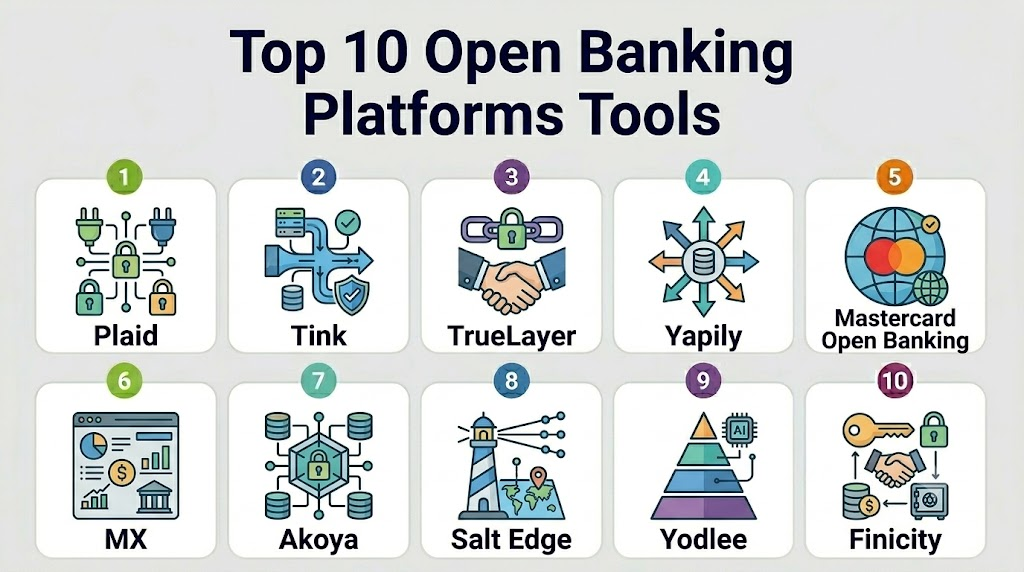
Top 10 Open Banking Platforms
1- Plaid
Short description: Plaid is a major open banking and financial data platform that helps apps connect to user-permissioned bank accounts. It is widely used by fintech apps, lenders, payment providers, personal finance tools, and embedded finance teams.
Key Features
- Bank account data connectivity
- Account verification workflows
- Transactions and balance data
- Income and cash-flow insights
- Identity and risk-related data products
- Developer-friendly APIs and documentation
- Strong ecosystem for fintech applications
Pros
- Strong adoption in fintech and financial data use cases
- Good developer experience and API ecosystem
- Useful for lending, payments, personal finance, and onboarding workflows
Cons
- Coverage and product availability can vary by region
- Pricing may become significant at scale
- Some businesses may need additional providers for specific regional coverage
Platforms / Deployment
Web / Cloud / API-based deployment
Security & Compliance
Plaid is built for financial data connectivity and uses secure API-based access patterns. Specific certifications, access controls, audit logs, data privacy commitments, and compliance requirements should be verified during procurement.
Integrations & Ecosystem
Plaid fits well into fintech products that need financial account connectivity and user-permissioned data access.
- Fintech apps
- Lending platforms
- Personal finance tools
- Payment workflows
- Account verification systems
- Embedded finance products
Support & Community
Plaid provides developer documentation, onboarding resources, and support options. Enterprise support availability may vary by plan and contract.
2- Tink
Short description: Tink is an open banking platform focused on financial data access, payments, account verification, and data enrichment across Europe. It is useful for banks, fintechs, lenders, and payment providers building open banking products.
Key Features
- Open banking data access
- Account-to-account payment support
- Account verification
- Data enrichment and categorization
- Bank connectivity across supported European markets
- Developer APIs
- Consent-based financial data workflows
Pros
- Strong European open banking presence
- Good fit for banks and fintechs building PSD2-driven products
- Supports both data and payment use cases
Cons
- Best fit is region-dependent
- Businesses outside Europe may need alternative providers
- Coverage and feature availability should be validated by country
Platforms / Deployment
Web / Cloud / API-based deployment
Security & Compliance
Tink is built for regulated open banking environments. Buyers should verify current compliance details, security controls, access management, and data processing terms during vendor review.
Integrations & Ecosystem
Tink is suitable for European financial products that need bank data and payment connectivity.
- Banks and fintechs
- Lending workflows
- Payment initiation
- Personal finance apps
- Account verification
- Data enrichment systems
Support & Community
Tink provides developer resources and business support. Buyers should confirm onboarding support, regional coverage, and implementation timelines.
3- TrueLayer
Short description: TrueLayer is an open banking platform focused on payments, data access, verification, and financial connectivity. It is especially relevant for businesses building account-to-account payments and open banking experiences in supported markets.
Key Features
- Open banking payment initiation
- Financial data access
- Account verification
- Real-time payment workflows
- Developer APIs and hosted payment flows
- Consent-led user journeys
- Suitable for fintech, payments, and financial apps
Pros
- Strong fit for open banking payments
- Developer-friendly payment and data workflows
- Useful for businesses looking beyond card-based payments
Cons
- Regional support should be verified
- Payment conversion depends on user experience and bank support
- Not every use case needs full payment initiation capability
Platforms / Deployment
Web / Cloud / API-based deployment
Security & Compliance
TrueLayer operates in regulated open banking environments. Buyers should confirm current security controls, regulatory permissions, audit features, and compliance commitments for their region.
Integrations & Ecosystem
TrueLayer is useful for businesses building payment and data products around bank connectivity.
- Account-to-account payments
- Fintech applications
- Verification flows
- Checkout experiences
- Wallet funding
- Financial data products
Support & Community
TrueLayer provides documentation, implementation guidance, and support resources. Support may vary by plan and customer size.
4- Yapily
Short description: Yapily is an open banking infrastructure provider offering data access, payment initiation, account verification, and API-based financial connectivity. It is suitable for fintechs, lenders, payment providers, and enterprises operating across supported European markets.
Key Features
- Open banking API infrastructure
- Account information services
- Payment initiation services
- Account verification and financial data access
- Strong focus on European connectivity
- Developer-friendly APIs
- Support for scalable fintech and enterprise use cases
Pros
- Strong fit for European open banking infrastructure
- Useful for data and payments use cases
- Good option for businesses needing API-first connectivity
Cons
- Country coverage and bank depth should be validated
- May require technical implementation resources
- Not ideal for businesses needing primarily non-European coverage
Platforms / Deployment
Web / Cloud / API-based deployment
Security & Compliance
Yapily is designed for regulated open banking workflows. Buyers should validate current security controls, regulatory coverage, access controls, and data processing terms.
Integrations & Ecosystem
Yapily can support open banking products that require bank data, payments, and verification workflows.
- Lending platforms
- Payment products
- Personal finance apps
- Account verification
- Financial data enrichment
- Enterprise fintech infrastructure
Support & Community
Yapily provides developer resources and business support. Buyers should confirm integration support, regional coverage, and implementation timelines.
5- Mastercard Open Banking
Short description: Mastercard Open Banking provides financial data connectivity, account verification, and open banking solutions through Mastercard’s broader financial technology ecosystem. It is suitable for enterprises, lenders, fintechs, and financial institutions.
Key Features
- Open banking data connectivity
- Account verification
- Consumer-permissioned financial data access
- Lending and risk decisioning support
- Financial insights and data products
- Enterprise-grade financial ecosystem
- Useful for fintech and institutional use cases
Pros
- Strong enterprise and financial services positioning
- Useful for lenders, banks, and fintech platforms
- Benefits from Mastercard’s broader ecosystem
Cons
- May be more enterprise-focused than startup-friendly
- Product availability can vary by market
- Pricing and implementation should be reviewed carefully
Platforms / Deployment
Web / Cloud / API-based deployment
Security & Compliance
Mastercard Open Banking is positioned for financial institutions and regulated financial data use cases. Buyers should verify current compliance commitments, data handling, access controls, and security documentation.
Integrations & Ecosystem
Mastercard Open Banking is useful for organizations that want financial data connectivity within a broader financial services ecosystem.
- Lending workflows
- Account verification
- Financial data products
- Risk decisioning
- Fintech integrations
- Enterprise financial systems
Support & Community
Support is generally aligned with business and enterprise customers. Buyers should review onboarding, technical support, account management, and regional service coverage.
6- MX
Short description: MX is a financial data platform that supports data aggregation, data enhancement, personal finance experiences, and open finance connectivity. It is relevant for banks, credit unions, fintechs, and financial service providers.
Key Features
- Financial data aggregation
- Account verification support
- Data cleansing and enrichment
- Personal financial management capabilities
- Open finance connectivity
- API-based integrations
- Useful for banks, fintechs, and financial institutions
Pros
- Strong fit for financial institutions and fintechs
- Data enhancement and financial insights are key strengths
- Useful for customer financial wellness and account aggregation
Cons
- Coverage and features should be verified by region
- May be more suitable for financial institutions than small apps
- Implementation can require planning for data use cases
Platforms / Deployment
Web / Cloud / API-based deployment
Security & Compliance
MX is designed for financial data environments. Specific certifications, security controls, audit logs, and compliance commitments should be verified during procurement.
Integrations & Ecosystem
MX supports financial products that need clean financial data, user insights, and account connectivity.
- Banks and credit unions
- Fintech applications
- Personal finance tools
- Lending platforms
- Account verification
- Data enrichment workflows
Support & Community
MX provides business support, documentation, and implementation resources. Buyers should validate onboarding support and service expectations.
7- Akoya
Short description: Akoya is a financial data access network focused on secure API-based data sharing between financial institutions and authorized third parties. It is relevant for banks, fintechs, and organizations prioritizing permissioned data access through API connections.
Key Features
- Secure financial data access network
- API-based consumer-permissioned data sharing
- Focus on direct data access
- Bank and financial institution connectivity
- Consent-based sharing workflows
- Useful for open finance use cases
- Supports data minimization and secure access concepts
Pros
- Strong positioning around secure API-based data sharing
- Useful for financial institutions and fintechs focused on open finance
- Reduces reliance on less secure legacy data access methods
Cons
- Coverage depends on participating institutions
- May not fit every international open banking need
- Product scope should be reviewed for specific use cases
Platforms / Deployment
Web / Cloud / API-based deployment
Security & Compliance
Akoya is built around secure, permissioned financial data access. Buyers should verify current security controls, participant coverage, data handling, access management, and compliance details.
Integrations & Ecosystem
Akoya is useful for organizations that want controlled data sharing between financial institutions and third-party apps.
- Banks
- Fintech applications
- Financial data access workflows
- Account data sharing
- Open finance products
- API-based integrations
Support & Community
Support depends on customer type and integration model. Buyers should confirm onboarding, technical documentation, institution coverage, and service availability.
8- Salt Edge
Short description: Salt Edge is an open banking and open finance platform offering bank data aggregation, payment initiation, account verification, and compliance-focused connectivity. It is suitable for fintechs, lenders, banks, and businesses needing broad financial data access.
Key Features
- Bank data aggregation
- Payment initiation services
- Account verification
- Open banking compliance tools
- API-based financial connectivity
- Broad market coverage positioning
- Useful for fintech and financial service products
Pros
- Strong open banking and open finance positioning
- Useful for data and payment use cases
- Suitable for businesses needing API-driven financial connectivity
Cons
- Coverage depth should be verified country by country
- Advanced use cases may require technical configuration
- Buyers should validate support and bank reliability for target markets
Platforms / Deployment
Web / Cloud / API-based deployment
Security & Compliance
Salt Edge is designed for open banking workflows. Buyers should verify current security controls, regulatory coverage, consent management, data protection, and compliance documentation.
Integrations & Ecosystem
Salt Edge supports applications that need bank connectivity, payments, and account data workflows.
- Fintech applications
- Lending platforms
- Payment initiation
- Account verification
- Financial data aggregation
- Compliance workflows
Support & Community
Salt Edge provides documentation and business support. Buyers should validate coverage, implementation assistance, and support response expectations.
9- Yodlee
Short description: Yodlee is a long-established financial data aggregation and analytics platform used by financial institutions, fintechs, wealth apps, and personal finance products. It helps businesses connect, enrich, and analyze consumer financial data.
Key Features
- Financial data aggregation
- Account and transaction data access
- Data enrichment and categorization
- Personal finance and wealth use cases
- Risk and analytics workflows
- API-based data delivery
- Longstanding presence in financial data aggregation
Pros
- Mature financial data aggregation provider
- Useful for wealth, personal finance, and financial analytics products
- Strong fit for established financial institutions
Cons
- May feel more enterprise-oriented than startup-focused
- Open banking coverage and API experience should be validated by region
- Pricing and implementation can require procurement review
Platforms / Deployment
Web / Cloud / API-based deployment
Security & Compliance
Yodlee operates in financial data environments. Buyers should verify current security controls, data privacy terms, compliance commitments, and access management capabilities.
Integrations & Ecosystem
Yodlee fits products that need financial data aggregation and analytics.
- Wealth management tools
- Personal finance apps
- Financial institutions
- Lending analytics
- Data enrichment workflows
- Account aggregation systems
Support & Community
Yodlee provides enterprise-focused support and documentation. Buyers should validate onboarding, data coverage, service levels, and integration support.
10- Finicity
Short description: Finicity is an open banking and financial data platform associated with Mastercard’s open banking ecosystem. It supports account data access, verification, lending, and financial data workflows for fintechs, lenders, and financial institutions.
Key Features
- Financial data connectivity
- Account verification
- Income and asset verification workflows
- Lending and credit decisioning support
- API-based financial data access
- Consumer-permissioned data sharing
- Useful for banks, fintechs, and lenders
Pros
- Strong fit for lending and verification workflows
- Useful for financial institutions and fintechs
- Connected with broader Mastercard open banking capabilities
Cons
- Product packaging should be reviewed because of ecosystem overlap
- Coverage and feature availability vary by use case
- May be more enterprise-focused than small developer-first tools
Platforms / Deployment
Web / Cloud / API-based deployment
Security & Compliance
Finicity is built for financial data and open banking workflows. Buyers should verify current security controls, compliance status, audit features, and data protection terms.
Integrations & Ecosystem
Finicity supports financial data workflows where verified bank information is needed.
- Digital lending
- Account verification
- Income verification
- Fintech onboarding
- Financial data analytics
- Mastercard ecosystem workflows
Support & Community
Support depends on business relationship, implementation scope, and product package. Buyers should validate technical support, onboarding resources, and service-level expectations.
Comparison Table
| Tool Name | Best For | Platform Supported | Deployment | Standout Feature | Public Rating |
|---|---|---|---|---|---|
| Plaid | Fintech apps and financial data access | Web / API | Cloud | Broad financial data API ecosystem | N/A |
| Tink | European open banking data and payments | Web / API | Cloud | Open banking data plus payments | N/A |
| TrueLayer | Open banking payments | Web / API | Cloud | Account-to-account payment flows | N/A |
| Yapily | API-first European open banking | Web / API | Cloud | Data and payment infrastructure | N/A |
| Mastercard Open Banking | Enterprises and financial institutions | Web / API | Cloud | Financial data connectivity at scale | N/A |
| MX | Banks, credit unions, and data enrichment | Web / API | Cloud | Clean financial data and insights | N/A |
| Akoya | Secure API-based data sharing | Web / API | Cloud | Permissioned financial data network | N/A |
| Salt Edge | Open banking and open finance coverage | Web / API | Cloud | Data aggregation and payments | N/A |
| Yodlee | Financial data aggregation and analytics | Web / API | Cloud | Mature financial data aggregation | N/A |
| Finicity | Lending and verification workflows | Web / API | Cloud | Income and account verification | N/A |
Evaluation and Scoring of Open Banking Platforms
| Tool Name | Core 25% | Ease 15% | Integrations 15% | Security 10% | Performance 10% | Support 10% | Value 15% | Weighted Total 0-10 |
|---|---|---|---|---|---|---|---|---|
| Plaid | 9 | 9 | 9 | 8 | 8 | 8 | 8 | 8.50 |
| Tink | 8 | 8 | 8 | 8 | 8 | 8 | 8 | 8.00 |
| TrueLayer | 8 | 8 | 8 | 8 | 8 | 8 | 8 | 8.00 |
| Yapily | 8 | 8 | 8 | 8 | 8 | 8 | 8 | 8.00 |
| Mastercard Open Banking | 8 | 7 | 8 | 9 | 8 | 9 | 7 | 8.00 |
| MX | 8 | 8 | 8 | 8 | 8 | 8 | 8 | 8.00 |
| Akoya | 7 | 7 | 7 | 9 | 8 | 8 | 7 | 7.45 |
| Salt Edge | 8 | 8 | 8 | 8 | 8 | 7 | 8 | 7.90 |
| Yodlee | 8 | 7 | 8 | 8 | 8 | 8 | 7 | 7.75 |
| Finicity | 8 | 7 | 8 | 8 | 8 | 8 | 7 | 7.75 |
Which Open Banking Platform Tool Is Right for You?
Solo / Freelancer
Solo founders and independent developers should prioritize easy onboarding, sandbox access, clear documentation, and startup-friendly pricing. Plaid, TrueLayer, Yapily, and Salt Edge may be good starting points depending on region.
For a small prototype, focus on the specific connection you need: account verification, transaction data, balances, or payments. Avoid buying an enterprise platform before validating your use case.
SMB
SMBs should look for platforms that balance ease of integration with strong coverage and reliable support. Plaid, Tink, TrueLayer, Yapily, MX, and Salt Edge can be strong options depending on market and product type.
SMBs should evaluate pricing carefully because API call volume, connected accounts, data refreshes, and payment flows can affect total cost.
Mid-Market
Mid-market fintechs, lenders, and payment providers often need better uptime, support, data enrichment, and compliance documentation. Plaid, Tink, TrueLayer, Yapily, MX, and Mastercard Open Banking are practical candidates.
At this stage, teams should evaluate consent flows, user conversion rates, API reliability, data refresh quality, and customer support response.
Enterprise
Enterprises, banks, lenders, and large fintechs should evaluate Mastercard Open Banking, Plaid, MX, Akoya, Yodlee, Tink, and Finicity based on region, regulatory requirements, and data-sharing strategy.
Enterprise buyers should involve product, engineering, compliance, legal, procurement, data privacy, security, and risk teams before final selection.
Budget vs Premium
Budget-conscious teams may start with platforms that offer developer-friendly testing and simple pricing. However, low cost should not be the only factor because poor data reliability can increase support costs and user drop-off.
Premium providers may offer stronger support, broader coverage, data enrichment, enterprise contracts, better SLAs, and compliance documentation.
Feature Depth vs Ease of Use
For ease of use, Plaid, TrueLayer, and Salt Edge can be practical depending on region. For enterprise data enrichment and institutional use cases, MX, Yodlee, Mastercard Open Banking, and Finicity may be stronger.
For payment-focused workflows, TrueLayer, Tink, and Yapily are important to evaluate.
Integrations and Scalability
Scalable open banking products should prioritize API reliability, bank coverage, webhook support, consent management, data refresh quality, and error handling. Teams should also test how the platform behaves when bank connections fail or user consent expires.
If your product expands across countries, plan for provider overlap or a multi-provider strategy.
Security and Compliance Needs
Security-focused buyers should evaluate encryption, consent flows, data minimization, SSO, MFA, RBAC, audit logs, access controls, incident response, and privacy documentation.
Compliance-focused buyers should confirm regulatory status, data processing terms, user consent handling, and regional open banking requirements.
Frequently Asked Questions
1- What is an Open Banking Platform?
An Open Banking Platform provides APIs that let businesses access customer-permissioned bank data or initiate payments securely. It helps fintechs, banks, lenders, and apps build financial products without direct bank-by-bank integrations.
2- What is open banking used for?
Open banking is used for account verification, transaction data access, income verification, lending decisions, payment initiation, budgeting apps, accounting automation, and embedded finance workflows.
3- Which Open Banking Platform is best?
There is no single best platform for every business. Plaid, Tink, TrueLayer, Yapily, Mastercard Open Banking, MX, Akoya, Salt Edge, Yodlee, and Finicity serve different regions and use cases.
4- Is open banking secure?
Open banking can be secure when implemented with consent, strong authentication, encryption, API controls, and regulated data-sharing practices. Buyers should still review each provider’s security and compliance documentation.
5- What is the difference between open banking and open finance?
Open banking usually focuses on bank account data and payments. Open finance expands the concept to broader financial data such as lending, investments, pensions, insurance, payroll, and other financial services.
6- Do open banking platforms support payments?
Many open banking platforms support payment initiation, but availability depends on region, regulation, bank support, and provider capabilities. Buyers should test conversion, settlement, refunds, and user experience.
7- How do businesses choose an open banking provider?
Businesses should compare bank coverage, data quality, supported use cases, regional compliance, API reliability, pricing, consent flows, documentation, support, and security controls.
8- What are common mistakes when selecting a platform?
Common mistakes include choosing only by brand, ignoring regional coverage, failing to test real banks, underestimating pricing, not reviewing consent flows, and skipping security due diligence.
9- Can one provider cover every country?
Usually not. Open banking coverage varies by region and bank. Global businesses may need multiple providers or a regional strategy to ensure reliable coverage and data quality.
10- Are open banking platforms useful for lenders?
Yes, lenders use open banking to verify income, analyze cash flow, assess affordability, detect fraud, and automate underwriting. Data quality and categorization accuracy are especially important for lending.
Conclusion
Open Banking Platforms are becoming core infrastructure for fintech, lending, payments, accounting, embedded finance, and digital banking products. Plaid is strong for broad fintech data connectivity, Tink and Yapily are important for European open banking, TrueLayer is strong for payment-led workflows, Mastercard Open Banking and Finicity support enterprise financial data use cases, MX and Yodlee are valuable for data enrichment and financial institutions, Akoya focuses on secure API-based data sharing, and Salt Edge supports open banking and open finance connectivity. The best platform depends on region, bank coverage, data quality, payment needs, developer experience, compliance requirements, and pricing. A practical next step is to shortlist two or three providers, test real customer journeys, compare connection success rates, review security controls, and validate the total cost before scaling.

Find Trusted Cardiac Hospitals
Compare heart hospitals by city and services — all in one place.
Explore Hospitals
One aspect that deserves more attention is customer consent management and data portability. As regulations evolve, platforms that simplify consent tracking and provide transparent data access controls will be better positioned for long-term trust and adoption.