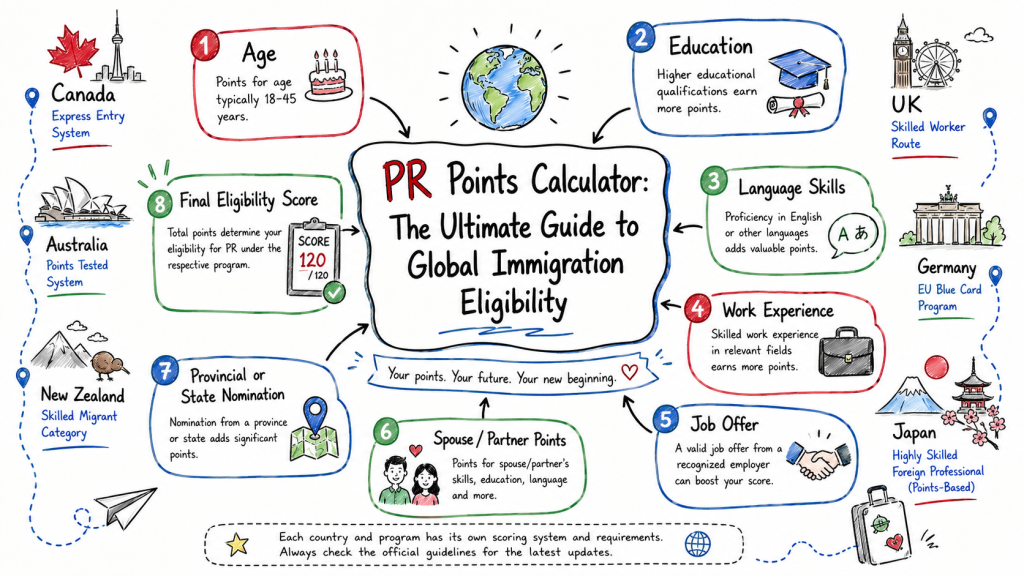
Introduction: Turning Your Global Dreams into Reality
Have you ever looked at a map and wondered, “Where could my skills take me?” Maybe you’re a software engineer in Bangalore dreaming of the tech hubs in Toronto, or a nurse in Manila eyeing the coastal lifestyle of Brisbane.
The dream of immigration is powerful. It’s about better healthcare, world-class education for your children, and a career that rewards your hard work. But before you pack your bags, there is a crucial gatekeeper you need to meet: The PR Points Calculator.
Most modern immigration systems—especially in Canada, Australia, and New Zealand—don’t rely on luck or who you know. They rely on merit. They use a transparent, points-based system to rank candidates. If you have the right “score,” you get an invitation to apply for Permanent Residency (PR).
Checking your eligibility before you spend thousands of dollars on application fees is the smartest move you can make. This guide is designed to be your compass. We will break down how points work, compare the world’s top destinations, and show you exactly how to maximize your score to secure your future abroad.
1. What Is a PR Points Calculator?
At its core, a PR Points Calculator is a digital tool or a set of criteria used by immigration departments to evaluate whether a foreign national is “ideal” for their country’s economy and society.
Why Do Countries Use Points?
Imagine if a country received 1 million applications a year but only had 100,000 spots. How do they choose? In the past, it was “first-come, first-served,” which led to massive backlogs. Today, countries use a Human Capital Model. They want young, educated, English/French-speaking professionals who can integrate quickly into the workforce.
The Two Types of Scores
It is vital to understand the difference between these two:
- Eligibility Score: The minimum points required to even enter the “pool” or system (e.g., 67 points for Canada’s FSWP).
- Invitation Score (Ranking Score): The actual score you need to be selected from the pool (e.g., the CRS score in Canada’s Express Entry draws).
Think of it like a marathon: The Eligibility Score gets you to the starting line. The Invitation Score determines if you win the race.
2. How PR Points Systems Work: The Building Blocks
While every country has its own flavor, almost all points-based systems look at the same “Big Five” factors. Let’s break down how these categories typically reward points.
A. Age
Immigration is an economic strategy. Countries want young taxpayers who will contribute to the economy for 30–40 years.
- Peak Points: Usually between ages 25 and 32.
- The “Cliff”: Points begin to drop after age 35 and often hit zero for age by 45–50.
B. Education
The higher your degree, the higher your score.
- Example: A Master’s degree is worth significantly more than a Bachelor’s. A PhD is the gold standard.
- ECA: For many countries, you must get an Educational Credential Assessment (ECA) to prove your foreign degree is equivalent to their local standards.
C. Language Proficiency
This is the “Great Equalizer.” Even if you are older or have less experience, a high score in IELTS, PTE, or CELPIP can skyrocket your total.
- The Magic Number: In Canada, hitting “CLB 9” across all categories is the tipping point for most successful applicants.
D. Work Experience
Countries look for “Skilled Work.” This usually means roles that require a degree or specialized training.
- International Experience: 3+ years is often the sweet spot.
- Local Experience: If you have worked inside the country you are applying to, your points will be much higher.
E. The “Bonus” Factors
- Spouse’s Profile: Your partner’s education and language skills can add points.
- Job Offer: A valid job offer from a local employer is often a “golden ticket.”
- Siblings: Having a sibling who is already a citizen or PR in that country often provides a small point boost.
Typical Points Distribution Table (Generalized Example)
| Factor | Description | Potential Impact |
| Age | Max points for 20-29 year olds | High |
| Education | PhD or Double Degree | High |
| Language | Native-level proficiency (IELTS 8+) | Critical |
| Experience | 3-6 years of skilled work | Medium/High |
| Adaptability | Family in country/Local study | Medium |
3. Canada PR Points Calculator: The Express Entry Era
Canada is currently the most popular destination for skilled migrants. Their system, Express Entry, is famous for its Comprehensive Ranking System (CRS).
How it Works
You create a profile. The system assigns you a CRS score out of 1,200. Every few weeks, the Canadian government holds a “draw” and invites those with the highest scores to apply for PR.
The CRS Score Breakdown
- Core Human Capital: Up to 500 points (Age, Education, Language, Experience).
- Spouse Factors: Up to 40 points.
- Skill Transferability: Up to 100 points (e.g., combining high language skills with a Master’s degree).
- Additional Points: Up to 600 points (Provincial Nomination, Job Offer, French skills).
Improving Your Canada PR Score
- Get a PNP: A Provincial Nominee Program (PNP) nomination gives you 600 points automatically. This virtually guarantees a PR invitation.
- Learn French: Canada is heavily incentivizing French speakers. Even basic proficiency can add significant points.
- The “Sibling” Rule: 15 points if you or your spouse have a sibling in Canada.
Real-World Example: Meet “Aarav”
- Age: 29 (Max points)
- Education: Master’s Degree
- Language: IELTS 8.0 (CLB 9 equivalent)
- Experience: 3 years as a Software Developer
- Result: Aarav scores roughly 469–475. Depending on the draw, he is in a very strong position to receive an Invitation to Apply (ITA).
4. Australia PR Points Calculator: The Skilled Migration Path
Australia uses a points-based system for its General Skilled Migration (GSM) program. Unlike Canada, the minimum threshold to submit an Expression of Interest (EOI) is 65 points.
Popular Visa Subclasses
- Subclass 189: Skilled Independent (No sponsor needed).
- Subclass 190: Skilled Nominated (Requires state sponsorship).
- Subclass 491: Skilled Work Regional (Provisional visa for regional areas).
Australia Points Breakdown (Key Highlights)
- Professional Year: Completing a “Professional Year” in Australia in fields like IT or Accounting adds 5 points.
- NAATI: Passing a community language interpreting test adds 5 points.
- Partner Skills: If your partner is also a skilled professional and passes a skills assessment, you get 10 points.
- STEM Bonus: Specialist educational qualifications (Masters by research or PhD in STEM) add 10 points.
Australia Points Table Summary
| Category | Criteria | Points |
| Age | 25–32 years | 30 |
| English | Superior (IELTS 8/PTE 79) | 20 |
| Experience | 8+ years (Overseas) | 15 |
| Education | Doctorate Degree | 20 |
| State Nom. | Subclass 190 | 5 |
5. New Zealand PR Points Calculator: The “Green List”
New Zealand recently overhauled its system to focus on the Skilled Migrant Category (SMC) and the Green List.
The 6-Point System
New Zealand now uses a simplified 6-point threshold. You can claim points from:
- Professional Registration
- Qualifications (Bachelor’s = 3 points, Master’s = 5, PhD = 6)
- Income (Earning 1.5x to 3x the median wage)
Crucial Note: You also need a job offer from an Accredited Employer in New Zealand to qualify under this category.
6. PR Systems in Other Countries: A Quick Look
While Canada and Australia are the “Big Two,” other nations are launching points-based systems to compete for talent.
- Germany (Opportunity Card / Chancenkarte): Launched in 2024. You need 6 points to come to Germany and look for work. Points are given for German/English skills, age, and ties to Germany.
- Japan (Highly Skilled Professional Visa): A points-based track that can lead to PR in as little as 1 to 3 years (instead of the usual 10). Points are heavily weighted toward salary and academic research.
- UK (Skilled Worker Visa): You need 70 points. Most are “non-tradable” (Job offer, skill level, English), but some can be “traded” (e.g., a lower salary if you have a PhD in a relevant field).
Global Comparison Table
| Feature | Canada | Australia | Germany |
| Primary Goal | Direct PR | Direct PR or Regional | Job Seeker/Work |
| Difficulty | Moderate/High | High (Occupation specific) | Moderate |
| Language | English/French | English | German/English |
| Key Factor | CRS Score | Occupation Lists | Qualifications |
7. Benefits of Using a PR Points Calculator
Why should you use an online calculator before talking to a lawyer or consultant?
- Reality Check: It tells you if your dream is currently possible or if you need to work on your profile.
- Strategic Planning: You can “toggle” variables. What if I retake the IELTS? What if I wait until I have 3 years of experience?
- Cost Savings: Don’t pay for a skills assessment or ECA if you are nowhere near the qualifying score.
- Country Comparison: You might find that while you don’t qualify for Canada, you are a perfect fit for Australia’s regional program.
8. Step-by-Step Guide to Calculating Your PR Points
Don’t just guess your score. Follow this systematic approach:
Step 1: Gather Your Documents
You can’t calculate points accurately without “proof.” You need your transcripts, work experience letters (with specific job duties), and passport.
Step 2: Take a Mock Language Test
Language is the most volatile variable. Don’t assume you’ll get a perfect score. Take a practice test to see where you actually stand.
Step 3: Evaluate Your Education
Use a tool like WES (World Education Services) for Canada to see what your degree is worth. A 4-year Bachelor’s degree from your country might only be considered a 3-year degree abroad.
Step 4: Verify Your NOC/ANZSCO Code
Immigration systems categorize jobs by codes.
- Canada: NOC (National Occupational Classification)
- Australia/NZ: ANZSCO (Australian and New Zealand Standard Classification of Occupations)If your job is “Unskilled” according to their code, you get zero points for experience.
Step 5: Add Spouse/Partner Points
If you are married, calculate two scores: one as a “Single” applicant and one as a “Couple.” Sometimes, the single score is actually higher!
9. How to Increase Your PR Score: Expert Strategies
If your current score is too low, don’t give up. The points system is a “living” number. Here is how to boost it:
- The “Max Out” Language Strategy: Moving from an IELTS 7 to an 8 can sometimes add 20–50 points to your CRS score due to “skill transferability” bonuses. It is the fastest way to improve.
- The Second Degree: If you have a Bachelor’s, getting a 1-year Post-Graduate Diploma can move you into the “Two or more certificates” category, which is worth significantly more points.
- State/Provincial Nomination: This is the ultimate “cheat code.” Research provinces like Saskatchewan (Canada) or states like South Australia (Australia) that have their own occupation lists.
- Gain Local Experience: If you can’t get a PR from outside, consider a Student Visa or a Working Holiday Visa. Local experience is often weighted double.
10. Common Mistakes to Avoid
- Overestimating Work Experience: Only “Post-Qualification” experience counts in many systems. If you worked while studying, it might not count toward your points.
- Using Expired Results: Language tests are usually only valid for 2 years.
- Ignoring the “Tie-Breaking Rule”: In Canada, if two people have the same score, the person who submitted their profile earlier gets the invitation. Don’t wait!
- Miscalculating Spouse Points: Ensure your spouse is actually willing to take the IELTS and get their ECA. If they don’t, you lose points for “accompanying spouse” without gaining the “spouse factor” points.
11. Real-Life Case Studies
Case Study 1: The Young Techie (Canada)
- Name: Elena, 26, UI/UX Designer.
- Initial Score: 435 (Bachelor’s, IELTS 7.0).
- The Problem: Score too low for general draws.
- The Fix: Elena retook the IELTS and achieved CLB 9 (8777). She also gained one more year of work experience.
- Final Result: Score jumped to 481. Received an ITA in a STEM-targeted draw.
Case Study 2: The Married Couple (Australia)
- Name: David (38) and Sarah (35).
- Initial Score: 60 (Below the 65-point threshold).
- The Problem: David’s age was dragging the score down.
- The Fix: They realized Sarah’s occupation (Occupational Therapist) was in high demand. They made Sarah the “Primary Applicant.” Sarah got a Superior English score (PTE 79+) and David passed a skills assessment to give her 10 partner points.
- Final Result: Total score 85. Received a Subclass 190 nomination from Victoria.
Case Study 3: The Healthcare Hero (New Zealand)
- Name: Kofi, 32, Registered Nurse.
- Initial Score: Unclear under old rules.
- The Path: New Zealand put Nursing on the “Straight to Residence” Green List.
- Final Result: Kofi secured a job offer from a New Zealand hospital. Because his profession was on Tier 1 of the Green List, he applied for PR immediately without needing to navigate a complex points pool.
12. FAQs: Your Questions Answered
Q: What is a “good” CRS score?
A: It changes with every draw. Currently, anything above 500 is excellent for general draws. However, for “Category-based draws” (Trade, Healthcare, STEM), a score in the 450s–480s can be enough.
Q: Can I apply for PR without a job offer?
A: Yes! Both Canada’s Express Entry and Australia’s Subclass 189 are designed for people without job offers. However, a job offer makes it much easier.
Q: Does my age stop me from immigrating?
A: Not necessarily, but it makes it harder. After 40, you must compensate with a PhD, a job offer, or Provincial Nomination.
Q: Which country is easiest for PR?
A: “Easy” is subjective. Canada is the most consistent. Australia is great for specific trades. Germany is currently the easiest for job seekers.
Q: How accurate are online PR calculators?
A: They are very accurate if you provide correct data. Most “errors” come from users overestimating their language levels or misinterpreting their job codes.
Q: Does having a child affect my PR points?
A: Generally, no. Children do not add points, but they also don’t subtract them. They are included as dependents in your application.
Conclusion: Start Your Calculation Today
A PR Points Calculator is more than a simple score-checking tool; it is a practical roadmap for planning your immigration journey with clarity and confidence.
It helps you understand where you currently stand, which country or program may suit your profile, and what improvements can increase your chances of receiving an invitation.
Whether you are applying for Canada PR, Australia PR, New Zealand skilled migration, or another global pathway, your age, education, language score, work experience, job offer, and spouse factors can all influence your final eligibility.
Using a calculator early helps you avoid costly mistakes, prepare documents properly, and focus on the areas that can add the most value to your profile.
For many applicants, small improvements such as a higher IELTS or PTE score, stronger work documentation, or a provincial/state nomination can make a major difference.
The smartest approach is to calculate your score, compare pathways, improve weak areas, and stay updated with changing immigration rules before submitting your application.
With the right planning and accurate eligibility assessment, your dream of building a successful life abroad becomes more realistic, organized, and achievable.

Find Trusted Cardiac Hospitals
Compare heart hospitals by city and services — all in one place.
Explore Hospitals