Introduction
Log Management Tools help organizations collect, store, analyze, monitor, and visualize log data generated by applications, servers, networks, cloud infrastructure, and security systems. These platforms centralize logs from multiple sources into a single environment, enabling IT teams to troubleshoot issues faster, improve security visibility, and optimize system performance. Modern log management solutions also include AI-powered analytics, anomaly detection, observability capabilities, and automation features to handle growing telemetry volumes efficiently.As organizations increasingly adopt cloud-native infrastructure, Kubernetes, distributed applications, and hybrid cloud environments, log management has become critical for operational monitoring, compliance, cybersecurity, and incident response. Businesses now require real-time insights and scalable analytics to process massive amounts of machine-generated data without performance bottlenecks.
Real-World Use Cases Include:
- Centralizing application and server logs for troubleshooting.
- Detecting cybersecurity threats and suspicious activity.
- Monitoring Kubernetes and cloud-native infrastructure.
- Troubleshooting API failures and application errors.
- Maintaining compliance audit trails for regulated industries.
- Improving observability across distributed systems.
- Supporting DevOps incident response and root cause analysis.
- Monitoring customer-facing SaaS applications.
Key Buyer Evaluation Criteria Include:
- Real-time log ingestion and search performance.
- Scalability for large telemetry workloads.
- AI-driven analytics and anomaly detection.
- Integration ecosystem with cloud and DevOps platforms.
- Dashboard and visualization flexibility.
- Security controls including RBAC, MFA, and encryption.
- Compliance reporting and audit capabilities.
- Kubernetes and cloud-native monitoring support.
- Pricing transparency and storage efficiency.
- Ease of onboarding and operational management.
Best For
- DevOps and Site Reliability Engineering teams.
- Security operations and compliance teams.
- Enterprises managing hybrid and multi-cloud environments.
- SaaS companies requiring centralized observability.
- Organizations processing large-scale telemetry data.
Not Ideal For
- Small businesses needing only lightweight log collection.
- Teams without dedicated IT or security resources.
- Organizations with minimal infrastructure complexity.
- Businesses seeking only basic uptime monitoring.
- Environments where simple open-source logging is sufficient.
Key Trends in Log Management Tools
- AI-powered anomaly detection and predictive analytics are becoming standard capabilities.
- Unified observability platforms are combining logs, metrics, traces, and security analytics.
- OpenTelemetry adoption is improving interoperability between monitoring ecosystems.
- Cloud-native and Kubernetes log management demand continues growing rapidly.
- Security analytics and SIEM integration are becoming tightly connected with log management.
- Automated remediation and incident response workflows are improving operational efficiency.
- Cost optimization for telemetry storage and ingestion is becoming a major priority.
- Edge infrastructure and distributed cloud visibility are expanding rapidly.
- Real-time streaming analytics is improving incident detection speed.
- Multi-cloud log aggregation and centralized visibility are becoming operational necessities.
How We Selected These Tools (Methodology)
The tools in this list were selected using multiple operational and technical evaluation criteria:
- Enterprise adoption and market reputation.
- Feature completeness across log management workflows.
- Scalability for distributed cloud and hybrid environments.
- AI-powered analytics and automation capabilities.
- Security and compliance readiness.
- Kubernetes and cloud-native support.
- Integration ecosystem flexibility.
- Ease of onboarding and operational usability.
- Vendor support quality and community strength.
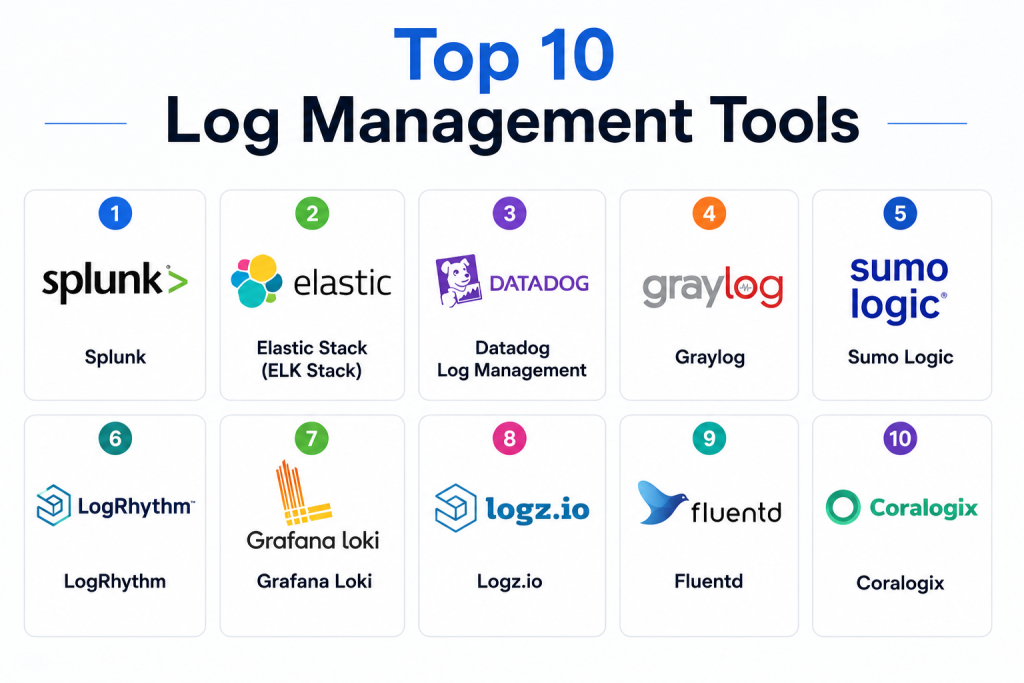
Top 10 Log Management Tools
1- Splunk
Short Description:
Enterprise-grade log management and analytics platform designed for operational intelligence, security monitoring, and observability.
Key Features
- Centralized log collection and indexing.
- Real-time search and analytics.
- AI-driven anomaly detection.
- Security and SIEM integration.
- Dashboard customization.
- Distributed infrastructure monitoring.
- Automated alerting.
Pros
- Extremely powerful analytics engine.
- Strong enterprise scalability.
- Excellent security monitoring integration.
Cons
- High licensing and storage costs.
- Complex setup for large environments.
- Requires experienced administrators.
Platforms / Deployment
- Web / Windows / Linux / macOS
- Cloud / Self-hosted / Hybrid
Security & Compliance
- SOC 2
- SSO/SAML
- MFA
- RBAC
- Encryption
Integrations & Ecosystem
Splunk integrates with cloud providers, security tools, and DevOps ecosystems.
- AWS
- Azure
- Kubernetes
- ServiceNow
- PagerDuty
- APIs
Support & Community
Strong enterprise support ecosystem with extensive documentation and training resources.
2- Elastic Stack (ELK Stack)
Short Description:
Open-source log management and analytics platform combining Elasticsearch, Logstash, and Kibana for centralized observability.
Key Features
- Centralized log ingestion.
- Full-text search capabilities.
- Visualization dashboards.
- Distributed tracing support.
- Machine learning analytics.
- Scalable storage architecture.
- Open-source flexibility.
Pros
- Highly customizable platform.
- Strong search and analytics capabilities.
- Flexible deployment models.
Cons
- Requires Elastic expertise.
- Complex scaling for large clusters.
- Some advanced features require paid licensing.
Platforms / Deployment
- Web / Linux / Windows / macOS
- Cloud / Self-hosted / Hybrid
Security & Compliance
- RBAC
- Encryption
- SSO
Integrations & Ecosystem
Elastic integrates with telemetry, cloud, and DevOps ecosystems.
- Kubernetes
- Beats
- Logstash
- AWS
- Azure
- APIs
Support & Community
Large open-source community with enterprise support options available.
3- Datadog Log Management
Short Description:
Cloud-native log management platform designed for centralized observability, troubleshooting, and cloud infrastructure monitoring.
Key Features
- Centralized log aggregation.
- AI-powered analytics.
- Real-time search and filtering.
- Kubernetes log monitoring.
- Correlation with metrics and traces.
- Custom dashboards.
- Automated alerts.
Pros
- Excellent cloud-native observability.
- Unified monitoring experience.
- Strong integration ecosystem.
Cons
- Expensive at large scale.
- Telemetry ingestion costs can increase quickly.
- Advanced configurations require expertise.
Platforms / Deployment
- Web / Windows / Linux / macOS
- Cloud
Security & Compliance
- SOC 2
- ISO 27001
- RBAC
- Encryption
- MFA
Integrations & Ecosystem
Datadog integrates with cloud, DevOps, and collaboration platforms.
- AWS
- Azure
- Google Cloud
- Kubernetes
- Slack
- PagerDuty
Support & Community
Strong documentation and enterprise support structure with active community engagement.
4- Graylog
Short Description:
Centralized log management platform designed for operational monitoring, security analytics, and troubleshooting.
Key Features
- Centralized log collection.
- Real-time search and analysis.
- Alerting and event correlation.
- Dashboard customization.
- Pipeline processing.
- Threat detection capabilities.
- Scalable log ingestion.
Pros
- Flexible deployment options.
- Good operational visibility.
- Strong open-source foundation.
Cons
- Advanced features require enterprise licensing.
- UI may require customization.
- Large-scale deployments require tuning.
Platforms / Deployment
- Web / Linux / Windows
- Cloud / Self-hosted
Security & Compliance
- RBAC
- Encryption
- SSO
Integrations & Ecosystem
Graylog integrates with monitoring, SIEM, and infrastructure platforms.
- Elasticsearch
- Kubernetes
- AWS
- Slack
- APIs
- Syslog sources
Support & Community
Active community support with enterprise support plans available.
5- Sumo Logic
Short Description:
Cloud-native log analytics and observability platform designed for operational intelligence and security monitoring.
Key Features
- Real-time log analytics.
- AI-powered anomaly detection.
- Cloud-native observability.
- Security analytics integration.
- Dashboard visualization.
- Automated alerting.
- Compliance monitoring.
Pros
- Strong cloud-native architecture.
- Good scalability for enterprise workloads.
- Unified observability capabilities.
Cons
- Query language learning curve.
- Advanced features increase costs.
- Complex analytics may require training.
Platforms / Deployment
- Web / Windows / Linux / macOS
- Cloud
Security & Compliance
- SOC 2
- RBAC
- Encryption
- MFA
Integrations & Ecosystem
Sumo Logic integrates with DevOps, cloud, and security ecosystems.
- AWS
- Azure
- Kubernetes
- Jenkins
- PagerDuty
- APIs
Support & Community
Enterprise support plans with onboarding resources and technical documentation.
6- LogRhythm
Short Description:
Security-focused log management and SIEM platform designed for threat detection, compliance, and operational visibility.
Key Features
- Centralized log collection.
- Security event monitoring.
- Threat detection analytics.
- Compliance reporting.
- Incident response workflows.
- AI-powered analytics.
- Automated alerting.
Pros
- Strong cybersecurity capabilities.
- Compliance-focused reporting.
- Integrated SIEM workflows.
Cons
- More security-focused than DevOps-focused.
- Complex deployment process.
- Premium pricing structure.
Platforms / Deployment
- Web / Windows / Linux
- Cloud / Hybrid
Security & Compliance
- SOC 2
- MFA
- RBAC
- Encryption
- Audit logging
Integrations & Ecosystem
LogRhythm integrates with enterprise security and infrastructure ecosystems.
- Active Directory
- AWS
- Azure
- SIEM platforms
- Firewalls
- APIs
Support & Community
Enterprise-focused support with compliance and security expertise.
7- Grafana Loki
Short Description:
Lightweight log aggregation system optimized for Kubernetes and cloud-native observability workflows.
Key Features
- Kubernetes-native logging.
- Efficient log indexing.
- Integration with Grafana dashboards.
- Multi-tenant support.
- Cloud-native scalability.
- Distributed log aggregation.
- Open-source flexibility.
Pros
- Cost-efficient log storage.
- Excellent Kubernetes integration.
- Lightweight architecture.
Cons
- Limited advanced analytics.
- Requires Grafana ecosystem familiarity.
- Enterprise capabilities may require additional tools.
Platforms / Deployment
- Web / Linux / macOS
- Cloud / Self-hosted
Security & Compliance
- Not publicly stated
Integrations & Ecosystem
Grafana Loki integrates with cloud-native monitoring ecosystems.
- Grafana
- Kubernetes
- Prometheus
- OpenTelemetry
- AWS
- APIs
Support & Community
Strong open-source community with growing enterprise adoption.
8- Logz.io
Short Description:
Cloud-native log analytics and observability platform built on open-source monitoring technologies.
Key Features
- Centralized log analytics.
- AI-powered insights.
- Cloud-native observability.
- Security monitoring support.
- Dashboard visualization.
- OpenTelemetry support.
- Real-time alerting.
Pros
- Simplified observability workflows.
- Strong Kubernetes support.
- Easy onboarding process.
Cons
- Smaller ecosystem than enterprise competitors.
- Advanced customizations are limited.
- Pricing varies by telemetry volume.
Platforms / Deployment
- Web / Linux / Windows / macOS
- Cloud
Security & Compliance
- SOC 2
- Encryption
- RBAC
- SSO
Integrations & Ecosystem
Logz.io integrates with modern observability and DevOps platforms.
- Kubernetes
- AWS
- Azure
- Grafana
- Slack
- APIs
Support & Community
Responsive support with onboarding assistance and technical documentation.
9- Fluentd
Short Description:
Open-source data collector and log forwarding platform designed for centralized logging and telemetry pipelines.
Key Features
- Unified log collection.
- Flexible routing pipelines.
- Cloud-native support.
- Plugin ecosystem.
- Real-time log forwarding.
- Kubernetes integration.
- Lightweight architecture.
Pros
- Extremely flexible deployment.
- Large plugin ecosystem.
- Strong Kubernetes support.
Cons
- Requires configuration expertise.
- Limited built-in analytics.
- Dashboarding requires additional tools.
Platforms / Deployment
- Linux / macOS / Windows
- Self-hosted / Hybrid
Security & Compliance
- Not publicly stated
Integrations & Ecosystem
Fluentd integrates with logging, observability, and cloud ecosystems.
- Elasticsearch
- Kubernetes
- AWS
- Azure
- Grafana
- APIs
Support & Community
Large open-source community with extensive plugin documentation.
10- Coralogix
Short Description:
Cloud-native log analytics and observability platform focused on scalable telemetry processing and operational insights.
Key Features
- Centralized log analytics.
- AI-powered anomaly detection.
- Real-time monitoring.
- Compliance reporting.
- Kubernetes observability.
- Alerting workflows.
- Telemetry optimization.
Pros
- Strong scalability capabilities.
- Efficient telemetry processing.
- Good cloud-native support.
Cons
- Smaller ecosystem than major competitors.
- Some advanced features require premium plans.
- Limited brand recognition in some markets.
Platforms / Deployment
- Web / Linux / Windows / macOS
- Cloud
Security & Compliance
- SOC 2
- Encryption
- RBAC
- MFA
Integrations & Ecosystem
Coralogix integrates with cloud-native infrastructure and DevOps ecosystems.
- AWS
- Azure
- Kubernetes
- Grafana
- Slack
- APIs
Support & Community
Enterprise support options with onboarding and implementation guidance.
Comparison Table
| Tool Name | Best For | Platforms Supported | Deployment | Standout Feature | Public Rating |
|---|---|---|---|---|---|
| Splunk | Enterprise analytics | Web, Windows, Linux | Cloud/Self-hosted/Hybrid | Advanced log analytics | N/A |
| Elastic Stack | Open-source observability | Web, Linux, Windows | Cloud/Self-hosted/Hybrid | Search-driven analytics | N/A |
| Datadog Log Management | Cloud-native observability | Web, Linux, Windows | Cloud | Unified monitoring | N/A |
| Graylog | Operational monitoring | Web, Linux, Windows | Cloud/Self-hosted | Flexible pipelines | N/A |
| Sumo Logic | Cloud-native analytics | Web, Linux, Windows | Cloud | AI-powered analytics | N/A |
| LogRhythm | Security monitoring | Web, Windows, Linux | Cloud/Hybrid | SIEM integration | N/A |
| Grafana Loki | Kubernetes logging | Linux, macOS | Cloud/Self-hosted | Lightweight architecture | N/A |
| Logz.io | Cloud observability | Web, Linux, Windows | Cloud | Open-source observability | N/A |
| Fluentd | Log forwarding | Linux, macOS, Windows | Self-hosted/Hybrid | Flexible pipelines | N/A |
| Coralogix | Scalable observability | Web, Linux, Windows | Cloud | Telemetry optimization | N/A |
Evaluation & Scoring of Log Management Tools
| Tool Name | Core | Ease | Integrations | Security | Performance | Support | Value | Weighted Total |
|---|---|---|---|---|---|---|---|---|
| Splunk | 9 | 7 | 9 | 9 | 9 | 8 | 6 | 8.3 |
| Elastic Stack | 8 | 6 | 8 | 7 | 8 | 7 | 9 | 7.7 |
| Datadog Log Management | 9 | 8 | 9 | 9 | 9 | 8 | 6 | 8.5 |
| Graylog | 7 | 7 | 7 | 7 | 7 | 7 | 8 | 7.2 |
| Sumo Logic | 8 | 7 | 8 | 8 | 8 | 7 | 7 | 7.7 |
| LogRhythm | 8 | 6 | 7 | 9 | 8 | 8 | 6 | 7.5 |
| Grafana Loki | 7 | 7 | 8 | 6 | 8 | 7 | 9 | 7.5 |
| Logz.io | 7 | 8 | 7 | 8 | 7 | 7 | 7 | 7.3 |
| Fluentd | 7 | 6 | 8 | 6 | 8 | 7 | 9 | 7.2 |
| Coralogix | 8 | 7 | 7 | 8 | 8 | 7 | 7 | 7.5 |
These scores are comparative and designed to help organizations evaluate platforms across observability depth, analytics capabilities, integrations, security, operational efficiency, and overall value. Buyers should align tool selection with infrastructure scale, telemetry volume, compliance requirements, and operational maturity.
Which Log Management Tool Is Right for You?
Solo / Freelancer
Grafana Loki and Fluentd are suitable for smaller environments requiring lightweight and cost-efficient logging.
SMB
Graylog and Logz.io provide balanced usability, operational visibility, and scalability for growing businesses.
Mid-Market
Datadog Log Management and Sumo Logic offer strong cloud-native observability and operational intelligence.
Enterprise
Splunk, Elastic Stack, and LogRhythm are ideal for enterprises requiring large-scale analytics, security monitoring, and compliance reporting.
Budget vs Premium
Grafana Loki and Fluentd provide cost-efficient open-source flexibility, while Splunk and Datadog focus on premium enterprise observability capabilities.
Feature Depth vs Ease of Use
Datadog balances usability and functionality well, while Elastic Stack and Splunk provide deeper analytics with increased complexity.
Integrations & Scalability
Large organizations should prioritize Kubernetes, multi-cloud, and SIEM integration capabilities.
Security & Compliance Needs
Organizations with strict governance requirements should prioritize tools offering RBAC, MFA, SSO, encryption, and compliance reporting features.
Frequently Asked Questions (FAQs)
1. What are log management tools?
Log management tools collect, store, analyze, and monitor log data generated by applications, servers, networks, and infrastructure systems.
2. Why are log management tools important?
They improve troubleshooting, observability, security monitoring, compliance reporting, and operational visibility.
3. What is centralized logging?
Centralized logging aggregates logs from multiple systems into a single platform for easier analysis and monitoring.
4. Are log management tools used for cybersecurity?
Yes. Many platforms support threat detection, SIEM integration, anomaly detection, and security monitoring workflows.
5. Do log management tools support Kubernetes?
Most modern platforms support Kubernetes, containers, and cloud-native infrastructure monitoring.
6. Can open-source log management tools scale?
Yes. Platforms like Elastic Stack, Grafana Loki, and Fluentd can scale effectively when properly configured.
7. What integrations are important for log management?
Cloud providers, Kubernetes, SIEM systems, DevOps pipelines, and ITSM tools are important integration areas.
8. What is the difference between log management and observability?
Log management focuses on log collection and analysis, while observability combines logs, metrics, traces, and telemetry insights.
9. How should organizations choose a log management tool?
Organizations should evaluate scalability, analytics depth, integrations, deployment flexibility, security, usability, and operational costs.
10. Are AI features important in log management?
AI-powered analytics and anomaly detection help organizations identify issues faster and reduce operational workload.
Conclusion
Log Management Tools have become essential for organizations operating modern cloud-native, distributed, and hybrid infrastructure environments. Businesses now require more than simple log collection — they need centralized observability, AI-powered analytics, security visibility, and scalable telemetry processing to manage operational complexity effectively. Platforms like Splunk, Datadog Log Management, and Elastic Stack provide enterprise-grade analytics and observability capabilities, while Grafana Loki and Fluentd offer flexible alternatives for organizations prioritizing lightweight and open-source architectures. The right log management platform ultimately depends on infrastructure scale, telemetry volume, compliance requirements, operational maturity, and budget considerations. Organizations should shortlist multiple tools, validate integrations with existing infrastructure, test analytics scalability, and run pilot deployments before making long-term operational decisions.

Find Trusted Cardiac Hospitals
Compare heart hospitals by city and services — all in one place.
Explore Hospitals
This gave me a better understanding of how log management tools help centralize logs, troubleshoot issues, and improve system visibility. I’d like to explore which tool fits best for scalable monitoring.