Introduction
SASE Platforms (Secure Access Service Edge) are modern cloud-based security frameworks that combine networking and cybersecurity capabilities into a single unified service. Instead of relying on traditional hardware-based security tools like VPNs, firewalls, and separate security gateways, SASE integrates networking functions such as SD-WAN with security services like SWG, CASB, ZTNA, and firewall-as-a-service. In a world where organizations are rapidly adopting cloud applications, hybrid work models, and distributed infrastructure, SASE has become essential. It provides secure, fast, and scalable access to applications and data regardless of user location. This shift is critical because traditional perimeter-based security models can no longer protect users who operate outside the corporate network.
Common Real-world use cases include:
- Secure access for remote and hybrid employees
- Protecting SaaS and cloud applications from cyber threats
- Replacing legacy VPN infrastructure with Zero Trust access
- Enforcing consistent security policies across global offices
- Optimizing network performance for distributed teams
Buyers should Evaluate:
- Integration of networking and security functions
- Zero Trust and identity-based access capabilities
- Cloud-native architecture and scalability
- Threat detection and prevention accuracy
- SD-WAN performance and reliability
- CASB, SWG, and ZTNA integration depth
- Ease of deployment and management
- Global network performance and latency
- Compliance and data protection features
- Vendor ecosystem maturity
Best for: Large enterprises, hybrid organizations, cloud-first companies, financial institutions, healthcare providers, and globally distributed teams.
Not ideal for: Very small businesses with minimal remote access needs or organizations with simple on-premise-only infrastructure.
Key Trends in SASE Platforms
- Convergence of networking and security into unified cloud platforms
- Rapid replacement of VPNs with ZTNA-based access models
- AI-driven threat detection and automated response
- Expansion of edge computing integration with SASE architectures
- Increased adoption of identity-centric security policies
- Strong integration of CASB, SWG, and DLP within SASE stacks
- Growth of cloud-native SD-WAN replacing legacy WAN infrastructure
- Real-time traffic inspection at global edge locations
- Increased automation in policy management and enforcement
- Vendor consolidation into full-stack SASE ecosystems
How We Selected These Tools
- Global enterprise adoption and market presence
- Depth of integrated security and networking features
- SD-WAN and Zero Trust capabilities
- Cloud-native scalability and architecture
- Performance and latency optimization
- Integration with IAM, SIEM, and endpoint security tools
- Threat detection and prevention accuracy
- Ease of deployment and management
- Ecosystem maturity and vendor reliability
- Support for hybrid and multi-cloud environments
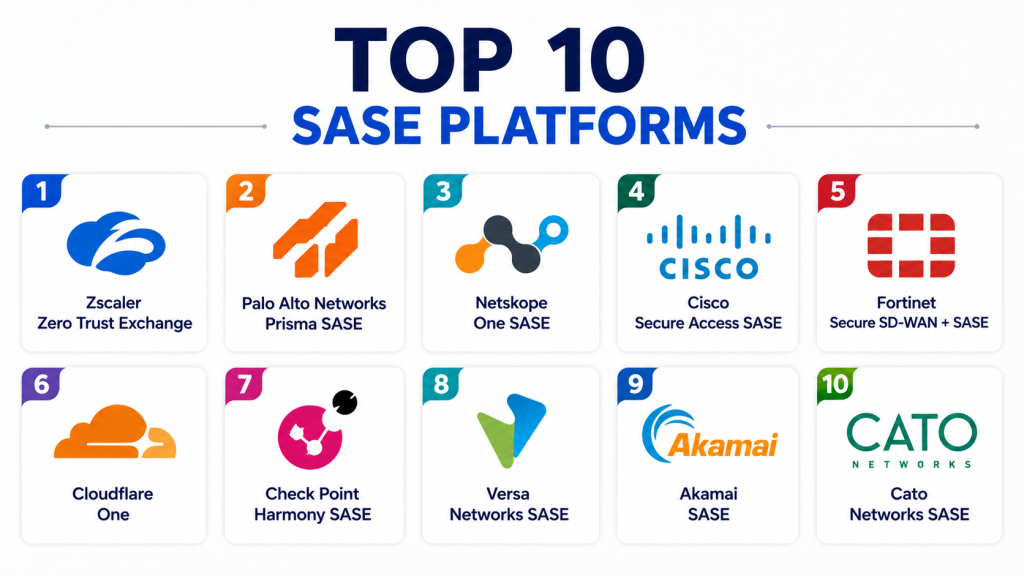
Top 10 SASE Platforms
1- Zscaler Zero Trust Exchange
Short description: Zscaler is one of the most widely adopted SASE platforms, delivering secure access, Zero Trust connectivity, and cloud-native security at global scale.
Key Features
- Zero Trust network access
- Cloud-native SWG and CASB
- Inline threat prevention
- DNS security
- Data loss prevention integration
- Global security cloud
- Identity-based access control
Pros
- Highly scalable global architecture
- Strong Zero Trust implementation
- Excellent cloud performance
Cons
- Enterprise-focused pricing
- Complex initial setup
- Requires cloud-first adoption
Platforms / Deployment
Cloud
Security & Compliance
SSO, MFA, RBAC, encryption, audit logs
Integrations & Ecosystem
- Microsoft Entra ID
- Okta
- SIEM platforms
- Endpoint security tools
- CASB and ZTNA integrations
Support & Community
Strong global enterprise support
2- Palo Alto Networks Prisma SASE
Short description: Prisma SASE combines Prisma Access, SD-WAN, and cloud security into a unified enterprise-grade platform.
Key Features
- Integrated SD-WAN and security
- ZTNA and SWG capabilities
- Advanced threat prevention
- Cloud firewall services
- AI-driven traffic inspection
- Policy-based access control
- Cloud-delivered architecture
Pros
- Comprehensive security stack
- Strong enterprise integration
- High-performance architecture
Cons
- Complex deployment model
- High cost structure
- Vendor ecosystem dependency
Platforms / Deployment
Cloud / Hybrid
Security & Compliance
SSO, MFA, RBAC, encryption
Integrations & Ecosystem
- Cortex XDR
- SIEM platforms
- IAM providers
- Cloud environments
Support & Community
Enterprise-grade global support
3- Netskope One SASE
Short description: Netskope provides cloud-first SASE with strong data protection, CASB, and real-time security visibility.
Key Features
- Cloud-native security stack
- CASB and SWG integration
- ZTNA access controls
- Data loss prevention
- Real-time traffic inspection
- SaaS security posture monitoring
- Advanced analytics
Pros
- Strong SaaS visibility
- Excellent data protection
- Modern cloud architecture
Cons
- Enterprise pricing
- Complex policy configuration
- Requires cloud maturity
Platforms / Deployment
Cloud
Security & Compliance
SSO, MFA, RBAC, encryption
Integrations & Ecosystem
- Microsoft 365
- Google Workspace
- SIEM platforms
- IAM systems
Support & Community
Strong enterprise support ecosystem
4- Cisco Secure Access SASE
Short description: Cisco SASE combines networking and security with strong enterprise connectivity and cloud protection.
Key Features
- SD-WAN integration
- Secure web gateway
- ZTNA access control
- Cloud firewall services
- Threat intelligence
- DNS-layer security
- Policy-based management
Pros
- Strong enterprise networking heritage
- Reliable global infrastructure
- Good security integration
Cons
- Complex deployment
- Cisco ecosystem dependency
- Licensing complexity
Platforms / Deployment
Cloud / Hybrid
Security & Compliance
SSO, MFA, RBAC, encryption
Integrations & Ecosystem
- Cisco SecureX
- SIEM platforms
- Endpoint security tools
- IAM providers
Support & Community
Strong enterprise support
5- Fortinet Secure SD-WAN + SASE
Short description: Fortinet provides integrated SASE through its FortiGate SD-WAN and security ecosystem.
Key Features
- SD-WAN with security integration
- ZTNA access control
- Firewall-as-a-service
- Threat intelligence
- Secure web gateway
- Cloud security services
- Policy orchestration
Pros
- Strong security fabric ecosystem
- Cost-effective enterprise solution
- High-performance SD-WAN
Cons
- Complex configuration
- Requires Fortinet ecosystem alignment
- Learning curve
Platforms / Deployment
Cloud / Hybrid
Security & Compliance
SSO, MFA, RBAC, encryption
Integrations & Ecosystem
- FortiGate ecosystem
- SIEM platforms
- IAM tools
- Endpoint security
Support & Community
Strong enterprise support
6- Cloudflare One
Short description: Cloudflare One is a high-performance SASE platform built on Cloudflare’s global edge network.
Key Features
- Global edge security network
- ZTNA access control
- SWG and DNS security
- Application isolation
- Cloud firewall
- Zero Trust policies
- Traffic optimization
Pros
- Extremely fast global performance
- Easy deployment
- Strong edge infrastructure
Cons
- Limited deep enterprise customization
- Advanced features require tuning
- Vendor dependency
Platforms / Deployment
Cloud
Security & Compliance
SSO, MFA, RBAC, encryption
Integrations & Ecosystem
- IAM providers
- SIEM systems
- SaaS platforms
- Endpoint tools
Support & Community
Strong developer and enterprise support
7- Check Point Harmony SASE
Short description: Check Point SASE combines cloud security with Zero Trust access and enterprise threat prevention.
Key Features
- ZTNA and SWG integration
- Threat prevention engine
- Cloud firewall
- Identity-based access
- Secure connectivity
- Policy enforcement
- Data protection
Pros
- Strong threat intelligence
- Unified security platform
- Good enterprise integration
Cons
- Complex setup
- Requires Check Point ecosystem
- Enterprise pricing
Platforms / Deployment
Cloud
Security & Compliance
SSO, MFA, RBAC
Integrations & Ecosystem
- Check Point Infinity
- SIEM tools
- IAM systems
- Cloud environments
Support & Community
Strong enterprise support
8- Versa Networks SASE
Short description: Versa provides unified SASE with strong SD-WAN, security, and networking convergence.
Key Features
- Integrated SD-WAN and security
- ZTNA access control
- Cloud firewall services
- SWG capabilities
- Real-time analytics
- Multi-cloud support
- Policy automation
Pros
- Strong SD-WAN capabilities
- Unified architecture
- Flexible deployment
Cons
- Complex configuration
- Smaller ecosystem than leaders
- Enterprise focus
Platforms / Deployment
Cloud / Hybrid
Security & Compliance
SSO, MFA, RBAC
Integrations & Ecosystem
- IAM providers
- SIEM platforms
- Cloud environments
- Endpoint tools
Support & Community
Enterprise-level support
9- Akamai SASE
Short description: Akamai SASE uses its global edge platform to deliver secure access and high-performance connectivity.
Key Features
- Edge-based security delivery
- ZTNA access control
- DDoS protection
- Application acceleration
- Secure web gateway
- Cloud firewall services
- Identity-based policies
Pros
- Strong global edge performance
- Excellent scalability
- Reliable infrastructure
Cons
- Complex enterprise setup
- Limited SMB suitability
- Ecosystem dependency
Platforms / Deployment
Cloud
Security & Compliance
SSO, MFA, RBAC
Integrations & Ecosystem
- IAM providers
- SIEM systems
- Cloud platforms
- Endpoint security
Support & Community
Strong enterprise infrastructure support
10- Cato Networks SASE
Short description: Cato Networks offers a fully cloud-native SASE platform combining SD-WAN and security in a single unified service.
Key Features
- Cloud-native SD-WAN
- ZTNA access control
- SWG and CASB integration
- Firewall-as-a-service
- Global backbone network
- Real-time monitoring
- Policy automation
Pros
- Fully unified SASE platform
- Simple deployment
- Strong performance consistency
Cons
- Smaller enterprise footprint
- Limited customization depth
- Vendor lock-in concerns
Platforms / Deployment
Cloud
Security & Compliance
SSO, MFA, RBAC, encryption
Integrations & Ecosystem
- IAM systems
- SIEM platforms
- SaaS applications
- Endpoint tools
Support & Community
Strong enterprise support
Comparison Table
| Tool | Best For | Platform | Deployment | Standout Feature | Rating |
|---|---|---|---|---|---|
| Zscaler | Enterprise Zero Trust | Web | Cloud | Global security cloud | N/A |
| Prisma SASE | Enterprise hybrid | Web | Cloud/Hybrid | Full security stack | N/A |
| Netskope | SaaS security | Web | Cloud | Data protection focus | N/A |
| Cisco | Enterprise networking | Web | Hybrid | Networking + security | N/A |
| Fortinet | Cost-efficient SASE | Web | Hybrid | Security fabric | N/A |
| Cloudflare | Performance-first orgs | Web | Cloud | Global edge network | N/A |
| Check Point | Security ecosystems | Web | Cloud | Threat prevention | N/A |
| Versa | SD-WAN-heavy orgs | Web | Hybrid | SD-WAN integration | N/A |
| Akamai | Global enterprises | Web | Cloud | Edge delivery | N/A |
| Cato Networks | Unified SASE | Web | Cloud | Single-stack SASE | N/A |
Evaluation & Scoring
| Tool | Core | Ease | Integrations | Security | Performance | Support | Value | Total |
|---|---|---|---|---|---|---|---|---|
| Zscaler | 9.5 | 8.5 | 9 | 9 | 9 | 9 | 7.5 | 8.7 |
| Prisma SASE | 9 | 8 | 9 | 9 | 9 | 9 | 7.5 | 8.6 |
| Netskope | 9 | 8.5 | 9 | 9 | 9 | 8.5 | 8 | 8.6 |
| Cisco | 8.8 | 8 | 8.5 | 9 | 8.5 | 8.5 | 7.5 | 8.3 |
| Fortinet | 8.8 | 8 | 8.5 | 9 | 9 | 8.5 | 8 | 8.5 |
| Cloudflare | 9 | 9 | 8.5 | 9 | 9.5 | 8.5 | 8.5 | 8.8 |
| Check Point | 8.6 | 8 | 8.5 | 9 | 8.5 | 8.5 | 7.5 | 8.4 |
| Versa | 8.5 | 7.5 | 8.5 | 9 | 8.5 | 8 | 7.5 | 8.2 |
| Akamai | 8.8 | 8 | 8.5 | 9 | 9 | 8.5 | 7.5 | 8.4 |
| Cato | 8.8 | 8.5 | 8.5 | 9 | 9 | 8.5 | 8 | 8.6 |
Frequently Asked Questions FAQs
1. What is SASE?
SASE stands for Secure Access Service Edge.
It is a cloud-based architecture that combines networking and security services into a single platform.
It helps secure access to applications from anywhere.
2. Why is SASE important?
SASE is important because modern users work from multiple locations and devices.
It provides secure, fast, and scalable access to cloud and on-prem applications.
It replaces traditional VPN and legacy network security models.
3. What technologies are included in SASE?
SASE includes SD-WAN, ZTNA, CASB, SWG, and firewall-as-a-service.
These components work together to secure network traffic and cloud access.
They provide unified security and networking.
4. How does SASE work?
SASE works by routing traffic through a cloud security platform.
It applies identity-based policies and inspects traffic in real time.
Only trusted users and devices are allowed access to applications.
5. What is the difference between SASE and VPN?
VPN gives users access to an entire network.
SASE provides secure access only to specific applications based on identity.
SASE is more secure and scalable than traditional VPNs.
6. Who should use SASE platforms?
SASE is ideal for enterprises, remote teams, and cloud-first organizations.
It is widely used in industries like finance, healthcare, and IT.
Any organization with distributed users benefits from SASE.
7. Does SASE improve performance?
Yes, SASE improves performance by using global cloud networks and edge routing.
It reduces latency compared to traditional VPNs.
It ensures faster and more reliable access to applications.
8. Is SASE cloud-based?
Most modern SASE platforms are fully cloud-native.
Some vendors also offer hybrid deployment models.
Cloud-based SASE is more scalable and easier to manage.
9. What security benefits does SASE provide?
SASE provides Zero Trust access, threat prevention, and data protection.
It reduces attack surfaces and prevents unauthorized access.
It also improves visibility across all network traffic.
10. What should buyers consider before choosing SASE tools?
Buyers should evaluate scalability, integration, and security features.
They should also check performance, deployment complexity, and vendor ecosystem.
Compatibility with existing IAM, SIEM, and cloud systems is important.
Conclusion
SASE platforms represent the future of enterprise networking and cybersecurity by combining SD-WAN, Zero Trust access, and cloud security into a unified architecture. As organizations continue to adopt cloud-first and remote-first strategies, SASE ensures secure, scalable, and high-performance access to applications and data. Leading vendors like Zscaler, Cloudflare, and Netskope dominate due to their cloud-native architecture and global scalability, while Cisco and Fortinet provide strong hybrid enterprise solutions. Meanwhile, Cato Networks and Versa Networks deliver simplified unified SASE experiences. Choosing the right SASE platform depends on enterprise scale, cloud maturity, and integration requirements. A pilot-driven evaluation approach is recommended to ensure optimal performance, security alignment, and long-term scalability.

Find Trusted Cardiac Hospitals
Compare heart hospitals by city and services — all in one place.
Explore Hospitals
SASE platforms are becoming essential for modern businesses, and this article clearly explains how they combine networking and security to provide safer and more efficient access for remote and cloud-based environments.