Introduction
Data Encryption Tools help organizations protect sensitive information by converting readable data into encrypted formats that unauthorized users cannot access. These tools secure files, databases, cloud workloads, communications, endpoints, and backups using cryptographic algorithms and key management systems. encryption has become a core cybersecurity requirement rather than an optional security layer. Organizations face increasing ransomware threats, stricter global privacy regulations, AI-driven attacks, insider risks, and growing adoption of hybrid cloud infrastructure. Encryption tools now play a central role in protecting customer records, financial data, intellectual property, healthcare systems, and enterprise communications.
Common Real-world use cases include:
- Encrypting laptops and employee devices
- Protecting cloud databases and SaaS workloads
- Securing backup archives and disaster recovery systems
- Encrypting email communications and file sharing
- Protecting regulated data for GDPR, HIPAA, PCI DSS, and compliance audits
Buyers Evaluating data encryption platforms should consider:
- Encryption standards and algorithms
- Key management capabilities
- Centralized policy management
- Performance impact
- Endpoint and cloud coverage
- Compliance reporting
- Integration ecosystem
- Scalability
- Ease of deployment
- Recovery and disaster management
Best for: Enterprises, financial institutions, healthcare providers, SaaS companies, government agencies, remote-work organizations, and security-conscious SMBs.
Not ideal for: Very small teams with minimal sensitive data exposure, short-term projects, or organizations already relying entirely on encrypted infrastructure managed by hyperscale cloud providers.
Key Trends in Data Encryption Tools
- AI-assisted threat detection is being integrated with encryption policy enforcement.
- Post-quantum cryptography preparation is becoming a strategic priority.
- Cloud-native encryption platforms are replacing traditional appliance-heavy models.
- Zero Trust security frameworks increasingly require encryption at every layer.
- Confidential computing and hardware-based encryption adoption is growing.
- More vendors are integrating automated key rotation and lifecycle management.
- Unified encryption management across endpoint, cloud, and SaaS platforms is becoming standard.
- Organizations are demanding lower performance overhead for real-time encryption workloads.
- Encryption tools are increasingly bundled with data loss prevention and identity security capabilities.
- Compliance automation and audit-ready reporting are becoming major differentiators.
How We Selected These Tools (Methodology)
The tools in this list were selected using a combination of technical capability, market presence, and practical enterprise adoption criteria.
- Evaluated overall market adoption and long-term industry reputation
- Prioritized tools with strong encryption standards and key management
- Assessed support for cloud, endpoint, database, and hybrid environments
- Considered enterprise scalability and operational maturity
- Reviewed security-focused deployment flexibility
- Evaluated integrations with SIEM, IAM, cloud, and compliance ecosystems
- Considered ease of administration and centralized policy management
- Included a mix of enterprise-grade, SMB-friendly, and developer-focused tools
- Prioritized vendors with strong reliability and operational performance
- Considered support quality, documentation, and ecosystem maturity
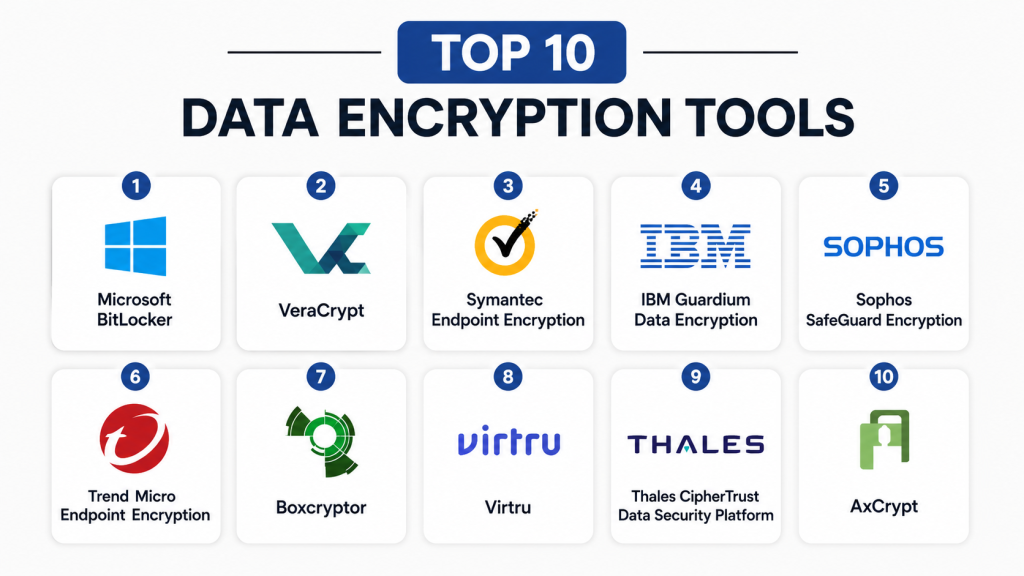
Top 10 Data Encryption Tools
1- Microsoft BitLocker
Short description: Microsoft BitLocker is a full-disk encryption solution built into Windows environments. It is widely used by enterprises for endpoint security, device protection, and centralized encryption management.
Key Features
- Full disk encryption for Windows devices
- TPM integration for hardware-based protection
- Recovery key management
- Group Policy integration
- Enterprise deployment support
- Integration with Microsoft Intune
- AES encryption support
Pros
- Native Windows integration
- Strong enterprise manageability
- Minimal additional licensing for many organizations
Cons
- Limited non-Windows support
- Advanced management may require Microsoft ecosystem tools
- Less flexible for heterogeneous environments
Platforms / Deployment
- Windows
- Cloud / Hybrid
Security & Compliance
- AES encryption
- MFA support through Windows ecosystem
- RBAC via Microsoft administration tools
- Audit logging capabilities
- GDPR support capabilities
Integrations & Ecosystem
BitLocker integrates deeply with Microsoft security and device management platforms, making it highly suitable for organizations already invested in Microsoft infrastructure.
- Microsoft Intune
- Microsoft Defender
- Active Directory
- Azure AD
- Microsoft Endpoint Manager
Support & Community
Strong enterprise documentation, large community ecosystem, and mature enterprise support through Microsoft.
2- VeraCrypt
Short description: VeraCrypt is a popular open-source encryption tool focused on secure disk, partition, and file-container encryption. It is widely used by privacy-focused professionals and technical users.
Key Features
- Full disk encryption
- Hidden encrypted volumes
- Cross-platform support
- Open-source cryptography
- Strong encryption algorithms
- Portable encrypted containers
- Pre-boot authentication
Pros
- Free and open source
- Strong security reputation
- Flexible encryption options
Cons
- Steeper learning curve
- Limited enterprise management
- Basic UI experience
Platforms / Deployment
- Windows / macOS / Linux
- Self-hosted
Security & Compliance
- AES, Serpent, Twofish encryption
- Strong cryptographic standards
- Open-source auditing model
Integrations & Ecosystem
VeraCrypt primarily operates as a standalone encryption platform with limited enterprise ecosystem integration.
- Local storage encryption
- External drive support
- Portable storage protection
Support & Community
Large open-source community with extensive documentation, though enterprise-grade support is limited.
3- Symantec Endpoint Encryption
Short description: Symantec Endpoint Encryption provides enterprise-grade encryption for endpoints, removable media, and email systems. It is commonly used in regulated industries.
Key Features
- Full disk encryption
- Removable media encryption
- Centralized policy management
- Recovery management
- Email encryption capabilities
- Compliance reporting
- Enterprise administration console
Pros
- Strong enterprise governance capabilities
- Good compliance management
- Mature centralized administration
Cons
- Can be complex to deploy
- Licensing may be expensive
- Heavy enterprise focus
Platforms / Deployment
- Windows / macOS
- Cloud / Hybrid
Security & Compliance
- AES encryption
- Role-based administration
- Audit logging
- Compliance reporting support
- GDPR and enterprise compliance alignment
Integrations & Ecosystem
Symantec integrates with broader enterprise security environments and endpoint management platforms.
- Active Directory
- SIEM platforms
- Endpoint management systems
- Enterprise identity tools
Support & Community
Enterprise-grade support structure with mature documentation and onboarding resources.
4- IBM Guardium Data Encryption
Short description: IBM Guardium Data Encryption focuses on protecting enterprise databases, files, and cloud workloads using centralized encryption and key lifecycle management.
Key Features
- Transparent data encryption
- Centralized key management
- Tokenization support
- Database encryption
- Cloud workload protection
- Policy automation
- Compliance reporting
Pros
- Strong database encryption capabilities
- Enterprise scalability
- Broad compliance support
Cons
- Complex implementation
- Higher operational overhead
- Better suited for large enterprises
Platforms / Deployment
- Cloud / Self-hosted / Hybrid
Security & Compliance
- Encryption key lifecycle management
- Role-based access controls
- Audit logging
- GDPR support
- Enterprise compliance alignment
Integrations & Ecosystem
IBM Guardium integrates with enterprise data protection, analytics, and compliance ecosystems.
- IBM security ecosystem
- SIEM integrations
- Cloud platforms
- Enterprise databases
- Compliance systems
Support & Community
Strong enterprise support with experienced consulting ecosystem and enterprise-grade onboarding.
5- Sophos SafeGuard Encryption
Short description: Sophos SafeGuard Encryption provides centralized encryption management for endpoints, removable devices, and file sharing environments.
Key Features
- Full disk encryption
- File encryption
- Removable media protection
- Centralized management
- Policy-based controls
- Recovery key management
- Native Windows integration
Pros
- Good balance of usability and security
- Strong endpoint management
- Effective policy enforcement
Cons
- Primarily endpoint-focused
- Smaller ecosystem compared to larger vendors
- Some advanced features require Sophos ecosystem adoption
Platforms / Deployment
- Windows / macOS
- Cloud / Hybrid
Security & Compliance
- AES encryption
- MFA support
- Centralized auditing
- Compliance-oriented policy management
Integrations & Ecosystem
Sophos SafeGuard works closely with broader Sophos security platforms and endpoint ecosystems.
- Sophos Central
- Endpoint security tools
- Active Directory
- Device management systems
Support & Community
Strong enterprise support with growing SMB adoption and accessible administration tools.
6- Trend Micro Endpoint Encryption
Short description: Trend Micro Endpoint Encryption helps organizations secure endpoints, removable storage, and enterprise data with centralized encryption policies.
Key Features
- Full disk encryption
- Media encryption
- Centralized management
- Remote recovery
- Compliance reporting
- Policy automation
- Endpoint integration
Pros
- Strong enterprise endpoint protection
- Good policy management
- Integrated security ecosystem
Cons
- Management complexity for smaller teams
- Higher licensing costs
- Limited open ecosystem flexibility
Platforms / Deployment
- Windows / macOS
- Cloud / Hybrid
Security & Compliance
- AES encryption
- Compliance management support
- Audit capabilities
- Enterprise policy controls
Integrations & Ecosystem
Trend Micro integrates with broader endpoint security and threat management environments.
- SIEM integrations
- Endpoint detection platforms
- Device management systems
- Enterprise IAM tools
Support & Community
Mature enterprise support organization with strong security documentation.
7- Boxcryptor
Short description: Boxcryptor is a cloud-focused encryption platform designed to secure files stored in public cloud storage services and collaboration platforms.
Key Features
- End-to-end cloud encryption
- Zero-knowledge architecture
- Cloud storage integration
- Cross-platform support
- File sharing protection
- Multi-user management
- Key ownership controls
Pros
- Excellent cloud storage integration
- Easy for end users
- Strong privacy-centric model
Cons
- Primarily focused on cloud file storage
- Limited broader enterprise security tooling
- Advanced governance may be limited
Platforms / Deployment
- Windows / macOS / Linux / iOS / Android
- Cloud
Security & Compliance
- Zero-knowledge encryption
- AES encryption
- Secure key ownership
- Privacy-oriented architecture
Integrations & Ecosystem
Boxcryptor integrates with many mainstream cloud storage and collaboration platforms.
- Google Drive
- Dropbox
- OneDrive
- SharePoint
- Box
Support & Community
Good user-focused documentation with strong SMB and professional user adoption.
8- Virtru
Short description: Virtru specializes in email and file encryption with a strong focus on secure collaboration and regulatory compliance.
Key Features
- Email encryption
- File encryption
- Access revocation
- Secure collaboration
- Data access controls
- Encryption policy automation
- Compliance support
Pros
- Easy deployment
- Strong email security focus
- User-friendly experience
Cons
- Less comprehensive endpoint encryption
- Best suited for collaboration use cases
- Enterprise scalability varies by deployment
Platforms / Deployment
- Web / Cloud
Security & Compliance
- Encryption policy management
- Access controls
- Audit capabilities
- Compliance-oriented design
Integrations & Ecosystem
Virtru integrates with enterprise communication and productivity ecosystems.
- Gmail
- Microsoft 365
- Google Workspace
- Outlook
- Collaboration tools
Support & Community
Strong onboarding experience and good usability for non-technical users.
9- Thales CipherTrust Data Security Platform
Short description: Thales CipherTrust is an enterprise-grade data security platform focused on encryption, tokenization, and centralized key management.
Key Features
- Centralized key management
- Data encryption
- Tokenization
- Secrets management
- Cloud workload protection
- Data discovery
- Policy orchestration
Pros
- Extremely strong enterprise security capabilities
- Broad cloud and hybrid support
- Advanced governance controls
Cons
- Enterprise complexity
- Higher cost structure
- Requires experienced administration
Platforms / Deployment
- Cloud / Self-hosted / Hybrid
Security & Compliance
- Enterprise key management
- RBAC
- Audit logging
- Compliance automation support
- Strong enterprise governance controls
Integrations & Ecosystem
CipherTrust integrates broadly across enterprise security, cloud, and data ecosystems.
- AWS
- Azure
- Google Cloud
- VMware
- SIEM platforms
- Enterprise databases
Support & Community
Strong enterprise support organization with mature implementation services.
10- AxCrypt
Short description: AxCrypt is a lightweight encryption tool designed for individuals and SMBs that need simple file encryption and secure file sharing.
Key Features
- File encryption
- Password management integration
- Secure file sharing
- Cloud storage support
- Mobile access
- Simple user interface
- Automatic encryption workflows
Pros
- Easy to use
- Lightweight deployment
- Good SMB affordability
Cons
- Limited enterprise governance
- Fewer advanced compliance features
- Narrower feature depth
Platforms / Deployment
- Windows / macOS / Android / iOS
- Cloud
Security & Compliance
- AES encryption
- Password-protected sharing
- Basic security policy support
Integrations & Ecosystem
AxCrypt integrates mainly with common productivity and cloud storage tools.
- Dropbox
- Google Drive
- OneDrive
- File sharing workflows
Support & Community
Good usability-focused support experience with straightforward onboarding.
Comparison Table
| Tool Name | Best For | Platform(s) Supported | Deployment | Standout Feature | Public Rating |
|---|---|---|---|---|---|
| Microsoft BitLocker | Windows enterprises | Windows | Hybrid | Native Windows disk encryption | N/A |
| VeraCrypt | Privacy-focused users | Windows, macOS, Linux | Self-hosted | Open-source hidden volumes | N/A |
| Symantec Endpoint Encryption | Regulated enterprises | Windows, macOS | Hybrid | Enterprise policy management | N/A |
| IBM Guardium Data Encryption | Database security | Multi-platform | Hybrid | Enterprise database encryption | N/A |
| Sophos SafeGuard Encryption | Endpoint security | Windows, macOS | Hybrid | Centralized endpoint encryption | N/A |
| Trend Micro Endpoint Encryption | Enterprise endpoints | Windows, macOS | Hybrid | Integrated endpoint ecosystem | N/A |
| Boxcryptor | Cloud storage security | Multi-platform | Cloud | Cloud-native file encryption | N/A |
| Virtru | Secure collaboration | Web, Cloud | Cloud | Email encryption simplicity | N/A |
| Thales CipherTrust | Enterprise data governance | Multi-platform | Hybrid | Centralized key management | N/A |
| AxCrypt | SMB file encryption | Multi-platform | Cloud | Lightweight usability | N/A |
Evaluation & Scoring of Data Encryption Tools
| Tool Name | Core 25% | Ease 15% | Integrations 15% | Security 10% | Performance 10% | Support 10% | Value 15% | Weighted Total |
|---|---|---|---|---|---|---|---|---|
| Microsoft BitLocker | 9 | 9 | 8 | 9 | 9 | 8 | 9 | 8.7 |
| VeraCrypt | 8 | 6 | 5 | 9 | 8 | 6 | 10 | 7.5 |
| Symantec Endpoint Encryption | 9 | 7 | 8 | 9 | 8 | 8 | 7 | 8.1 |
| IBM Guardium Data Encryption | 9 | 6 | 9 | 10 | 9 | 8 | 6 | 8.2 |
| Sophos SafeGuard Encryption | 8 | 8 | 7 | 8 | 8 | 8 | 8 | 7.9 |
| Trend Micro Endpoint Encryption | 8 | 7 | 8 | 8 | 8 | 8 | 7 | 7.8 |
| Boxcryptor | 7 | 9 | 8 | 8 | 8 | 7 | 8 | 7.9 |
| Virtru | 7 | 9 | 8 | 8 | 8 | 7 | 8 | 7.9 |
| Thales CipherTrust | 10 | 6 | 9 | 10 | 9 | 8 | 6 | 8.4 |
| AxCrypt | 6 | 9 | 6 | 7 | 7 | 7 | 9 | 7.3 |
These scores are comparative rather than absolute. Enterprise-focused tools tend to score higher in governance, integrations, and compliance, while SMB-focused tools typically perform better in usability and affordability. Organizations should prioritize criteria that align with operational goals rather than focusing only on overall scores. For example, a small business may benefit more from ease of deployment, while large enterprises may prioritize centralized policy enforcement and compliance reporting.
Which Data Encryption Tool Is Right for You?
Solo / Freelancer
Individuals and freelancers usually benefit most from lightweight and affordable tools. VeraCrypt and AxCrypt are strong options for secure file storage, portable encrypted containers, and cloud file protection without requiring enterprise infrastructure.
SMB
Small and medium-sized businesses often need centralized management without excessive complexity. Sophos SafeGuard Encryption, Boxcryptor, and Virtru provide a practical balance between usability, security, and deployment simplicity.
Mid-Market
Mid-sized organizations should prioritize scalable management, compliance reporting, and endpoint visibility. Trend Micro Endpoint Encryption and Symantec Endpoint Encryption are well suited for growing operational environments.
Enterprise
Large enterprises typically require centralized governance, cloud workload protection, key lifecycle management, and broad compliance support. IBM Guardium and Thales CipherTrust are strong enterprise-focused choices for these environments.
Budget vs Premium
Budget-conscious buyers often prefer open-source or lightweight tools such as VeraCrypt and AxCrypt. Premium enterprise platforms deliver stronger automation, governance, and compliance management but come with higher operational and licensing costs.
Feature Depth vs Ease of Use
Tools with extensive governance capabilities often require more administrative expertise. Simpler products such as Virtru and Boxcryptor focus on user-friendly deployment and collaboration security, while platforms like CipherTrust prioritize advanced enterprise controls.
Integrations & Scalability
Organizations operating across hybrid cloud environments should prioritize products with mature APIs, SIEM integrations, and centralized policy orchestration. IBM Guardium and Thales CipherTrust perform strongly in highly integrated enterprise ecosystems.
Security & Compliance Needs
Highly regulated industries should prioritize products with strong audit logging, centralized key management, and compliance-focused controls. Healthcare, finance, and government sectors typically require enterprise-grade governance and reporting features.
Frequently Asked Questions (FAQs)
1. What are data encryption tools used for?
Data encryption tools protect sensitive information by converting readable data into encrypted formats. They are commonly used to secure devices, cloud storage, communications, backups, and enterprise databases.
2. What is the difference between file encryption and full-disk encryption?
File encryption protects specific files or folders, while full-disk encryption secures the entire storage drive. Full-disk encryption is commonly used for laptops and enterprise endpoints.
3. Are open-source encryption tools safe?
Well-established open-source encryption tools can be highly secure when actively maintained and audited by the security community. However, they may lack enterprise support and centralized management features.
4. Do encryption tools affect system performance?
Modern encryption tools generally have minimal performance impact, especially when hardware acceleration is available. Performance differences are more noticeable in large-scale enterprise workloads.
5. What industries require strong encryption solutions?
Healthcare, financial services, legal firms, SaaS providers, government agencies, and retail organizations commonly require strong encryption due to compliance and data protection obligations.
6. Can encryption tools help with ransomware protection?
Encryption itself does not stop ransomware, but it helps protect data confidentiality and can reduce exposure from stolen or leaked files. Many organizations combine encryption with backup and endpoint security tools.
7. What should organizations look for in key management?
Organizations should prioritize centralized key lifecycle management, secure key storage, automated rotation, recovery workflows, and strong administrative access controls.
8. Are cloud-native encryption tools enough for hybrid environments?
Not always. Hybrid environments often require broader visibility across endpoints, databases, SaaS applications, and on-premises systems. Enterprise-grade platforms usually handle this complexity better.
9. Is email encryption still important in 2026?
Yes. Email remains one of the most common attack vectors for phishing, data leaks, and compliance violations. Secure email encryption platforms help protect sensitive communications and file sharing.
10. How should companies evaluate encryption vendors?
Organizations should run pilot deployments, validate integrations, test recovery workflows, review compliance capabilities, and evaluate long-term operational management before standardizing on a platform.
Conclusion
Data encryption tools have evolved from basic endpoint protection utilities into strategic cybersecurity platforms that secure cloud workloads, communications, enterprise databases, SaaS applications, and distributed workforces. As organizations continue adopting hybrid infrastructure and AI-driven operations, encryption is becoming foundational to both cybersecurity and compliance strategies. The right platform depends heavily on operational complexity, regulatory obligations, deployment preferences, and internal security maturity. There is no universal winner for every organization. Lightweight tools such as VeraCrypt and AxCrypt work well for individuals and smaller teams, while enterprise platforms like IBM Guardium and Thales CipherTrust are designed for highly regulated environments with advanced governance requirements. Most buyers should shortlist two or three tools, validate integration compatibility, test management workflows, and run a controlled pilot before making a long-term encryption investment.

Find Trusted Cardiac Hospitals
Compare heart hospitals by city and services — all in one place.
Explore Hospitals
This article explains data encryption tools in a simple way. The comparison helps understand their features, pros, and cons for securing sensitive data.