Introduction
Key Management Systems KMS are security platforms designed to create, store, rotate, distribute, and manage cryptographic keys used for encryption across applications, cloud services, databases, endpoints, and enterprise infrastructure. Without proper key management, even strong encryption becomes difficult to secure and scale, KMS platforms have become essential because organizations now operate across multi-cloud environments, remote work ecosystems, SaaS applications, AI pipelines, and containerized infrastructure. Regulatory requirements around privacy, encryption, and data sovereignty continue to increase, making centralized key lifecycle management critical for modern cybersecurity programs.
Common Real-world use cases include:
- Managing encryption keys for cloud workloads
- Securing databases and storage systems
- Protecting API secrets and machine identities
- Supporting Zero Trust architectures
- Enabling compliance for GDPR, PCI DSS, HIPAA, and financial regulations
Buyers Evaluating KMS platforms should consider:
- Key lifecycle automation
- Multi-cloud compatibility
- Hardware Security Module HSM integration
- Access control and RBAC
- API availability and developer tooling
- Audit logging and compliance reporting
- Scalability and performance
- Integration ecosystem
- Deployment flexibility
- Disaster recovery and backup capabilities
Best for: Enterprises, cloud-native organizations, DevSecOps teams, financial institutions, SaaS providers, healthcare systems, and regulated industries managing large-scale encryption operations.
Not ideal for: Very small teams with limited encryption requirements or organizations relying fully on managed encryption services with minimal customization needs.
Key Trends in Key Management Systems KMS
- AI-driven anomaly detection is being integrated into key usage monitoring.
- Multi-cloud key orchestration is becoming a standard enterprise requirement.
- Post-quantum cryptography readiness is gaining attention among large enterprises.
- Secrets management and KMS platforms are increasingly converging.
- Confidential computing integration is expanding across cloud providers.
- More organizations are adopting centralized policy-based key rotation.
- Kubernetes-native KMS integrations are becoming critical for container security.
- Compliance automation and audit-ready reporting continue to evolve.
- Hardware-backed encryption adoption is increasing for sensitive workloads.
- API-first KMS platforms are growing in popularity among developer-focused teams.
How We Selected These Tools Methodology
The tools in this list were selected using a combination of enterprise adoption, technical capability, cloud relevance, and operational maturity.
- Evaluated market adoption and industry trust
- Prioritized strong key lifecycle management capabilities
- Assessed cloud-native and hybrid infrastructure support
- Reviewed integration maturity with enterprise ecosystems
- Considered developer tooling and API accessibility
- Evaluated scalability for enterprise workloads
- Included a mix of hyperscaler, enterprise, and open-source solutions
- Assessed compliance and governance capabilities
- Considered operational usability and deployment flexibility
- Reviewed ecosystem maturity and long-term platform viability
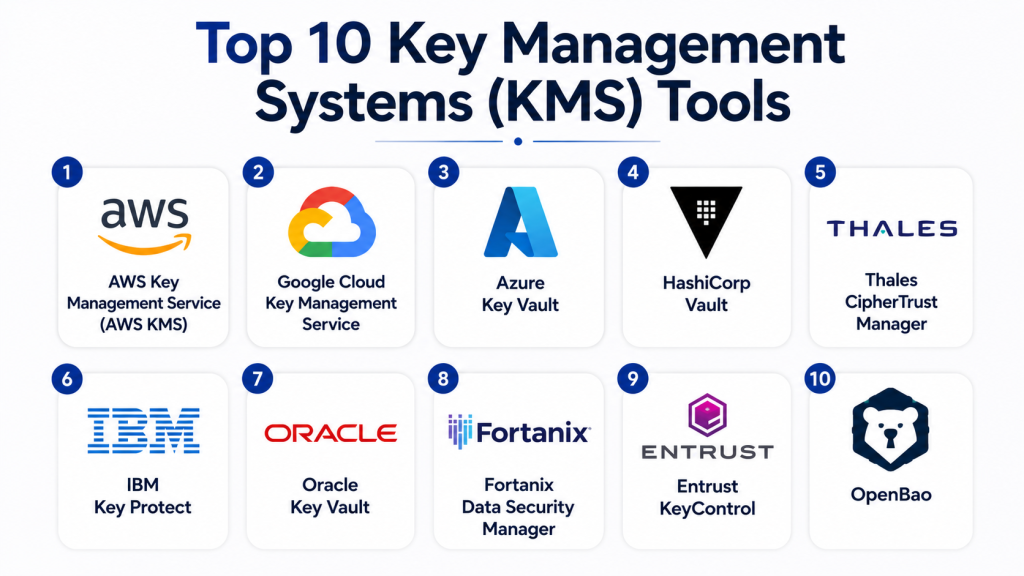
Top 10 Key Management Systems KMS Tools
1- AWS Key Management Service AWS KMS
Short description: AWS KMS is a cloud-native key management platform tightly integrated with the AWS ecosystem. It is widely used by enterprises and developers managing encrypted cloud workloads on AWS.
Key Features
- Centralized encryption key management
- Automatic key rotation
- Integration with AWS services
- Hardware security module support
- Fine-grained IAM controls
- Audit logging through CloudTrail
- Multi-region key replication
Pros
- Deep AWS ecosystem integration
- Highly scalable cloud-native architecture
- Strong automation capabilities
Cons
- Best suited primarily for AWS environments
- Cross-cloud portability can be limited
- Pricing complexity for large workloads
Platforms / Deployment
- Cloud
Security & Compliance
- MFA support through AWS IAM
- Audit logging
- RBAC controls
- Hardware-backed key protection
- GDPR support capabilities
Integrations & Ecosystem
AWS KMS integrates deeply with AWS infrastructure services, making it highly effective for organizations operating primarily in AWS environments.
- Amazon S3
- Amazon RDS
- AWS Lambda
- Amazon EKS
- AWS CloudTrail
- AWS IAM
Support & Community
Extensive enterprise documentation, large developer ecosystem, and mature enterprise support through AWS.
2- Google Cloud Key Management Service
Short description: Google Cloud KMS provides centralized encryption key management for Google Cloud workloads, applications, and containerized infrastructure.
Key Features
- Cloud-native key management
- Automatic key rotation
- HSM-backed encryption
- IAM integration
- Centralized audit logging
- API-driven automation
- Kubernetes integrations
Pros
- Strong Kubernetes support
- Excellent scalability
- Developer-friendly APIs
Cons
- Primarily optimized for Google Cloud
- Enterprise governance depth varies by use case
- Advanced configurations may require expertise
Platforms / Deployment
- Cloud
Security & Compliance
- RBAC
- Audit logging
- HSM support
- Encryption policy management
Integrations & Ecosystem
Google Cloud KMS works closely with cloud-native infrastructure and containerized application ecosystems.
- Google Kubernetes Engine
- BigQuery
- Cloud Storage
- Google IAM
- Anthos
Support & Community
Strong developer documentation and growing enterprise support ecosystem.
3- Azure Key Vault
Short description: Azure Key Vault is Microsoft’s cloud-native KMS and secrets management platform designed for securing encryption keys, certificates, and application secrets.
Key Features
- Centralized key storage
- Certificate management
- Secrets management
- HSM support
- Azure AD integration
- Role-based access control
- Automated key rotation
Pros
- Strong Microsoft ecosystem integration
- Unified secrets and key management
- Enterprise-grade governance
Cons
- Best optimized for Azure-centric environments
- Some advanced integrations require Microsoft expertise
- Pricing varies by workload scale
Platforms / Deployment
- Cloud
Security & Compliance
- Azure AD authentication
- RBAC
- Audit logging
- HSM-backed encryption
- Compliance-oriented controls
Integrations & Ecosystem
Azure Key Vault integrates broadly across Microsoft cloud and enterprise ecosystems.
- Microsoft Entra ID
- Azure Kubernetes Service
- Azure Storage
- Microsoft Defender
- Azure DevOps
Support & Community
Mature enterprise support and extensive administrator documentation.
4- HashiCorp Vault
Short description: HashiCorp Vault is a widely adopted secrets management and KMS platform used by DevOps and security teams for dynamic secrets and encryption management.
Key Features
- Dynamic secrets generation
- Encryption as a service
- Identity-based access controls
- Multi-cloud support
- Token-based authentication
- Secret leasing and revocation
- Kubernetes-native integrations
Pros
- Strong multi-cloud flexibility
- Developer-first architecture
- Excellent automation support
Cons
- Operational complexity
- Learning curve for advanced deployments
- Enterprise features may require premium licensing
Platforms / Deployment
- Cloud / Self-hosted / Hybrid
Security & Compliance
- RBAC
- Audit logging
- Encryption services
- MFA support
- Policy-based governance
Integrations & Ecosystem
Vault has one of the broadest integration ecosystems among KMS and secrets management platforms.
- Kubernetes
- Terraform
- AWS
- Azure
- Google Cloud
- CI/CD pipelines
Support & Community
Large DevOps community with strong open-source adoption and enterprise support options.
5- Thales CipherTrust Manager
Short description: Thales CipherTrust Manager is an enterprise-grade KMS platform focused on centralized encryption management, compliance, and hybrid cloud governance.
Key Features
- Centralized key lifecycle management
- HSM integration
- Data encryption management
- Multi-cloud support
- Compliance reporting
- Policy automation
- Tokenization support
Pros
- Strong enterprise governance
- Excellent compliance capabilities
- Broad infrastructure compatibility
Cons
- Higher operational complexity
- Premium enterprise pricing
- Requires experienced administration
Platforms / Deployment
- Cloud / Self-hosted / Hybrid
Security & Compliance
- RBAC
- Audit logging
- Enterprise encryption governance
- HSM support
- Compliance reporting
Integrations & Ecosystem
CipherTrust integrates broadly across enterprise data protection and cloud ecosystems.
- VMware
- AWS
- Azure
- Google Cloud
- Enterprise databases
- SIEM platforms
Support & Community
Strong enterprise consulting and implementation support ecosystem.
6- IBM Key Protect
Short description: IBM Key Protect provides cloud-based encryption key lifecycle management for IBM Cloud workloads and enterprise applications.
Key Features
- Centralized key management
- HSM-backed key storage
- Automated key rotation
- Policy enforcement
- Cloud-native APIs
- Audit logging
- Data encryption integration
Pros
- Strong IBM ecosystem integration
- Enterprise-grade security
- Reliable cloud infrastructure support
Cons
- Smaller ecosystem compared to hyperscalers
- Best suited for IBM-centric environments
- Advanced integrations may require customization
Platforms / Deployment
- Cloud
Security & Compliance
- HSM-backed encryption
- RBAC
- Audit logging
- Enterprise policy enforcement
Integrations & Ecosystem
IBM Key Protect integrates with IBM cloud and enterprise security ecosystems.
- IBM Cloud
- Kubernetes
- Enterprise storage systems
- Security analytics platforms
Support & Community
Good enterprise documentation and professional support services.
7- Oracle Key Vault
Short description: Oracle Key Vault centralizes encryption key management for Oracle databases and enterprise infrastructure environments.
Key Features
- Database encryption key management
- Oracle integration
- Centralized governance
- Automated backup and recovery
- HSM integration
- Secure key distribution
- Audit reporting
Pros
- Strong Oracle ecosystem optimization
- Reliable enterprise database security
- Mature governance capabilities
Cons
- Best suited for Oracle-heavy environments
- Less attractive for multi-cloud flexibility
- Complex enterprise deployment
Platforms / Deployment
- Self-hosted / Hybrid
Security & Compliance
- Audit logging
- RBAC
- Encryption policy enforcement
- Enterprise governance controls
Integrations & Ecosystem
Oracle Key Vault integrates deeply with Oracle infrastructure and enterprise database environments.
- Oracle Database
- Oracle Cloud
- Enterprise applications
- Oracle security platforms
Support & Community
Strong enterprise support with mature Oracle administrator ecosystem.
8- Fortanix Data Security Manager
Short description: Fortanix DSM is a modern cloud-focused KMS and data security platform emphasizing confidential computing and centralized encryption management.
Key Features
- Centralized key management
- Confidential computing support
- Secrets management
- Multi-cloud integrations
- Tokenization
- Runtime encryption protection
- Compliance automation
Pros
- Modern cloud-native design
- Strong confidential computing capabilities
- Flexible deployment options
Cons
- Smaller market presence
- Enterprise adoption still growing
- Some advanced features may require expertise
Platforms / Deployment
- Cloud / Hybrid
Security & Compliance
- RBAC
- Audit logging
- Hardware-backed security support
- Compliance automation features
Integrations & Ecosystem
Fortanix integrates with cloud platforms, containers, and enterprise security infrastructure.
- AWS
- Azure
- Google Cloud
- Kubernetes
- VMware
Support & Community
Growing enterprise support ecosystem with modern developer-focused documentation.
9- Entrust KeyControl
Short description: Entrust KeyControl is a centralized KMS platform designed for hybrid cloud encryption governance and enterprise key lifecycle management.
Key Features
- Centralized key management
- Multi-cloud support
- Policy automation
- VM encryption support
- Key lifecycle management
- Compliance reporting
- Secure backup controls
Pros
- Good hybrid cloud support
- Enterprise-friendly governance
- Strong virtualization support
Cons
- Smaller ecosystem than hyperscalers
- Enterprise-focused pricing
- Limited developer-centric tooling
Platforms / Deployment
- Cloud / Self-hosted / Hybrid
Security & Compliance
- Audit logging
- RBAC
- Compliance-oriented governance
- Encryption lifecycle management
Integrations & Ecosystem
Entrust KeyControl supports enterprise virtualization and hybrid infrastructure environments.
- VMware
- Cloud platforms
- Enterprise storage systems
- Virtual machine encryption tools
Support & Community
Enterprise-grade support with strong infrastructure-focused guidance.
10- OpenBao
Short description: OpenBao is an open-source secrets management and KMS project designed as a community-driven alternative for secure key and secrets management.
Key Features
- Open-source architecture
- Secrets management
- Encryption APIs
- Dynamic credentials
- Kubernetes support
- Multi-platform deployment
- API-driven automation
Pros
- Open-source flexibility
- Community-driven development
- Good DevOps alignment
Cons
- Smaller enterprise ecosystem
- Community maturity still evolving
- Enterprise support varies
Platforms / Deployment
- Self-hosted / Hybrid
Security & Compliance
- Encryption services
- Audit logging
- Access policy controls
- Community-driven security improvements
Integrations & Ecosystem
OpenBao integrates with modern cloud-native and DevOps infrastructure environments.
- Kubernetes
- CI/CD pipelines
- Cloud platforms
- Infrastructure automation tools
Support & Community
Growing open-source community with improving documentation and ecosystem support.
Comparison Table Top 10
| Tool Name | Best For | Platform(s) Supported | Deployment | Standout Feature | Public Rating |
|---|---|---|---|---|---|
| AWS KMS | AWS cloud workloads | Cloud | Cloud | Deep AWS integrations | N/A |
| Google Cloud KMS | Kubernetes environments | Cloud | Cloud | Cloud-native scalability | N/A |
| Azure Key Vault | Microsoft ecosystems | Cloud | Cloud | Unified secrets and key management | N/A |
| HashiCorp Vault | DevOps and multi-cloud | Multi-platform | Hybrid | Dynamic secrets management | N/A |
| Thales CipherTrust Manager | Enterprise governance | Multi-platform | Hybrid | Centralized encryption governance | N/A |
| IBM Key Protect | IBM cloud security | Cloud | Cloud | IBM ecosystem integration | N/A |
| Oracle Key Vault | Oracle database security | Enterprise infrastructure | Hybrid | Oracle database encryption | N/A |
| Fortanix DSM | Confidential computing | Multi-platform | Hybrid | Confidential computing support | N/A |
| Entrust KeyControl | Hybrid cloud governance | Multi-platform | Hybrid | VM encryption management | N/A |
| OpenBao | Open-source DevOps teams | Multi-platform | Self-hosted | Open-source flexibility | N/A |
Evaluation & Scoring of Key Management Systems KMS
| Tool Name | Core 25% | Ease 15% | Integrations 15% | Security 10% | Performance 10% | Support 10% | Value 15% | Weighted Total |
|---|---|---|---|---|---|---|---|---|
| AWS KMS | 9 | 8 | 9 | 9 | 9 | 8 | 8 | 8.6 |
| Google Cloud KMS | 8 | 8 | 8 | 9 | 9 | 8 | 8 | 8.2 |
| Azure Key Vault | 9 | 8 | 9 | 9 | 9 | 8 | 8 | 8.6 |
| HashiCorp Vault | 10 | 7 | 10 | 9 | 9 | 9 | 8 | 8.9 |
| Thales CipherTrust Manager | 10 | 6 | 9 | 10 | 9 | 8 | 6 | 8.3 |
| IBM Key Protect | 8 | 7 | 7 | 9 | 8 | 8 | 7 | 7.7 |
| Oracle Key Vault | 8 | 6 | 7 | 9 | 8 | 8 | 6 | 7.4 |
| Fortanix DSM | 8 | 7 | 8 | 9 | 8 | 7 | 7 | 7.7 |
| Entrust KeyControl | 8 | 7 | 7 | 9 | 8 | 7 | 7 | 7.5 |
| OpenBao | 7 | 6 | 7 | 8 | 7 | 6 | 9 | 7.1 |
These scores are comparative and intended to help buyers evaluate trade-offs between enterprise governance, cloud-native flexibility, developer usability, and operational complexity. Enterprise-focused platforms typically score higher in compliance and governance, while open-source tools often perform better in cost efficiency and deployment flexibility. Buyers should prioritize categories most aligned with their infrastructure and regulatory requirements.
Which Key Management Systems KMS Tool Is Right for You
Solo / Freelancer
Independent developers and technical users may prefer lightweight or open-source solutions such as OpenBao for flexibility and cost efficiency. Simpler managed cloud KMS options may also work well for cloud-native personal projects.
SMB
Small and mid-sized businesses often benefit from cloud-native managed services such as AWS KMS, Azure Key Vault, or Google Cloud KMS because they reduce operational overhead while providing strong scalability.
Mid-Market
Mid-market organizations typically require stronger governance, centralized visibility, and multi-cloud support. HashiCorp Vault and Entrust KeyControl are strong choices for growing infrastructure complexity.
Enterprise
Large enterprises with hybrid cloud environments, regulatory requirements, and advanced encryption governance needs often prioritize Thales CipherTrust Manager, HashiCorp Vault, or Oracle Key Vault.
Budget vs Premium
Managed cloud KMS platforms generally reduce operational complexity but may become expensive at scale. Open-source solutions reduce licensing costs but often require stronger internal operational expertise.
Feature Depth vs Ease of Use
Platforms like HashiCorp Vault provide extensive flexibility and automation but require experienced teams. Cloud-native managed services are easier to operate but may offer less customization.
Integrations & Scalability
Organizations operating across multi-cloud and Kubernetes environments should prioritize API maturity, orchestration capabilities, and ecosystem compatibility when selecting a KMS platform.
Security & Compliance Needs
Highly regulated industries should focus on audit logging, HSM integration, centralized governance, RBAC, and automated compliance reporting when evaluating KMS vendors.
Frequently Asked Questions FAQs
1. What is a Key Management System KMS?
A KMS is a platform used to create, store, rotate, manage, and protect encryption keys across applications, databases, cloud services, and enterprise infrastructure.
2. Why is key management important?
Strong encryption is only effective if encryption keys are properly protected. Poor key management can expose sensitive data even when encryption algorithms are strong.
3. What is the difference between KMS and secrets management?
KMS platforms primarily manage cryptographic keys, while secrets management platforms also handle passwords, tokens, API keys, and credentials. Many modern platforms combine both functions.
4. Are cloud-native KMS platforms secure?
Major cloud-native KMS services provide strong security controls, HSM-backed encryption, audit logging, and access controls. However, organizations should still validate governance and compliance requirements.
5. What industries use KMS platforms most heavily?
Financial services, healthcare, SaaS providers, government agencies, and enterprises with regulated data environments commonly rely on centralized KMS platforms.
6. What is automatic key rotation?
Automatic key rotation periodically replaces encryption keys to reduce long-term exposure risk and improve compliance with security best practices.
7. Can KMS platforms work across multiple clouds?
Some KMS platforms support multi-cloud environments, while others are tightly integrated with a specific cloud provider. Multi-cloud organizations often prioritize vendor-neutral platforms.
8. Do KMS tools impact application performance?
Modern KMS platforms are designed for scalability and generally introduce minimal performance overhead. However, high-volume encryption operations should still be performance tested.
9. What role do Hardware Security Modules HSMs play?
HSMs provide hardware-based protection for cryptographic operations and key storage. They are commonly used in highly regulated or high-security environments.
10. How should organizations evaluate KMS vendors?
Organizations should test integrations, validate compliance capabilities, review key recovery workflows, evaluate scalability, and run pilot deployments before selecting a long-term platform.
Conclusion
Key Management Systems KMS platforms have become foundational components of modern cybersecurity architecture. As organizations continue expanding across multi-cloud infrastructure, containerized applications, AI-driven systems, and remote work environments, centralized encryption key governance is increasingly critical for protecting sensitive data and meeting regulatory obligations. Modern KMS solutions now extend beyond simple encryption management into broader areas such as secrets management, compliance automation, confidential computing, and policy orchestration. The best KMS platform depends heavily on infrastructure strategy, operational maturity, regulatory requirements, and cloud architecture. Organizations deeply invested in a single cloud provider may benefit from native services like AWS KMS or Azure Key Vault, while enterprises operating across hybrid or multi-cloud environments may require broader platforms such as HashiCorp Vault or Thales CipherTrust Manager. Most buyers should shortlist a few tools, validate integrations with existing infrastructure, test operational workflows, and conduct security and compliance reviews before standardizing on a long-term KMS strategy.

Find Trusted Cardiac Hospitals
Compare heart hospitals by city and services — all in one place.
Explore Hospitals
This article explains key management systems in a simple way. The comparison helps understand their features, pros, and cons for managing encryption keys securely.