Introduction
Public Key Infrastructure PKI Tools are platforms used to create, manage, distribute, validate, and revoke digital certificates and cryptographic keys. These systems form the foundation of secure communications, digital identity verification, encrypted authentication, secure web traffic, VPN security, and machine-to-machine trust. PKI has become more critical as organizations adopt Zero Trust architectures, cloud-native applications, remote work environments, IoT ecosystems, and AI-driven infrastructure. Enterprises now manage thousands or even millions of certificates across users, servers, APIs, containers, and connected devices. Without centralized PKI management, organizations face risks such as expired certificates, service outages, identity compromise, and compliance failures.
Common Real-world PKI use cases include:
- SSL/TLS certificate management
- Secure email and document signing
- VPN and Wi-Fi authentication
- Machine identity management
- IoT device authentication and encryption
Buyers Evaluating PKI tools should consider:
- Certificate lifecycle automation
- Scalability
- Multi-cloud compatibility
- Hardware Security Module HSM support
- Compliance capabilities
- Integration ecosystem
- API availability
- Role-based access controls
- Certificate discovery capabilities
- Ease of administration
Best for: Enterprises, financial institutions, healthcare organizations, telecom providers, government agencies, SaaS companies, and security-focused DevOps teams managing digital identities at scale.
Not ideal for: Very small businesses with minimal certificate requirements or organizations fully outsourcing certificate management to managed cloud providers.
Key Trends in Public Key Infrastructure PKI Tools
- Machine identity management is becoming a primary PKI focus area.
- AI-driven certificate monitoring and anomaly detection are growing rapidly.
- Certificate lifecycle automation is replacing manual certificate management.
- Post-quantum cryptography readiness is becoming a strategic initiative.
- PKI integration with Zero Trust architectures is expanding.
- Kubernetes and container-native certificate automation is increasing.
- IoT device authentication demand continues to accelerate.
- Cloud-native PKI platforms are replacing legacy on-premise-only systems.
- Compliance-driven certificate visibility and reporting are becoming standard.
- API-first PKI platforms are increasingly preferred by DevOps teams.
How We Selected These Tools Methodology
The tools in this list were selected based on enterprise adoption, technical maturity, automation capabilities, and operational scalability.
- Evaluated global PKI market adoption and industry trust
- Prioritized certificate lifecycle automation capabilities
- Assessed scalability for enterprise and cloud-native environments
- Reviewed support for hybrid and multi-cloud infrastructure
- Considered integration ecosystems and API maturity
- Evaluated compliance and governance capabilities
- Included both enterprise and developer-focused solutions
- Assessed HSM integration and advanced security capabilities
- Reviewed usability and administrative experience
- Considered long-term ecosystem maturity and vendor stability
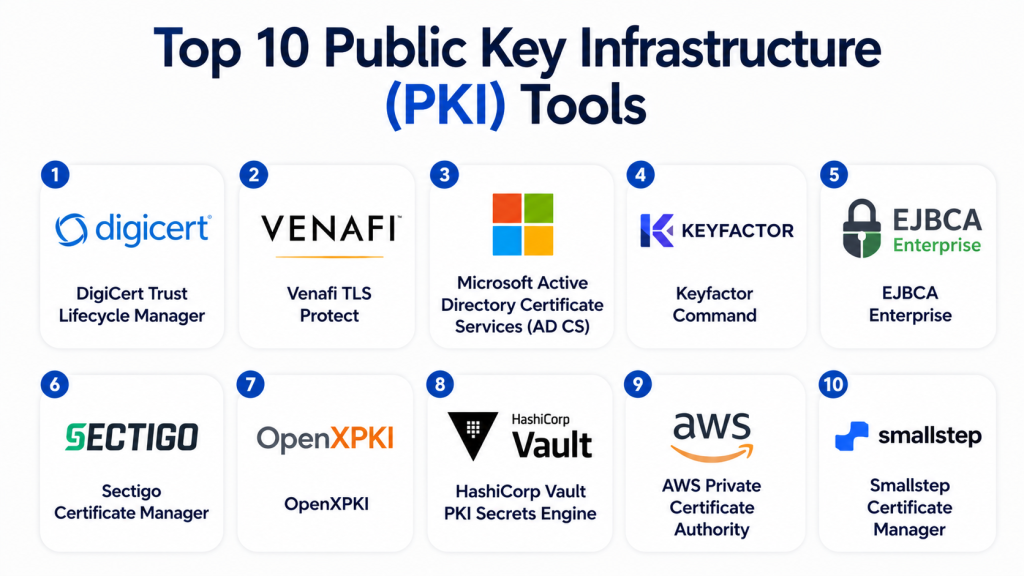
Top 10 Public Key Infrastructure PKI Tools
1- DigiCert Trust Lifecycle Manager
Short description: DigiCert Trust Lifecycle Manager is an enterprise PKI and certificate management platform designed for large-scale certificate automation, machine identity management, and digital trust operations.
Key Features
- Automated certificate lifecycle management
- Enterprise PKI services
- Machine identity management
- Multi-cloud certificate visibility
- Discovery and inventory management
- API-driven automation
- IoT certificate support
Pros
- Strong enterprise automation capabilities
- Broad certificate ecosystem support
- Excellent scalability
Cons
- Enterprise pricing may be expensive
- Advanced deployments can be complex
- Smaller organizations may not require full feature depth
Platforms / Deployment
- Cloud / Hybrid
Security & Compliance
- RBAC
- Audit logging
- HSM support
- MFA support
- Enterprise governance controls
Integrations & Ecosystem
DigiCert integrates broadly across enterprise infrastructure, cloud services, DevOps pipelines, and network security environments.
- Kubernetes
- AWS
- Azure
- Google Cloud
- SIEM platforms
- Enterprise IAM tools
Support & Community
Strong enterprise support organization with mature onboarding and extensive documentation.
2- Venafi TLS Protect
Short description: Venafi TLS Protect focuses on machine identity protection and automated certificate lifecycle management for enterprise infrastructure and cloud-native environments.
Key Features
- Machine identity protection
- Certificate lifecycle automation
- Certificate discovery
- Policy enforcement
- Kubernetes integrations
- Cloud-native certificate management
- Risk monitoring
Pros
- Excellent certificate visibility
- Strong automation capabilities
- Enterprise-focused governance
Cons
- Premium enterprise pricing
- Complex deployments for smaller teams
- Requires operational maturity
Platforms / Deployment
- Cloud / Hybrid
Security & Compliance
- RBAC
- Audit logging
- Certificate governance
- Enterprise policy controls
Integrations & Ecosystem
Venafi integrates deeply with enterprise PKI, cloud infrastructure, and DevOps ecosystems.
- Kubernetes
- AWS
- Azure
- Google Cloud
- CI/CD pipelines
- Security orchestration platforms
Support & Community
Mature enterprise support and strong machine identity management expertise.
3- Microsoft Active Directory Certificate Services AD CS
Short description: Microsoft AD CS is Microsoft’s enterprise PKI platform used widely in Windows-centric environments for certificate issuance and internal identity management.
Key Features
- Internal certificate authority management
- Active Directory integration
- Smart card authentication
- Certificate templates
- Auto-enrollment
- Group Policy integration
- Enterprise certificate services
Pros
- Strong Windows ecosystem integration
- Widely adopted enterprise platform
- Good internal PKI management capabilities
Cons
- Primarily Windows-focused
- Complex enterprise administration
- Limited cloud-native flexibility
Platforms / Deployment
- Windows / Self-hosted / Hybrid
Security & Compliance
- RBAC
- Active Directory authentication
- Audit logging
- Certificate policy management
Integrations & Ecosystem
AD CS integrates tightly with Microsoft enterprise identity and infrastructure environments.
- Active Directory
- Microsoft Intune
- Windows Server
- Microsoft Defender
- Enterprise VPN systems
Support & Community
Extensive enterprise administrator community and strong Microsoft support ecosystem.
4- Keyfactor Command
Short description: Keyfactor Command is an enterprise PKI orchestration platform designed for certificate automation, machine identity governance, and centralized visibility.
Key Features
- Certificate lifecycle automation
- PKI orchestration
- Discovery and inventory
- Compliance reporting
- Cloud-native integrations
- Automated renewal workflows
- Centralized policy management
Pros
- Strong automation features
- Excellent certificate visibility
- Flexible enterprise integrations
Cons
- Enterprise-focused pricing
- Advanced configurations require expertise
- Smaller organizations may find it excessive
Platforms / Deployment
- Cloud / Hybrid
Security & Compliance
- RBAC
- Audit logging
- Policy automation
- Enterprise governance features
Integrations & Ecosystem
Keyfactor integrates broadly across enterprise PKI, cloud, and DevOps ecosystems.
- Kubernetes
- AWS
- Azure
- Google Cloud
- HSM platforms
- Enterprise identity systems
Support & Community
Strong enterprise support with growing adoption in cloud-native environments.
5- EJBCA Enterprise
Short description: EJBCA Enterprise is a highly scalable PKI and certificate authority platform used in enterprise, telecom, and IoT environments.
Key Features
- Certificate authority management
- High scalability architecture
- IoT certificate issuance
- Multi-tenant support
- Automated certificate workflows
- API-driven management
- HSM integration
Pros
- Strong scalability
- Good IoT support
- Flexible deployment options
Cons
- Operational complexity
- Requires PKI expertise
- Enterprise deployment overhead
Platforms / Deployment
- Linux / Self-hosted / Hybrid
Security & Compliance
- HSM support
- RBAC
- Audit logging
- Enterprise-grade PKI controls
Integrations & Ecosystem
EJBCA integrates with enterprise PKI infrastructure, telecom systems, and IoT platforms.
- HSM vendors
- Kubernetes
- IoT ecosystems
- Enterprise identity platforms
Support & Community
Strong enterprise documentation and active PKI-focused community ecosystem.
6- Sectigo Certificate Manager
Short description: Sectigo Certificate Manager provides centralized certificate lifecycle automation and PKI governance for enterprise infrastructure and cloud-native environments.
Key Features
- Certificate discovery
- Lifecycle automation
- Multi-cloud integrations
- Automated renewal workflows
- Centralized dashboards
- Compliance visibility
- API integrations
Pros
- Good automation capabilities
- Broad certificate management support
- User-friendly administration
Cons
- Enterprise pricing varies
- Advanced governance may require premium tiers
- Smaller ecosystem than some competitors
Platforms / Deployment
- Cloud / Hybrid
Security & Compliance
- RBAC
- Audit logging
- Certificate governance controls
- Compliance-oriented reporting
Integrations & Ecosystem
Sectigo integrates with enterprise networking, cloud, and DevOps infrastructure.
- Kubernetes
- AWS
- Azure
- Google Cloud
- Enterprise VPN solutions
Support & Community
Strong commercial support and accessible onboarding resources.
7- OpenXPKI
Short description: OpenXPKI is an open-source PKI platform focused on certificate authority management, workflow automation, and enterprise PKI customization.
Key Features
- Open-source PKI architecture
- Certificate authority management
- Workflow automation
- Policy customization
- Multi-tenant support
- API access
- Certificate lifecycle management
Pros
- Open-source flexibility
- Strong customization options
- Cost-effective deployment
Cons
- Requires technical expertise
- Smaller enterprise ecosystem
- Community support varies
Platforms / Deployment
- Linux / Self-hosted
Security & Compliance
- RBAC
- Audit logging
- Policy enforcement
- Certificate lifecycle controls
Integrations & Ecosystem
OpenXPKI integrates with enterprise PKI environments and infrastructure automation systems.
- HSM platforms
- Linux infrastructure
- Enterprise authentication systems
- Automation pipelines
Support & Community
Active open-source community with improving documentation and enterprise adoption.
8- HashiCorp Vault PKI Secrets Engine
Short description: HashiCorp Vault PKI Secrets Engine enables automated certificate issuance and machine identity management within modern DevOps and cloud-native environments.
Key Features
- Dynamic certificate issuance
- Short-lived certificates
- API-first architecture
- Kubernetes integrations
- Multi-cloud support
- Automated revocation
- Identity-based authentication
Pros
- Excellent DevOps alignment
- Strong automation capabilities
- Cloud-native flexibility
Cons
- Operational learning curve
- Advanced deployments require expertise
- Enterprise features may require premium licensing
Platforms / Deployment
- Cloud / Self-hosted / Hybrid
Security & Compliance
- RBAC
- Audit logging
- Policy enforcement
- Encryption controls
Integrations & Ecosystem
Vault integrates broadly with cloud-native infrastructure and automation ecosystems.
- Kubernetes
- Terraform
- AWS
- Azure
- Google Cloud
- CI/CD platforms
Support & Community
Large DevOps community with strong documentation and enterprise support options.
9- AWS Private Certificate Authority
Short description: AWS Private CA provides managed private certificate authority services for AWS environments and cloud-native applications.
Key Features
- Managed private certificate authority
- Automated certificate issuance
- AWS integration
- API-driven certificate management
- Cloud-native scalability
- Certificate lifecycle automation
- IAM integration
Pros
- Strong AWS ecosystem integration
- Simplified certificate management
- Highly scalable cloud-native design
Cons
- Best suited for AWS-centric organizations
- Limited cross-cloud flexibility
- Pricing may scale with usage
Platforms / Deployment
- Cloud
Security & Compliance
- IAM integration
- RBAC
- Audit logging
- Managed security controls
Integrations & Ecosystem
AWS Private CA integrates deeply across AWS infrastructure and cloud-native workloads.
- AWS IAM
- Amazon EKS
- AWS Certificate Manager
- AWS Lambda
- Amazon EC2
Support & Community
Extensive AWS documentation and mature cloud support ecosystem.
10- Smallstep Certificate Manager
Short description: Smallstep Certificate Manager is a developer-focused PKI platform designed for modern infrastructure, DevOps automation, and Zero Trust certificate management.
Key Features
- Automated certificate issuance
- ACME support
- SSH certificate management
- Kubernetes integrations
- Zero Trust support
- API-first architecture
- Lightweight deployment
Pros
- Developer-friendly experience
- Strong automation workflows
- Modern infrastructure focus
Cons
- Smaller enterprise ecosystem
- Limited large-enterprise governance depth
- Advanced compliance features may vary
Platforms / Deployment
- Cloud / Self-hosted / Hybrid
Security & Compliance
- RBAC
- Audit logging
- Identity-based authentication
- Encryption policy controls
Integrations & Ecosystem
Smallstep integrates with cloud-native environments and developer automation workflows.
- Kubernetes
- Terraform
- CI/CD systems
- Cloud infrastructure
- SSH environments
Support & Community
Growing developer-focused community with strong technical documentation.
Comparison Table Top 10
| Tool Name | Best For | Platform(s) Supported | Deployment | Standout Feature | Public Rating |
|---|---|---|---|---|---|
| DigiCert Trust Lifecycle Manager | Enterprise certificate automation | Multi-platform | Hybrid | Machine identity management | N/A |
| Venafi TLS Protect | Large enterprises | Multi-platform | Hybrid | Certificate visibility and automation | N/A |
| Microsoft AD CS | Windows enterprises | Windows | Hybrid | Active Directory integration | N/A |
| Keyfactor Command | PKI orchestration | Multi-platform | Hybrid | Centralized PKI automation | N/A |
| EJBCA Enterprise | Telecom and IoT PKI | Linux | Hybrid | High scalability architecture | N/A |
| Sectigo Certificate Manager | Enterprise certificate management | Multi-platform | Hybrid | Automated renewal workflows | N/A |
| OpenXPKI | Open-source PKI | Linux | Self-hosted | Workflow customization | N/A |
| HashiCorp Vault PKI | DevOps environments | Multi-platform | Hybrid | Dynamic certificate issuance | N/A |
| AWS Private CA | AWS cloud workloads | Cloud | Cloud | Managed private CA services | N/A |
| Smallstep Certificate Manager | Developer-focused PKI | Multi-platform | Hybrid | Lightweight Zero Trust automation | N/A |
Evaluation & Scoring of Public Key Infrastructure PKI Tools
| Tool Name | Core 25% | Ease 15% | Integrations 15% | Security 10% | Performance 10% | Support 10% | Value 15% | Weighted Total |
|---|---|---|---|---|---|---|---|---|
| DigiCert Trust Lifecycle Manager | 10 | 8 | 9 | 10 | 9 | 9 | 7 | 8.9 |
| Venafi TLS Protect | 10 | 7 | 9 | 10 | 9 | 9 | 6 | 8.6 |
| Microsoft AD CS | 8 | 7 | 8 | 9 | 8 | 8 | 8 | 8.0 |
| Keyfactor Command | 9 | 8 | 9 | 9 | 9 | 8 | 7 | 8.5 |
| EJBCA Enterprise | 9 | 6 | 8 | 9 | 9 | 7 | 8 | 8.0 |
| Sectigo Certificate Manager | 8 | 8 | 8 | 8 | 8 | 8 | 8 | 8.0 |
| OpenXPKI | 7 | 6 | 7 | 8 | 7 | 6 | 9 | 7.2 |
| HashiCorp Vault PKI | 9 | 7 | 10 | 9 | 9 | 9 | 8 | 8.7 |
| AWS Private CA | 8 | 8 | 8 | 9 | 9 | 8 | 7 | 8.0 |
| Smallstep Certificate Manager | 8 | 8 | 8 | 8 | 8 | 7 | 8 | 7.9 |
These scores are comparative and intended to help organizations evaluate trade-offs between automation, governance, scalability, cloud-native flexibility, and operational complexity. Enterprise-focused tools generally score higher in governance and compliance capabilities, while developer-focused platforms often perform better in automation and usability. Buyers should prioritize features aligned with their infrastructure, compliance, and operational maturity requirements.
Which Public Key Infrastructure PKI Tool Is Right for You
Solo / Freelancer
Independent developers and small technical teams often benefit from lightweight and automation-focused tools such as Smallstep Certificate Manager or OpenXPKI for cost-effective certificate management.
SMB
Small and medium-sized businesses typically prioritize simplified certificate automation and operational efficiency. Sectigo Certificate Manager and AWS Private CA can provide manageable deployments with good scalability.
Mid-Market
Mid-sized organizations often require broader certificate visibility, centralized governance, and automation. Keyfactor Command and HashiCorp Vault PKI provide strong operational flexibility.
Enterprise
Large enterprises with complex infrastructure and compliance requirements generally benefit from DigiCert Trust Lifecycle Manager, Venafi TLS Protect, or EJBCA Enterprise for advanced machine identity governance and scalability.
Budget vs Premium
Open-source and lightweight tools reduce licensing costs but often require more internal expertise. Enterprise-grade PKI platforms deliver stronger automation, governance, and support at higher operational cost.
Feature Depth vs Ease of Use
Highly advanced PKI orchestration platforms offer deep governance capabilities but may introduce operational complexity. Simpler cloud-native services are easier to deploy but may provide fewer customization options.
Integrations & Scalability
Organizations managing hybrid cloud infrastructure and containerized applications should prioritize API maturity, Kubernetes integrations, and certificate automation capabilities.
Security & Compliance Needs
Highly regulated industries should focus on audit logging, HSM integrations, certificate visibility, RBAC, and automated compliance reporting when evaluating PKI solutions.
Frequently Asked Questions FAQs
1. What is a PKI tool?
A PKI tool manages digital certificates and cryptographic keys used for secure communication, identity verification, encryption, and authentication across enterprise systems.
2. Why is PKI important in 2026?
PKI is critical for securing cloud workloads, APIs, IoT devices, remote access, Zero Trust environments, and machine identities in modern distributed infrastructure.
3. What is certificate lifecycle management?
Certificate lifecycle management includes issuing, renewing, revoking, monitoring, and replacing digital certificates throughout their operational lifespan.
4. What happens when certificates expire?
Expired certificates can cause outages, failed authentication, application downtime, browser warnings, and operational disruptions across enterprise infrastructure.
5. What is machine identity management?
Machine identity management focuses on authenticating servers, applications, APIs, containers, and IoT devices using digital certificates and cryptographic trust models.
6. Are cloud-native PKI tools secure?
Major cloud-native PKI platforms provide strong encryption, RBAC, audit logging, and managed security controls. Organizations should still validate compliance requirements carefully.
7. Can PKI tools support Kubernetes environments?
Yes. Many modern PKI platforms integrate directly with Kubernetes for automated certificate issuance, renewal, and workload authentication.
8. What role do HSMs play in PKI?
Hardware Security Modules HSMs securely store and protect cryptographic keys and are commonly used in highly regulated or security-sensitive environments.
9. What industries rely heavily on PKI?
Financial services, healthcare, telecom, SaaS providers, manufacturing, government agencies, and critical infrastructure organizations heavily rely on PKI systems.
10. How should organizations evaluate PKI vendors?
Organizations should assess certificate automation, integration capabilities, scalability, compliance features, operational complexity, and long-term ecosystem support before selecting a PKI platform.
Conclusion
Public Key Infrastructure PKI tools have become foundational components of modern cybersecurity architecture. As organizations continue expanding across hybrid cloud environments, APIs, IoT ecosystems, remote work models, and Zero Trust security frameworks, the importance of automated certificate management and machine identity governance continues to grow. Modern PKI platforms now provide far more than traditional certificate authorities, offering centralized automation, compliance reporting, cloud-native orchestration, and developer-focused integrations. The right PKI platform depends heavily on organizational scale, operational maturity, cloud strategy, and compliance obligations. Enterprises managing large-scale machine identities may prioritize platforms such as DigiCert Trust Lifecycle Manager or Venafi TLS Protect, while developer-focused teams may prefer Smallstep or HashiCorp Vault PKI for automation flexibility. Most organizations should shortlist a few platforms, validate integrations with existing infrastructure, test certificate automation workflows, and conduct compliance reviews before committing to a long-term PKI strategy.

Find Trusted Cardiac Hospitals
Compare heart hospitals by city and services — all in one place.
Explore Hospitals
This article explains PKI tools in a simple way. The comparison helps understand their features, pros, and cons for securing digital communication.