Introduction
Data Integration & ETL Tools help organizations collect, transform, clean, and move data between databases, cloud platforms, SaaS applications, APIs, data warehouses, and analytics systems. ETL stands for Extract, Transform, and Load, while modern ELT workflows increasingly push transformations into cloud data warehouses for scalability and performance. As organizations continue adopting cloud-native architectures, AI analytics, real-time dashboards, and multi-cloud environments, data integration has become a critical operational requirement. Businesses now manage data across CRM systems, ERP platforms, marketing tools, IoT devices, customer applications, and AI pipelines. Without reliable integration workflows, reporting becomes inconsistent, automation fails, and decision-making slows down.
Common Real-world use cases include:
- Synchronizing SaaS application data across departments
- Building centralized data warehouses and lakehouses
- Migrating legacy systems to cloud platforms
- Powering AI and business intelligence pipelines
- Real-time streaming and event-driven analytics
Key Evaluation criteria buyers should consider:
- Connector library and ecosystem depth
- Batch vs real-time processing support
- Scalability and performance
- Transformation flexibility
- Cloud-native deployment options
- Security and compliance controls
- Monitoring and observability
- Ease of use for technical and non-technical users
- Pricing predictability
- AI-assisted automation capabilities
Best for: Enterprises, data engineers, analytics teams, DevOps teams, cloud architects, and organizations managing large or distributed datasets.
Not ideal for: Very small businesses with minimal integration needs, companies relying only on spreadsheets, or teams needing only lightweight file transfers.
Key Trends in Data Integration & ETL Tools
- AI-assisted pipeline generation is becoming standard for reducing manual coding and mapping work.
- Real-time streaming ETL is replacing overnight batch processing in many industries.
- ELT architectures continue growing due to cloud warehouse scalability.
- Low-code and no-code interfaces are expanding adoption among business users.
- Data observability and pipeline monitoring are becoming critical platform features.
- Hybrid and multi-cloud integrations are now expected in enterprise deployments.
- Embedded governance and lineage tracking are increasingly important for compliance.
- Open-source ecosystems are growing alongside enterprise managed services.
- Reverse ETL capabilities are helping teams operationalize warehouse data.
- API-first integration models are replacing rigid connector-only architectures.
How We Selected These Tools
The tools in this list were evaluated using the following criteria:
- Market adoption and enterprise mindshare
- Breadth of connectors and integrations
- Scalability across cloud and hybrid environments
- Transformation and orchestration capabilities
- Reliability and operational stability
- Security and governance functionality
- Ease of onboarding and developer experience
- Support for modern ELT and streaming workflows
- Documentation quality and community maturity
- Suitability across SMB, mid-market, and enterprise environments
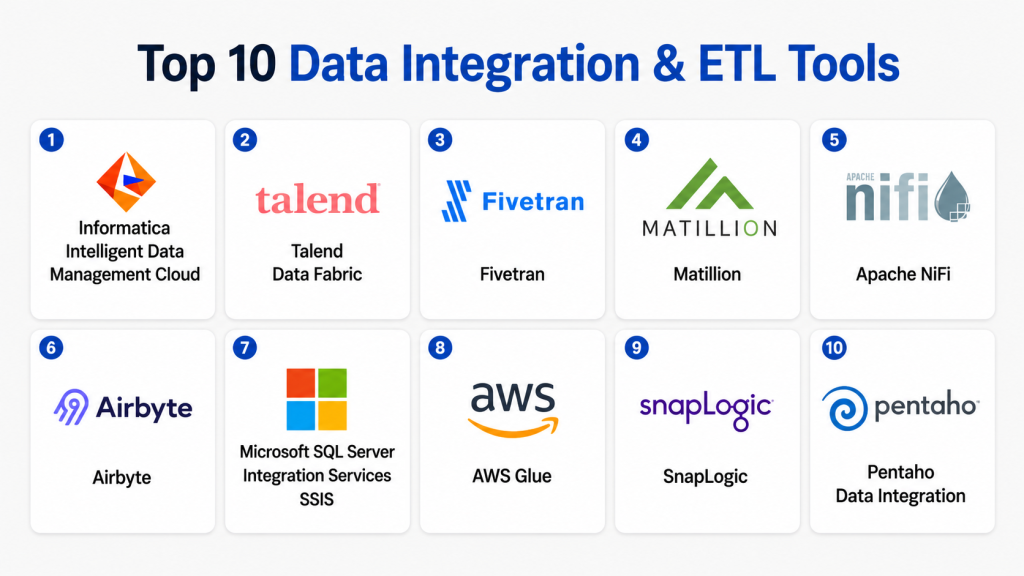
Top 10 Data Integration & ETL Tools
1- Informatica Intelligent Data Management Cloud
Short description: Informatica is one of the most established enterprise-grade data integration platforms. It is widely used by large enterprises for ETL, governance, data quality, master data management, and cloud modernization initiatives.
Key Features
- Extensive enterprise ETL and ELT capabilities
- AI-powered automation using CLAIRE engine
- Data governance and lineage tracking
- Hybrid and multi-cloud integration support
- Large connector ecosystem
- Advanced metadata management
- Enterprise workflow orchestration
Pros
- Extremely mature enterprise platform
- Strong governance and compliance functionality
- Excellent scalability for large workloads
Cons
- Can be expensive for smaller teams
- Steeper learning curve for beginners
- Complex implementation for advanced deployments
Platforms / Deployment
- Web / Windows / Linux
- Cloud / Hybrid / Self-hosted
Security & Compliance
Supports RBAC, encryption, audit logging, SSO/SAML, MFA. Enterprise compliance features available. Additional certifications vary by deployment model.
Integrations & Ecosystem
Informatica integrates with major cloud platforms, enterprise applications, databases, and analytics systems.
- Snowflake
- AWS
- Microsoft Azure
- Google Cloud
- SAP
- Salesforce
Support & Community
Strong enterprise support ecosystem with extensive documentation, training, partner networks, and professional services.
2- Talend Data Fabric
Short description: Talend provides unified data integration, governance, and quality tooling for organizations modernizing analytics and cloud data operations.
Key Features
- Open-source roots with enterprise capabilities
- Visual pipeline designer
- Built-in data quality tools
- Cloud-native integration workflows
- API integration support
- Metadata management
- Batch and streaming pipelines
Pros
- Flexible and extensible architecture
- Good balance of usability and power
- Strong data quality functionality
Cons
- Advanced deployments can become complex
- Some enterprise features require premium licensing
- Performance tuning may require expertise
Platforms / Deployment
- Web / Windows / Linux / macOS
- Cloud / Hybrid / Self-hosted
Security & Compliance
Supports RBAC, encryption, SSO, audit controls, and enterprise governance features.
Integrations & Ecosystem
Talend supports a broad ecosystem of enterprise systems and cloud data services.
- Snowflake
- Databricks
- AWS
- Azure
- Salesforce
- SAP
Support & Community
Large enterprise customer base and active open-source heritage community.
3- Fivetran
Short description: Fivetran is a cloud-native ELT platform focused on automated data movement with minimal maintenance requirements.
Key Features
- Fully managed connectors
- Automated schema evolution
- High-volume cloud data replication
- Prebuilt integrations
- Minimal configuration workflows
- Automatic pipeline maintenance
- Strong warehouse integrations
Pros
- Very easy to operate
- Excellent connector reliability
- Fast cloud warehouse onboarding
Cons
- Less transformation flexibility than code-first tools
- Pricing can increase rapidly with data volume
- Limited customization for advanced workflows
Platforms / Deployment
- Web
- Cloud
Security & Compliance
Supports encryption, RBAC, SSO/SAML, audit logging, and enterprise governance capabilities.
Integrations & Ecosystem
Fivetran focuses heavily on SaaS application and cloud warehouse integrations.
- Snowflake
- BigQuery
- Redshift
- Databricks
- Salesforce
- HubSpot
Support & Community
Strong cloud documentation and onboarding experience with responsive enterprise support.
4- Matillion
Short description: Matillion specializes in cloud-native ETL and ELT workflows optimized for modern cloud data warehouses.
Key Features
- Visual transformation builder
- Cloud warehouse optimization
- Native orchestration workflows
- Prebuilt connectors
- Push-down transformation processing
- Data pipeline scheduling
- Low-code development environment
Pros
- Excellent for cloud-first architectures
- Easy visual workflow creation
- Strong warehouse performance optimization
Cons
- Primarily optimized for cloud ecosystems
- Limited on-premise flexibility
- Advanced customization may require SQL expertise
Platforms / Deployment
- Web / Linux
- Cloud / Hybrid
Security & Compliance
Supports enterprise access controls, encryption, SSO, and audit capabilities.
Integrations & Ecosystem
Matillion integrates closely with major analytics ecosystems.
- Snowflake
- Redshift
- BigQuery
- Azure Synapse
- AWS
- Salesforce
Support & Community
Strong onboarding and training resources with active customer community programs.
5- Apache NiFi
Short description: Apache NiFi is an open-source data flow automation platform designed for real-time and batch data movement.
Key Features
- Visual flow-based programming
- Real-time streaming support
- Extensive processor ecosystem
- Data provenance tracking
- Fine-grained routing logic
- Clustered deployments
- Open-source extensibility
Pros
- Highly flexible architecture
- Excellent real-time flow capabilities
- Strong open-source community
Cons
- UI can become complex at scale
- Enterprise governance may require additional tooling
- Advanced scaling requires operational expertise
Platforms / Deployment
- Windows / Linux / macOS
- Self-hosted / Hybrid
Security & Compliance
Supports encryption, RBAC, LDAP integration, and secure communication protocols.
Integrations & Ecosystem
NiFi supports hundreds of processors and extensible integrations.
- Kafka
- Hadoop
- AWS
- MQTT
- REST APIs
- Databases
Support & Community
Large open-source ecosystem with strong community documentation and enterprise distributions available.
6- Airbyte
Short description: Airbyte is a rapidly growing open-source ELT platform focused on extensibility and modern data stack integrations.
Key Features
- Open-source connector framework
- Large connector marketplace
- Cloud and self-hosted deployment
- Custom connector development
- Incremental sync support
- ELT-focused architecture
- API-driven extensibility
Pros
- Highly extensible platform
- Strong developer-focused flexibility
- Active innovation pace
Cons
- Some connectors vary in maturity
- Enterprise governance features are newer
- Advanced operations may require engineering support
Platforms / Deployment
- Web / Linux / macOS
- Cloud / Self-hosted / Hybrid
Security & Compliance
Supports RBAC, encryption, and enterprise security capabilities in commercial offerings.
Integrations & Ecosystem
Airbyte integrates with modern cloud data stacks and analytics systems.
- Snowflake
- BigQuery
- PostgreSQL
- MongoDB
- Stripe
- Salesforce
Support & Community
Very active open-source community with growing enterprise support offerings.
7- Microsoft SQL Server Integration Services SSIS
Short description: SSIS is Microsoft’s long-established ETL platform for SQL Server and enterprise Windows-based data integration workloads.
Key Features
- SQL Server ecosystem integration
- Visual workflow designer
- Enterprise scheduling support
- Batch ETL automation
- Data transformation engine
- Strong Microsoft ecosystem compatibility
- Legacy modernization support
Pros
- Excellent for Microsoft-centric environments
- Mature enterprise tooling
- Reliable batch processing
Cons
- Less cloud-native than newer platforms
- UI feels dated compared to modern competitors
- Limited flexibility outside Microsoft ecosystem
Platforms / Deployment
- Windows
- Self-hosted / Hybrid
Security & Compliance
Supports Active Directory integration, RBAC, encryption, and enterprise access management.
Integrations & Ecosystem
Deep integration with Microsoft enterprise products and databases.
- SQL Server
- Azure
- Power BI
- Dynamics 365
- Oracle
- SAP
Support & Community
Large enterprise user base and extensive Microsoft documentation ecosystem.
8- AWS Glue
Short description: AWS Glue is Amazon’s serverless ETL and data integration service built for cloud-native analytics environments.
Key Features
- Serverless ETL execution
- Automatic schema discovery
- Data catalog integration
- Apache Spark-based processing
- Workflow orchestration
- Native AWS ecosystem support
- Streaming ETL capabilities
Pros
- Strong scalability
- Tight AWS integration
- Reduced infrastructure management
Cons
- Best suited for AWS-centric environments
- Pricing complexity for large workloads
- Debugging can be challenging
Platforms / Deployment
- Web
- Cloud
Security & Compliance
Supports IAM, encryption, audit logging, VPC integration, and enterprise-grade AWS security controls.
Integrations & Ecosystem
Deeply integrated into AWS analytics and storage services.
- S3
- Redshift
- Athena
- Lambda
- DynamoDB
- Kinesis
Support & Community
Strong enterprise documentation backed by AWS support ecosystem.
9- SnapLogic
Short description: SnapLogic is an AI-powered integration platform designed for application integration, ETL, and workflow automation.
Key Features
- AI-assisted pipeline creation
- Visual low-code interface
- Application and data integration
- Real-time integration support
- API management capabilities
- Workflow automation
- Cloud-native architecture
Pros
- Strong low-code usability
- Broad enterprise integration support
- AI-driven workflow acceleration
Cons
- Enterprise pricing can be high
- Advanced customization may require scripting
- Some complex pipelines may impact usability
Platforms / Deployment
- Web
- Cloud / Hybrid
Security & Compliance
Supports encryption, RBAC, SSO, MFA, and enterprise governance controls.
Integrations & Ecosystem
SnapLogic supports enterprise SaaS, APIs, and cloud integrations.
- Salesforce
- SAP
- Oracle
- AWS
- Azure
- ServiceNow
Support & Community
Enterprise-focused support with onboarding and training services.
10- Pentaho Data Integration
Short description: Pentaho Data Integration is a long-standing ETL platform known for flexible workflows and strong open-source heritage.
Key Features
- Drag-and-drop pipeline designer
- ETL and analytics integration
- Big data processing support
- Batch workflow orchestration
- Metadata-driven architecture
- Extensible plugin framework
- Hybrid deployment support
Pros
- Flexible architecture
- Strong legacy integration support
- Good balance between ETL and analytics
Cons
- UI appears less modern
- Enterprise support varies by deployment
- Advanced tuning may require expertise
Platforms / Deployment
- Windows / Linux / macOS
- Self-hosted / Hybrid
Security & Compliance
Supports enterprise authentication and encryption capabilities. Additional compliance details vary.
Integrations & Ecosystem
Pentaho integrates with traditional enterprise systems and big data ecosystems.
- Hadoop
- Oracle
- SQL Server
- AWS
- MongoDB
- SAP
Support & Community
Strong historical community presence with enterprise support options available.
Comparison Table
| Tool Name | Best For | Platform(s) Supported | Deployment | Standout Feature | Public Rating |
|---|---|---|---|---|---|
| Informatica | Large enterprises | Web, Windows, Linux | Cloud, Hybrid, Self-hosted | Enterprise governance | N/A |
| Talend | Hybrid cloud integration | Web, Windows, Linux | Cloud, Hybrid | Data quality tooling | N/A |
| Fivetran | Cloud ELT automation | Web | Cloud | Fully managed connectors | N/A |
| Matillion | Cloud warehouses | Web, Linux | Cloud, Hybrid | Push-down transformations | N/A |
| Apache NiFi | Real-time data flow | Windows, Linux, macOS | Self-hosted, Hybrid | Flow-based automation | N/A |
| Airbyte | Modern ELT stacks | Web, Linux, macOS | Cloud, Hybrid | Open-source extensibility | N/A |
| SSIS | Microsoft ecosystems | Windows | Self-hosted, Hybrid | SQL Server integration | N/A |
| AWS Glue | AWS analytics pipelines | Web | Cloud | Serverless ETL | N/A |
| SnapLogic | Low-code enterprise integration | Web | Cloud, Hybrid | AI-assisted pipelines | N/A |
| Pentaho | Hybrid ETL environments | Windows, Linux, macOS | Self-hosted, Hybrid | Flexible ETL architecture | N/A |
Evaluation & Scoring of Data Integration & ETL Tools
| Tool Name | Core 25% | Ease 15% | Integrations 15% | Security 10% | Performance 10% | Support 10% | Value 15% | Weighted Total |
|---|---|---|---|---|---|---|---|---|
| Informatica | 9.5 | 7.5 | 9.5 | 9 | 9 | 9 | 7 | 8.7 |
| Talend | 8.5 | 8 | 8.5 | 8.5 | 8 | 8 | 8 | 8.2 |
| Fivetran | 8 | 9.5 | 8.5 | 8.5 | 8.5 | 8 | 7 | 8.2 |
| Matillion | 8 | 8.5 | 8 | 8 | 8.5 | 8 | 8 | 8.1 |
| Apache NiFi | 8.5 | 6.5 | 8 | 8 | 8.5 | 7.5 | 9 | 8.0 |
| Airbyte | 8 | 8 | 8.5 | 7.5 | 7.5 | 7.5 | 9 | 8.0 |
| SSIS | 7.5 | 7.5 | 7.5 | 8 | 8 | 8 | 8.5 | 7.8 |
| AWS Glue | 8 | 7.5 | 8 | 8.5 | 8.5 | 8 | 7.5 | 8.0 |
| SnapLogic | 8.5 | 8.5 | 8.5 | 8.5 | 8 | 8 | 7 | 8.2 |
| Pentaho | 7.5 | 7 | 7.5 | 7.5 | 7.5 | 7 | 8.5 | 7.5 |
These scores are comparative rather than absolute. Enterprise-focused platforms typically score higher in governance and scalability, while open-source tools often provide stronger flexibility and value. Organizations should prioritize criteria based on their operational needs, internal skill levels, and long-term architecture strategy. A tool with the highest overall score may not always be the best fit for a specific deployment model or budget.
Which Data Integration & ETL Tool Is Right for You?
Solo / Freelancer
Airbyte and Apache NiFi are attractive for developers and smaller technical teams needing flexibility without massive licensing costs. Open-source ecosystems can reduce expenses while providing customization freedom.
SMB
Fivetran and Matillion work well for SMBs that want faster deployment with minimal operational overhead. These platforms simplify integration management and reduce engineering complexity.
Mid-Market
Talend and SnapLogic offer a balanced mix of governance, usability, and scalability for growing organizations handling hybrid cloud environments and expanding analytics workloads.
Enterprise
Informatica and AWS Glue are strong enterprise choices for large-scale governance, compliance, complex integrations, and cloud modernization initiatives.
Budget vs Premium
Open-source platforms such as Airbyte and Apache NiFi offer strong value for technical teams. Premium enterprise platforms provide broader governance, support, and operational automation.
Feature Depth vs Ease of Use
Fivetran emphasizes simplicity and automation, while Informatica prioritizes enterprise depth and advanced governance functionality. Buyers should balance operational simplicity against customization needs.
Integrations & Scalability
Organizations with large SaaS ecosystems should prioritize connector reliability and API extensibility. Enterprises handling massive workloads should evaluate distributed processing and orchestration capabilities.
Security & Compliance Needs
Highly regulated industries should prioritize platforms offering audit logs, RBAC, encryption, SSO, and governance workflows. Healthcare and financial services environments often require deeper compliance capabilities.
Frequently Asked Questions FAQs
1. What is the difference between ETL and ELT?
ETL transforms data before loading it into a destination system, while ELT loads raw data first and performs transformations inside the warehouse. Modern cloud platforms increasingly favor ELT architectures because cloud warehouses can scale processing efficiently.
2. Are cloud-native ETL tools better than self-hosted platforms?
Cloud-native tools simplify operations and scalability, but self-hosted platforms may provide better control, customization, or regulatory alignment. The best option depends on security, compliance, and operational requirements.
3. Which ETL tools are best for real-time data processing?
Apache NiFi, AWS Glue, and SnapLogic offer strong support for streaming and real-time workflows. Organizations handling IoT, operational analytics, or event-driven systems often prioritize these capabilities.
4. Do ETL tools require coding skills?
Many modern tools provide low-code or no-code interfaces. However, advanced transformations, custom integrations, and performance optimization still often require SQL, Python, or scripting knowledge.
5. How important are connectors in an ETL platform?
Connector quality directly affects reliability and maintenance overhead. Strong connector ecosystems reduce custom integration work and simplify onboarding for SaaS and cloud applications.
6. What are the biggest ETL implementation mistakes?
Common mistakes include underestimating data quality issues, ignoring governance planning, overcomplicating pipelines, and failing to monitor operational performance after deployment.
7. Can open-source ETL tools scale for enterprise workloads?
Yes, many open-source platforms support enterprise-scale deployments. However, organizations may need additional operational expertise, governance tooling, and infrastructure management capabilities.
8. How should buyers evaluate ETL pricing?
Pricing models vary widely based on connectors, data volume, compute usage, users, or workflow executions. Buyers should model future scaling costs instead of focusing only on entry-level pricing.
9. Are ETL tools important for AI and machine learning projects?
Absolutely. AI systems depend heavily on reliable, high-quality, continuously updated data pipelines. ETL and ELT tools help maintain consistency across analytics and machine learning workflows.
10. How difficult is it to migrate from one ETL platform to another?
Migration complexity depends on workflow size, custom logic, connectors, and transformation depth. Organizations should document dependencies carefully and validate integrations before switching platforms.
Conclusion
Data Integration & ETL Tools have evolved far beyond traditional batch data movement systems. Modern platforms now support cloud-native ELT workflows, AI-assisted automation, streaming pipelines, governance, observability, and large-scale analytics integration. As organizations continue modernizing data architectures, choosing the right platform becomes increasingly important for operational efficiency, analytics accuracy, and long-term scalability. There is no universal best solution for every organization. Enterprises with strict governance requirements may prefer Informatica or Talend, while cloud-first teams may lean toward Fivetran, Matillion, or AWS Glue. Open-source platforms like Airbyte and Apache NiFi remain highly attractive for flexible engineering-driven deployments. The best next step is to shortlist two or three platforms, run a pilot using real workloads, validate connector reliability and security controls, and evaluate operational complexity before scaling organization-wide.

Find Trusted Cardiac Hospitals
Compare heart hospitals by city and services — all in one place.
Explore Hospitals
Data integration and ETL tools are most valuable when they help organizations collect, transform, synchronize, and deliver data across diverse business systems and data environments. By providing data extraction, transformation workflows, data loading, pipeline orchestration, connectors, data mapping, scheduling, monitoring, error handling, data quality controls, and integration with databases, cloud platforms, data warehouses, and business applications, these tools enable organizations to automate data movement, reduce manual integration work, improve data consistency, support scalable analytics, and create more reliable data pipelines.