Introduction
Stream Processing Frameworks help organizations process and analyze continuously flowing data streams in real time. Unlike traditional batch processing systems that analyze stored datasets periodically, stream processing frameworks enable applications to ingest, transform, enrich, and react to events instantly as data is generated. As enterprises continue investing in AI systems, IoT infrastructure, real-time analytics, event-driven architectures, and cloud-native modernization, stream processing has become a foundational technology for modern digital operations. Businesses now require low-latency processing for fraud detection, observability, customer personalization, cybersecurity monitoring, and operational automation. Modern stream processing frameworks combine distributed computing, event-time processing, fault tolerance, AI integrations, and scalable cloud-native architectures to support high-throughput streaming environments.
Common Real-world use cases include:
- Fraud detection and transaction monitoring
- Real-time observability and infrastructure analytics
- IoT telemetry and sensor processing
- AI feature engineering pipelines
- Customer activity and personalization workflows
Key Evaluation criteria buyers should consider:
- Streaming throughput and latency performance
- Fault tolerance and reliability
- Stateful processing capabilities
- Event-time processing support
- Scalability across distributed environments
- Cloud-native deployment flexibility
- Security and governance capabilities
- Integration ecosystem breadth
- Operational observability and monitoring
- Developer experience and APIs
Best for: Enterprises, fintech companies, SaaS providers, telecommunications firms, logistics organizations, AI platforms, gaming companies, and cloud-native engineering teams requiring low-latency distributed processing.
Not ideal for: Small businesses with lightweight reporting needs or organizations operating mostly on periodic batch-processing workflows.
Key Trends in Stream Processing Frameworks
- AI-assisted stream processing optimization is becoming more common.
- Unified batch and streaming architectures continue gaining adoption.
- Stateful stream processing capabilities are improving significantly.
- Cloud-native serverless stream processing is expanding rapidly.
- Event-driven architectures are replacing tightly coupled systems.
- Edge stream processing adoption is growing for IoT environments.
- Governance and observability integrations are becoming standard expectations.
- Real-time feature engineering for AI pipelines is increasing rapidly.
- Multi-cloud deployment flexibility is becoming an enterprise requirement.
- Open-source ecosystems continue dominating innovation in stream processing.
How We Selected These Tools Methodology
The tools in this list were evaluated using the following methodology:
- Enterprise adoption and community mindshare
- Streaming scalability and low-latency performance
- Reliability and fault tolerance capabilities
- Stateful processing and event-time support
- Security and governance readiness
- Integration ecosystem maturity
- Cloud-native and hybrid deployment flexibility
- Operational observability support
- Customer fit across SMB, mid-market, and enterprise segments
- Documentation, support, and community strength
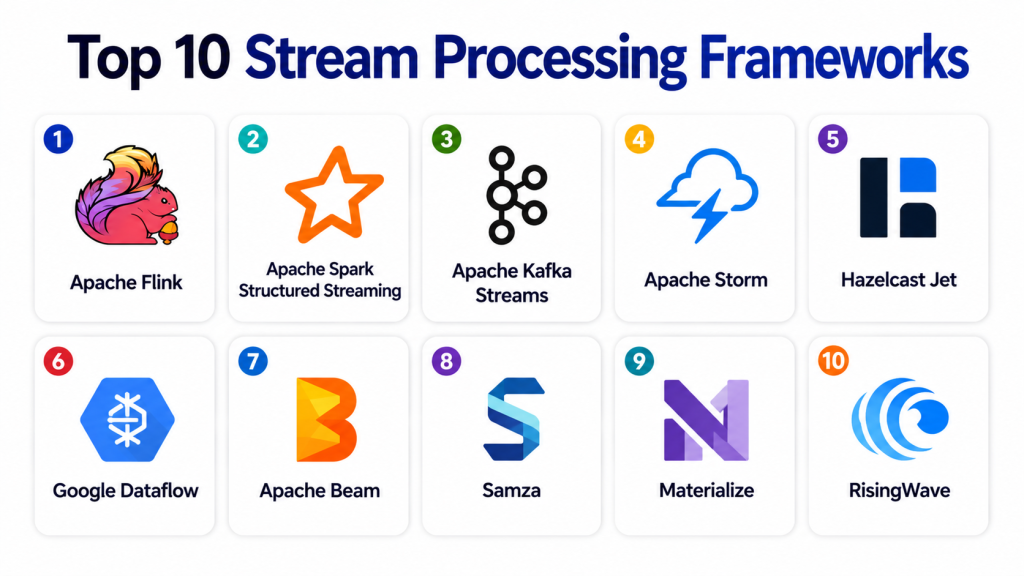
Top 10 Stream Processing Frameworks
1 — Apache Flink
Short description: Apache Flink is one of the most advanced distributed stream processing frameworks for large-scale low-latency analytics and event-driven architectures.
Key Features
- Stateful stream processing
- Event-time processing support
- Fault-tolerant distributed execution
- Low-latency analytics
- Batch and stream unification
- Real-time windowing
- Horizontal scalability
Pros
- Excellent real-time performance
- Strong scalability for distributed workloads
- Advanced state management capabilities
Cons
- Requires engineering expertise
- Operational complexity at scale
- Steeper learning curve for beginners
Platforms / Deployment
- Linux / Windows / macOS
- Cloud / Self-hosted / Hybrid
Security & Compliance
Supports authentication, encryption, RBAC integrations, and secure communication workflows.
Integrations & Ecosystem
Flink integrates broadly across modern analytics and streaming ecosystems.
- Kafka
- Kubernetes
- Hadoop
- Snowflake
- Elasticsearch
- Spark
Support & Community
Large open-source ecosystem with strong enterprise adoption and active contributors.
2 — Apache Spark Structured Streaming
Short description: Apache Spark Structured Streaming provides scalable real-time stream processing integrated into the broader Spark analytics ecosystem.
Key Features
- Unified batch and streaming workflows
- Micro-batch stream processing
- SQL-based streaming support
- Distributed analytics
- Machine learning integrations
- Cloud-native scalability
- Structured APIs
Pros
- Excellent analytics ecosystem integration
- Strong developer familiarity
- Broad enterprise adoption
Cons
- Higher latency than some native streaming engines
- Resource-intensive workloads
- Advanced optimization may require expertise
Platforms / Deployment
- Linux / Windows / macOS
- Cloud / Self-hosted / Hybrid
Security & Compliance
Supports authentication, encryption, RBAC integrations, and secure deployment workflows.
Integrations & Ecosystem
Spark integrates deeply with analytics engineering ecosystems.
- Databricks
- Kafka
- Hadoop
- Delta Lake
- Snowflake
- Kubernetes
Support & Community
Massive global open-source ecosystem with enterprise vendor support.
3 — Apache Kafka Streams
Short description: Kafka Streams is a lightweight Java stream processing library designed for real-time event-driven processing within Kafka ecosystems.
Key Features
- Native Kafka integration
- Stateful stream processing
- Event-time support
- Lightweight deployment
- Real-time aggregations
- Distributed processing
- Stream-table joins
Pros
- Simplified Kafka-native development
- Low operational overhead
- Strong event-driven architecture support
Cons
- Java-focused development model
- Smaller ecosystem than Flink or Spark
- Limited non-Kafka interoperability
Platforms / Deployment
- Linux / Windows / macOS
- Cloud / Self-hosted / Hybrid
Security & Compliance
Supports encryption, authentication, RBAC integrations, and secure communication protocols.
Integrations & Ecosystem
Kafka Streams integrates tightly with Kafka-centric architectures.
- Apache Kafka
- Confluent
- Kubernetes
- Spring Boot
- Elasticsearch
- Prometheus
Support & Community
Strong open-source ecosystem driven by Kafka community adoption.
4 — Apache Storm
Short description: Apache Storm is a distributed real-time computation framework designed for low-latency event processing and analytics.
Key Features
- Real-time event processing
- Distributed architecture
- Fault-tolerant execution
- Scalable topology management
- Multi-language support
- Streaming analytics
- Operational monitoring
Pros
- Very low-latency processing
- Flexible distributed architecture
- Mature open-source ecosystem
Cons
- Smaller adoption compared to Flink and Spark
- Complex operational management
- Limited modern ecosystem momentum
Platforms / Deployment
- Linux / Windows
- Self-hosted / Hybrid
Security & Compliance
Supports authentication, encryption, and secure deployment configurations.
Integrations & Ecosystem
Storm integrates with analytics and messaging ecosystems.
- Kafka
- Hadoop
- Zookeeper
- Elasticsearch
- HBase
- Prometheus
Support & Community
Established open-source ecosystem with moderate enterprise adoption.
5 — Hazelcast Jet
Short description: Hazelcast Jet is a distributed stream and batch processing engine optimized for low-latency event processing and operational simplicity.
Key Features
- Distributed stream processing
- In-memory execution
- Event-time processing
- Batch and streaming support
- Real-time analytics
- Lightweight deployment
- Cloud-native compatibility
Pros
- Good low-latency performance
- Simplified deployment workflows
- Unified stream and batch processing
Cons
- Smaller ecosystem than major frameworks
- Enterprise adoption still growing
- Limited third-party integrations
Platforms / Deployment
- Linux / Windows / macOS
- Cloud / Self-hosted / Hybrid
Security & Compliance
Supports encryption, authentication, RBAC integrations, and secure deployment workflows.
Integrations & Ecosystem
Hazelcast Jet integrates with distributed analytics ecosystems.
- Kafka
- Kubernetes
- JDBC
- Hadoop
- Elasticsearch
- Hazelcast IMDG
Support & Community
Growing developer ecosystem with commercial enterprise support available.
6 — Google Dataflow
Short description: Google Dataflow is a fully managed stream and batch processing platform built on Apache Beam for cloud-native analytics environments.
Key Features
- Fully managed infrastructure
- Unified batch and streaming processing
- Auto-scaling capabilities
- Serverless deployment
- Real-time analytics
- AI and ML integrations
- Apache Beam compatibility
Pros
- Excellent operational simplicity
- Strong cloud-native scalability
- Fully managed infrastructure
Cons
- Best optimized for Google Cloud
- Pricing complexity at scale
- Multi-cloud flexibility limited
Platforms / Deployment
- Web
- Cloud
Security & Compliance
Supports MFA, RBAC, encryption, SSO, and governance controls.
Integrations & Ecosystem
Dataflow integrates strongly with Google Cloud ecosystems.
- BigQuery
- Pub/Sub
- Vertex AI
- Kubernetes
- Looker
- Dataform
Support & Community
Strong cloud-native ecosystem with enterprise documentation and support.
7 — Apache Beam
Short description: Apache Beam provides a unified programming model for defining both batch and stream processing pipelines across multiple execution engines.
Key Features
- Unified programming model
- Portable execution architecture
- Batch and stream processing
- Windowing and event-time support
- Multi-engine compatibility
- Scalable distributed execution
- SDK flexibility
Pros
- Strong portability across engines
- Flexible execution model
- Good ecosystem interoperability
Cons
- Requires engineering expertise
- Operational complexity depends on execution engine
- Smaller direct enterprise adoption
Platforms / Deployment
- Linux / Windows / macOS
- Cloud / Self-hosted / Hybrid
Security & Compliance
Supports secure deployment configurations depending on execution environment.
Integrations & Ecosystem
Beam integrates with distributed analytics ecosystems.
- Flink
- Spark
- Dataflow
- Kafka
- BigQuery
- Kubernetes
Support & Community
Strong open-source contributor ecosystem with growing adoption.
8 — Samza
Short description: Apache Samza is a distributed stream processing framework optimized for stateful processing and Kafka-based architectures.
Key Features
- Stateful stream processing
- Kafka-native integration
- Distributed execution
- Fault-tolerant architecture
- Event-driven processing
- Local state management
- Scalable workloads
Pros
- Strong Kafka ecosystem compatibility
- Good stateful processing support
- Reliable distributed execution
Cons
- Smaller ecosystem compared to Flink
- Limited broader enterprise adoption
- Requires operational expertise
Platforms / Deployment
- Linux
- Self-hosted / Hybrid
Security & Compliance
Supports secure deployment configurations and authentication integrations.
Integrations & Ecosystem
Samza integrates with distributed messaging and analytics systems.
- Kafka
- Hadoop
- YARN
- Kubernetes
- HDFS
- Elasticsearch
Support & Community
Smaller but active open-source ecosystem.
9 — Materialize
Short description: Materialize is a streaming SQL database designed for low-latency real-time analytics and continuously updated data views.
Key Features
- Real-time SQL processing
- Incremental computation
- Streaming materialized views
- Low-latency analytics
- Kafka-native architecture
- Cloud-native scalability
- Event-driven workflows
Pros
- Strong developer experience
- Efficient incremental updates
- Excellent real-time SQL capabilities
Cons
- Smaller ecosystem compared to major frameworks
- Enterprise adoption still maturing
- Advanced tuning may require expertise
Platforms / Deployment
- Linux / macOS
- Cloud / Self-hosted
Security & Compliance
Supports authentication, RBAC integrations, and encrypted communication workflows.
Integrations & Ecosystem
Materialize integrates with modern streaming architectures.
- Kafka
- PostgreSQL
- dbt
- Redpanda
- Debezium
- Kubernetes
Support & Community
Growing developer-focused ecosystem with increasing cloud-native adoption.
10 — RisingWave
Short description: RisingWave is a cloud-native stream processing database focused on SQL-based streaming analytics and operational simplicity.
Key Features
- Streaming SQL engine
- Cloud-native architecture
- Stateful stream processing
- Materialized views
- Real-time analytics
- Distributed execution
- Kafka integrations
Pros
- Simplified SQL-based workflows
- Strong cloud-native architecture
- Good developer usability
Cons
- Smaller ecosystem than mature frameworks
- Enterprise adoption still emerging
- Limited large-scale production maturity
Platforms / Deployment
- Linux
- Cloud / Self-hosted / Hybrid
Security & Compliance
Supports secure deployment configurations and encrypted communication workflows.
Integrations & Ecosystem
RisingWave integrates with modern analytics ecosystems.
- Kafka
- PostgreSQL
- Kubernetes
- Debezium
- Grafana
- Prometheus
Support & Community
Growing open-source ecosystem with active developer community.
Comparison Table
| Tool Name | Best For | Platform(s) Supported | Deployment | Standout Feature | Public Rating |
|---|---|---|---|---|---|
| Apache Flink | Low-latency enterprise streaming | Linux, Windows, macOS | Hybrid | Advanced stateful processing | N/A |
| Apache Spark Structured Streaming | Unified analytics pipelines | Linux, Windows, macOS | Hybrid | Unified batch and streaming | N/A |
| Apache Kafka Streams | Kafka-native stream processing | Linux, Windows, macOS | Hybrid | Lightweight Kafka integration | N/A |
| Apache Storm | Real-time event computation | Linux, Windows | Self-hosted | Very low-latency execution | N/A |
| Hazelcast Jet | Lightweight distributed processing | Linux, Windows, macOS | Hybrid | In-memory stream execution | N/A |
| Google Dataflow | Managed cloud stream processing | Web | Cloud | Serverless streaming infrastructure | N/A |
| Apache Beam | Portable processing pipelines | Linux, Windows, macOS | Hybrid | Multi-engine portability | N/A |
| Samza | Stateful Kafka processing | Linux | Hybrid | Kafka-native distributed processing | N/A |
| Materialize | Real-time SQL streaming | Linux, macOS | Cloud, Self-hosted | Incremental streaming SQL | N/A |
| RisingWave | SQL-based stream analytics | Linux | Hybrid | Streaming materialized views | N/A |
Evaluation & Scoring of Stream Processing Frameworks
| Tool Name | Core 25% | Ease 15% | Integrations 15% | Security 10% | Performance 10% | Support 10% | Value 15% | Weighted Total |
|---|---|---|---|---|---|---|---|---|
| Apache Flink | 9.5 | 6.5 | 9 | 8 | 9.5 | 8.5 | 9 | 8.7 |
| Apache Spark Structured Streaming | 9 | 7.5 | 9.5 | 8 | 8.5 | 9 | 8.5 | 8.7 |
| Apache Kafka Streams | 8.5 | 8 | 8.5 | 8 | 8.5 | 8 | 9 | 8.4 |
| Apache Storm | 8 | 6.5 | 7.5 | 7.5 | 9 | 7.5 | 8.5 | 7.9 |
| Hazelcast Jet | 8 | 8 | 7.5 | 7.5 | 8.5 | 7.5 | 8 | 7.9 |
| Google Dataflow | 8.5 | 8.5 | 8 | 8.5 | 8.5 | 8 | 7.5 | 8.2 |
| Apache Beam | 8 | 7 | 8.5 | 7.5 | 8 | 8 | 9 | 8.0 |
| Samza | 7.5 | 6.5 | 7.5 | 7.5 | 8.5 | 7 | 8.5 | 7.7 |
| Materialize | 8 | 8 | 7.5 | 7.5 | 8.5 | 7.5 | 8 | 7.9 |
| RisingWave | 7.5 | 8 | 7 | 7 | 8 | 7 | 8 | 7.5 |
These scores are comparative evaluations intended to help buyers understand relative strengths across streaming capabilities, scalability, integrations, operational simplicity, and value. Enterprise-focused frameworks generally score higher in reliability and ecosystem maturity, while newer cloud-native platforms often provide stronger usability and operational simplicity. Buyers should prioritize categories aligned with workload complexity, cloud strategy, and engineering expertise.
Which Stream Processing Framework Is Right for You?
Solo / Freelancer
Materialize and RisingWave are attractive for developers seeking SQL-driven real-time analytics with simpler operational requirements.
SMB
Google Dataflow and Kafka Streams provide manageable deployment complexity and strong integration capabilities for growing organizations.
Mid-Market
Spark Structured Streaming and Hazelcast Jet balance operational scalability, ecosystem support, and usability for expanding engineering teams.
Enterprise
Apache Flink and Spark Structured Streaming are better suited for large-scale enterprise stream processing and AI-driven operational workloads.
Budget vs Premium
Open-source frameworks reduce licensing costs but often require stronger engineering expertise. Managed cloud-native services simplify operations while increasing recurring infrastructure expenses.
Feature Depth vs Ease of Use
Materialize and RisingWave emphasize usability and SQL-driven workflows, while Flink and Beam prioritize advanced distributed processing flexibility.
Integrations & Scalability
Organizations operating distributed analytics ecosystems should prioritize API compatibility, cloud-native scalability, and observability integrations.
Security & Compliance Needs
Highly regulated industries should prioritize encryption, RBAC integrations, audit logging, governance workflows, and secure deployment architectures.
Frequently Asked Questions FAQs
1. What are Stream Processing Frameworks?
Stream processing frameworks continuously process and analyze flowing data streams in real time instead of relying on periodic batch processing.
2. Why are stream processing frameworks important today?
Modern digital systems require immediate insights for fraud detection, AI pipelines, operational monitoring, and customer personalization workflows.
3. What is the difference between batch processing and stream processing?
Batch processing analyzes stored data periodically, while stream processing continuously analyzes data instantly as events occur.
4. Are open-source stream processing frameworks suitable for enterprises?
Yes. Apache Flink and Spark Structured Streaming are widely used in enterprise environments, though they often require strong engineering and operational expertise.
5. Which industries benefit most from stream processing?
Financial services, telecommunications, gaming, SaaS, IoT, healthcare, logistics, and AI-intensive organizations benefit significantly from stream processing.
6. How do AI-powered streaming systems improve operations?
AI-assisted streaming systems improve anomaly detection, predictive analytics, operational automation, and real-time decision-making workflows.
7. What are common stream processing implementation mistakes?
Common mistakes include underestimating infrastructure complexity, weak observability planning, poor schema governance, and incomplete fault-tolerance strategies.
8. Do stream processing frameworks support cloud-native deployments?
Most modern stream processing frameworks support cloud-native, hybrid, and distributed deployment architectures.
9. Can stream processing frameworks integrate with analytics platforms?
Yes. Modern frameworks integrate with Kafka, Snowflake, Databricks, Elasticsearch, Kubernetes, Power BI, and cloud-native analytics ecosystems.
10. How should organizations evaluate pricing?
Organizations should evaluate infrastructure complexity, engineering overhead, managed service costs, scalability requirements, and operational maintenance expenses before selecting a framework.
Conclusion
Stream Processing Frameworks have become foundational infrastructure for organizations operating modern AI-driven, event-centric, and cloud-native environments. As enterprises continue expanding real-time analytics, operational automation, IoT architectures, and streaming AI workloads, stream processing frameworks now play a critical role in enabling scalable, low-latency, and continuously responsive digital systems. The best framework depends heavily on organizational scale, engineering expertise, cloud strategy, and operational complexity. Enterprises may prioritize Apache Flink or Spark Structured Streaming for large-scale distributed processing, while developer-focused teams may prefer Materialize or RisingWave for SQL-centric streaming workflows. The smartest next step is to shortlist two or three frameworks, validate integrations with existing analytics and streaming ecosystems, run pilot workloads using production-like data streams, and then scale gradually across operational environments.

Find Trusted Cardiac Hospitals
Compare heart hospitals by city and services — all in one place.
Explore Hospitals
This article clearly explains how stream processing frameworks help handle real-time data efficiently and makes it easier to understand their role in modern data-driven applications.