Introduction
Lead generation platforms are software tools designed to help organizations attract, capture, track, and qualify potential customers or “leads” across digital channels. These platforms are built to automate and scale top‑of‑funnel activities, turning website visitors, content engagements, events, and social interactions into actionable leads for sales and marketing teams. lead generation tools matter more than ever as companies seek to optimize digital engagement in a world where first‑party data, AI‑driven personalization, and frictionless customer experiences are critical. With rising competition and the increasing cost of acquiring customers, the ability to generate high‑quality leads efficiently has become a strategic differentiator for businesses of all sizes.
Real‑world use cases include:
- Capturing leads via optimized web forms, chatbots, and landing pages.
- Enriching and qualifying leads through automated scoring and B2B intent data.
- Tracking multi‑channel campaigns from social ads to search to email.
- Segmenting audiences for targeted nurture campaigns.
- Routing qualified leads to sales teams based on scoring thresholds and rules.
What buyers should evaluate: lead capture flexibility, qualification and scoring, integration capabilities (CRM and automation), analytics depth, scalability, security & compliance, ease of use, support, and cost/value.
Best for: Digital marketers, demand generation specialists, sales ops, and growth teams in SMBs, mid‑market, and enterprise environments looking to automate and optimize top‑of‑funnel activities.
Not ideal for: Organizations with minimal online presence, extremely niche markets with non‑digital lead behaviors, or teams that rely solely on direct sales/outbound calling without digital engagement channels.
Key Trends in Lead Generation Platforms
- AI‑enhanced lead scoring and qualification: Machine learning models prioritize leads based on behavior, propensity to convert, and historical outcomes.
- Conversational engagement: Chatbots, virtual assistants, and on‑site messaging engage prospects in real time, reducing friction and improving conversion rates.
- First‑party data strategies: With cookie deprecation and privacy changes, tools emphasize capturing and activating first‑party user data.
- Omnichannel capture: Support for form capture, social lead ads, landing pages, webinars, chat, SMS, and interactive content.
- Predictive analytics: Predictive insights help predict which leads are most likely to convert or become high‑value customers.
- CRM and ecosystem integration: Tighter integration with CRM, marketing automation, analytics, and data platforms to ensure seamless workflows.
- Privacy & compliance automation: Built‑in support for GDPR, CCPA, and evolving privacy laws to manage consent and data processing.
- Mobile optimization: Lead capture and nurture workflows designed for mobile experiences, including progressive profiling and push notifications.
- Real‑time routing: Automated lead routing to the right sales rep based on territory, score, or intent signals.
- Self‑serve automation: Low/no‑code automation workflows for marketers without developer dependency.
How We Selected These Tools (Methodology)
We evaluated lead generation platforms through a comprehensive lens of capabilities important in 2026 and beyond:
- Market adoption / mindshare: Widespread use or recognition among digital marketing and sales teams.
- Feature completeness: Ability to capture, score, qualify, nurture, and route leads across multiple channels.
- Reliability / performance: Platform performance consistency, uptime stability, and responsiveness under load.
- Security posture signals: Evidence of encryption, role‑based controls, identity access, and privacy compliance emphasis.
- Integrations / ecosystem: Quality and depth of connections with CRM, analytics, email, and automation tools.
- Customer fit across segments: Practical functionality for SMBs, mid‑market teams, and enterprises with diverse requirements.
- Innovation in AI & automation: Incorporation of AI‑based scoring, predictive analytics, and conversational automation.
- Support & community: Presence of onboarding resources, documentation depth, and customer support channels.
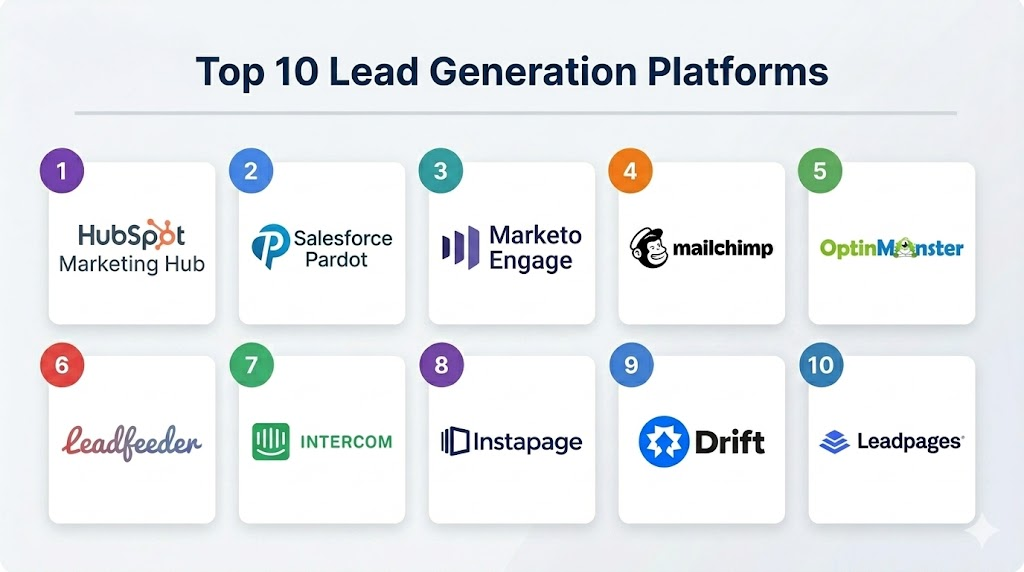
Top 10 Lead Generation Platforms
1‑ HubSpot Marketing Hub
Short description: A comprehensive inbound marketing and lead generation platform that integrates capture, automation, and analytics for growth teams.
Key Features
- Drag‑and‑drop landing page and form builder
- Smart forms with conditional logic
- Lead scoring and lifecycle stages
- Email automation and nurture workflows
- Built‑in analytics and dashboards
Pros
- All‑in‑one platform reducing tool fragmentation
- Strong native CRM integration
Cons
- More advanced features require higher pricing tiers
- Can be overwhelming for very small teams
Platforms / Deployment
- Web
- Cloud
Security & Compliance
Not publicly stated
Integrations & Ecosystem
HubSpot offers a broad ecosystem that synchronizes lead data with CRM, email, ads, and content tools.
- CRM modules
- Email and automation
- Analytics and reporting
- Third‑party connectors
Support & Community
Extensive knowledge base, certification training, onboarding assistance, and robust community.
2‑ Salesforce Pardot
Short description: A B2B marketing automation and lead generation solution tailored for complex enterprise sales workflows.
Key Features
- Lead capture forms and landing pages
- B2B lead scoring and grading
- Engagement studio automation
- Campaign ROI analytics
- Alignment with sales pipeline reporting
Pros
- Deep CRM integration with Salesforce CRM
- Powerful scoring and automation for complex buyer journeys
Cons
- Higher cost and complex setup
- Best suited for Salesforce‑centric stacks
Platforms / Deployment
- Web
- Cloud
Security & Compliance
Not publicly stated
Integrations & Ecosystem
Seamless integration with Salesforce CRM, forecasting, and analytics.
- CRM (Salesforce)
- Email and automation
- Data enrichment partners
Support & Community
Salesforce Trailhead resources, professional services, and enterprise support tiers.
3‑ Marketo Engage
Short description: An advanced marketing automation platform with powerful lead management, scoring, segmentation, and cross‑channel nurture capabilities.
Key Features
- Lead capture and routing workflows
- Predictive scoring and adaptive campaigns
- Cross‑channel email, landing pages, and forms
- Behavioral tracking and segmentation
- Revenue cycle analytics
Pros
- Enterprise‑grade automation and personalization
- Scalable for multi‑region and enterprise use
Cons
- Requires technical expertise to configure advanced workflows
- Higher learning curve
Platforms / Deployment
- Web
- Cloud
Security & Compliance
Not publicly stated
Integrations & Ecosystem
Deep integrations with CRM and analytics stacks.
- CRM systems
- Data platforms
- Third‑party enrichment
Support & Community
Documentation, enterprise support plans, and user community.
4‑ Mailchimp
Short description: A versatile marketing platform that supports lead capture, email automation, and segmentation suitable for SMBs and growing teams.
Key Features
- Subscription forms and pop‑ups
- Audience segmentation
- Automated email nurture workflows
- Basic lead tagging and scoring
- Analytics and performance insights
Pros
- Easy to use for SMB teams
- Affordable and beginner‑friendly
Cons
- Limited advanced lead scoring and predictive analytics
- Not as robust for enterprise needs
Platforms / Deployment
- Web / iOS / Android
- Cloud
Security & Compliance
Not publicly stated
Integrations & Ecosystem
Connects with e‑commerce, CRM, and content platforms for lead sharing and campaign management.
- E‑commerce systems
- CRM connections
- Analytics integrations
Support & Community
Help center resources, tutorials, and email support.
5‑ OptinMonster
Short description: A specialized lead capture and conversion optimization platform focused on on‑site lead forms and interactive capture tools.
Key Features
- Pop‑ups, slide‑ins, and floating bars
- Exit‑intent and scroll trigger forms
- A/B testing for conversion optimization
- Geo‑location and behavior targeting
- Campaign analytics
Pros
- Excellent conversion tools for web traffic
- Easy design and targeting options
Cons
- Primarily focused on capture, not nurture
- Requires integration with CRM or email tools for full workflows
Platforms / Deployment
- Web
- Cloud
Security & Compliance
Not publicly stated
Integrations & Ecosystem
Integrates with CRMs, email, and analytics tools through native and plugin connectors.
- CRM systems
- Email marketing platforms
- Analytics tools
Support & Community
Documentation, tutorials, and email support.
6‑ Leadfeeder
Short description: A B2B lead generation tool that identifies website visitors and enriches leads with company insights.
Key Features
- Website visitor tracking
- Company identification and firmographics
- Lead scoring and alerts
- CRM exports and workflows
- Segmentation based on behavior
Pros
- Useful for uncovering hidden leads from website traffic
- Easy to activate leads into CRM
Cons
- Focused mainly on B2B website traffic
- Not a full automation suite
Platforms / Deployment
- Web
- Cloud
Security & Compliance
Not publicly stated
Integrations & Ecosystem
Works with CRM and sales engagement tools to import and action lead data.
- CRM connectors
- Sales engagement systems
- Analytics tools
Support & Community
Guides, help documentation, and customer support.
7‑ Intercom
Short description: A conversational engagement platform that uses bots and messaging to capture leads and qualify them through chat workflows.
Key Features
- On‑site chat and bot capture
- Lead qualification flows
- Multi‑channel messaging
- Lead data enrichment
- Analytics and reporting
Pros
- Real‑time conversational capture improves engagement
- Customizable qualification bots
Cons
- Conversation data requires integration to CRM for full lead workflows
- May be overkill for simple lead capture needs
Platforms / Deployment
- Web / iOS / Android
- Cloud
Security & Compliance
Not publicly stated
Integrations & Ecosystem
Integrates with CRM and automation systems to synchronize lead conversations.
- CRM systems
- Support platforms
- Analytics tools
Support & Community
Documentation, developer resources, and support team.
8‑ Instapage
Short description: A landing‑page focused lead generation platform that enables conversion optimization and personalized experiences.
Key Features
- Drag‑and‑drop page builder
- Dynamic text replacement
- A/B testing
- Conversion analytics
- Lead capture and form builders
Pros
- Excellent for paid campaigns and high‑intent traffic capture
- Powerful testing and optimization
Cons
- Less focus on nurture and scoring
- Requires integration for full funnel execution
Platforms / Deployment
- Web
- Cloud
Security & Compliance
Not publicly stated
Integrations & Ecosystem
Connects with CRMs, email, and analytics platforms to route captured leads.
- CRM integrations
- Email automation systems
- Analytics tools
Support & Community
Guides, tutorials, and customer success support.
9‑ Drift
Short description: A conversational marketing and lead capture platform that uses AI chat and bots to qualify leads in real time.
Key Features
- AI‑powered chat and bot sequences
- Lead qualification and routing
- Meeting scheduling automation
- Behavior‑based triggers
- Conversion reporting
Pros
- Real‑time qualification reduces friction
- Integrated meeting booking increases speed to connect
Cons
- Requires CRM integration for full workflows
- Pricing may be high for small teams
Platforms / Deployment
- Web / iOS / Android
- Cloud
Security & Compliance
Not publicly stated
Integrations & Ecosystem
Syncs with CRM, calendar, and sales engagement tools for connected workflows.
- CRM integrations
- Calendar and scheduling
- Engagement platforms
Support & Community
Documentation, onboarding resources, and account support.
10‑ Leadpages
Short description: A simple but powerful lead capture and landing page platform aimed at SMBs and online marketers.
Key Features
- Landing page and pop‑up builder
- Templates for conversion optimization
- A/B testing features
- Lead distribution and notifications
- Analytics dashboards
Pros
- Affordable and easy for SMB adoption
- Good conversion‑focused templates
Cons
- Limited automation and scoring capabilities
- Less robust than enterprise automation platforms
Platforms / Deployment
- Web
- Cloud
Security & Compliance
Not publicly stated
Integrations & Ecosystem
Connects with email, CRM, and analytics systems to export and manage leads.
- CRM connectors
- Email marketing
- Analytics tools
Support & Community
Onboarding support, tutorials, and help documentation.
Comparison Table (Top 10)
| Tool Name | Best For | Platform(s) Supported | Deployment | Standout Feature | Public Rating |
|---|---|---|---|---|---|
| HubSpot Marketing Hub | All‑in‑one inbound lead gen | Web | Cloud | Integrated CRM + workflows | N/A |
| Salesforce Pardot | Enterprise B2B lead management | Web | Cloud | Deep Salesforce integration | N/A |
| Marketo Engage | Enterprise automation | Web | Cloud | Predictive scoring & segmentation | N/A |
| Mailchimp | SMB lead capture & email | Web, iOS, Android | Cloud | Simple capture and segmentation | N/A |
| OptinMonster | On‑site conversion capture | Web | Cloud | Behavior‑based pop‑ups | N/A |
| Leadfeeder | B2B website lead discovery | Web | Cloud | Company visitor identification | N/A |
| Intercom | Conversational lead capture | Web, iOS, Android | Cloud | AI chat and qualification | N/A |
| Instapage | Landing page conversion | Web | Cloud | Page optimization tools | N/A |
| Drift | Conversational qualification | Web, iOS, Android | Cloud | AI bots and triggers | N/A |
| Leadpages | SMB landing pages | Web | Cloud | Easy‑to‑use templates | N/A |
Evaluation & Scoring of Lead Generation Platforms
| Tool Name | Core (25%) | Ease (15%) | Integrations (15%) | Security (10%) | Performance (10%) | Support (10%) | Value (15%) | Weighted Total |
|---|---|---|---|---|---|---|---|---|
| HubSpot Marketing Hub | 9 | 8 | 9 | 7 | 8 | 8 | 7 | 8.4 |
| Salesforce Pardot | 8 | 7 | 9 | 7 | 8 | 8 | 7 | 8.1 |
| Marketo Engage | 8 | 7 | 9 | 7 | 8 | 7 | 7 | 8.0 |
| Mailchimp | 7 | 9 | 8 | 7 | 7 | 8 | 8 | 8.1 |
| OptinMonster | 6 | 8 | 8 | 7 | 7 | 7 | 8 | 7.4 |
| Leadfeeder | 7 | 7 | 7 | 7 | 7 | 7 | 7 | 7.2 |
| Intercom | 8 | 7 | 8 | 7 | 8 | 8 | 7 | 7.8 |
| Instapage | 7 | 8 | 7 | 7 | 7 | 7 | 8 | 7.5 |
| Drift | 8 | 7 | 8 | 7 | 8 | 8 | 7 | 7.9 |
| Leadpages | 6 | 9 | 7 | 7 | 7 | 7 | 8 | 7.3 |
Which Lead Generation Tool Is Right for You?
Solo / Freelancer
Tools like Mailchimp, Leadpages, and OptinMonster provide easy entry points with simple capture and basic automation without complex setup.
SMB
Small businesses benefit from platforms like HubSpot Marketing Hub, Mailchimp, and Instapage — offering balanced capture, nurture, and analytics capabilities.
Mid‑Market
Mid‑market teams with defined sales processes often require more robust capabilities such as Salesforce Pardot, Marketo Engage, or Drift to support scoring, routing, and cross‑channel engagement.
Enterprise
Large enterprises should prioritize platforms with advanced automation, predictive analytics, and deep integrations — including HubSpot Marketing Hub, Salesforce Pardot, and Marketo Engage.
Budget vs Premium
Budget‑conscious teams excel with Leadpages, Mailchimp, and OptinMonster, while premium enterprises see value in Salesforce Pardot and Marketo Engage for deep automation.
Feature Depth vs Ease of Use
Tools like HubSpot Marketing Hub and Drift offer rich capabilities but require time to master, whereas Leadpages and Mailchimp are more intuitive for quick deployment.
Integrations & Scalability
Teams focused on scalable workflows and future growth should emphasize integration depth with CRM and automation workflows — a strength of HubSpot, Salesforce Pardot, and Marketo Engage.
Security & Compliance Needs
Enterprises should validate privacy, access controls, and compliance tooling as part of evaluation — ensuring alignment with internal security standards and regulatory requirements.
Frequently Asked Questions (FAQs)
1. What pricing models do lead generation platforms use?
Lead generation platforms normally use subscription pricing based on features, contacts, or usage volume. SMB tools tend to offer lower entry prices, while enterprise solutions often include custom pricing tied to volume or support tiers.
2. How long does onboarding take?
Onboarding varies widely. Simple tools can be deployed in days, while enterprise platforms often require a few weeks for CRM integration, data import, and workflow configuration.
3. Can these tools handle multi‑channel lead capture?
Yes, modern tools support form capture, landing pages, bots/chat, social ads, and email. The degree of integration across channels depends on the platform’s scope and connectors.
4. What are common mistakes when implementing lead tools?
Common errors include poor data hygiene, ignoring lead scoring thresholds, failing to integrate with CRM, and not nurturing leads promptly after capture.
5. How important is CRM integration?
CRM integration is critical for routing leads, tracking conversions, and ensuring sales access to fresh data. Without it, lead data often remains siloed.
6. Do these platforms support compliance requirements?
Some offer features like opt‑in management and consent capture. Buyers should verify compliance tools for GDPR, CCPA, and internal governance needs.
7. Are AI scoring models reliable?
AI can significantly help prioritize leads, but accuracy depends on data quality, model training, and ongoing tuning. Reps should validate scores with real outcomes.
8. Can lead generation tools scale?
Cloud deployment models allow tools to support organizations from startups to global enterprises; selecting tools with strong integration frameworks enhances scalability.
9. Should teams use separate capture and automation tools?
While specialized capture tools may excel at certain tasks, using integrated lead gen and automation platforms streamlines data flows and reporting.
10. How do I choose between tools?
Start by defining your capture channels, CRM environment, team size, budget, and required analytics. Pilot the shortlisted tools to validate workflows before full rollout.
Conclusion
Lead generation platforms are foundational tools for driving growth in digital‑first business environments across With rising competition, privacy‑first data landscapes, and the need for personalized engagement, teams must select tools offering not just capture capabilities but also qualification, orchestration, and analytics that tie back to revenue outcomes. Whether you are a solo marketer, a growing SMB, or a global enterprise, evaluating lead capture flexibility, automation depth, integration ecosystem, security posture, and support quality will help ensure your investment accelerates pipeline and scalability. Begin by shortlisting 2–3 platforms aligned with your goals, run a pilot to verify integration and reporting fidelity, and scale adoption based on real lead quality and conversion outcomes.

Find Trusted Cardiac Hospitals
Compare heart hospitals by city and services — all in one place.
Explore Hospitals
Lead generation platforms are most valuable when they help businesses identify, capture, qualify, and nurture potential customers across multiple digital channels. By combining landing pages, web forms, CRM integration, marketing automation, analytics, and AI-powered targeting, these platforms enable sales and marketing teams to generate higher-quality leads, improve conversion rates, and accelerate business growth.