Introduction
Account‑Based Marketing (ABM) Platforms are software solutions designed to help B2B marketing and revenue teams identify, target, engage, and measure high‑value accounts rather than individual leads. Unlike broad inbound or demand‑generation tools, ABM platforms focus on orchestrating personalized campaigns across channels that are tailored to specific accounts or account segments. By aligning sales and marketing around key accounts, these platforms help teams deliver more contextual, high‑impact engagement that drives growth and retention. ABM continues to be a core strategy for enterprise and mid‑market B2B organizations. Rising customer acquisition costs, fragmentation of marketing channels, and demand for hyper‑personalization have made ABM an essential discipline. Modern ABM platforms incorporate AI‑driven insights, predictive account scoring, automated orchestration, and deep CRM integration. Organizations now leverage these tools not only for new account acquisition but also for cross‑sell/upsell motions and post‑sale expansion.
Real‑world use cases include:
- Aligning marketing campaigns with priority accounts to drive pipeline acceleration.
- Coordinating cross‑channel engagement (email, display advertising, social) tailored to buying committees.
- Prioritizing sales outreach using predictive account scoring and intent signals.
- Measuring impact across the entire account lifecycle, from first touch to revenue.
- Harmonizing sales and marketing activities with shared account dashboards and KPIs.
What Buyers Should Evaluate
- Core Features: Account selection, personalized messaging, multi-channel orchestration, and analytics to target high-value accounts effectively.
- Ease of Use: Intuitive workflows so marketing and sales teams can adopt campaigns quickly without lengthy training.
- Integrations: CRM, marketing automation, and engagement channel connectors to align campaigns with real sales pipelines.
- Security & Compliance: Encryption, access controls, and GDPR adherence to safeguard sensitive account and contact data.
- Performance & Reliability: Accurate AI-driven account scoring, consistent campaign execution, and timely reporting to support actionable decisions.
- Support & Value: Onboarding assistance, professional services, and ROI assessment to ensure campaigns can scale efficiently across target accounts.
Best for: B2B marketing and revenue teams in mid‑market to enterprise companies, particularly those with complex buyer journeys, long sales cycles, and sizable TAM (total addressable market) segmentation goals.
Not ideal for: Very small businesses or pure SMBs with limited account lists, simple outbound requirements, or those better served by demand‑generation automation tools rather than targeted ABM orchestration.
Key Trends in Account‑Based Marketing Platforms
- AI‑Driven Account Scoring & Predictive Targeting: Machine learning models use intent, engagement, and firmographic data to prioritize accounts with the highest likelihood to convert.
- Cross‑Channel Orchestration: Unified orchestration of email, display ads, social media, and direct sales outreach with real‑time coordination.
- Intent Data Integration: First‑party and third‑party intent signals plugged into ABM workflows to adjust engagement timing and messaging.
- Personalization at Scale: Dynamic content and messaging tailored to specific accounts or buying groups using AI templates and predictive insights.
- Revenue Attribution & Closed‑Loop Analytics: Sophisticated revenue tracking that ties marketing engagement directly to pipeline and closed revenue outcomes.
- Enhanced Sales‑Marketing Alignment: Shared dashboards, account timelines, and joint SLA tracking for improved go‑to‑market execution.
- Privacy & Compliance Prioritization: Built‑in support for GDPR, CCPA, and enterprise governance policies with consent management.
- Integration‑First Architectures: Deep connectors to CRM, customer data platforms (CDPs), B2B commerce systems, and engagement channels.
- Conversational AI & Chat Personalization: Chatbots and virtual assistants engaging accounts with tailored messaging based on account intent.
- Flexible Pricing & Packaging: More usage‑based and modular pricing models that let teams adopt portions of ABM functionality without a full suite commitment.
How We Selected These Tools (Methodology)
We evaluated tools based on criteria that reflect modern ABM requirements across enterprise and scale‑ready organizations:
- Market Adoption & Mindshare: Recognized use across B2B companies and consistent deployment in ABM programs.
- Feature Completeness: Capabilities covering account selection, personalization, orchestration, analytics, and sales alignment.
- Reliability & Performance Signals: Stability of platform operations and ability to handle high data volume without degradation.
- Security & Compliance Posture: Availability of role‑based access, encryption, audit logging, and enterprise governance support.
- Integrations & Ecosystem: Native connectors to major CRM systems, CDPs, and engagement channels.
- Customer Fit Diversity: Relevance across segments including enterprise, mid‑market, and scaling B2B organizations.
- AI & Analytics Capabilities: Predictive scoring, intent enrichment, automated insights, and account recommendations.
- Support Quality & Resources: Documentation, onboarding support, training, and community presence.
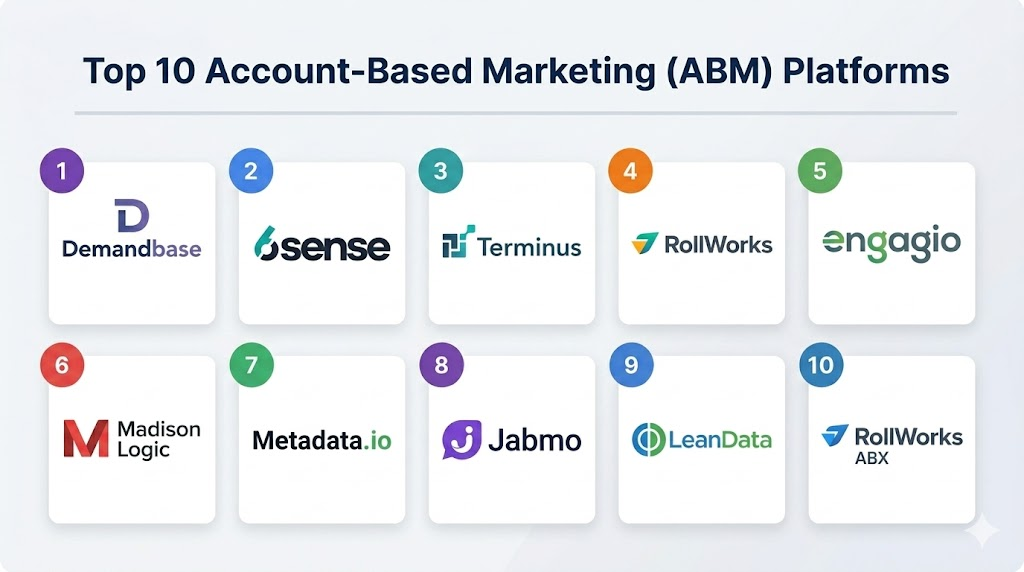
Top 10 Account‑Based Marketing (ABM) Platforms
1 — Demandbase
Short description: Demandbase is a comprehensive ABM platform that unifies account identification, multi‑channel engagement, and revenue analytics for B2B revenue teams.
Key Features
- AI‑driven account scoring and intent analytics.
- Cross‑channel orchestration (email, display, social).
- Unified account dashboards with revenue attribution.
- Custom account segment creation and targeting.
- CRM and customer data platform integration.
Pros
- Strong alignment between sales and marketing with shared insights.
- Deep analytics for pipeline influence and revenue measurement.
Cons
- Can be complex to configure initially.
- Enterprise focus may be heavy for smaller teams.
Platforms / Deployment
- Web
- Cloud
Security & Compliance
Not publicly stated
Integrations & Ecosystem
Demandbase integrates closely with CRM and engagement systems to centralize data and streamline execution.
- CRM platforms
- Engagement channels (email, advertising)
- Analytics systems
Support & Community
Structured onboarding, documentation, and professional services; community engagement varies.
2 — 6sense
Short description: 6sense uses AI and intent data to help organizations discover in‑market accounts, prioritize ABM efforts, and orchestrate personalized engagement.
Key Features
- Predictive analytics and intent signals.
- Account prioritization and scoring models.
- Campaign orchestration across digital channels.
- Forecasting and revenue influence tracking.
- AI‑powered recommendations.
Pros
- Strong predictive intelligence and intent detection.
- Helps reduce wasted spend on low‑value accounts.
Cons
- Pricing and deployment can be high for mid‑market teams.
- Learning curve for advanced AI modules.
Platforms / Deployment
- Web
- Cloud
Security & Compliance
Not publicly stated
Integrations & Ecosystem
Designed to extend CRM and marketing ecosystems with intent and predictive layers.
- CRM connectors
- Marketing automation systems
- BI and analytics tools
Support & Community
Onboarding support and professional services available; documentation is comprehensive.
3 — Terminus
Short description: Terminus is an ABM platform focused on helping B2B teams execute campaigns, personalize engagement, and measure outcomes tied to revenue.
Key Features
- Account targeting and segmentation.
- Multi‑channel campaign orchestration.
- Intent data enrichment.
- Closed‑loop analytics dashboards.
- Playbooks for ABM execution.
Pros
- Emphasis on coordinated cross‑channel campaigns.
- Playbook templates help teams get started.
Cons
- Some advanced analytics features require higher tiers.
- Setup may be time‑intensive for new teams.
Platforms / Deployment
- Web
- Cloud
Security & Compliance
Not publicly stated
Integrations & Ecosystem
Terminus connects to CRM, marketing automation, and data systems to unify account insights.
- CRM connectors
- Marketing tools
- Data enrichment services
Support & Community
Offers onboarding, knowledge base articles, and customer support tiers.
4 — RollWorks
Short description: RollWorks provides account planning, predictive analytics, and cross‑channel engagement tools aimed at scaling ABM programs.
Key Features
- Account scoring and categorization.
- Predictive insights with intent signals.
- Targeted advertising and personalization modules.
- Engagement analytics.
- Playbooks for account journeys.
Pros
- Useful for both early‑stage and scaling ABM efforts.
- Combines intent, targeting, and measurement in one interface.
Cons
- Smaller teams may find the full feature set more than needed.
- Some features depend on third‑party data enrichment.
Platforms / Deployment
- Web
- Cloud
Security & Compliance
Not publicly stated
Integrations & Ecosystem
Designed for integration with CRM and marketing data sources.
- CRM platforms
- Data enrichment systems
- Marketing automation
Support & Community
Documentation, onboarding resources, and responsive support.
5 — Engagio (Now Part of Demandbase)
Short description: Engagio combines engagement analytics with ABM orchestration to help teams coordinate tailored campaigns and measure impact across accounts.
Key Features
- Engagement analytics and account insights.
- Orchestration playbooks.
- Multi‑channel campaign rollout support.
- Account scoring and prioritization.
- Revenue influence tracking.
Pros
- Strong historical analytics and engagement measurement.
- Integration with sales‑enablement systems.
Cons
- As part of a larger suite, feature naming and modules may overlap.
- Enterprise positioning may be heavier for smaller teams.
Platforms / Deployment
- Web
- Cloud
Security & Compliance
Not publicly stated
Integrations & Ecosystem
Lean integration with CRM and analytics platforms to support ABM orchestration.
- CRM connectors
- Marketing automation
- Analytics tools
Support & Community
Onboarding, documentation, and support vary depending on suite configuration.
6 — Madison Logic
Short description: Madison Logic offers account‑based advertising, data solutions, and analytics to fuel ABM efforts, with an emphasis on digital engagement.
Key Features
- Account targeting and display advertising.
- Intent signal integration and enrichment.
- Digital engagement measurement.
- Audience segmentation tools.
- Campaign performance dashboards.
Pros
- Strong at connecting advertising efforts with ABM strategy.
- Useful for driving awareness at key accounts.
Cons
- Less focused on full orchestration beyond advertising.
- Intent data accuracy varies with source quality.
Platforms / Deployment
- Web
- Cloud
Security & Compliance
Not publicly stated
Integrations & Ecosystem
Integrates with account data and advertising channels to align audiences.
- CRM data sync
- Marketing automation
- DSP connections
Support & Community
Documentation and campaign support are available with customer plans.
7 — Metadata.io
Short description: Metadata.io provides automated ABM campaign optimization using AI, with a focus on paid media and lead conversion at target accounts.
Key Features
- Automated campaign experimentation and optimization.
- Predictive audience selection.
- Multi‑channel paid campaign management.
- Conversion and pipeline analytics.
- AI‑driven budget allocation.
Pros
- Strong automation for campaign optimization.
- Reduces manual campaign configuration.
Cons
- Focused primarily on paid engagement.
- Less depth in organic or sales‑orchestration workflows.
Platforms / Deployment
- Web
- Cloud
Security & Compliance
Not publicly stated
Integrations & Ecosystem
Designed to connect with CRM and campaign measurement tools.
- CRM platforms
- Marketing automation
- Analytics systems
Support & Community
Provides onboarding support and resources tailored to campaign optimization.
8 — Jabmo
Short description: Jabmo specializes in account‑based digital marketing and channel partner ABM, with tools for personalization and measurement.
Key Features
- Digital ABM orchestration.
- Personalization across channels.
- ABM analytics dashboards.
- Channel partner alignment features.
- Intent and engagement tracking.
Pros
- Useful for complex partner ecosystems and B2B channels.
- Focus on personalization and analytics.
Cons
- Niche focus may not fit all ABM programs.
- Some advanced features require configuration.
Platforms / Deployment
- Web
- Cloud
Security & Compliance
Not publicly stated
Integrations & Ecosystem
Integrates with CRM and data systems to unify account insights.
- CRM connectors
- Data enrichment
- Marketing systems
Support & Community
Documentation and support resources vary.
9 — LeanData
Short description: LeanData focuses on lead routing, matching, and account‑based workflows that help ensure sales and marketing teams align around shared account priorities.
Key Features
- Lead‑to‑account matching and routing.
- Account workflow automation.
- Account‑centric reporting.
- Orchestration logic for sales triggers.
- Integration with CRM and engagement tools.
Pros
- Strong lead and account matching logic.
- Enhances alignment between sales and marketing.
Cons
- Not a full outbound campaign builder on its own.
- Limited native advertising or personalization modules.
Platforms / Deployment
- Web
- Cloud
Security & Compliance
Not publicly stated
Integrations & Ecosystem
Strong CRM and engagement platform connections.
- CRM systems
- Marketing automation
- Workflow tools
Support & Community
Offers onboarding support and documentation.
10 — RollWorks ABX Platform (Extended)
Short description: RollWorks ABX Platform extends core RollWorks with advanced analytics, concierge onboarding, and orchestration workflows for larger enterprises.
Key Features
- Advanced account scoring and segmentation.
- Playbooks for account journeys.
- Predictive intent analytics.
- Multi‑channel orchestration.
- Revenue analytics.
Pros
- Enterprise‑ready orchestration and analytics.
- Concierge support for onboarding.
Cons
- Cost may be high for smaller deployments.
- Platform depth requires training.
Platforms / Deployment
- Web
- Cloud
Security & Compliance
Not publicly stated
Integrations & Ecosystem
Extends integrations across CRM, engagement, and data platforms.
- CRM systems
- Data enrichment
- Analytics channels
Support & Community
Enterprise onboarding and support tiers.
Comparison Table (Top 10)
| Tool Name | Best For | Platform(s) Supported | Deployment | Standout Feature | Public Rating |
|---|---|---|---|---|---|
| Demandbase | Full‑suite ABM | Web | Cloud | Unified ABM suite | N/A |
| 6sense | Predictive ABM | Web | Cloud | Intent analytics | N/A |
| Terminus | Campaign orchestration | Web | Cloud | Playbooks | N/A |
| RollWorks | Scalable ABM | Web | Cloud | Predictive targeting | N/A |
| Engagio | Engagement analytics | Web | Cloud | Account engagement | N/A |
| Madison Logic | Digital ABM | Web | Cloud | Advertising focus | N/A |
| Metadata.io | Paid campaign ABM | Web | Cloud | AI optimization | N/A |
| Jabmo | Digital personalization | Web | Cloud | Channel partner ABM | N/A |
| LeanData | Lead‑to‑account workflows | Web | Cloud | Routing automation | N/A |
| RollWorks ABX | Enterprise orchestration | Web | Cloud | Concierge support | N/A |
Evaluation & Scoring of Account‑Based Marketing Platforms
| Tool Name | Core (25%) | Ease (15%) | Integrations (15%) | Security (10%) | Performance (10%) | Support (10%) | Value (15%) | Weighted Total |
|---|---|---|---|---|---|---|---|---|
| Demandbase | 9 | 7 | 8 | 7 | 8 | 7 | 7 | 8.0 |
| 6sense | 9 | 7 | 8 | 7 | 8 | 7 | 7 | 8.0 |
| Terminus | 8 | 8 | 7 | 7 | 8 | 8 | 8 | 8.0 |
| RollWorks | 8 | 8 | 7 | 7 | 8 | 8 | 8 | 8.1 |
| Engagio | 8 | 7 | 7 | 7 | 8 | 7 | 7 | 7.6 |
| Madison Logic | 7 | 7 | 6 | 7 | 7 | 7 | 8 | 7.3 |
| Metadata.io | 7 | 8 | 7 | 7 | 7 | 7 | 8 | 7.5 |
| Jabmo | 7 | 7 | 7 | 7 | 7 | 7 | 8 | 7.5 |
| LeanData | 7 | 8 | 8 | 7 | 8 | 8 | 8 | 8.0 |
| RollWorks ABX | 8 | 7 | 7 | 7 | 8 | 7 | 7 | 7.7 |
Which Account‑Based Marketing (ABM) Tool Is Right for You?
Solo / Freelancer
Most ABM platforms are designed for teams rather than individuals. Freelancers should consider lightweight tools or general marketing automation solutions with basic targeting capabilities rather than full ABM suites.
SMB
SMB teams with targeted account lists can benefit from tools like Terminus, RollWorks, or LeanData, which provide strong orchestration without requiring heavy enterprise commitments.
Mid‑Market
Mid‑market organizations aiming to scale ABM efforts and measure impact across sales and marketing should consider 6sense, Demandbase, or RollWorks ABX. These offer predictive insights and robust orchestration.
Enterprise
Enterprises with large TAM and complex buyer journeys benefit from Demandbase, 6sense, and RollWorks ABX, where advanced analytics, concierge support, and deep CRM integrations are critical.
Budget vs Premium
Budget‑conscious teams might start with Terminus or LeanData to deploy ABM with less upfront complexity. Premium buyers focused on predictive analytics and deep orchestration would prioritize 6sense or Demandbase.
Feature Depth vs Ease of Use
Platforms with extensive features like Demandbase and 6sense require investment in setup and training, while tools focused on workflows and campaign playbooks (Terminus, LeanData) balance usability with depth.
Integrations & Scalability
Teams with existing CRM and marketing stacks should choose platforms with native connectors and extensible APIs to scale smoothly as account lists grow.
Security & Compliance Needs
Organizations in regulated industries should evaluate platform security capabilities, governance controls, and data handling practices as part of pre‑deployment due diligence.
Frequently Asked Questions (FAQs)
1. What pricing models do ABM platforms use?
ABM platforms typically use subscription‑based pricing, often tiered by feature set, number of accounts, and level of support. Enterprise tiers may include professional services and custom onboarding fees. Pricing often reflects data volume, channel usage, and predictive analytics capabilities.
2. How long does implementation take?
Implementation timelines vary by platform and use case. Smaller ABM rollouts can take a few weeks, especially with pre‑built playbooks, while enterprise deployments involving CRM and intent data integration may take several months. Proper planning ensures data alignment and campaign readiness.
3. What are common mistakes when adopting ABM tools?
Common mistakes include starting without a clear account selection strategy, poor sales‑marketing alignment, ignoring data hygiene, and underestimating the need for ongoing optimization. Teams should define KPIs and governance before implementation for better outcomes.
4. How do ABM platforms integrate with CRM systems?
Most ABM solutions provide native connectors or APIs to synchronize account data, engagement activities, and pipeline outcomes with CRM systems. This ensures unified views of accounts, improves measurement accuracy, and enables automated triggers based on account behavior.
5. Can ABM platforms support global teams?
Yes, many ABM platforms support multi‑region operations with localized data handling, time zone support, and multi‑currency reporting. It’s important to verify language support, data residency controls, and compliance with local privacy regulations.
6. What role does AI play in ABM today?
AI enhances ABM with predictive scoring, intent signal analysis, personalized recommendations, automated budget allocation, and prioritized outreach suggestions. It helps teams focus efforts on accounts most likely to convert or expand.
7. Are ABM platforms suitable for small businesses?
Smaller companies with focused account lists may benefit from ABM practices, but full enterprise ABM platforms can be resource‑heavy. Lightweight tools or modules within marketing automation suites may be more appropriate for SMB contexts.
8. How do ABM platforms measure ROI?
ABM platforms track engagement metrics, pipeline influence, close rates, revenue impact, and account progression over time. Closed‑loop analytics that tie back to revenue outcomes provide clarity into return on investment.
9. Can ABM platforms assist with sales and marketing alignment?
Yes, ABM platforms unify sales and marketing around shared account lists, engagement dashboards, and performance metrics. This alignment helps ensure consistent messaging and coordinated outreach.
10. What should organizations consider before upgrading ABM tools?
Before upgrading, teams should assess data quality, integration maturity, internal readiness, and governance processes. A clear roadmap for expanding ABM workflows helps maximize the value of enhanced features.
Conclusion
Account‑Based Marketing platforms have become strategic assets for B2B organizations seeking to focus their revenue efforts on high‑value accounts, align sales and marketing teams, and measure impact across multi‑stage account journeys. As ABM continues to evolve beyond, AI‑driven insights, cross‑channel orchestration, and predictive analytics stand out as critical differentiators. Buyers must assess core features, integrations, ease of use, and support to match their team’s size, goals, and existing technology stack. Start by shortlisting two to three platforms that align with your priorities, run a pilot to validate key capabilities, and ensure integrations and data flows are configured before full rollout. With a structured evaluation approach, organizations can maximize the ROI of their ABM investments and accelerate revenue growth by engaging the right accounts with the right messages at the right time.

Find Trusted Cardiac Hospitals
Compare heart hospitals by city and services — all in one place.
Explore Hospitals
Account-Based Marketing (ABM) platforms are most effective when they help sales and marketing teams identify, target, and engage high-value accounts with personalized campaigns. By combining account intelligence, intent data, multichannel engagement, CRM integration, and performance analytics, these platforms improve alignment between teams, increase pipeline quality, and drive higher conversion rates from strategically important customers.