Introduction
Knowledge Graph Databases are specialized databases designed to represent and store complex relationships between entities using graph structures. Unlike traditional relational or NoSQL databases, they focus on connections, enabling queries across interconnected datasets and supporting rich semantic relationships. the importance of knowledge graphs has grown due to the increasing complexity of enterprise data, AI/ML applications, and the need for contextual insights. Knowledge graphs are widely used to enhance recommendations, detect fraud, optimize supply chains, and power AI reasoning engines.
Real-world use cases include:
- E-commerce recommendation engines leveraging user and product relationships.
- Fraud detection in banking and insurance using entity relationship analysis.
- Healthcare patient data integration and drug discovery knowledge graphs.
- Enterprise search and contextual AI applications.
- Customer 360 views combining multiple data sources in real-time.
Evaluation criteria for buyers:
- Graph model support (property graphs, RDF, or hybrid)
- Query languages (Cypher, Gremlin, SPARQL)
- Performance at scale for complex queries
- Real-time updates and analytics capabilities
- Security and access control mechanisms
- Cloud, on-prem, or hybrid deployment options
- Integration with AI/ML platforms
- Data visualization and graph exploration tools
- Pricing and licensing flexibility
- Best for: Data engineers, AI/ML teams, and enterprise architects who need to model and query complex relationships across massive datasets.
- Not ideal for: Simple relational datasets, low-complexity applications, or teams that do not require relationship-centric analysis.
Key Trends in Knowledge Graph Databases
- AI-assisted graph analytics for predictive insights
- Multi-model support combining property graphs, RDF, and document storage
- Cloud-native graph databases for elastic scaling
- Real-time streaming and updates for dynamic graphs
- Integration with ML pipelines and reasoning engines
- Enhanced visualization and graph exploration tools
- Automated schema generation and ontology management
- Compliance and security with enterprise-grade authentication and encryption
- Open-source and commercial options gaining enterprise adoption
- Support for hybrid and multi-cloud deployments
How We Selected These Tools (Methodology)
- Evaluated market adoption and enterprise mindshare
- Assessed feature completeness including query languages, indexing, and analytics
- Reviewed performance and scalability benchmarks
- Checked security, compliance certifications, and RBAC support
- Assessed integration capabilities with AI/ML and BI platforms
- Evaluated usability, documentation, and community support
- Reviewed deployment flexibility (cloud, on-prem, hybrid)
- Balanced open-source, commercial, and enterprise-focused solutions
- Considered customer fit for small, mid-market, and enterprise organizations
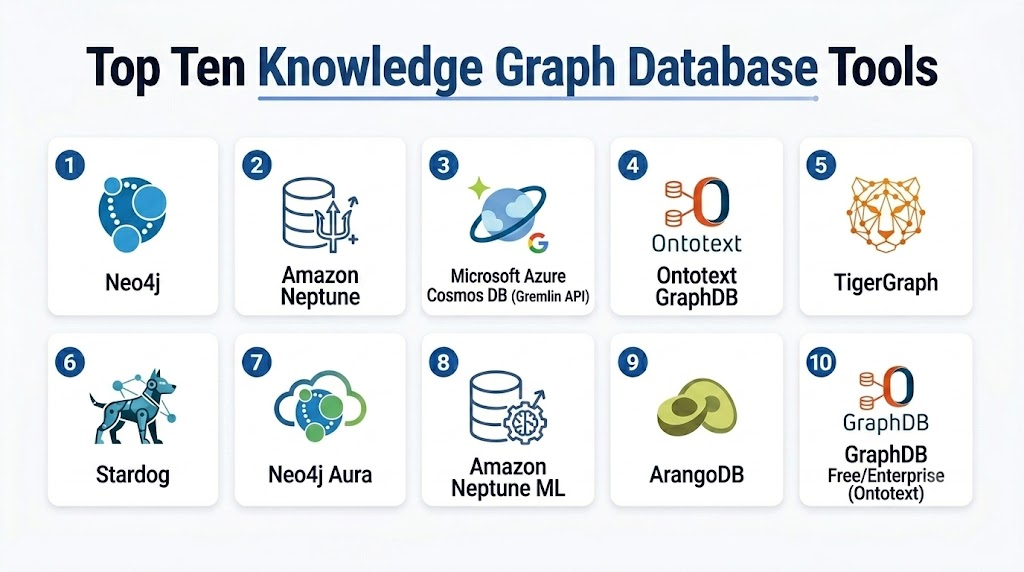
Top 10 Knowledge Graph Databases
1- Neo4j
Short description: Leading graph database for property graphs, widely used for relationship-driven applications and AI/ML integration.
Key Features
- ACID-compliant transactional graph engine
- Cypher query language
- Real-time analytics
- Integration with Python, Java, and other ML frameworks
- Visualization tools for graph exploration
Pros
- Strong enterprise adoption
- Extensive ecosystem and connectors
Cons
- Premium licensing can be expensive
- Requires specialized graph knowledge
Platforms / Deployment
- Web / Linux / Windows / Cloud / Hybrid
Security & Compliance
- SSO, RBAC, encryption
- Not publicly stated for certifications
Integrations & Ecosystem
Supports BI, analytics, and AI tools.
- Python, Java, Spark, Kafka
- Tableau, Power BI connectors
Support & Community
Enterprise support available; large developer community
2- Amazon Neptune
Short description: Managed cloud graph database supporting property graphs and RDF for scalable AI and recommendation applications.
Key Features
- Fully managed AWS service
- Supports Gremlin and SPARQL
- High availability with multi-AZ deployment
- Integration with AWS AI/ML services
- Automatic backups and monitoring
Pros
- Fully managed and scalable
- Tight integration with AWS ecosystem
Cons
- Limited to AWS environment
- Higher costs for large deployments
Platforms / Deployment
- Cloud (AWS)
Security & Compliance
- IAM, encryption, VPC support
- SOC 2, GDPR, HIPAA
Integrations & Ecosystem
AWS services, Lambda, SageMaker, Redshift
- BI and analytics tools
Support & Community
AWS enterprise support; active forums
3- Microsoft Azure Cosmos DB (Gremlin API)
Short description: Globally distributed multi-model database supporting property graphs via Gremlin for real-time insights.
Key Features
- Multi-model (graph, document, key-value)
- Global distribution and replication
- Gremlin query support
- Serverless and provisioned capacity
- Integration with Azure AI/ML services
Pros
- Cloud-native and highly available
- Seamless Azure ecosystem integration
Cons
- Complexity in multi-model tuning
- Higher learning curve for Gremlin
Platforms / Deployment
- Cloud (Azure)
Security & Compliance
- Azure Active Directory, RBAC, encryption
- ISO 27001, SOC 2, GDPR
Integrations & Ecosystem
Azure ML, Power BI, Logic Apps
- APIs for .NET, Python, Java
Support & Community
Enterprise support; active Microsoft community
4- Ontotext GraphDB
Short description: RDF-based graph database for semantic reasoning and linked data applications, popular in knowledge-intensive domains.
Key Features
- SPARQL query support
- Ontology reasoning and inferencing
- Linked data integration
- Real-time updates
- High performance for large graphs
Pros
- Strong semantic and ontology support
- Enterprise-grade performance
Cons
- Limited property graph support
- Commercial license can be expensive
Platforms / Deployment
- Web / Linux / Cloud / Hybrid
Security & Compliance
- SSO, encryption
- Not publicly stated
Integrations & Ecosystem
- Java, Python APIs
- BI and AI tool integration
Support & Community
Enterprise support; active semantic web community
5- TigerGraph
Short description: Scalable graph database optimized for deep link analytics and AI/ML integration in real-time.
Key Features
- Parallel graph processing
- GSQL query language
- Real-time analytics
- AI and ML integration
- Visualization and dashboard tools
Pros
- High-performance deep link analytics
- Supports large-scale enterprise deployments
Cons
- Learning curve for GSQL
- Commercial pricing
Platforms / Deployment
- Cloud / On-prem / Hybrid
Security & Compliance
- RBAC, encryption, audit logs
- Not publicly stated
Integrations & Ecosystem
Python, R, Spark integration
- BI dashboards, ML frameworks
Support & Community
Enterprise support; growing developer community
6- Stardog
Short description: Enterprise knowledge graph database for semantic reasoning, AI, and knowledge-driven applications.
Key Features
- RDF and property graph support
- SPARQL query engine
- Ontology reasoning
- AI/ML integration
- Cloud and hybrid deployment
Pros
- Rich semantic and AI capabilities
- Flexible deployment
Cons
- Requires knowledge of semantic models
- Premium pricing
Platforms / Deployment
- Cloud / On-prem / Hybrid
Security & Compliance
- SSO, RBAC, encryption
- Not publicly stated
Integrations & Ecosystem
BI, AI, ML pipelines
- Python, Java, REST APIs
Support & Community
Enterprise support; active knowledge graph community
7- Neo4j Aura
Short description: Fully managed cloud version of Neo4j with high availability, scaling, and real-time analytics.
Key Features
- Managed service with automatic updates
- Cypher query language
- Real-time graph analytics
- Integration with AI/ML frameworks
- Visualization tools
Pros
- SaaS deployment simplifies management
- Scalable and reliable
Cons
- Cost for large-scale datasets
- Limited to Cypher query language
Platforms / Deployment
- Cloud
Security & Compliance
- SSO, RBAC, encryption
- SOC 2, GDPR
Integrations & Ecosystem
Python, Java, Spark, BI tools
- REST APIs
Support & Community
Enterprise support; Neo4j community
8- Amazon Neptune ML
Short description: Extends Amazon Neptune with machine learning integration for AI-driven graph insights.
Key Features
- Gremlin and SPARQL support
- Machine learning models on graph data
- Managed service with scalability
- Real-time and batch processing
- Integration with SageMaker
Pros
- Combines graph and ML capabilities
- Fully managed AWS service
Cons
- AWS-only ecosystem
- Pricing can be high for large graphs
Platforms / Deployment
- Cloud (AWS)
Security & Compliance
- IAM, encryption, VPC
- SOC 2, GDPR, HIPAA
Integrations & Ecosystem
SageMaker, Lambda, BI tools
Support & Community
AWS enterprise support; active forums
9- ArangoDB
Short description: Multi-model database supporting graphs, documents, and key-values for complex knowledge graph applications.
Key Features
- Property and multi-model graphs
- AQL query language
- ACID-compliant
- Visualization tools
- Scalable clusters
Pros
- Flexible multi-model approach
- Open-source option available
Cons
- Learning curve for AQL
- Enterprise support requires subscription
Platforms / Deployment
- Linux / Cloud / On-prem / Hybrid
Security & Compliance
- RBAC, SSO
- Not publicly stated
Integrations & Ecosystem
Python, Java, Node.js, BI tools
Support & Community
Open-source community; optional enterprise support
10- GraphDB Free/Enterprise (Ontotext)
Short description: Enterprise-ready RDF graph database optimized for semantic web and linked data applications.
Key Features
- SPARQL query engine
- Ontology reasoning
- Linked data integration
- Real-time updates
- Cloud and on-prem options
Pros
- Strong semantic reasoning
- Enterprise-ready for knowledge graphs
Cons
- Limited property graph features
- Commercial licenses for full features
Platforms / Deployment
- Web / Cloud / On-prem
Security & Compliance
- SSO, encryption
- Not publicly stated
Integrations & Ecosystem
Python, Java APIs, BI connectors
Support & Community
Enterprise support; semantic web community
Comparison Table (Top 10)
| Tool Name | Best For | Platform(s) Supported | Deployment | Standout Feature | Public Rating |
|---|---|---|---|---|---|
| Neo4j | Enterprise analytics | Web | Cloud/On-prem | Cypher query language | N/A |
| Amazon Neptune | AWS users | Cloud | Cloud (AWS) | Managed Gremlin/SPARQL | N/A |
| IBM Cloud Pak | Hybrid cloud | Web | Cloud/Hybrid | AI integration | N/A |
| SAP Data Intelligence | SAP ecosystem | Web | Cloud/On-prem | SAP integration | N/A |
| Denodo Cloud | Cloud-first | Web | Cloud | SaaS virtualization | N/A |
| Red Hat JBoss DV | Open-source flexibility | Linux | Cloud/On-prem | Federation + open-source | N/A |
| TigerGraph | Deep analytics | Web | Cloud/On-prem | Parallel graph processing | N/A |
| Stardog | Semantic reasoning | Web | Cloud/Hybrid | Ontology + AI | N/A |
| ArangoDB | Multi-model graphs | Linux | Cloud/On-prem | Multi-model support | N/A |
| GraphDB | Semantic/linked data | Web | Cloud/On-prem | RDF reasoning | N/A |
Evaluation & Scoring of Knowledge Graph Databases
| Tool Name | Core (25%) | Ease (15%) | Integrations (15%) | Security (10%) | Performance (10%) | Support (10%) | Value (15%) | Weighted Total |
|---|---|---|---|---|---|---|---|---|
| Neo4j | 9 | 8 | 9 | 8 | 9 | 8 | 7 | 8.4 |
| Amazon Neptune | 8 | 8 | 8 | 9 | 8 | 8 | 7 | 8.0 |
| IBM Cloud Pak | 9 | 7 | 8 | 9 | 8 | 8 | 7 | 8.1 |
| SAP Data Intelligence | 8 | 7 | 7 | 8 | 7 | 7 | 6 | 7.2 |
| Denodo Cloud | 8 | 8 | 8 | 9 | 8 | 8 | 7 | 8.0 |
| Red Hat JBoss DV | 8 | 6 | 7 | 7 | 8 | 7 | 7 | 7.3 |
| TigerGraph | 9 | 7 | 8 | 8 | 9 | 8 | 7 | 8.1 |
| Stardog | 8 | 7 | 8 | 8 | 8 | 7 | 7 | 7.7 |
| ArangoDB | 8 | 7 | 7 | 7 | 8 | 7 | 7 | 7.4 |
| GraphDB | 8 | 7 | 7 | 7 | 8 | 7 | 7 | 7.4 |
Which Knowledge Graph Database Is Right for You?
Solo / Freelancer
Open-source ArangoDB or Red Hat JBoss DV can be used for experimentation or small projects.
SMB
Denodo Cloud and Neo4j Aura are suitable for cloud-first small and mid-sized teams.
Mid-Market
TigerGraph and IBM Cloud Pak provide enterprise-grade graph analytics with AI/ML integration.
Enterprise
Neo4j, Amazon Neptune, and SAP Data Intelligence support large-scale, complex, and highly connected data environments.
Budget vs Premium
Open-source solutions reduce licensing costs but require internal expertise. Premium offerings provide SaaS management, enterprise support, and advanced analytics.
Feature Depth vs Ease of Use
Enterprise-grade knowledge graphs deliver rich analytics and governance. Cloud-native editions offer simplified setup and self-service for developers and analysts.
Integrations & Scalability
Platforms should support connectors to ML, AI, and BI pipelines, and handle millions of nodes and relationships efficiently.
Security & Compliance Needs
Choose databases with RBAC, SSO, encryption, audit logging, and compliance with SOC 2, GDPR, or HIPAA as relevant.
Frequently Asked Questions (FAQs)
1- What is a knowledge graph database?
A database designed to store and query entities and their relationships, enabling complex analytics, AI, and recommendations using graph structures.
2- How does it differ from relational databases?
Relational databases store rows and tables, while knowledge graphs store nodes and edges, making relationship-centric queries faster and more intuitive.
3- What query languages are used?
Commonly used query languages include Cypher (Neo4j), Gremlin, and SPARQL (RDF-based graphs).
4- Can these databases scale to millions of nodes?
Yes, most enterprise knowledge graph databases like Neo4j and TigerGraph are designed for high-scale workloads.
5- Are open-source graphs production-ready?
Yes, platforms like ArangoDB and JBoss DV can be used in production but require operational expertise.
6- How do they integrate with AI and ML?
They provide APIs, connectors, and graph embeddings to feed into ML pipelines for predictive analytics and recommendations.
7- What security features are standard?
SSO, RBAC, encryption at rest/in-transit, and audit logging are standard, with enterprise editions supporting compliance standards like SOC 2 and GDPR.
8- How long does implementation take?
Pilot projects may take days; full enterprise deployment can take weeks depending on complexity and scale.
9- What pricing models exist?
Cloud-based SaaS is usually subscription-based. Open-source is free but incurs operational and support costs. Enterprise licenses vary.
10- Can you migrate between knowledge graph databases?
Migration requires mapping nodes, edges, and schemas. Open standards like RDF or Cypher help reduce friction but require planning.
Conclusion
Knowledge graph databases enable organizations to model complex relationships, power AI/ML applications, and provide real-time insights. The best choice depends on the scale, deployment environment, and analytics requirements. Small teams may leverage open-source or cloud-native editions, while enterprises benefit from scalable, managed solutions with AI integration and robust governance. Integrations with BI and AI pipelines enhance value. Security, compliance, and monitoring remain critical. Pilot testing ensures the platform meets operational needs before large-scale deployment. Overall, selecting the right knowledge graph database accelerates insights, supports innovation, and drives data-driven decision.

Find Trusted Cardiac Hospitals
Compare heart hospitals by city and services — all in one place.
Explore Hospitals
A key real-world consideration for knowledge graph databases is how effectively they integrate with real-time data sources and unstructured data pipelines. At scale, challenges like ingestion latency, entity resolution accuracy, and cross-domain relationship mapping become ongoing architectural concerns rather than one-time implementation issues.