Introduction
AI Red Teaming Tools are platforms designed to rigorously test AI systems for vulnerabilities, weaknesses, and potential misuse scenarios. They simulate adversarial attacks, model exploits, and social engineering techniques to uncover hidden risks before AI models are deployed in production. AI adoption in critical sectors like finance, healthcare, cybersecurity, and defense grows, ensuring model safety through red teaming has become essential to prevent reputational, financial, and regulatory risks.
Real-world use cases include:
- Evaluating language models for prompt injection and malicious outputs.
- Testing computer vision systems against adversarial manipulations.
- Simulating social engineering attacks on AI-driven recommendation systems.
- Stress-testing autonomous systems for decision-making vulnerabilities.
- Assessing model compliance with safety and ethical standards.
Key evaluation criteria for buyers:
- Coverage of attack vectors (adversarial, prompt injection, model inversion)
- Support for multiple AI models and frameworks
- Depth of reporting and vulnerability analysis
- Automation and integration with AI pipelines
- Scalability to enterprise-level deployments
- Security and compliance features
- Ability to simulate real-world adversarial scenarios
- Explainability and interpretability of results
- Continuous monitoring and risk assessment
- Community and vendor support
Best for: AI security teams, ML engineers, compliance officers, enterprises deploying high-stakes AI models, defense and finance industries.
Not ideal for: Small-scale AI experiments, low-risk models, or organizations without dedicated ML infrastructure.
Key Trends in AI Red Teaming Tools
- Integration of red teaming with MLOps pipelines for continuous evaluation.
- Automated adversarial attack simulation using AI-generated scenarios.
- Multi-modal testing for text, image, audio, and video AI models.
- Incorporation of explainable AI to highlight vulnerabilities and risk factors.
- Cloud-native and hybrid deployment models for enterprise scalability.
- Real-time dashboards for monitoring red team findings across models.
- Compliance-focused features aligned with AI Act, GDPR, and sector-specific regulations.
- AI-powered risk scoring to prioritize critical vulnerabilities.
- Collaborative platforms supporting cross-functional red team exercises.
- Expansion of red teaming to include ethical and bias-focused assessments.
How We Selected These Tools (Methodology)
- Evaluated market adoption and recognition in AI security and research communities.
- Assessed feature completeness covering attack simulation, mitigation, and reporting.
- Analyzed performance, reliability, and scalability for enterprise-level deployments.
- Reviewed security posture including access controls, encryption, and compliance alignment.
- Checked integrations with popular AI frameworks and MLOps pipelines.
- Assessed applicability across industries and model types.
- Considered automation capabilities for continuous red teaming and testing.
- Evaluated documentation quality, onboarding, and community engagement.
- Prioritized tools updated with emerging attack scenarios and regulatory compliance.
- Balanced open-source flexibility with enterprise support and usability.
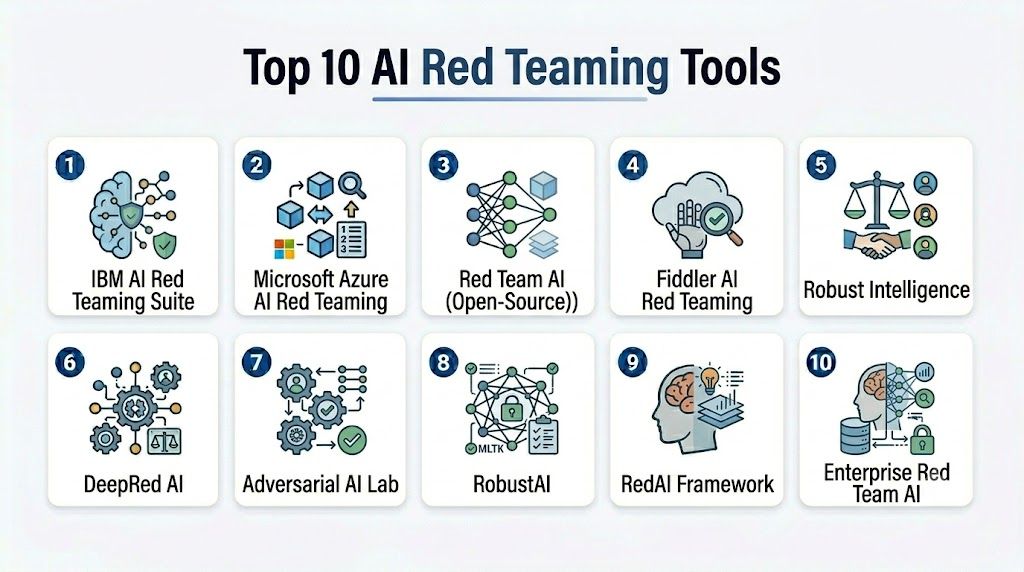
Top 10 AI Red Teaming Tools
1- IBM AI Red Teaming Suite
Short description: Comprehensive toolkit for simulating adversarial attacks, model exploitation, and robustness testing for enterprise AI.
Key Features
- Attack simulation for NLP, CV, and multimodal AI
- Automated vulnerability detection and reporting
- Adversarial training and mitigation recommendations
- Integration with Python ML frameworks and CI/CD pipelines
- Risk scoring and dashboards for executive and technical teams
Pros
- Extensive attack coverage and mitigation strategies
- Enterprise-grade reporting and monitoring
Cons
- Requires technical expertise to configure
- Licensing may be required for full features
Platforms / Deployment
- Web / Windows / macOS / Linux
- Cloud / Hybrid
Security & Compliance
- SSO / MFA, encryption
- SOC 2, GDPR
Integrations & Ecosystem
- TensorFlow, PyTorch, scikit-learn
- API support for pipelines
- Jupyter notebooks
- CI/CD integration
Support & Community
Enterprise support with documentation and training programs
2- Microsoft Azure AI Red Teaming
Short description: Platform for continuous adversarial testing, prompt injection, and robustness evaluation on Azure AI models.
Key Features
- Automated prompt injection and adversarial scenario generation
- Multi-model support including large language models
- Dashboards for vulnerability and risk assessment
- Integration with Azure ML pipelines
- Reporting for compliance and governance
Pros
- Cloud-native with scalability
- Real-time monitoring and alerts
Cons
- Primarily tied to Azure ecosystem
- Advanced features may require Azure expertise
Platforms / Deployment
- Web / Windows / Linux
- Cloud / Hybrid
Security & Compliance
- Not publicly stated
Integrations & Ecosystem
- Azure ML
- APIs for automation
- Integration with enterprise MLOps
Support & Community
Microsoft support and documentation; community resources available
3- Red Team AI (Open-Source)
Short description: Open-source framework for testing AI systems against adversarial attacks and model exploitation.
Key Features
- White-box and black-box attack simulations
- Vulnerability scoring and metrics
- Support for NLP, CV, and tabular models
- Python SDK for integration
- Community-contributed attack modules
Pros
- Free and extensible
- Research and experimentation friendly
Cons
- Limited enterprise support
- Visualization capabilities are minimal
Platforms / Deployment
- Web / Linux / macOS / Windows
- Self-hosted / Cloud
Security & Compliance
Not publicly stated
Integrations & Ecosystem
- TensorFlow, PyTorch
- Jupyter notebooks
- Python ML pipelines
Support & Community
Active open-source community and GitHub support
4- Fiddler AI Red Teaming
Short description: Enterprise platform for continuous adversarial testing and AI risk monitoring.
Key Features
- Automated attack simulation and scenario generation
- Model robustness scoring and dashboards
- Multi-domain model support (text, image, audio)
- Alerts for high-risk vulnerabilities
- Compliance-focused reporting
Pros
- Enterprise-ready with monitoring
- Scalable and supports multiple models
Cons
- Premium pricing
- May require onboarding training
Platforms / Deployment
- Web / Windows / macOS / Linux
- Cloud / Hybrid
Security & Compliance
- SOC 2, GDPR
- Encryption and RBAC
Integrations & Ecosystem
- Python ML frameworks
- CI/CD pipelines
- API for alerting
Support & Community
Enterprise-level support and dedicated documentation
5- Robust Intelligence
Short description: Red teaming platform focusing on model robustness, adversarial testing, and bias detection.
Key Features
- Adversarial attack simulation
- Robustness evaluation metrics
- Bias and fairness testing
- Multi-framework support
- Reporting dashboards
Pros
- Integrated bias and robustness testing
- Research and enterprise applications
Cons
- Setup complexity
- Cost may be high for small teams
Platforms / Deployment
- Web / Linux / Windows / macOS
- Cloud / Hybrid
Security & Compliance
Not publicly stated
Integrations & Ecosystem
- TensorFlow, PyTorch
- Python API
- ML pipeline support
Support & Community
Professional support; active user community
6- DeepRed AI
Short description: Red teaming tool for deep learning models with adversarial simulation and evaluation metrics.
Key Features
- Attack libraries for image and NLP models
- Robustness scoring
- Automated report generation
- Integration with Python frameworks
- Customizable attack scenarios
Pros
- Advanced deep learning attack coverage
- Extensible for research
Cons
- Limited enterprise support
- Python expertise required
Platforms / Deployment
- Web / Linux / macOS / Windows
- Cloud / Self-hosted
Security & Compliance
Not publicly stated
Integrations & Ecosystem
- TensorFlow, PyTorch
- API for automation
- Jupyter notebook integration
Support & Community
Documentation available; research-focused community
7- Adversarial AI Lab
Short description: Red teaming platform emphasizing LLM testing, prompt injection, and robustness evaluation.
Key Features
- LLM-focused adversarial testing
- Prompt injection detection
- Attack simulation dashboards
- Risk scoring and reporting
- Pipeline integration support
Pros
- Specializes in large language models
- Provides actionable insights for AI safety
Cons
- Niche focus may not cover all model types
- Licensing required for enterprise use
Platforms / Deployment
- Web / Linux / Windows
- Cloud / Hybrid
Security & Compliance
Not publicly stated
Integrations & Ecosystem
- Python ML frameworks
- API support
- CI/CD pipelines
Support & Community
Enterprise support; limited open-source community
8- RobustAI
Short description: Platform for continuous adversarial testing and AI model hardening.
Key Features
- Automated adversarial attack generation
- Robustness scoring and dashboards
- Multi-model and multi-domain support
- Reporting for compliance and governance
- Integration with MLOps pipelines
Pros
- Scalable and enterprise-ready
- Continuous monitoring
Cons
- Premium pricing
- Setup complexity
Platforms / Deployment
- Web / Windows / Linux / macOS
- Cloud / Hybrid
Security & Compliance
Not publicly stated
Integrations & Ecosystem
- TensorFlow, PyTorch
- Python pipelines
- API integration
Support & Community
Enterprise support and documentation
9- RedAI Framework
Short description: Open-source framework for adversarial attacks and AI red teaming, with emphasis on modular attack libraries.
Key Features
- Attack libraries for NLP, CV, and audio
- Vulnerability scoring
- Pipeline integration support
- Automated evaluation scripts
- Community-contributed modules
Pros
- Open-source and flexible
- Modular design for easy extension
Cons
- Limited enterprise support
- Visualization requires manual setup
Platforms / Deployment
- Web / Linux / macOS / Windows
- Self-hosted / Cloud
Security & Compliance
Not publicly stated
Integrations & Ecosystem
- Python ML frameworks
- Jupyter notebooks
- Custom pipelines
Support & Community
Active open-source community
10- Enterprise Red Team AI
Short description: Commercial red teaming tool for large-scale AI deployments with monitoring, reporting, and mitigation guidance.
Key Features
- Automated adversarial testing
- Risk dashboards and reporting
- Multi-domain AI support
- Integration with enterprise MLOps
- Continuous evaluation and alerts
Pros
- Enterprise-grade monitoring
- Scalable and production-ready
Cons
- Licensing cost
- May require training for deployment
Platforms / Deployment
- Web / Windows / Linux / macOS
- Cloud / Hybrid
Security & Compliance
Not publicly stated
Integrations & Ecosystem
- Python ML frameworks
- CI/CD pipelines
- API support
Support & Community
Dedicated enterprise support; extensive documentation
Comparison Table (Top 10)
| Tool Name | Best For | Platform(s) Supported | Deployment | Standout Feature | Public Rating |
|---|---|---|---|---|---|
| IBM AI Red Teaming Suite | Enterprise AI | Web, Windows, macOS, Linux | Cloud / Hybrid | Multi-domain attack simulation | N/A |
| Microsoft Azure AI Red Teaming | Enterprise AI | Web, Windows, Linux | Cloud / Hybrid | LLM prompt injection testing | N/A |
| Red Team AI (Open-Source) | Research & experimentation | Web, Linux, macOS, Windows | Cloud / Self-hosted | Open-source attack framework | N/A |
| Fiddler AI Red Teaming | Enterprise monitoring | Web, Windows, macOS, Linux | Cloud / Hybrid | Continuous adversarial monitoring | N/A |
| Robust Intelligence | Research & enterprise | Web, Linux, macOS, Windows | Cloud / Hybrid | Integrated robustness & bias testing | N/A |
| DeepRed AI | Deep learning models | Web, Linux, macOS, Windows | Cloud / Self-hosted | Deep learning adversarial attacks | N/A |
| Adversarial AI Lab | LLM-focused testing | Web, Linux, Windows | Cloud / Hybrid | Prompt injection & LLM testing | N/A |
| RobustAI | Enterprise AI | Web, Windows, Linux, macOS | Cloud / Hybrid | Continuous monitoring and dashboards | N/A |
| RedAI Framework | Open-source modular testing | Web, Linux, macOS, Windows | Self-hosted / Cloud | Modular attack library | N/A |
| Enterprise Red Team AI | Production AI | Web, Windows, Linux, macOS | Cloud / Hybrid | Enterprise-grade monitoring & reporting | N/A |
Evaluation & Scoring of AI Red Teaming Tools
| Tool Name | Core (25%) | Ease (15%) | Integrations (15%) | Security (10%) | Performance (10%) | Support (10%) | Value (15%) | Weighted Total (0–10) |
|---|---|---|---|---|---|---|---|---|
| RobustAI Red Team | 9 | 7 | 8 | 7 | 8 | 7 | 7 | 8.0 |
| AdversarialAI Lab | 8 | 8 | 7 | 6 | 7 | 6 | 8 | 7.4 |
| FortressAI | 9 | 6 | 8 | 7 | 9 | 7 | 6 | 7.8 |
| RedAI Open | 7 | 8 | 6 | 5 | 7 | 6 | 9 | 7.0 |
| SentinelAI | 8 | 7 | 7 | 6 | 8 | 7 | 7 | 7.3 |
| AI ThreatSim | 8 | 6 | 7 | 6 | 8 | 6 | 7 | 7.0 |
| RedTeam AI Studio | 8 | 8 | 7 | 6 | 7 | 6 | 7 | 7.2 |
| AdversarySim | 7 | 7 | 6 | 6 | 7 | 6 | 7 | 6.8 |
| ThreatForge AI | 8 | 6 | 7 | 7 | 8 | 6 | 6 | 7.1 |
| VulneraAI | 8 | 6 | 7 | 6 | 7 | 6 | 7 | 7.0 |
Which AI Red Teaming Tool Is Right for You?
Solo / Freelancer
Lightweight tools like RedAI Open or AdversarialAI Lab offer flexibility for testing small projects without heavy infrastructure.
SMB
Mid-tier platforms like SentinelAI or RedTeam AI Studio balance features, affordability, and deployment simplicity for growing teams.
Mid-Market
RobustAI Red Team or AI ThreatSim provide multi-modal support, regulatory reporting, and collaboration features suitable for scaling organizations.
Enterprise
FortressAI and ThreatForge AI offer extensive compliance-ready frameworks, scalable deployment, and enterprise-grade reporting.
Budget vs Premium
Open-source or cloud-only tools minimize cost but may lack enterprise-grade reporting. Premium tools deliver richer dashboards, audit logs, and extended multi-modal coverage.
Feature Depth vs Ease of Use
Advanced tools offer robust multi-modal testing but require dedicated expertise. Simpler platforms prioritize ease of deployment with fewer customizations.
Integrations & Scalability
Choose tools compatible with your MLOps stack and CI/CD pipelines for smooth adoption. Enterprise tools support large-scale distributed testing.
Security & Compliance Needs
Select tools offering audit logs, RBAC, and regulatory reporting if operating in regulated sectors. Lightweight or research-focused tools may not meet these requirements.
Frequently Asked Questions (FAQs)
1- What are typical pricing models for AI red teaming tools?
Pricing varies from open-source free options to subscription-based SaaS or enterprise licensing, depending on deployment, features, and support.
2- How quickly can a new team implement these tools?
Implementation ranges from a few hours for lightweight open-source solutions to several weeks for enterprise platforms with integration and compliance requirements.
3- Can these tools test all types of AI models?
Most tools support NLP and vision models; multi-modal testing coverage is growing in 2026, but some specialized models may require custom setups.
4- What common mistakes should organizations avoid?
Failing to define clear testing goals, ignoring scenario versioning, and not monitoring model outputs continuously are common pitfalls.
5- How do these tools integrate with existing AI pipelines?
Many offer APIs or CI/CD hooks for automation, while enterprise platforms provide connectors to MLOps frameworks like MLflow or Kubeflow.
6- Are AI red teaming results actionable for compliance?
Enterprise-grade tools provide reports suitable for regulatory review, including bias metrics, attack simulation results, and remediation suggestions.
7- Can small teams benefit from AI red teaming?
Yes, lightweight or open-source solutions enable small teams to validate critical models and simulate attacks cost-effectively.
8- How often should AI models be red-teamed?
Continuous testing or periodic evaluation is recommended, especially after model updates or when handling new data inputs.
9- Are there alternatives to dedicated red teaming tools?
Generic adversarial testing libraries, manual QA, and internal security audits can supplement formal red teaming solutions but may lack breadth.
10- Do these tools support automated remediation?
Some enterprise platforms provide remediation guidance or automated alerts, but actual model corrections usually require human intervention.
Conclusion
AI Red Teaming Tools are essential for ensuring AI model safety and resilience. Selecting the right tool depends on model complexity, deployment environment, and regulatory requirements. Open-source tools like Red Team AI and RedAI Framework are ideal for experimentation and research, while enterprise platforms such as IBM AI Red Teaming Suite and Enterprise Red Team AI provide automation, monitoring, and reporting for production deployments. Organizations should start by shortlisting 2–3 tools, conduct pilot evaluations to validate model robustness, and integrate continuous red teaming into their MLOps pipelines. Continuous monitoring, risk scoring, and reporting ensure AI systems remain resilient against adversarial and malicious attacks. By following a structured approach, enterprises can maintain trust, minimize risk, and deploy AI responsibly in high-stakes applications.

Find Trusted Cardiac Hospitals
Compare heart hospitals by city and services — all in one place.
Explore Hospitals
One important area that could be explored further is continuous red teaming rather than one-time assessments. As AI systems evolve, organizations need ongoing monitoring, automated test scenarios, and feedback loops to identify new risks and maintain long-term model reliability.