Introduction
Adversarial Robustness Testing Tools are specialized platforms that evaluate and enhance the resilience of AI and machine learning models against adversarial attacks. These tools simulate malicious input perturbations, data manipulations, or model evasion attempts to determine how models perform under attack scenarios.AI deployed in critical domains such as autonomous vehicles, cybersecurity, finance, and healthcare, robustness testing is essential to prevent catastrophic failures and ensure trust in AI-driven systems.
Real-world use cases include:
- Testing image recognition models for adversarial perturbations in self-driving cars.
- Evaluating fraud detection algorithms in financial systems for evasion attempts.
- Securing healthcare AI models from manipulated diagnostic inputs.
- Stress-testing recommendation systems to prevent malicious manipulation.
- Auditing NLP models against adversarial text attacks in content moderation.
Key evaluation criteria for buyers:
- Coverage of attack types (white-box, black-box, poisoning, evasion)
- Support for multiple ML frameworks and model architectures
- Depth of robustness metrics and reporting
- Integration with MLOps pipelines
- Automation of testing and continuous evaluation
- Scalability for large datasets and production models
- Security and compliance features
- Explainability of test results
- Frequency and ease of updating attack scenarios
- Support and community strength
Best for: AI engineers, data scientists, cybersecurity teams, enterprises deploying high-stakes AI systems, autonomous vehicle manufacturers, fintech, and healthcare AI providers.
Not ideal for: Small-scale AI experiments, low-risk models, or teams without dedicated ML infrastructure.
Key Trends in Adversarial Robustness Testing Tools
- Automation of adversarial attack simulations and defenses within CI/CD pipelines.
- Integration with AI observability and model monitoring platforms.
- Expansion of attack libraries to cover multi-modal models (images, text, video, audio).
- Adoption of explainable AI to highlight model vulnerabilities and robustness gaps.
- Cloud-native testing frameworks with hybrid deployment support.
- Continuous evaluation under evolving attack scenarios and threat models.
- Support for regulatory alignment, including AI Act, GDPR, and sector-specific standards.
- Incorporation of AI-powered attack generation and mitigation strategies.
- Enhanced reporting dashboards for executive and technical stakeholders.
- Focus on end-to-end robustness testing, including data preprocessing and deployment layers.
How We Selected These Tools (Methodology)
- Evaluated market adoption, mindshare, and recognition in the AI security community.
- Analyzed completeness of attack simulations and robustness metrics.
- Assessed performance, reliability, and scalability in large-scale deployments.
- Reviewed security posture, including encryption, access control, and compliance features.
- Checked integration capabilities with popular ML frameworks and MLOps pipelines.
- Evaluated applicability across different industries and model types.
- Considered automation, workflow orchestration, and continuous testing capabilities.
- Reviewed documentation quality, onboarding experience, and community engagement.
- Prioritized platforms actively updating attack scenarios and defense strategies.
- Assessed balance between open-source flexibility and enterprise-grade support.
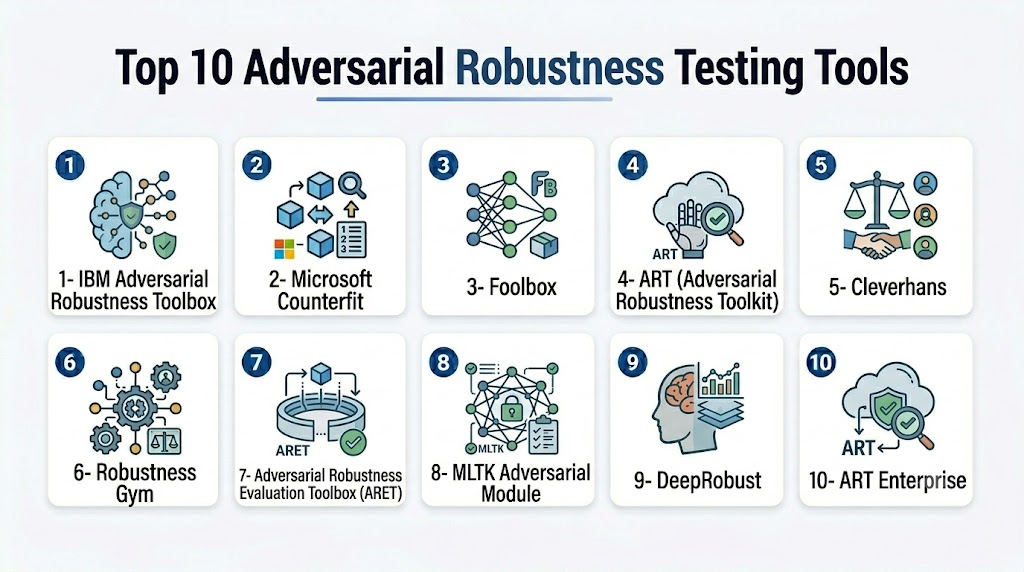
Top 10 Adversarial Robustness Testing Tools
1- IBM Adversarial Robustness Toolbox
Short description: Open-source Python library providing a comprehensive suite for evaluating and mitigating adversarial attacks on machine learning models.
Key Features
- Supports evasion, poisoning, and inference attacks
- Preprocessing, in-processing, and post-processing defense techniques
- Metrics for robustness, perturbation analysis, and attack success rate
- Integration with TensorFlow, PyTorch, and scikit-learn
- Attack libraries for images, text, and audio
- Model hardening techniques and adversarial training support
Pros
- Comprehensive attack and defense toolkit
- Extensive documentation and active community
Cons
- Requires Python and ML expertise
- Some advanced features may require manual tuning
Platforms / Deployment
- Web / Windows / macOS / Linux
- Cloud / Self-hosted
Security & Compliance
Not publicly stated
Integrations & Ecosystem
Integrates with major ML frameworks and MLOps pipelines
- TensorFlow, PyTorch, scikit-learn
- Jupyter notebooks
- CI/CD workflow integration
Support & Community
Active open-source community with extensive tutorials and examples
2- Microsoft Counterfit
Short description: Open-source framework for assessing adversarial robustness of machine learning models and generating attack scenarios.
Key Features
- White-box and black-box attack simulation
- Evaluation of model defenses and adversarial training
- REST API for automation
- Integration with Python ML pipelines
- Visualization of attack impact
Pros
- Easy automation for continuous testing
- Flexible for different attack types
Cons
- Limited GUI; primarily code-based
- Advanced attack strategies require scripting
Platforms / Deployment
- Web / Windows / macOS / Linux
- Cloud / Self-hosted
Security & Compliance
Not publicly stated
Integrations & Ecosystem
- Python ML frameworks
- API and pipeline support
- Docker and cloud deployment compatibility
Support & Community
Community-driven with documentation and code examples
3- Foolbox
Short description: Python library for robust adversarial attack testing on neural networks, widely used in academic and industry research.
Key Features
- Supports a wide range of attack algorithms
- Robustness evaluation metrics
- Multi-framework support (PyTorch, TensorFlow, JAX)
- Easy-to-use API for generating adversarial examples
- Integration with model training pipelines
Pros
- Extensive attack coverage
- Well-documented and research-friendly
Cons
- Limited mitigation strategies
- Requires Python expertise
Platforms / Deployment
- Web / Linux / macOS / Windows
- Cloud / Self-hosted
Security & Compliance
Not publicly stated
Integrations & Ecosystem
- TensorFlow, PyTorch, JAX
- Notebook integration
- Custom pipeline compatibility
Support & Community
Active academic and industry user community
4- ART (Adversarial Robustness Toolkit)
Short description: Toolkit providing evaluation and defense methods for adversarial machine learning, with emphasis on AI security.
Key Features
- Supports multiple attack vectors
- Defense algorithms and adversarial training
- Metrics for robustness and model evaluation
- Multi-domain support for images, text, and audio
- Python library with pipeline integration
Pros
- Comprehensive tool for robustness evaluation
- Open-source and extensible
Cons
- Can be complex to configure for beginners
- Visualization features are limited
Platforms / Deployment
- Web / Windows / macOS / Linux
- Cloud / Self-hosted
Security & Compliance
Not publicly stated
Integrations & Ecosystem
- TensorFlow, PyTorch
- Python ML pipelines
- Docker deployment
Support & Community
Documentation available; community support active
5- Cleverhans
Short description: Python library for benchmarking and evaluating adversarial attacks, maintained for research and industrial use.
Key Features
- Implements state-of-the-art attack algorithms
- Supports robustness testing for neural networks
- Integration with TensorFlow and PyTorch
- Benchmarking tools for model comparison
- Script-based automation for experiments
Pros
- Established research-grade framework
- Continuous updates aligned with new attack methods
Cons
- Minimal GUI support
- Focused on research; enterprise features limited
Platforms / Deployment
- Web / Windows / macOS / Linux
- Cloud / Self-hosted
Security & Compliance
Not publicly stated
Integrations & Ecosystem
- TensorFlow, PyTorch
- Jupyter notebooks
- Custom Python pipelines
Support & Community
Research community support; active GitHub
6- Robustness Gym
Short description: Toolkit for evaluating robustness and generalization of NLP and ML models under adversarial perturbations.
Key Features
- NLP and text attack evaluation
- Integration with Transformer-based models
- Metrics for robustness and accuracy under attacks
- Benchmark datasets for testing
- Modular API for custom evaluations
Pros
- Focused on NLP robustness
- Easy integration with Hugging Face models
Cons
- Primarily NLP-focused
- Limited image/audio support
Platforms / Deployment
- Web / Linux / macOS / Windows
- Cloud / Self-hosted
Security & Compliance
Not publicly stated
Integrations & Ecosystem
- Transformers, PyTorch, TensorFlow
- API for dataset injection
- Evaluation pipelines
Support & Community
Documentation available; community support growing
7- Adversarial Robustness Evaluation Toolbox (ARET)
Short description: Platform for enterprise-level evaluation of ML models against adversarial attacks with reporting capabilities.
Key Features
- Predefined adversarial test suites
- Metrics dashboards for robustness
- Integration with ML pipelines
- Support for multi-domain data
- Automated attack simulations
Pros
- Enterprise-ready with reporting
- Scalable for large datasets
Cons
- Licensing required
- May require technical expertise
Platforms / Deployment
- Web / Windows / Linux
- Cloud / Hybrid
Security & Compliance
Not publicly stated
Integrations & Ecosystem
- Python frameworks
- CI/CD pipelines
- API integration
Support & Community
Enterprise support; documentation provided
8- MLTK Adversarial Module
Short description: Integrated module for evaluating ML model robustness with adversarial attacks and defenses.
Key Features
- Automated adversarial testing
- Metrics for model vulnerability
- Integration with ML frameworks
- Prebuilt attacks and defenses
- Logging and reporting features
Pros
- Integrated with MLOps platforms
- Automation reduces manual testing
Cons
- Limited attack types compared to open-source research tools
- Enterprise deployment may require setup
Platforms / Deployment
- Web / Linux / Windows
- Cloud / Self-hosted
Security & Compliance
Not publicly stated
Integrations & Ecosystem
- TensorFlow, PyTorch
- ML pipelines
- API for automation
Support & Community
Documentation provided; moderate community
9- DeepRobust
Short description: Python library for adversarial attack and defense research, supporting graph and deep learning models.
Key Features
- Graph and image model robustness testing
- Multiple attack and defense algorithms
- Evaluation metrics for robustness
- Integration with deep learning frameworks
- Supports automated pipelines
Pros
- Supports advanced graph models
- Research-oriented and extensible
Cons
- Focused on research, less enterprise-ready
- Requires Python expertise
Platforms / Deployment
- Web / Linux / macOS / Windows
- Cloud / Self-hosted
Security & Compliance
Not publicly stated
Integrations & Ecosystem
- PyTorch, TensorFlow
- Jupyter notebooks
- Pipeline integration
Support & Community
Active academic and research community
10- ART Enterprise
Short description: Commercial version of Adversarial Robustness Toolkit for enterprise-level evaluation and defense of production AI models.
Key Features
- Predefined enterprise attacks
- Advanced dashboards and reporting
- Continuous monitoring for deployed models
- Multi-domain support for images, text, and audio
- Integration with MLOps platforms
Pros
- Enterprise-grade support and automation
- Scalable and production-ready
Cons
- Licensing cost
- May require training for deployment
Platforms / Deployment
- Web / Windows / Linux / macOS
- Cloud / Hybrid
Security & Compliance
Not publicly stated
Integrations & Ecosystem
- Python ML frameworks
- CI/CD integration
- API support
Support & Community
Dedicated enterprise support; documentation included
Comparison Table (Top 10)
| Tool Name | Best For | Platform(s) Supported | Deployment | Standout Feature | Public Rating |
|---|---|---|---|---|---|
| IBM ART 360 | Developers / Data Scientists | Web, Windows, macOS, Linux | Cloud / Self-hosted | Comprehensive attack & defense library | N/A |
| Microsoft Counterfit | Enterprise AI | Web, Windows, macOS, Linux | Cloud / Self-hosted | Automation for attack simulations | N/A |
| Foolbox | Research & Academia | Web, Linux, macOS, Windows | Cloud / Self-hosted | Wide range of attack algorithms | N/A |
| ART Toolkit | AI Security Teams | Web, Windows, macOS, Linux | Cloud / Self-hosted | Multi-domain attack/defense | N/A |
| Cleverhans | Research & Industrial ML | Web, Windows, macOS, Linux | Cloud / Self-hosted | Benchmarking & attack evaluation | N/A |
| Robustness Gym | NLP Models | Web, Linux, macOS, Windows | Cloud / Self-hosted | NLP-focused robustness evaluation | N/A |
| ARET | Enterprise AI | Web, Windows, Linux | Cloud / Hybrid | Dashboards & automated attacks | N/A |
| MLTK Adversarial | ML Teams | Web, Linux, Windows | Cloud / Self-hosted | Integrated automation module | N/A |
| DeepRobust | Graph & Deep Learning | Web, Linux, macOS, Windows | Cloud / Self-hosted | Graph model robustness | N/A |
| ART Enterprise | Production AI | Web, Windows, Linux, macOS | Cloud / Hybrid | Enterprise-level evaluation & monitoring | N/A |
Evaluation & Scoring of Adversarial Robustness Testing Tools
| Tool Name | Core (25%) | Ease (15%) | Integrations (15%) | Security (10%) | Performance (10%) | Support (10%) | Value (15%) | Weighted Total (0–10) |
|---|---|---|---|---|---|---|---|---|
| IBM ART 360 | 9 | 7 | 8 | 7 | 8 | 7 | 9 | 8.1 |
| Microsoft Counterfit | 8 | 8 | 7 | 7 | 8 | 7 | 8 | 7.8 |
| Foolbox | 8 | 7 | 7 | 6 | 8 | 7 | 8 | 7.6 |
| ART Toolkit | 8 | 7 | 8 | 7 | 8 | 7 | 7 | 7.7 |
| Cleverhans | 7 | 7 | 7 | 6 | 7 | 7 | 7 | 7.0 |
| Robustness Gym | 7 | 8 | 7 | 6 | 7 | 7 | 7 | 7.1 |
| ARET | 8 | 7 | 7 | 7 | 8 | 7 | 7 | 7.5 |
| MLTK Adversarial | 7 | 8 | 7 | 6 | 7 | 6 | 7 | 7.0 |
| DeepRobust | 8 | 7 | 7 | 6 | 8 | 6 | 7 | 7.2 |
| ART Enterprise | 9 | 7 | 8 | 7 | 9 | 8 | 6 | 7.9 |
Which Adversarial Robustness Testing Tool Is Right for You?
Solo / Freelancer
Open-source tools like IBM ART 360, Foolbox, and Microsoft Counterfit offer flexibility, low cost, and research-grade capabilities.
SMB
ART Toolkit and Robustness Gym provide scalable solutions for small teams focusing on NLP or standard ML pipelines.
Mid-Market
ARET and MLTK Adversarial enable automated evaluation and reporting with manageable enterprise-grade features.
Enterprise
ART Enterprise and IBM ART 360 provide comprehensive robustness testing, monitoring, and reporting for production models.
Budget vs Premium
Open-source frameworks suit smaller teams; enterprise platforms offer advanced monitoring, automation, and reporting at premium cost.
Feature Depth vs Ease of Use
Enterprise platforms excel in attack coverage, automation, and reporting; research-focused tools are easier for rapid experimentation.
Integrations & Scalability
Choose tools with APIs and CI/CD pipeline support for production deployment. Cloud/hybrid deployment ensures enterprise scalability.
Security & Compliance Needs
For regulated environments, platforms with explicit reporting and monitoring capabilities are preferred; open-source tools require additional validation steps.
Frequently Asked Questions (FAQs)
1- What types of attacks can these tools simulate?
They simulate evasion, poisoning, white-box, black-box, and data perturbation attacks to evaluate model robustness.
2- Can these tools help mitigate attacks?
Some include mitigation algorithms like adversarial training; others focus on evaluation to inform defense strategies.
3- Are they compatible with all AI models?
Most support standard ML frameworks; specialized tools may focus on deep learning, NLP, or graph models.
4- How easy is integration into ML pipelines?
Python libraries and APIs allow embedding in CI/CD and MLOps workflows for continuous robustness evaluation.
5- Can these tools be used for real-time monitoring?
Enterprise platforms like ART Enterprise provide continuous monitoring and alerting for deployed models.
6- Do they provide visualization of attacks?
Many platforms offer dashboards or plots to analyze attack impact and model vulnerability.
7- Are there open-source options?
IBM ART 360, Foolbox, Microsoft Counterfit, and Robustness Gym are widely used open-source solutions.
8- How scalable are these tools?
Enterprise platforms handle large datasets and multiple model deployments, while open-source tools suit research and small-scale evaluation.
9- Do they support multi-modal AI?
Some tools support images, text, audio, and graph data; choose based on your model type.
10- Can they replace human oversight?
No, they complement human evaluation by highlighting vulnerabilities and assisting in defense planning.
Conclusion
Adversarial Robustness Testing Tools are essential for deploying reliable AI. Choosing the right tool depends on model complexity, team expertise, regulatory requirements, and budget. Open-source solutions like IBM ART 360, Foolbox, and Microsoft Counterfit are ideal for experimentation and research, while enterprise platforms such as ART Enterprise and ARET provide automation, monitoring, and reporting for production models. Organizations should start by shortlisting 2–3 tools that align with their use cases and run pilot evaluations to validate robustness metrics. Integrating these tests into ML pipelines and continuously monitoring for new threats ensures AI systems remain resilient and secure. By following a structured approach, companies can deploy trustworthy, high-performance AI that withstands adversarial attacks and maintains stakeholder confidence. This strategy helps mitigate risk while maximizing the reliability and ethical deployment of AI models.

Find Trusted Cardiac Hospitals
Compare heart hospitals by city and services — all in one place.
Explore Hospitals
A key consideration often overlooked is how adversarial testing fits into CI/CD pipelines and continuous model validation. As models change over time, organizations need automated regression testing and monitoring to ensure robustness doesn’t degrade after updates.