Introduction
Infertility is a complex, deeply personal health journey that affects millions of individuals and couples worldwide. Navigating this path requires not only medical expertise but also a supportive environment equipped with the latest advancements in reproductive medicine. IVF clinics and fertility hospitals serve as the cornerstone of this journey, providing the diagnostic precision and therapeutic interventions necessary to assist those struggling to conceive.The importance of choosing a facility with state-of-the-art technology and a team of compassionate experts cannot be overstated, as the success of assisted reproductive technology often hinges on the quality of the care received.At MyHospitalNow, we are dedicated to helping you navigate the complexities of healthcare. In this guide, we will explore the essential aspects of fertility treatment, compare service models among leading centers, and provide the educational foundation you need to make an informed decision for your future.
Understanding Infertility and Assisted Reproductive Technology
In medical terms, infertility is generally defined as the inability to conceive after one year of regular, unprotected intercourse. However, it is a multifaceted condition that can stem from various biological factors in both partners. Assisted Reproductive Technology (ART) refers to all fertility treatments in which both eggs and embryos are handled. The most well-known form of ART is In Vitro Fertilization (IVF). IVF is particularly vital for cases involving tubal blockages, severe male factor infertility, advanced maternal age, or unexplained infertility where conventional treatments have not been successful.
IVF OVERVIEW TABLE
| Aspect | Description |
| Medical Specialty | Reproductive Endocrinology and Infertility (REI) |
| Main Purpose | Facilitating pregnancy through assisted laboratory fertilization |
| Common Conditions | Tubal factor, PCOS, endometriosis, male infertility |
| Key Procedures | Controlled ovarian stimulation, IVF, ICSI, embryo transfer |
| Success Factors | Egg/sperm quality, lab environment, maternal health |
Common Causes of Infertility
Infertility is rarely the result of a single cause. It is often a combination of biological factors that require specialized investigation.
Ovulation Disorders
These are among the most common causes of female infertility, often involving irregular or absent ovulation, which can be triggered by hormonal imbalances or conditions like PCOS.
Blocked Fallopian Tubes
When tubes are damaged or blocked, the egg cannot meet the sperm, or a fertilized embryo cannot travel to the uterus, necessitating interventions like IVF.
Male Factor Infertility
Issues such as low sperm count, poor sperm motility, or abnormal morphology account for a significant portion of fertility challenges.
Hormonal Imbalances
Disruptions in the endocrine system can interfere with the development of eggs or the ability of the uterus to support a pregnancy.
Age-Related Fertility Decline
The quality and quantity of eggs naturally decline as a person ages, which is a major factor in the success rates of fertility treatments.
Unexplained Infertility
In approximately 15-20% of cases, standard medical tests do not reveal a clear cause, though ART procedures can still be highly effective.
INFERTILITY CAUSES TABLE
| Cause | Description | Impact on Fertility |
| Ovulation Issues | Failure of eggs to release | Prevents fertilization |
| Tubal Blockage | Physical obstruction in tubes | Prevents egg-sperm union |
| Male Infertility | Sperm count or motility issues | Reduces fertilization potential |
| Hormonal Problems | Thyroid or prolactin imbalances | Disrupts reproductive cycle |
| Age Factor | Biological clock effects | Diminished ovarian reserve |
| Unexplained Causes | No clear diagnosis | Requires empirical treatment |
Understanding IVF Treatment
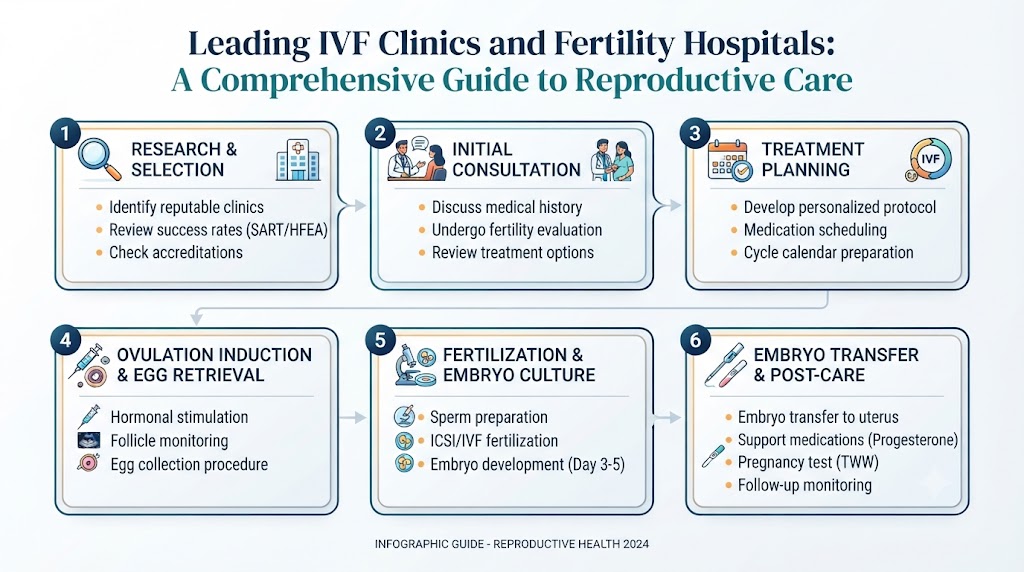
IVF is a multi-stage process that involves stimulating the ovaries, retrieving eggs, and fertilizing them with sperm in a highly controlled laboratory environment. The resulting embryos are then monitored for quality before being transferred to the uterus.
IVF PROCESS TABLE
| Stage | Description | Purpose |
| Ovarian Stimulation | Hormone injections to grow follicles | Produce multiple mature eggs |
| Egg Retrieval | Ultrasound-guided collection | Harvest eggs for the lab |
| Fertilization | Combining eggs and sperm | Creating embryos |
| Embryo Culture | Growing embryos in incubators | Selecting best embryos for transfer |
| Embryo Transfer | Placement into the uterus | Aiming for implantation |
Types of Fertility Treatments
- IVF (In Vitro Fertilization): The process of fertilizing eggs with sperm outside the body.
- IUI (Intrauterine Insemination): A simpler procedure where washed sperm is placed directly into the uterus during ovulation.
- ICSI (Intracytoplasmic Sperm Injection): A specialized form of IVF where a single sperm is injected directly into a mature egg.
- Egg Freezing: Preserving eggs for future use, often for fertility preservation.
- Donor Programs: Utilizing donor eggs, sperm, or embryos for those who cannot conceive with their own gametes.
FERTILITY TREATMENTS TABLE
| Treatment | Best For | Complexity | Success Influence |
| IVF | Complex infertility | High | High |
| IUI | Mild cases/unexplained | Low | Moderate |
| ICSI | Severe male factor | High | High |
| Egg Freezing | Preservation | Moderate | Age at freezing |
| Donor Programs | Diminished reserve | Moderate/High | Donor quality |
Leading IVF Clinics & Fertility Hospitals
When selecting a center, consider their clinical success rates, the expertise of their embryology team, and the technology available in their lab.
Hospital A: The Reproductive Science Institute
- Overview: A globally recognized center focusing on difficult cases.
- Fertility Department: Dedicated team of endocrinologists and counselors.
- Embryology Lab: Uses clean-room technology for optimal embryo growth.
- Specialists: Leaders in research and clinical application.
- Technology: Advanced PGT-A and time-lapse imaging.
- Support: Comprehensive psychological support groups.
Hospital B: Global Fertility & Wellness Center
- Overview: Known for its patient-centric approach and high-volume cycles.
- Department: Integrated approach combining nutrition and medicine.
- Lab: State-of-the-art diagnostic equipment.
- Specialists: Multi-disciplinary team of experts.
- International Care: Specialized concierge services for traveling patients.
HOSPITAL COMPARISON TABLE
| Hospital Name | Location | IVF | IUI | ICSI | Embryology Lab | International |
| Reproductive Science | Major City | Yes | Yes | Yes | Advanced | Excellent |
| Global Fertility | Major City | Yes | Yes | Yes | High-Tech | Dedicated |
Advanced IVF Technologies
Modern laboratories utilize technology to increase the chances of successful embryo implantation.
- Time-Lapse Embryo Imaging: Allows for constant monitoring of embryo development without removing them from the incubator.
- Laser-Assisted Hatching: Helping the embryo emerge from its outer shell to aid implantation.
- Cryopreservation: Advanced vitrification (fast freezing) ensures high survival rates for eggs and embryos.
IVF TECHNOLOGY TABLE
| Technology | Purpose | Benefit |
| Time-Lapse | Continuous imaging | Better embryo selection |
| Cryopreservation | Long-term storage | Flexibility in cycle timing |
| PGT Testing | Genetic screening | Reduces miscarriage risk |
| AI Selection | Data-driven ranking | Higher accuracy |
| Micromanipulation | Precision handling | Critical for ICSI |
Success Factors in IVF Treatment
Success is influenced by maternal age, the underlying cause of infertility, the quality of sperm and eggs, and the clinic’s standard of care. Lifestyle choices such as maintaining a healthy BMI, avoiding smoking, and reducing stress also play a significant role in improving outcomes.
Benefits of Specialized Fertility Hospitals
Specialized centers offer an environment optimized for fertility success, which general hospitals often cannot replicate. This includes specialized heating and air filtration systems in labs to protect sensitive embryos, as well as doctors who focus exclusively on reproductive endocrinology.
BENEFITS TABLE
| Benefit | Why It Matters | Patient Advantage |
| Specialized Care | Focused medical training | Higher accuracy |
| Advanced Labs | Precision equipment | Better embryo development |
| Expert Doctors | Depth of experience | Tailored protocols |
| Personalized Plan | Unique medical history | Optimized success potential |
| Monitoring | Frequent feedback | Faster adjustments |
How to Choose the Right IVF Hospital
- Success Rates: Look for clear, age-adjusted data.
- Lab Quality: Ask about laboratory certifications and air filtration quality.
- Transparency: Ensure all costs, including hidden fees, are explained upfront.
- Doctor Access: Ensure you have direct communication with your primary specialist.
Common Mistakes Patients Make
- Waiting too long: Delaying consultation due to fear or hope of natural conception.
- Prioritizing price over quality: Choosing a clinic solely based on the lowest cost rather than success rates and lab standards.
- Overlooking lifestyle: Failing to address lifestyle factors that impede treatment.
Real-Life Patient Scenarios
- Case 1: A couple with long-standing unexplained infertility succeeded after an IVF cycle customized based on previous failed attempts.
- Case 2: Severe male factor infertility was successfully bypassed using ICSI, highlighting the importance of specialized laboratory techniques.
Future of Fertility Treatment
The future of fertility medicine is moving toward increased personalization using AI and robotics. AI is already being used to analyze thousands of embryo images to select those with the highest implantation potential, while genetic screening continues to become more precise.
FUTURE OF IVF TABLE
| Innovation | Potential Benefit |
| AI Embryology | Reduced bias in selection |
| Genetic Screening | Better screening accuracy |
| Robotics | Improved consistency |
| Cryopreservation | Enhanced viability |
| Personalized Medicine | Tailored hormone dosing |
FAQs
- What is IVF? A process where eggs are fertilized by sperm in a lab.
- Who needs fertility treatment? Anyone struggling to conceive after one year of regular efforts.
- Is IVF painful? Most experience mild discomfort during injections and retrieval, but it is manageable.
- How long does IVF take? One cycle typically takes 4–6 weeks.
- What is the success rate? It varies widely based on age and clinical factors.
- Difference between IVF and IUI? IVF involves lab fertilization; IUI is internal.
- What are the risks? Ovarian Hyperstimulation Syndrome (OHSS) and multiple pregnancies.
- Can IVF guarantee pregnancy? No, no medical procedure can guarantee a result.
- How do I choose the best hospital? By reviewing lab quality and doctor expertise.
- Do lifestyle changes help? Yes, smoking cessation and healthy weight management are critical.
- What is ICSI? A method for injecting sperm into an egg.
- Is genetic testing necessary? It depends on individual history and maternal age.
- How many embryos are transferred? Usually one to reduce risks.
- What is egg freezing? Storing eggs for later use.
- Does insurance cover it? It varies significantly by policy and region.
Final Thoughts
Choosing a fertility clinic is one of the most significant decisions in a prospective parent’s life. By focusing on facilities that prioritize state-of-the-art laboratory technology, specialized expertise, and transparent patient care, you provide yourself with the best possible foundation for your journey.For more information and to compare leading providers, visit MyHospitalNow to find the resources and guidance you need to make informed decisions for your reproductive health.

Find Trusted Cardiac Hospitals
Compare heart hospitals by city and services — all in one place.
Explore Hospitals