Introduction
Navigating the intricate matrix of financial regulations, corporate taxation, and statutory compliance requires deep technical expertise. Whether you are an individual taxpayer aiming to optimize tax liability, an ambitious startup founder planning seamless company incorporation, or an established multi-state enterprise maintaining Goods and Services Tax (GST) compliance, securing qualified financial advisory is critical. Many business owners search for a chartered accountant near me or explore an BestCaNow to bridge knowledge gaps and prevent costly compliance oversights.A certified accounting professional serves as a strategic business partner rather than a simple ledger keeper. From statutory audits and tax filing to cross-border transfer pricing and Ministry of Corporate Affairs (MCA) filings, their role directly impacts organizational scalability and regulatory standing. Finding the right financial advisor tailored to your industry, scale, and functional scope remains a foundational business decision.
Understanding the Role of a Chartered Accountant
A Chartered Accountant (CA) is a credentialed professional certified by a recognized statutory governing body, such as the Institute of Chartered Accountants of India (ICAI). Unlike general bookkeepers who focus on day-to-day transaction entry, CAs possess specialized training in statutory auditing, advanced corporate tax planning, financial forensic analysis, financial reporting under Indian Accounting Standards (Ind AS) or International Financial Reporting Standards (IFRS), and financial structure design.
+-----------------------------------------------------------------------+
|                     CORE CHARTERED ACCOUNTANCY SCOPE                  |
+-----------------------------------------------------------------------+
|                                                                       |
|   [Statutory & Tax Audit] ------> Rigorous Financial Verification     |
|   [Taxation Strategy]     ------> Direct & Indirect Tax Optimization  |
|   [Regulatory Compliance] ------> MCA, ROC, GST, & TDS Filing         |
|   [Corporate Advisory]    ------> Valuation, Mergers, & Restructuring |
|                                                                       |
+-----------------------------------------------------------------------+
When you find a chartered accountant through a curated chartered accountant directory, you connect with verified experts who uphold strict technical and ethical standards. Their primary responsibility involves ensuring that your financial statements reflect a true and fair view while optimizing liabilities within legal boundaries.
Why Professional CA Services Matter for Modern Enterprises
Financial management extends far beyond basic recordkeeping. Evolving regulatory frameworks, dynamic tax policies, and digital tax monitoring mechanisms mean non-compliance can trigger severe penalties, interest charges, and operational disruptions.
Financial Integrity and Statutory Safeguards
Collaborating with a dedicated income tax consultant near me ensures that all income streams, deductions, allowances, and exemptions comply with applicable tax codes. Reliable advisory mitigates risks associated with income tax notices, scrutiny audits, and reassessments.
Operational Scalability and Governance
As businesses scale from single-owner setups to multi-shareholder entities, financial documentation complexity increases. Certified professionals establish robust internal financial controls, stream line cash flow projections, and prepare bankable project reports essential for securing equity investment or institutional capital.
Key Services Offered by Chartered Accountants
Professional accounting firms deliver a wide range of specialized services tailored to varied organizational setups and individual financial needs.
1. Direct and Indirect Taxation
Tax services encompass direct taxes—such as individual and corporate income tax, Tax Deducted at Source (TDS), and capital gains strategy—alongside indirect tax administration. Engaging a qualified GST consultant near me ensures accurate Tax Credit (ITC) reconciliation, error-free monthly or quarterly return submissions (GSTR-1, GSTR-3B, GSTR-9), and swift resolution of tax notices.
2. Audit and Assurance
Audit services provide independent verification of financial records. Engaging professional audit services near me guarantees thorough examination across statutory audits, tax audits under section 44AB, internal control evaluations, and specialized forensic audits required by financial institutions or regulatory bodies.
                               ┌──> Statutory Audit (Annual / Legal Mandate)
                               │
Financial Records Examination ─┼──> Tax Audit (Section 44AB Compliance)
                               │
                               └──> Internal Audit (Operational Control & Risk)
3. Corporate Law and Compliance
CA professionals manage statutory filings required by the Registrar of Companies (ROC) and the MCA. This includes annual return filings (MGT-7, AOC-4), director identification updates (DIR-3 KYC), statutory register management, and capital structure modifications.
Benefits for Individuals, Small Businesses, and MSMEs
| Stakeholder Category | Primary Financial Pain Point | CA Solution & Value Add |
| Individual Taxpayers | Complex salary structures, capital gains, multiple bank accounts | Maximized deduction filing, accurate loss set-off, notice management |
| Micro & Small Enterprises | Inconsistent cash flow, unorganized invoicing, manual bookkeeping | Automated bookkeeping systems, working capital management, GST filing |
| Medium Enterprises (MSMEs) | Regulatory audits, complex vendor ITC tracking, funding limits | Statutory audit compliance, detailed cost accounting, debt syndicate support |
Working with certified professionals gives business leaders clear financial visibility, allowing them to focus on operational growth while maintaining complete compliance.
Startup and MSME Use Cases: Building a Solid Foundation
Early-stage ventures operate under unique capital constraints and aggressive timelines. Engaging a dedicated CA for startups early prevents legal missteps during incorporation, equity dilution, or investor due diligence.
Entity Structuring and Registration
Selecting the right business format during early establishment directly influences tax rates, founder liability, and fundraising capabilities. A competent CA for company registration guides founders through name approval, digital signature acquisition, drafting Memorandum and Articles of Association (MOA/AOA), and obtaining essential tax registrations (PAN, TAN, GST, MSME/Udyam).
Pitch Preparation and Financial Modeling
Investors expect clean financial data. Accounting professionals assist founders by drafting 3-to-5-year financial projections, business valuations, cap table management plans, and regulatory compliance certificates needed for Seed or Series funding rounds.
Comparison Table 1: In-House Accountant vs. External Chartered Accountant
| Feature / Attribute | In-House Accountant | External Chartered Accountant |
| Core Responsibilities | Day-to-day data entry, basic invoicing, routine payroll ledger updates | Statutory audit, complex tax strategy, regulatory filings, corporate advisory |
| Technical Expertise | Operational bookkeeping and basic accounting software knowledge | Advanced statutory knowledge, certified qualification (ICAI), continuous legal training |
| Statutory Authority | Cannot sign statutory audit reports, tax audit returns, or regulatory certifications | Authorized by law to audit, certify, and sign financial statements and legal returns |
| Cost Structure | Fixed monthly salary, benefits, office space, training overhead | Retainer or project-based fees scaled to scope and business size |
| Best Use Cases | Processing daily business transactions and managing routine internal recordkeeping | Strategic tax planning, corporate compliance, external reporting, and statutory audits |
NRI Tax and Compliance Considerations
Non-Resident Indians (NRIs) face intricate cross-border tax considerations governed by national tax codes and Double Taxation Avoidance Agreements (DTAA). Consulting a knowledgeable NRI tax consultant in India helps manage complex cross-border financial transactions.
       [NRI Foreign Earned Income]             [NRI Indian Sourced Income]
                    │                                       │
                    ▼                                       ▼
      Exempt from Indian Tax (FEMA)            Subject to Indian IT Act / TDS
                    │                                       │
                    └───────────────┬───────────────────────┘
                                    │
                                    ▼
                      Apply DTAA Tax Credits (Form 10F / TRC)
Key NRI Advisory Areas
- Determination of Residential Status: Precise calculation of physical stay days under Section 6 of the Income Tax Act to determine taxable global income.
- Repatriation of Funds: Issuance of Form 15CA and Form 15CB certifications required by financial institutions to repatriate capital or income earned in India.
- Property Transactions: Tax planning for real estate purchases or sales, including reduced TDS applications under Section 195.
Company Registration Process: Step-by-Step Compliance
Registering a commercial business requires careful adherence to statutory processes overseen by the Ministry of Corporate Affairs (MCA).
Phase 1: Pre-Incorporation Preparation
- Obtain Digital Signature Certificates (DSC) for all proposed directors.
- Apply for Director Identification Numbers (DIN).
- Submit name reservation applications through the SPICe+ Part A portal.
Phase 2: Registration Submission
- Complete SPICe+ Part B forms, including legal details, registered address proof, and subscriber info.
- File linked e-forms: AGILE-PRO-S (for GSTIN, EPFO, ESIC, Professional Tax, and Bank Account setup) alongside INC-9.
- Pay registration fees and stamp duties to receive the Certificate of Incorporation (CoI) containing the Corporate Identification Number (CIN).
Comparison Table 2: Sole Proprietorship vs. LLP vs. Private Limited Company
| Feature | Sole Proprietorship | Limited Liability Partnership (LLP) | Private Limited Company (Pvt Ltd) |
| Legal Status | No separate legal entity from the owner | Separate legal entity distinct from partners | Separate legal entity distinct from shareholders |
| Owner Liability | Unlimited personal liability for business debts | Limited to agreed contribution | Limited to unpaid share capital amount |
| Compliance Load | Minimal (basic income tax return and GST filing) | Moderate (Form 11, Form 8 annual filings) | High (ROC filings, AOC-4, MGT-7, mandatory statutory audit) |
| Fundraising Ability | Extremely limited (personal loans or credit lines) | Moderate (partner contributions or debt) | High (ability to issue equity, preference shares, or ESOPs) |
| Best Use Cases | Micro-merchants, local shops, solo freelancers | Professional service firms, medium-sized service businesses | High-growth startups, scalable ventures, investor-backed platforms |
Tax and GST Compliance Frameworks
Maintaining consistent tax compliance prevents administrative blocks, penal interest, and statutory notices.
Direct Tax Management
Timely payment of Advance Tax in quarterly installments (15%, 45%, 75%, and 100%) prevents statutory interest charges under Sections 234B and 234C. Furthermore, proper monthly deduction and deposit of TDS—followed by quarterly filing of Form 24Q and 26Q—ensures tax credit alignment for payees.
Indirect Tax (GST) Management
GST compliance relies on continuous invoice matching. Businesses must reconcile outward supplies reported in GSTR-1 with inward supplies captured in GSTR-2B before submitting GSTR-3B returns. Mismatches can lead to Input Tax Credit (ITC) disallowance and interest demands.
Comparison Table 3: Online CA Consultation vs. Traditional In-Person CA Advisory
| Feature / Attribute | Online CA Consultation | Traditional In-Person CA Advisory |
| Accessibility | Geographic independence; book nationwide experts online | Limited to local, geographically reachable physical offices |
| Document Exchange | Encrypted cloud portals, secure document sharing, and digital signing | Physical paper delivery, manual sign-offs, and in-person file handovers |
| Turnaround Time | Faster query resolution via digital scheduling tools | Longer turnaround due to scheduled physical meetings |
| Cost Efficiency | Lower overhead costs translate to competitive service rates | Higher administrative and operational overhead reflected in billing |
| Best Use Cases | Digital startups, remote founders, busy professionals, and NRIs | Complex local audits, physical asset verifications, and traditional family businesses |
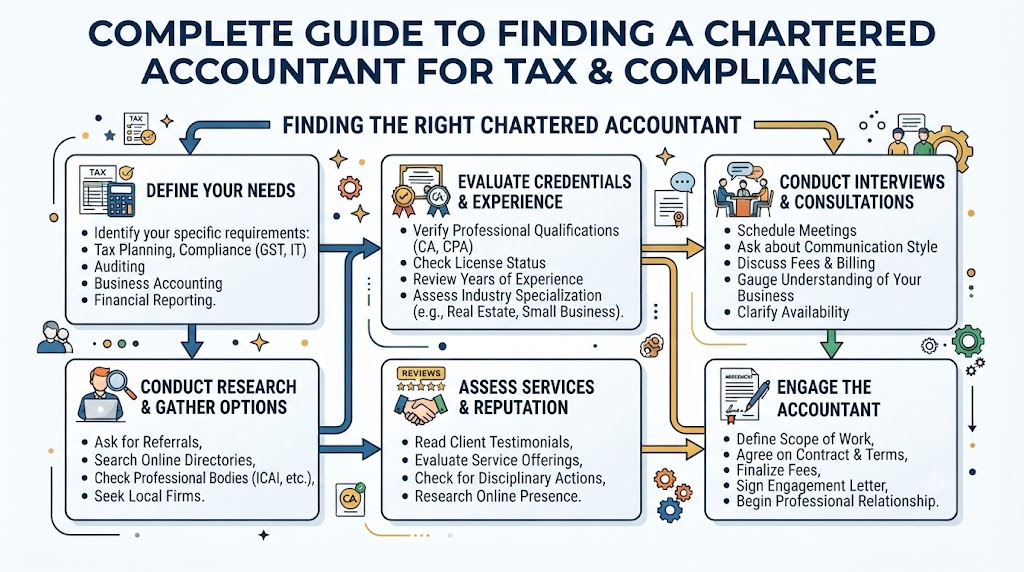
How to Choose the Right Chartered Accountant
Selecting a qualified financial professional requires careful evaluation across clear operational parameters:
- Verify Credentials: Ensure active membership registration with the official governing body (such as ICAI) and confirm a valid Certificate of Practice (COP).
- Assess Domain Specialization: Verify whether the firm specializes in your specific operational area—such as e-commerce tax, cross-border NRI transactions, or manufacturing cost audits.
- Evaluate Digital Infrastructure: Modern practices leverage secure cloud accounting, encrypted file transfers, and video consultation tools to maintain operational efficiency.
- Transparent Pricing Structure: Choose professionals who provide clear scope-of-work documentation and transparent retainer or project-based fee models.
Best Practices for Enterprise Financial Management
- Maintain Digital Invoicing Controls: Implement automated e-invoicing and real-time ledger updates to simplify quarterly audits and tax calculations.
- Conduct Monthly ITC Reconciliations: Match purchase ledgers against GSTR-2B data monthly to identify missing vendor uploads and protect tax credits.
- Separate Personal and Business Capital: Keep dedicated business bank accounts to preserve clear corporate records and simplify statutory reviews.
- Schedule Periodic Statutory Reviews: Review internal controls and tax compliance calendars quarterly to avoid last-minute deadline rushes.
- Archive Financial Records Securely: Maintain electronic backups of primary vouchers, tax invoices, and bank statements for at least eight fiscal years.
Expert Tips for Business Owners and Individual Taxpayers
Pro Tip 1: Do not wait until the final quarter to plan taxes. Conduct a comprehensive tax projection in the second quarter to make informed investments and business purchases.
Pro Tip 2: Startups should issue share capital strictly within Fair Market Value (FMV) benchmarks certified by registered valuers to avoid unexpected tax implications.
Pro Tip 3: NRIs selling property in India should apply for a Lower Deduction Certificate (Form 13) before transaction completion to avoid long-term capital lockup in high TDS withholdings.
Pro Tip 4: Maintain a centralized digital compliance repository tracking ROC, GST, TDS, and income tax submission receipts for rapid investor due diligence.
Common Mistakes to Avoid in Accounting and Taxation
Delaying Annual Tax and Statutory Filings
Deferring return filings until final due dates increases the risk of technical delays, statutory late fees, and penal interest charges under tax codes.
Choosing Financial Advisory Solely on Lowest Price
Selecting accounting support based exclusively on cheap pricing often results in missed compliance steps, overlooked tax deductions, or inadequate notice response capabilities.
Inconsistent Bookkeeping Practices
Updating accounting records only at year-end leaves business leaders without real-time financial visibility and increases invoice reconciliation errors.
       [Year-End Ledger Entry]  ──────> High Errors & Disallowed Tax Credits
                 vs
       [Monthly Reconciliations] ──────> Clean Audit Trail & Maximized Cash Flow
Neglecting GST Vendor Compliance Monitoring
Failing to verify that vendors file GSTR-1 returns regularly can cause your business to lose eligible Input Tax Credits, inflating tax liabilities.
Future Trends in Digital Accounting and Financial Consulting
The corporate accounting landscape continues to evolve through dynamic digital platforms:
- Automated Reconciliation Systems: Artificial intelligence and machine learning models streamline bank statement categorization and vendor invoice matching.
- Real-Time Tax Submissions: Tax authorities increasingly require direct system-to-system data integration, such as mandatory e-invoicing and e-way bill generation.
- Cloud Advisory Directories: Centralized digital platforms allow businesses and individuals to discover verified specialists across regions, specialized domains, and consultation formats.
Why Choose BestCaNow for Discovering Financial Experts
Connecting with qualified financial professionals should be transparent, efficient, and reliable. BestCaNow serves as a digital directory and consultation platform that bridges the gap between individuals, startups, and certified financial professionals.
- Verified Professional Profiles: Access curated profiles detailing qualifications, industry experience, and technical specializations.
- Flexible Engagement Models: Filter searches based on location, service area, or preferred communication mode—whether you need in-person support or an online CA consultation.
- Comprehensive Service Scope: Find qualified professionals across corporate registration, income tax advisory, GST compliance, cross-border NRI taxation, and statutory auditing.
Frequently Asked Questions (FAQs)
1. What is the main difference between a bookkeeper and a Chartered Accountant?
A bookkeeper handles routine financial recordkeeping, daily ledger entries, and invoice generation. A Chartered Accountant possesses professional certification to perform statutory audits, design tax strategies, file regulatory returns, and represent clients before tax authorities.
2. How do I verify if a Chartered Accountant is validly certified?
You can verify a professional’s credential by requesting their ICAI Membership Number and checking their active status through the official Institute of Chartered Accountants of India portal or firm register.
3. Why should a startup hire a CA before company incorporation?
Consulting a financial professional prior to registration ensures you select the optimal business structure (such as LLP or Private Limited), draft balanced cap tables, secure tax exemptions, and set up compliant accounting systems from day one.
4. What documents are required for online GST registration through a CA?
Key requirements include owner or director PAN and Aadhaar cards, business registration proof, bank details (cancelled cheque), registered address proof (utility bill or rental agreement), and board authorization letters.
5. Can an online CA consultation fulfill all statutory tax filing requirements?
Yes. Modern digital platforms allow secure document transmission, electronic signature integration, and remote consultations, enabling qualified professionals to manage complete tax filing remotely.
6. What penalties occur if a business misses the Income Tax Return filing deadline?
Failing to file within statutory due dates attracts late fees under Section 234F, penal interest on unpaid tax balances, loss of carry-forward provisions for business losses, and potential tax scrutiny notices.
7. How often should a business reconcile its GST Input Tax Credit?
Businesses should perform ITC reconciliations monthly by matching internal purchase registers against auto-populated GSTR-2B forms to ensure full credit claims before filing GSTR-3B.
8. What specialized services do CAs provide for NRI tax management?
CAs assist NRIs with residential status evaluations, Double Taxation Avoidance Agreement (DTAA) tax relief claims, Form 15CA/CB certifications for fund repatriation, and property sale tax optimization.
9. What is a statutory tax audit, and who requires one?
A tax audit under Section 44AB involves an independent review of business accounts to ensure compliance with tax laws. It is mandatory for businesses or professionals exceeding prescribed annual turnover thresholds.
10. How does hiring a CA help a small business save money on taxes?
Qualified professionals identify legitimate business deductions, optimize capital expenditure depreciation, structure tax-efficient payrolls, and prevent expensive non-compliance penalties.
11. What is the difference between an Internal Audit and a Statutory Audit?
An internal audit focuses on operational efficiency and risk management for internal board review, whereas a statutory audit is a legally required examination of financial statements for shareholders and regulators.
12. What steps are involved in obtaining Form 15CB for foreign remittances?
A Chartered Accountant examines the underlying remittance contracts, evaluates tax liability under national tax codes and applicable DTAA terms, calculates mandatory TDS, and issues an e-certified Form 15CB.
13. Is a physical meeting necessary when working with a Chartered Accountant?
No. Most financial advisory, tax filing, corporate registration, and compliance monitoring tasks can be completed efficiently online using cloud management platforms and secure communication channels.
14. What ROC annual compliance forms must a Private Limited Company submit?
A Private Limited Company must file Form AOC-4 (financial statement submissions) and Form MGT-7 (annual returns) with the Registrar of Companies every fiscal year, along with required director KYC updates.
15. How do I choose the right CA firm on BestCaNow?
Evaluate directory profiles based on specialized service requirements, years of industry experience, verified credentials, location preferences, and client feedback to find an expert aligned with your business needs.
Conclusion
Navigating corporate finance, statutory audits, complex taxation, and regulatory compliance requires steady professional guidance. Choosing the right financial advisor—whether for personal tax planning, startup incorporation, MSME accounting, or NRI cross-border compliance—ensures long-term stability and shields your enterprise from legal risks.
By prioritizing proactive tax planning, systematic bookkeeping, and regular audit reviews, individuals and businesses can make confident, informed financial decisions. Utilizing modern digital platforms simplifies finding verified experts tailored to your operational scale and domain requirements.

Find Trusted Cardiac Hospitals
Compare heart hospitals by city and services — all in one place.
Explore Hospitals