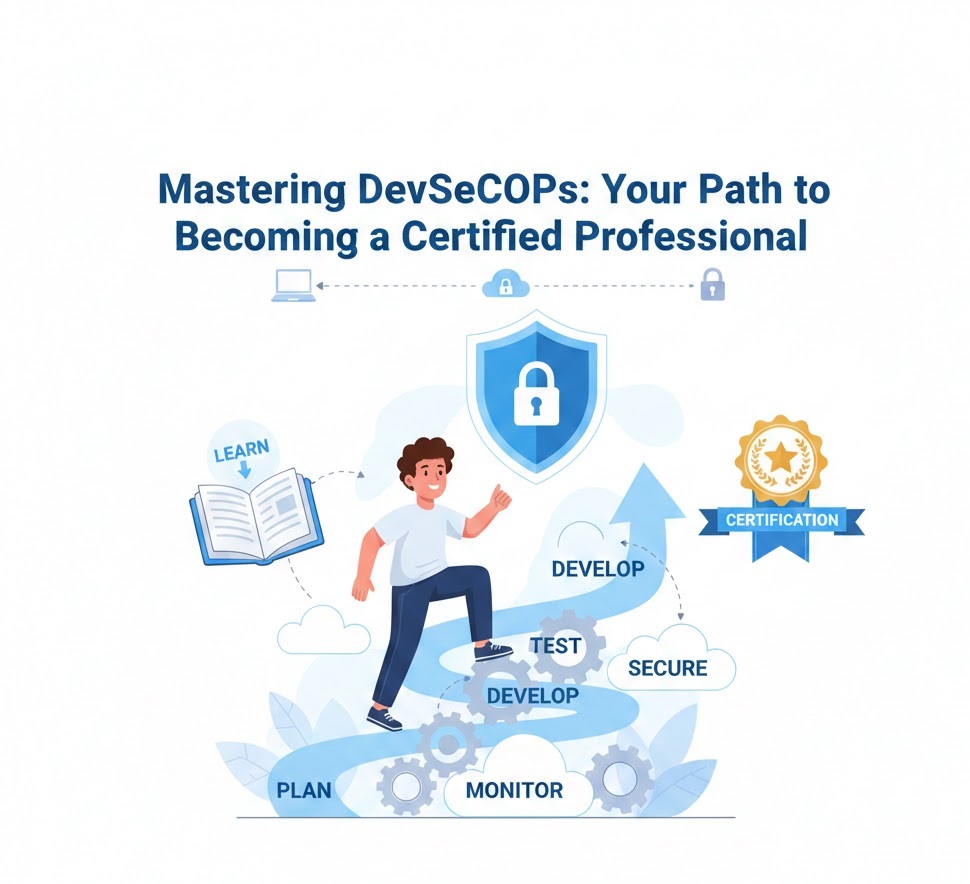
Introduction
As organizations continue to embrace cloud computing and adopt agile practices, the speed at which software is developed and delivered has drastically increased. However, with this rapid pace comes an equally fast-growing security threat landscape. While teams work tirelessly to push code into production, vulnerabilities can slip in early, with catastrophic downstream effects. This is where DevSecOps becomes invaluable — and specifically the DevSecOps Certified Professional (DSOCP) certification.The DSOCP certification is crafted to equip professionals with the skills needed to integrate security into the DevOps process, ensuring it becomes a continuous, automated, and measurable component of the software delivery pipeline — rather than an afterthought.This guide will cover everything you need to know about the DSOCP certification: its significance, the skills it imparts, the preparation process, the common mistakes to avoid, career progression, and much more. Let’s dive in!
Why DevSecOps Matters
For Engineers
Security challenges often arise when changes occur in the development pipeline. Whether it’s an update to a library, a small tweak to a configuration, or even a new automated deployment, security risks are constantly evolving. DevSecOps helps engineers address these risks head-on by embedding security directly into the development pipeline. This way, security is automatically checked, ensuring that vulnerabilities are caught early, before they reach production.
Key Benefits:
- Proactive security checks with every code change
- Automated security enforcement throughout the pipeline
- Increased visibility into security risks
- Fewer vulnerabilities in production due to early detection
For Managers
Managers are tasked with delivering software efficiently while ensuring that security is not compromised. DevSecOps with DSOCP equips managers to set measurable security standards and ensure accountability across teams for secure delivery. With DevSecOps, security becomes an integral part of the delivery process, reducing the likelihood of costly firefighting and ensuring predictable, secure releases.
Key Benefits:
- Increased security compliance across teams
- Reduced risks in the software delivery process
- Clear accountability for security practices
- Proactive rather than reactive security management
Certification Table
| Certification | Track | Level | Who It’s For | Prerequisites | Skills Covered | Recommended Order |
|---|---|---|---|---|---|---|
| Master in DevOps Engineering (MDE) | DevOps + DevSecOps + SRE | Master | End-to-end engineers & managers | None | DevOps + DevSecOps + SRE tools & projects | 4 |
| DevSecOps Certified Professional (DSOCP) | DevSecOps | Professional | DevOps & security-focused engineers | CI/CD + Git + Linux (recommended) | Secure pipelines, security automation, runtime basics | 2 |
| Docker Certified Associate (DCA) | Containers | Associate | Developers & DevOps | Docker basics | Docker images, runtime, registries | 1–2 |
| Certified Kubernetes Administrator (CKA) | Kubernetes | Professional | Platform/SRE | Docker + Linux basics | Cluster operations & workloads | 3–4 |
| SRE | Site Reliability Engineering | Professional | SRE, Ops, Platform | Monitoring + Incident basics | Reliability & on-call discipline | 3 |
| Splunk Master in Splunk Engineering | Observability / SecOps | Advanced | Monitoring/SOC engineers | Log basics | Dashboards, alerts | Optional |
| Python Master in Python Programming | Programming | Foundation+ | Automation engineers | None | Scripting & automation | Optional |
What is DSOCP?
What It Is
The DevSecOps Certified Professional (DSOCP) certification is a security-focused qualification designed to teach you how to incorporate security at every stage of the DevOps lifecycle. By learning to design and automate secure workflows, you’ll be able to handle security concerns earlier in the process.
Who Should Take It
- DevOps Engineers focused on automation and secure software delivery
- Platform Engineers securing deployment pipelines
- Security Engineers transitioning into DevSecOps roles
- Cloud Engineers safeguarding cloud-native infrastructure
- Engineering Managers guiding teams to safe and secure deliveries
Skills You’ll Gain
After earning the DSOCP certification, you will be able to:
- Build secure CI/CD pipelines with automated security checks
- Define and enforce security policies and gates
- Manage vulnerabilities in dependencies and ensure secure software supply chains
- Apply secrets management and container security
- Implement security best practices for Kubernetes clusters and cloud environments
- Detect and respond to security incidents in live environments
Real-World Projects You Should Be Able to Do
After completing DSOCP, you will be prepared to work on:
- Secure CI/CD Pipeline – Automate code testing, dependency scanning, and security checks.
- Container Security Workflow – Harden container images, define vulnerability thresholds.
- Kubernetes Security Implementation – Enforce RBAC and namespace isolation in Kubernetes.
- Secrets Management – Safely manage secrets, with automatic rotation and injection.
- Vulnerability Management – Set severity rules, define fix SLAs, and track exceptions.
Preparation Plan
7–14 Days (Fast Track)
Perfect for professionals with prior knowledge:
- Day 1–2: Learn CI/CD basics, Git, and Linux fundamentals
- Day 3–4: Dive into dependency management and build security
- Day 5–6: Study container security and cloud security essentials
- Day 7–9: Learn Kubernetes security and cloud security policies
- Day 10–12: Create a secure CI/CD pipeline
- Day 13–14: Review and practice exam questions
30-Day Plan (Balanced)
A well-rounded approach for DevOps professionals:
- Week 1: Study CI/CD and deployment fundamentals
- Week 2: Learn secure SDLC practices and threat modeling
- Week 3: Dive into container and Kubernetes security
- Week 4: Learn cloud security, IAM, and incident response
60-Day Plan (Career Transition)
For those new to DevSecOps or transitioning into a new role:
- Weeks 1–2: Strengthen DevOps foundations
- Weeks 3–4: Focus on DevSecOps and pipeline security
- Weeks 5–6: Learn cloud security and runtime security best practices
- Weeks 7–8: Complete hands-on projects and prepare for exams
Common Mistakes to Avoid
- Assuming security scans are sufficient without context and decision-making
- Blocking all traffic immediately, instead of gaining visibility first
- Not tracking exceptions or managing them effectively
- Storing secrets in code repositories
- Using overly permissive cloud roles for convenience
- Relying solely on build-time security checks without runtime visibility
Best Next Certification After DSOCP
Same Track (DevSecOps Depth)
Deepen your skills in policy enforcement, security automation, and implementing reusable guardrails.
Cross-Track (Platform/Kubernetes)
Expand your expertise into Kubernetes security, enhancing platform engineering skills.
Leadership Path
Focus on scalable security governance and team leadership with certifications like CISSP (Certified Information Systems Security Professional).
Choose Your Path
Select a learning path based on your career goals and interests. Each path focuses on specific skills that will help you excel in your chosen domain:
- DevOps Path: Focus on automating CI/CD, infrastructure as code (IaC), and deployments. Outcome: Reliable deployments and faster release cycles.
- DevSecOps Path: Integrate security into the DevOps pipeline with automated testing, vulnerability scanning, and security policies. Outcome: Early detection of risks and secure delivery.
- SRE Path: Focus on reliability, uptime, and incident response using SLIs/SLOs and monitoring. Outcome: Ensured system reliability and minimal downtime.
- AIOps/MLOps Path: Apply AI/ML to automate operational tasks, predict issues, and improve system performance. Outcome: Smarter, data-driven operations.
- DataOps Path: Manage and automate data pipelines, ensuring data quality, availability, and compliance. Outcome: Streamlined data workflows for faster decision-making.
- FinOps Path: Optimize cloud costs through financial management and budgeting. Outcome: Cost predictability and reduced cloud spend.
Role → Recommended Certifications
| Role | Recommended Certification |
|---|---|
| DevOps Engineer | CI/CD + DSOCP (Secure Delivery) |
| SRE | DevSecOps + SRE |
| Platform Engineer | Kubernetes + DSOCP |
| Cloud Engineer | Cloud Security + DSOCP |
| Security Engineer | DevSecOps + Runtime Security |
| Data Engineer | DataOps + DevSecOps |
| FinOps Practitioner | FinOps + DevSecOps |
| Engineering Manager | Leadership + DSOCP |
Top Institutions for DSOCP Training & Certification
When preparing for the DevSecOps Certified Professional (DSOCP) certification, it’s essential to choose the right training provider that offers in-depth, hands-on experience and expert guidance. Here are some of the leading institutions that provide comprehensive training and certification support for DevSecOps professionals:
- DevOpsSchool
- Overview: A trusted name in DevOps and DevSecOps training, DevOpsSchool offers structured, practical training with real-world projects designed to help you pass the DSOCP exam.
- Why Choose: They provide expert-led courses with a focus on real-world scenarios, ensuring that you learn practical skills applicable to today’s fast-paced software delivery environments.
- Cotocus
- Overview: Cotocus is known for its hands-on training and industry-relevant curriculum. They offer specialized DevSecOps courses aimed at helping professionals implement secure DevOps practices.
- Why Choose: Their training includes practical workshops and case studies that focus on deploying secure CI/CD pipelines, vulnerability management, and incident response.
- Scmgalaxy
- Overview: Scmgalaxy provides a wide range of DevSecOps training courses, including DevSecOps certification preparation. Their curriculum is tailored to meet industry standards, focusing on automation, continuous security, and compliance.
- Why Choose: With interactive learning sessions and project-based training, Scmgalaxy ensures that you gain hands-on experience that directly applies to the DSOCP exam and real-world job responsibilities.
- BestDevOps
- Overview: BestDevOps offers career-focused training with an emphasis on practical skills and exam preparation. Their courses include both foundational and advanced topics in DevOps and DevSecOps.
- Why Choose: They focus on making professionals job-ready with real-world projects and in-depth theoretical lessons that cover everything from CI/CD security to cloud-native security practices.
- devsecopsschool
- Overview: As a specialized school for DevSecOps, devsecopsschool offers detailed training that dives deep into integrating security practices into DevOps workflows.
- Why Choose: Their courses are designed specifically for security-first engineers, ensuring you gain the security knowledge necessary to excel in the DSOCP exam and in real-world DevSecOps roles.
- sreschool
- Overview: Focused on Site Reliability Engineering (SRE) alongside DevSecOps, sreschool provides a comprehensive learning path that includes incident management, security practices, and system reliability.
- Why Choose: If you want to combine SRE with DevSecOps, sreschool offers training that integrates both reliability and security practices to help you build resilient, secure systems.
- aiopsschool
- Overview: This institution focuses on AIOps (Artificial Intelligence for IT Operations) combined with DevSecOps principles. Their courses explore intelligent automation, security automation, and how to leverage AI/ML for better operations and security.
- Why Choose: Ideal for professionals who want to enhance their operational capabilities using AI/ML tools while ensuring secure software delivery processes.
- dataopsschool
- Overview: DataOpsSchool specializes in DataOps training with a focus on securely managing data pipelines and maintaining data quality in the DevSecOps pipeline.
- Why Choose: Perfect for those interested in data security and governance within DevSecOps, offering training on securing data pipelines, automating data workflows, and ensuring compliance.
- finopsschool
- Overview: FinOpsSchool offers specialized training in FinOps, the practice of managing cloud financial operations, while integrating security best practices within DevOps workflows.
- Why Choose: If you want to manage cloud costs effectively while ensuring the security of your infrastructure, FinOpsSchool combines financial optimization with secure delivery practices.
FAQs on DevSecOps Certified Professional (DSOCP)
- What is DSOCP?
- DSOCP certifies your ability to integrate security into DevOps pipelines.
- Who should pursue it?
- DevOps, security, cloud, and platform engineers, as well as managers aiming for secure delivery pipelines.
- What skills will I gain?
- Secure CI/CD pipelines, automated security checks, vulnerability management, and cloud-native security.
- How long is the preparation?
- Typically 30–60 days, depending on experience.
- Prerequisites for DSOCP?
- Basic knowledge of CI/CD, Git, and Linux is recommended.
- What is the exam format?
- The exam consists of multiple-choice questions on DevSecOps practices.
- Cost of DSOCP?
- Usually ranges from $300 to $600.
- What is the passing score?
- Typically a 70% or higher.
- How does DSOCP benefit my career?
- It boosts your expertise in integrating security into DevOps, making you more marketable.
- Common preparation mistakes?
- Focusing only on tools, ignoring runtime security, and neglecting automation.
- Do I need to renew my DSOCP?
- No renewal required, but continuous learning is recommended.
- Next certification after DSOCP?
- DevSecOps Certified Specialist (DSS), CCSP, or CISSP for leadership.
FAQs
- What is DSOCP?
DSOCP is a certification focused on integrating security practices into the DevOps lifecycle. - Who should take DSOCP?
Ideal for DevOps engineers, platform engineers, security engineers, cloud engineers, and managers. - How much time do I need to prepare for DSOCP?
Typically 30–60 days, depending on prior knowledge. - What skills will I gain?
Secure CI/CD pipelines, automated security tests, vulnerability management, and more. - What’s the best preparation plan for DSOCP?
Follow either a 7-day fast track, 30-day balanced plan, or 60-day career transition plan. - What’s the next step after DSOCP?
Consider certifications in Kubernetes security, platform engineering, or leadership certifications. - Can I retake the exam if I fail?
Yes, most providers allow a retake with a waiting period. - Does DSOCP help with career advancement?
Yes, as security expertise in DevOps is in high demand, it significantly boosts career opportunities.
Conclusion
The DevSecOps Certified Professional (DSOCP) certification is a powerful tool for professionals aiming to integrate security into their DevOps workflows. It equips you with the essential skills to automate security checks, manage vulnerabilities, and ensure compliance throughout the software development lifecycle. Whether you’re an engineer or manager, earning this certification enhances your career potential, making you a valuable asset to any organization prioritizing security. By mastering DevSecOps practices, you will be better prepared to deliver secure, efficient, and reliable software solutions in today’s fast-paced development environment.

Find Trusted Cardiac Hospitals
Compare heart hospitals by city and services — all in one place.
Explore Hospitals
This blog is very helpful for anyone who wants to understand DevSecOps in simple words. It clearly explains important topics like secure CI/CD, vulnerability management, container security, secrets management, and cloud security. A good and easy guide for learners and professionals who want to grow in DevSecOps.