Introduction
Container Platforms provide the infrastructure, orchestration, automation, and runtime environments needed to deploy, manage, scale, and secure containerized applications across cloud, hybrid, and on-premises infrastructure. These platforms simplify application deployment by packaging workloads and dependencies into lightweight, portable containers that can run consistently across environments. As enterprises continue adopting cloud-native architectures, microservices, Kubernetes, DevOps automation, and AI-driven infrastructure operations, container platforms have become foundational technologies for modern software delivery. Organizations increasingly rely on these platforms to improve scalability, accelerate deployment cycles, simplify infrastructure management, and strengthen operational consistency across distributed environments.
Common Eeal-world use cases include:
- Cloud-native application deployment
- Kubernetes orchestration and automation
- CI/CD pipeline integration
- Hybrid and multi-cloud application management
- AI and microservices infrastructure operations
When Evaluating Container Platforms, buyers should assess:
- Kubernetes orchestration capabilities
- Multi-cloud and hybrid deployment support
- Security and policy management
- Developer experience and usability
- CI/CD and DevOps integration
- Monitoring and observability features
- Scalability and workload performance
- Networking and service mesh capabilities
- API and extensibility support
- Licensing and operational complexity
Best for: Enterprises, DevOps teams, cloud-native organizations, MSPs, developers, AI infrastructure teams, and businesses modernizing application delivery environments.
Not ideal for: Small organizations with minimal infrastructure complexity or businesses relying entirely on traditional monolithic application deployments.
Key Trends in Container Platforms
- AI-assisted Kubernetes operations are improving infrastructure automation and workload optimization.
- Platform engineering adoption is reshaping container management workflows.
- GitOps and Infrastructure-as-Code continue becoming operational standards.
- Zero-trust container security is becoming mandatory in enterprise environments.
- Serverless container deployment models are growing rapidly.
- Multi-cluster centralized governance is improving operational visibility.
- Service mesh adoption is expanding for microservices security and observability.
- GPU-aware orchestration is becoming increasingly important for AI workloads.
- Cloud-native developer platforms are simplifying application deployment.
- Container and VM convergence is increasing across enterprise infrastructure stacks.
How We Selected These Tools
The platforms in this list were selected using practical cloud-native infrastructure evaluation criteria focused on scalability, operational flexibility, ecosystem maturity, and enterprise adoption.
Our evaluation methodology included:
- Kubernetes ecosystem adoption and mindshare
- Feature completeness and orchestration maturity
- Security and compliance capabilities
- Hybrid cloud and multi-cloud flexibility
- Developer and DevOps usability
- Monitoring and observability support
- API and automation ecosystem maturity
- Performance and workload scalability
- Customer fit across SMB, mid-market, and enterprise segments
- Vendor support quality and long-term operational viability
The final list balances enterprise-grade Kubernetes platforms, open-source environments, cloud-native orchestration solutions, and developer-focused container ecosystems.
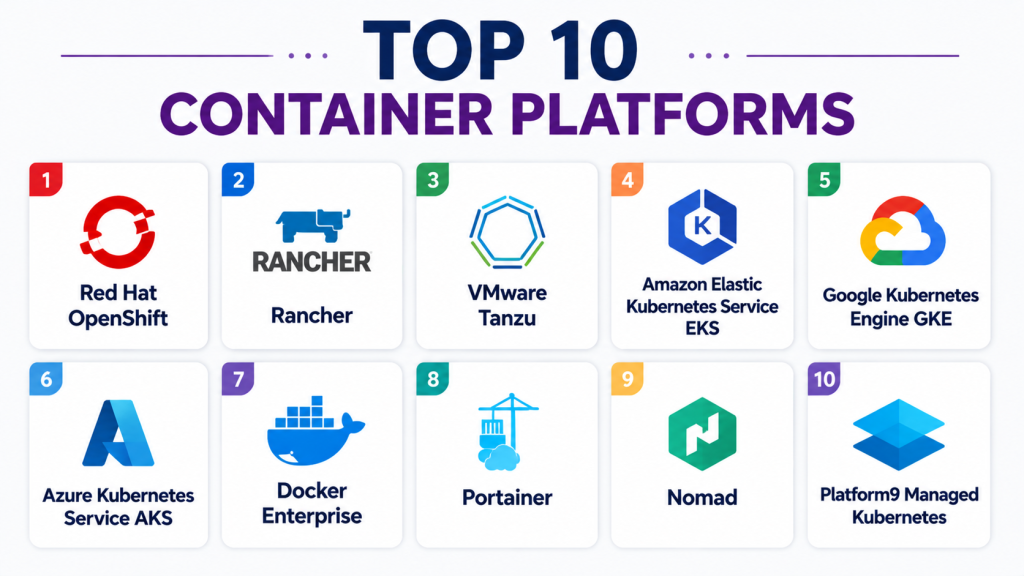
Top 10 Container Platforms
1- Red Hat OpenShift
Short Description:
Red Hat OpenShift is an enterprise Kubernetes platform designed for cloud-native application deployment, DevOps automation, and hybrid cloud orchestration. It is widely adopted by enterprises requiring centralized governance and secure container management.
Key Features
- Enterprise Kubernetes orchestration
- Integrated CI/CD pipelines
- Hybrid cloud deployment
- Built-in developer tools
- Policy-based security management
- Monitoring and observability
- GitOps automation support
Pros
- Strong enterprise governance
- Excellent hybrid cloud support
- Mature Kubernetes ecosystem
Cons
- Complex enterprise administration
- Premium pricing structure
- Requires Kubernetes expertise
Platforms / Deployment
Linux / Cloud / Hybrid / Self-hosted
Security & Compliance
Supports RBAC, SSO, MFA integration, audit logging, encryption, and enterprise policy controls.
Integrations & Ecosystem
OpenShift integrates deeply into cloud-native and enterprise DevOps environments.
- Kubernetes ecosystem integration
- GitOps support
- CI/CD platform compatibility
- Service mesh integration
- API automation support
Support & Community
Strong enterprise support organization with large open-source and enterprise ecosystem adoption.
2- Rancher
Short Description:
Rancher is a Kubernetes management platform designed for multi-cluster orchestration, centralized governance, and hybrid cloud container operations.
Key Features
- Multi-cluster Kubernetes management
- Centralized policy enforcement
- Lightweight deployment
- Hybrid cloud orchestration
- Role-based access management
- Monitoring integration
- Kubernetes lifecycle management
Pros
- Strong multi-cluster visibility
- Good operational simplicity
- Flexible infrastructure support
Cons
- Advanced customization requires expertise
- Enterprise governance setup can be complex
- Smaller ecosystem than hyperscale vendors
Platforms / Deployment
Linux / Cloud / Hybrid / Self-hosted
Security & Compliance
Supports RBAC, centralized authentication, policy enforcement, and secure cluster management.
Integrations & Ecosystem
Rancher integrates into cloud-native and Kubernetes operational environments.
- Kubernetes compatibility
- Monitoring integrations
- GitOps workflows
- CI/CD support
- API extensibility
Support & Community
Strong Kubernetes-focused community with enterprise support availability.
3- VMware Tanzu
Short Description:
VMware Tanzu is a cloud-native application platform designed for Kubernetes orchestration, enterprise modernization, and container lifecycle management.
Key Features
- Kubernetes orchestration
- Application modernization tools
- Multi-cloud management
- DevSecOps integration
- Container networking
- Centralized governance
- Developer self-service capabilities
Pros
- Strong VMware ecosystem integration
- Enterprise modernization support
- Good hybrid cloud flexibility
Cons
- Premium enterprise licensing
- Complex operational setup
- Requires VMware ecosystem familiarity
Platforms / Deployment
Cloud / Hybrid / Self-hosted
Security & Compliance
Supports RBAC, SSO integration, policy enforcement, encryption, and enterprise governance controls.
Integrations & Ecosystem
Tanzu integrates into enterprise VMware and cloud-native infrastructure environments.
- VMware ecosystem support
- Kubernetes integrations
- CI/CD compatibility
- API automation
- Multi-cloud integrations
Support & Community
Enterprise-focused support with strong modernization consulting ecosystem.
4- Amazon Elastic Kubernetes Service EKS
Short Description:
Amazon EKS is a managed Kubernetes platform designed for scalable container orchestration within AWS cloud environments.
Key Features
- Managed Kubernetes infrastructure
- Automated cluster scaling
- AWS-native integrations
- High availability management
- Monitoring and logging
- GPU workload support
- Identity and access management
Pros
- Strong AWS ecosystem integration
- Simplified Kubernetes management
- Reliable scalability
Cons
- AWS-centric ecosystem
- Cost optimization can be complex
- Less flexibility outside AWS
Platforms / Deployment
Cloud
Security & Compliance
Supports IAM integration, RBAC, encryption, audit logging, and AWS security controls.
Integrations & Ecosystem
EKS integrates naturally into AWS cloud operations.
- AWS monitoring services
- CI/CD integrations
- GPU infrastructure support
- API management compatibility
- Service mesh support
Support & Community
Strong enterprise documentation and AWS operational support ecosystem.
5- Google Kubernetes Engine GKE
Short Description:
Google Kubernetes Engine is a managed Kubernetes platform optimized for scalable cloud-native workloads and enterprise container orchestration.
Key Features
- Managed Kubernetes deployment
- Auto-scaling clusters
- AI and GPU support
- Integrated monitoring
- Multi-cluster management
- Service mesh integration
- Security automation
Pros
- Strong Kubernetes expertise from Google
- Excellent scalability
- Advanced automation capabilities
Cons
- Google Cloud dependency
- Cost management can become complex
- Multi-cloud flexibility may vary
Platforms / Deployment
Cloud
Security & Compliance
Supports RBAC, encryption, workload isolation, and cloud-native security controls.
Integrations & Ecosystem
GKE integrates deeply into Google Cloud infrastructure.
- Google Cloud compatibility
- AI infrastructure support
- Monitoring integrations
- GitOps workflows
- API automation
Support & Community
Large Kubernetes ecosystem with strong Google Cloud operational support.
6- Azure Kubernetes Service AKS
Short Description:
AKS is Microsoft’s managed Kubernetes platform designed for hybrid cloud application deployment and enterprise container orchestration.
Key Features
- Managed Kubernetes clusters
- Azure ecosystem integration
- Hybrid cloud deployment
- Monitoring and analytics
- Identity integration
- Auto-scaling support
- DevOps automation
Pros
- Excellent Microsoft ecosystem integration
- Simplified Kubernetes operations
- Strong enterprise compatibility
Cons
- Azure dependency for best experience
- Advanced networking complexity
- Cost visibility can vary
Platforms / Deployment
Cloud / Hybrid
Security & Compliance
Supports RBAC, Microsoft Entra ID integration, encryption, audit logging, and policy management.
Integrations & Ecosystem
AKS integrates naturally into Microsoft cloud-native operations.
- Azure DevOps integration
- Microsoft security tools
- CI/CD compatibility
- Monitoring integrations
- GitOps support
Support & Community
Strong enterprise ecosystem with mature Microsoft support resources.
7- Docker Enterprise
Short Description:
Docker Enterprise provides container runtime management, orchestration, and secure application packaging for enterprise container environments.
Key Features
- Enterprise container runtime
- Secure image management
- Application packaging
- Kubernetes orchestration support
- Developer tooling
- Policy enforcement
- CI/CD integration
Pros
- Familiar developer ecosystem
- Strong container packaging workflows
- Good onboarding simplicity
Cons
- Enterprise ecosystem smaller than Kubernetes-native vendors
- Advanced orchestration requires additional tooling
- Licensing costs for enterprise deployments
Platforms / Deployment
Windows / Linux / Cloud / Hybrid
Security & Compliance
Supports image signing, RBAC, encryption integration, and enterprise policy management.
Integrations & Ecosystem
Docker Enterprise integrates into DevOps and containerized application workflows.
- CI/CD integrations
- Kubernetes support
- Developer ecosystem compatibility
- Registry integrations
- API extensibility
Support & Community
Massive developer ecosystem with enterprise support options.
8- Portainer
Short Description:
Portainer is a lightweight container management platform designed for simplified Kubernetes and Docker administration.
Key Features
- Container management dashboard
- Kubernetes administration
- Role-based access controls
- Multi-environment visibility
- Lightweight deployment
- Monitoring capabilities
- Simplified operations
Pros
- Easy operational onboarding
- Lightweight infrastructure footprint
- Good SMB usability
Cons
- Limited enterprise orchestration depth
- Advanced automation capabilities vary
- Large-scale enterprise governance may require alternatives
Platforms / Deployment
Windows / Linux / Cloud / Self-hosted
Security & Compliance
Supports RBAC, secure authentication, and environment-level access controls.
Integrations & Ecosystem
Portainer integrates into lightweight DevOps and container operations environments.
- Docker support
- Kubernetes compatibility
- API integrations
- Monitoring support
Support & Community
Strong open-source community with growing enterprise adoption.
9- Nomad
Short Description:
Nomad is a workload orchestration platform designed by HashiCorp for containerized and non-containerized application deployment across distributed infrastructure.
Key Features
- Lightweight orchestration
- Multi-workload support
- Infrastructure automation
- Cluster scheduling
- Service discovery
- Multi-region deployment
- High scalability
Pros
- Lightweight operational footprint
- Flexible workload support
- Strong HashiCorp ecosystem integration
Cons
- Smaller ecosystem than Kubernetes
- Fewer enterprise-native integrations
- Requires infrastructure expertise
Platforms / Deployment
Linux / Cloud / Hybrid / Self-hosted
Security & Compliance
Supports ACLs, secure communication, policy enforcement, and workload isolation.
Integrations & Ecosystem
Nomad integrates deeply into HashiCorp infrastructure ecosystems.
- Consul integration
- Vault compatibility
- Infrastructure-as-Code workflows
- API automation
Support & Community
Strong DevOps-focused community with enterprise support availability.
10- Platform9 Managed Kubernetes
Short Description:
Platform9 provides managed Kubernetes infrastructure and container orchestration for hybrid and multi-cloud environments.
Key Features
- Managed Kubernetes operations
- Hybrid cloud orchestration
- Centralized governance
- Cluster lifecycle management
- Monitoring and observability
- Policy enforcement
- Multi-cloud support
Pros
- Strong operational simplicity
- Good hybrid cloud support
- Reduced Kubernetes management overhead
Cons
- Smaller ecosystem than hyperscalers
- Enterprise customization may vary
- Premium managed services focus
Platforms / Deployment
Cloud / Hybrid
Security & Compliance
Supports RBAC, secure authentication, policy enforcement, and centralized governance controls.
Integrations & Ecosystem
Platform9 integrates into enterprise Kubernetes and cloud-native operational environments.
- Kubernetes ecosystem compatibility
- Monitoring integrations
- CI/CD support
- API extensibility
Support & Community
Enterprise-focused support with hybrid cloud operational expertise.
Comparison Table
| Tool Name | Best For | Platform(s) Supported | Deployment | Standout Feature | Public Rating |
|---|---|---|---|---|---|
| Red Hat OpenShift | Enterprise Kubernetes | Linux | Hybrid | Enterprise governance | N/A |
| Rancher | Multi-cluster management | Linux | Hybrid | Centralized Kubernetes control | N/A |
| VMware Tanzu | Enterprise modernization | Cloud, Hybrid | Hybrid | VMware ecosystem integration | N/A |
| Amazon EKS | AWS container workloads | Cloud | Cloud | AWS-native orchestration | N/A |
| Google Kubernetes Engine | Cloud-native scalability | Cloud | Cloud | Advanced Kubernetes automation | N/A |
| Azure Kubernetes Service | Microsoft cloud operations | Cloud | Hybrid | Azure integration | N/A |
| Docker Enterprise | Container packaging | Windows, Linux | Hybrid | Developer ecosystem familiarity | N/A |
| Portainer | Lightweight container management | Windows, Linux | Self-hosted | Simplified administration | N/A |
| Nomad | Lightweight orchestration | Linux | Hybrid | Multi-workload orchestration | N/A |
| Platform9 Managed Kubernetes | Managed hybrid Kubernetes | Cloud | Hybrid | Simplified operations | N/A |
Evaluation & Scoring of Container Platforms
| Tool Name | Core 25% | Ease 15% | Integrations 15% | Security 10% | Performance 10% | Support 10% | Value 15% | Weighted Total |
|---|---|---|---|---|---|---|---|---|
| Red Hat OpenShift | 10 | 7 | 10 | 10 | 9 | 9 | 6 | 8.8 |
| Rancher | 8 | 8 | 8 | 8 | 8 | 8 | 9 | 8.1 |
| VMware Tanzu | 9 | 7 | 9 | 9 | 8 | 8 | 7 | 8.2 |
| Amazon EKS | 9 | 8 | 9 | 9 | 9 | 8 | 7 | 8.4 |
| Google Kubernetes Engine | 9 | 8 | 9 | 9 | 9 | 8 | 7 | 8.4 |
| Azure Kubernetes Service | 9 | 8 | 9 | 9 | 8 | 8 | 8 | 8.5 |
| Docker Enterprise | 8 | 9 | 8 | 8 | 8 | 8 | 7 | 8.0 |
| Portainer | 7 | 9 | 7 | 7 | 7 | 7 | 10 | 7.8 |
| Nomad | 8 | 7 | 8 | 8 | 8 | 7 | 9 | 7.9 |
| Platform9 Managed Kubernetes | 8 | 8 | 8 | 8 | 8 | 8 | 8 | 8.0 |
These scores are comparative evaluations rather than absolute rankings. Enterprise organizations often prioritize governance, orchestration depth, security, and hybrid cloud support, while SMBs usually focus more heavily on usability, operational simplicity, and pricing flexibility. Open-source and lightweight platforms may provide excellent efficiency but require stronger infrastructure expertise. Buyers should align scoring priorities with operational complexity and long-term cloud-native strategy.
Which Container Platform Is Right for You?
Solo / Freelancer
Developers and small technical teams often benefit most from Portainer or Docker Enterprise because of their simplicity and lightweight operational requirements.
SMB
SMBs typically prefer Rancher, Portainer, and Platform9 due to simplified Kubernetes management and operational usability.
Mid-Market
Mid-sized organizations requiring stronger governance and hybrid cloud flexibility should evaluate VMware Tanzu and Rancher.
Enterprise
Large enterprises generally prioritize Red Hat OpenShift, AKS, EKS, and GKE because of scalability, ecosystem maturity, and enterprise governance capabilities.
Budget vs Premium
Open-source platforms and lightweight orchestration tools provide strong operational value, while enterprise platforms justify higher costs through governance, support, and automation capabilities.
Feature Depth vs Ease of Use
Portainer and Docker Enterprise prioritize usability, while OpenShift and Tanzu provide deeper enterprise functionality with greater operational complexity.
Integrations & Scalability
Organizations with hybrid and multi-cloud operations should prioritize Kubernetes ecosystem compatibility, GitOps support, API automation, and centralized governance.
Security & Compliance Needs
Highly regulated industries should prioritize RBAC, workload isolation, audit logging, encryption, policy enforcement, and centralized identity management.
Frequently Asked Questions FAQs
1. What are Container Platforms?
Container Platforms help organizations deploy, orchestrate, manage, and secure containerized applications across cloud, hybrid, and on-premises infrastructure environments.
2. Why are container platforms important?
They improve application portability, scalability, operational consistency, deployment speed, and infrastructure automation for modern software delivery environments.
3. Which container platform is best for enterprises?
Red Hat OpenShift, EKS, GKE, and AKS are among the most widely adopted enterprise container platforms due to scalability and ecosystem maturity.
4. Is Kubernetes required for container platforms?
Most modern enterprise container platforms are Kubernetes-based, although some lightweight orchestration alternatives such as Nomad also exist.
5. What security features should buyers prioritize?
Organizations should prioritize RBAC, workload isolation, audit logging, policy enforcement, image security scanning, and zero-trust container controls.
6. Can container platforms support AI workloads?
Yes. Modern platforms increasingly support GPU-aware orchestration and scalable AI infrastructure deployment capabilities.
7. What is the difference between containers and virtual machines?
Containers share operating system kernels and are lightweight, while virtual machines include separate operating systems and heavier infrastructure overhead.
8. Are container platforms suitable for SMBs?
Yes. Platforms such as Portainer and Rancher simplify Kubernetes operations and are increasingly SMB-friendly.
9. Can container platforms integrate with CI/CD pipelines?
Yes. Most modern container platforms integrate deeply into CI/CD workflows, GitOps pipelines, and DevOps automation environments.
10. When should organizations move to enterprise-grade container platforms?
Organizations should upgrade when they require centralized governance, hybrid cloud orchestration, advanced security controls, and large-scale Kubernetes management.
Conclusion
Container Platforms have become foundational technologies for modern cloud-native infrastructure, DevOps automation, Kubernetes orchestration, and enterprise application modernization. While lightweight platforms such as Portainer and Nomad provide strong operational flexibility for smaller deployments, enterprise organizations increasingly require the advanced governance, scalability, automation, and hybrid cloud capabilities offered by platforms such as Red Hat OpenShift, EKS, GKE, and VMware Tanzu. The right platform ultimately depends on infrastructure complexity, cloud strategy, developer workflows, security priorities, and operational scale. Some organizations prioritize simplicity and cost efficiency, while others require deep orchestration, centralized governance, and enterprise-grade compliance controls. Before selecting a platform, organizations should shortlist several options, validate Kubernetes compatibility, evaluate DevOps integrations, test operational workflows, and confirm long-term scalability and security alignment.

Find Trusted Cardiac Hospitals
Compare heart hospitals by city and services — all in one place.
Explore Hospitals
It helped me understand how container platforms simplify deployment, scaling, and application management. I’d like to explore which platform fits best for cloud-native projects.