Introduction
Service Mesh Platforms help organizations manage, secure, monitor, and optimize communication between microservices in distributed cloud-native environments. These platforms provide a dedicated infrastructure layer that handles service-to-service networking, traffic routing, observability, encryption, policy enforcement, and reliability without requiring developers to manually code those capabilities into applications. As Kubernetes adoption and microservices architectures continue expanding, service mesh technologies have become increasingly important for enterprise-scale application delivery. Modern cloud-native applications often involve hundreds or thousands of interconnected services operating across hybrid, multi-cloud, and edge infrastructure environments. Service Mesh Platforms simplify operational complexity while improving security, resilience, traffic management, and observability.
Common Real-world use cases include:
- Secure microservices communication
- Traffic routing and canary deployments
- Multi-cluster Kubernetes networking
- Observability and distributed tracing
- Zero-trust service-to-service security
When Evaluating Service Mesh Platforms, buyers should assess:
- Traffic management capabilities
- Kubernetes and cloud-native compatibility
- Security and mTLS support
- Observability and tracing features
- Multi-cluster orchestration
- Performance overhead and scalability
- Policy enforcement capabilities
- Ease of deployment and management
- API and ecosystem integrations
- Hybrid and multi-cloud support
Best for: Enterprises, DevOps teams, platform engineering teams, cloud-native organizations, and businesses operating microservices-based applications at scale.
Not ideal for: Small monolithic applications, lightweight infrastructure environments, or teams without Kubernetes and distributed systems expertise.
Key Trends in Service Mesh Platforms
- Ambient mesh architectures are reducing sidecar operational overhead.
- AI-assisted observability and remediation are improving microservices troubleshooting.
- Zero-trust networking models are becoming standard in enterprise Kubernetes environments.
- Multi-cluster service mesh management is growing rapidly for hybrid cloud operations.
- Gateway API adoption is reshaping Kubernetes traffic management.
- eBPF-based networking optimization is improving performance and visibility.
- Service mesh consolidation with API gateways is becoming more common.
- GPU-aware service orchestration is increasing for AI workloads.
- Policy-as-Code governance is becoming operationally critical.
- Cloud-native security automation is expanding across service mesh ecosystems.
How We Selected These Tools (Methodology)
The platforms in this list were selected using practical cloud-native networking evaluation criteria focused on scalability, observability, ecosystem maturity, and enterprise adoption.
Our Evaluation methodology included:
- Kubernetes ecosystem adoption and industry mindshare
- Traffic management and routing capabilities
- Security and mTLS functionality
- Multi-cluster and hybrid cloud support
- Observability and distributed tracing maturity
- API and extensibility ecosystem
- Performance and operational reliability
- Ease of deployment and administration
- Customer fit across SMB, mid-market, and enterprise segments
- Vendor support and open-source community strength
The final list balances enterprise-grade service mesh platforms, open-source ecosystems, developer-focused solutions, and lightweight service networking technologies.
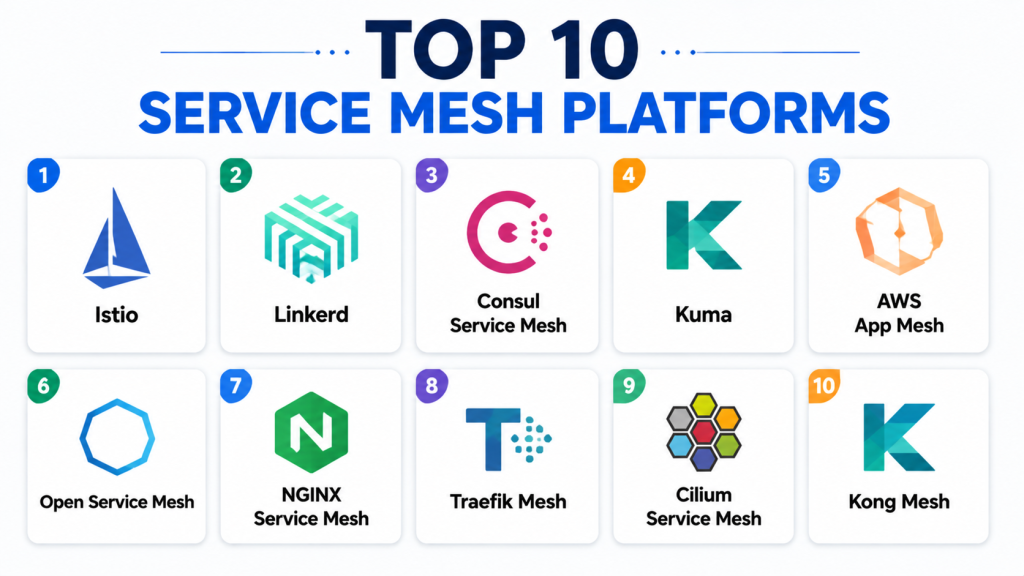
Top 10 Service Mesh Platforms
1 — Istio
Short description:
Istio is one of the most widely adopted open-source service mesh platforms for Kubernetes environments. It provides advanced traffic management, observability, security, and policy enforcement for large-scale microservices architectures.
Key Features
- Advanced traffic routing
- Mutual TLS encryption
- Distributed tracing support
- Policy enforcement
- Multi-cluster management
- Observability dashboards
- Gateway API integration
Pros
- Extremely mature ecosystem
- Strong enterprise adoption
- Advanced networking controls
Cons
- Complex operational management
- Higher learning curve
- Resource overhead can be significant
Platforms / Deployment
Linux / Cloud / Hybrid / Self-hosted
Security & Compliance
Supports mTLS, RBAC, encryption, policy enforcement, audit logging, and zero-trust networking controls.
Integrations & Ecosystem
Istio integrates deeply into Kubernetes and cloud-native ecosystems.
- Kubernetes compatibility
- Prometheus integration
- Grafana observability
- Jaeger tracing support
- API gateway integrations
Support & Community
Massive open-source ecosystem with strong enterprise adoption and extensive documentation.
2 — Linkerd
Short description:
Linkerd is a lightweight service mesh platform focused on operational simplicity, security, and reliability for Kubernetes-native environments.
Key Features
- Lightweight service mesh
- Automatic mTLS
- Real-time observability
- Traffic metrics
- Reliability optimization
- Kubernetes-native integration
- Minimal operational overhead
Pros
- Easier deployment experience
- Lightweight architecture
- Strong reliability focus
Cons
- Fewer advanced traffic controls than Istio
- Smaller ecosystem
- Enterprise extensibility may vary
Platforms / Deployment
Linux / Cloud / Hybrid / Self-hosted
Security & Compliance
Supports mTLS, RBAC compatibility, secure service communication, and encrypted traffic management.
Integrations & Ecosystem
Linkerd integrates naturally into Kubernetes observability environments.
- Prometheus integration
- Grafana compatibility
- Kubernetes ecosystem support
- CI/CD compatibility
Support & Community
Strong open-source community with developer-friendly documentation.
3 — Consul Service Mesh
Short description:
HashiCorp Consul Service Mesh provides secure service networking, service discovery, and multi-cloud networking for cloud-native and hybrid infrastructure environments.
Key Features
- Service discovery
- Secure service networking
- Multi-cloud compatibility
- Service segmentation
- Traffic routing
- Observability support
- Policy enforcement
Pros
- Strong hybrid cloud support
- Excellent service discovery
- Good HashiCorp ecosystem integration
Cons
- Operational complexity for large environments
- Advanced networking requires expertise
- Smaller service mesh ecosystem than Istio
Platforms / Deployment
Cloud / Hybrid / Self-hosted
Security & Compliance
Supports mTLS, ACLs, policy enforcement, encryption, and secure service communication.
Integrations & Ecosystem
Consul integrates deeply into HashiCorp operational environments.
- Vault integration
- Nomad compatibility
- Kubernetes integrations
- Infrastructure-as-Code workflows
- API automation
Support & Community
Strong DevOps-focused community with enterprise support availability.
4 — Kuma
Short description:
Kuma is an open-source service mesh platform built by Kong and designed for Kubernetes and virtual machine environments with simplified multi-zone networking.
Key Features
- Universal service mesh support
- Multi-zone networking
- Built-in observability
- Traffic permissions
- Mutual TLS support
- Lightweight deployment
- Kubernetes compatibility
Pros
- Simple operational model
- Multi-environment support
- Lightweight architecture
Cons
- Smaller ecosystem than Istio
- Fewer enterprise-native integrations
- Advanced features may vary
Platforms / Deployment
Cloud / Hybrid / Self-hosted
Security & Compliance
Supports mTLS, traffic policies, encryption, and secure service communication.
Integrations & Ecosystem
Kuma integrates into Kubernetes and Kong networking ecosystems.
- Kong Gateway compatibility
- Prometheus integrations
- Kubernetes ecosystem support
- API extensibility
Support & Community
Growing open-source ecosystem with strong Kong community backing.
5 — AWS App Mesh
Short description:
AWS App Mesh is a managed service mesh platform designed for secure service communication and traffic management within AWS environments.
Key Features
- Managed service mesh
- Traffic routing
- Service discovery
- Observability support
- mTLS compatibility
- AWS-native integrations
- Kubernetes compatibility
Pros
- Strong AWS ecosystem integration
- Simplified managed operations
- Good cloud-native scalability
Cons
- AWS-centric operational model
- Less flexibility outside AWS
- Advanced customization may vary
Platforms / Deployment
Cloud
Security & Compliance
Supports encryption, mTLS compatibility, IAM integration, and secure service communication.
Integrations & Ecosystem
AWS App Mesh integrates naturally into AWS cloud-native operations.
- Amazon EKS compatibility
- CloudWatch integration
- X-Ray tracing support
- API Gateway integrations
Support & Community
Strong AWS operational ecosystem with enterprise-grade support resources.
6 — Open Service Mesh OSM
Short description:
Open Service Mesh is a lightweight Kubernetes-native service mesh platform focused on simplicity, observability, and secure service communication.
Key Features
- Lightweight service mesh
- Automatic mTLS
- Traffic shaping
- Observability support
- Kubernetes-native operations
- Access control policies
- Simpler deployment workflows
Pros
- Lightweight operational footprint
- Easier onboarding experience
- Good Kubernetes integration
Cons
- Smaller ecosystem
- Fewer advanced enterprise capabilities
- Limited large-scale enterprise adoption
Platforms / Deployment
Linux / Cloud / Self-hosted
Security & Compliance
Supports mTLS, secure communication, traffic policies, and RBAC compatibility.
Integrations & Ecosystem
OSM integrates into Kubernetes-native operational environments.
- Prometheus integration
- Grafana compatibility
- Kubernetes support
- API extensibility
Support & Community
Growing open-source ecosystem with Kubernetes-focused community support.
7 — NGINX Service Mesh
Short description:
NGINX Service Mesh provides lightweight Kubernetes traffic management and secure service communication for modern cloud-native environments.
Key Features
- Kubernetes traffic management
- Lightweight service mesh
- Mutual TLS support
- Traffic shaping
- Monitoring integrations
- Simpler operations
- NGINX ecosystem compatibility
Pros
- Lightweight architecture
- Familiar NGINX ecosystem
- Easier operational management
Cons
- Smaller ecosystem than Istio
- Advanced governance features vary
- Enterprise scalability limitations
Platforms / Deployment
Cloud / Hybrid / Self-hosted
Security & Compliance
Supports mTLS, secure service communication, and Kubernetes RBAC compatibility.
Integrations & Ecosystem
NGINX Service Mesh integrates into NGINX and Kubernetes networking environments.
- NGINX integrations
- Kubernetes compatibility
- Monitoring support
- API extensibility
Support & Community
Strong NGINX ecosystem and broad cloud-native networking community support.
8 — Traefik Mesh
Short description:
Traefik Mesh is a lightweight service mesh solution designed for simplified Kubernetes networking and operational visibility.
Key Features
- Lightweight service mesh
- Kubernetes-native deployment
- Traffic routing
- Service discovery
- mTLS support
- Simpler operational workflows
- Observability integrations
Pros
- Lightweight operational footprint
- Easy Kubernetes deployment
- Good SMB usability
Cons
- Limited advanced enterprise governance
- Smaller ecosystem
- Less feature depth than Istio
Platforms / Deployment
Cloud / Self-hosted
Security & Compliance
Supports secure service communication, mTLS compatibility, and RBAC integration.
Integrations & Ecosystem
Traefik Mesh integrates into Kubernetes and Traefik networking environments.
- Traefik Proxy compatibility
- Kubernetes integrations
- Monitoring ecosystem support
- API extensibility
Support & Community
Strong developer-focused community with growing Kubernetes adoption.
9 — Cilium Service Mesh
Short description:
Cilium Service Mesh uses eBPF-based networking to deliver high-performance Kubernetes networking, security, and observability.
Key Features
- eBPF-powered networking
- High-performance observability
- Service mesh security
- Kubernetes-native operations
- Multi-cluster support
- Network policy enforcement
- Low-overhead architecture
Pros
- Excellent networking performance
- Advanced security visibility
- Modern eBPF architecture
Cons
- Requires advanced networking expertise
- Operational complexity can increase
- Enterprise adoption still growing
Platforms / Deployment
Linux / Cloud / Hybrid / Self-hosted
Security & Compliance
Supports network policies, encryption, observability, RBAC compatibility, and secure service communication.
Integrations & Ecosystem
Cilium integrates deeply into Kubernetes networking ecosystems.
- Kubernetes compatibility
- Prometheus integrations
- Grafana support
- eBPF observability tooling
Support & Community
Rapidly growing cloud-native networking community with strong Kubernetes ecosystem adoption.
10 — Kong Mesh
Short description:
Kong Mesh is an enterprise service mesh platform built on Kuma and designed for secure multi-cluster service networking and API management integration.
Key Features
- Multi-cluster service mesh
- Universal deployment support
- Traffic policies
- Observability dashboards
- API gateway compatibility
- Service security
- Hybrid infrastructure support
Pros
- Strong API gateway integration
- Good multi-environment flexibility
- Enterprise-focused governance
Cons
- Smaller ecosystem than Istio
- Premium enterprise features
- Advanced configuration may require expertise
Platforms / Deployment
Cloud / Hybrid / Self-hosted
Security & Compliance
Supports mTLS, RBAC compatibility, policy enforcement, encryption, and secure service communication.
Integrations & Ecosystem
Kong Mesh integrates deeply into API management and Kubernetes ecosystems.
- Kong Gateway integrations
- Kubernetes compatibility
- Monitoring integrations
- API extensibility
Support & Community
Enterprise-focused support ecosystem with strong Kong networking community backing.
Comparison Table
| Tool Name | Best For | Platform(s) Supported | Deployment | Standout Feature | Public Rating |
|---|---|---|---|---|---|
| Istio | Enterprise Kubernetes networking | Linux | Hybrid | Advanced traffic management | N/A |
| Linkerd | Lightweight Kubernetes mesh | Linux | Hybrid | Simplicity and reliability | N/A |
| Consul Service Mesh | Hybrid cloud networking | Cloud | Hybrid | Service discovery | N/A |
| Kuma | Multi-zone service mesh | Cloud | Hybrid | Universal deployment model | N/A |
| AWS App Mesh | AWS-native service mesh | Cloud | Cloud | AWS ecosystem integration | N/A |
| Open Service Mesh | Lightweight Kubernetes mesh | Linux | Self-hosted | Simpler deployment | N/A |
| NGINX Service Mesh | Kubernetes traffic management | Cloud | Hybrid | Lightweight architecture | N/A |
| Traefik Mesh | SMB Kubernetes networking | Cloud | Self-hosted | Simplicity and usability | N/A |
| Cilium Service Mesh | High-performance networking | Linux | Hybrid | eBPF-powered architecture | N/A |
| Kong Mesh | Enterprise API networking | Cloud | Hybrid | API gateway integration | N/A |
Evaluation & Scoring of Service Mesh Platforms
| Tool Name | Core 25% | Ease 15% | Integrations 15% | Security 10% | Performance 10% | Support 10% | Value 15% | Weighted Total |
|---|---|---|---|---|---|---|---|---|
| Istio | 10 | 6 | 10 | 10 | 9 | 9 | 7 | 8.7 |
| Linkerd | 8 | 9 | 8 | 8 | 8 | 8 | 9 | 8.3 |
| Consul Service Mesh | 9 | 7 | 9 | 9 | 8 | 8 | 8 | 8.3 |
| Kuma | 7 | 8 | 7 | 8 | 8 | 7 | 9 | 7.8 |
| AWS App Mesh | 8 | 8 | 9 | 8 | 8 | 8 | 7 | 8.0 |
| Open Service Mesh | 7 | 8 | 7 | 8 | 7 | 7 | 9 | 7.6 |
| NGINX Service Mesh | 7 | 8 | 7 | 7 | 8 | 7 | 8 | 7.5 |
| Traefik Mesh | 7 | 9 | 7 | 7 | 7 | 7 | 9 | 7.7 |
| Cilium Service Mesh | 9 | 6 | 8 | 9 | 10 | 8 | 8 | 8.3 |
| Kong Mesh | 8 | 7 | 8 | 8 | 8 | 8 | 7 | 7.8 |
These scores are comparative evaluations rather than absolute rankings. Enterprise organizations generally prioritize advanced traffic management, security, scalability, and multi-cluster governance, while SMBs often focus more heavily on usability and operational simplicity. Lightweight service mesh platforms can provide strong operational efficiency for smaller Kubernetes environments but may lack advanced enterprise networking capabilities. Buyers should align scoring priorities with operational scale, networking complexity, and long-term cloud-native strategy.
Which Service Mesh Platform Is Right for You?
Solo / Freelancer
Developers and small Kubernetes environments often benefit most from Linkerd or Traefik Mesh because of their lightweight operational models and easier onboarding experience.
SMB
SMBs typically prefer Linkerd, Traefik Mesh, and Kuma due to simplified operations and lower infrastructure overhead.
Mid-Market
Mid-sized organizations requiring stronger observability and multi-cluster networking should evaluate Consul Service Mesh and Kong Mesh.
Enterprise
Large enterprises generally prioritize Istio, Cilium Service Mesh, and Consul Service Mesh because of scalability, security, and advanced traffic management capabilities.
Budget vs Premium
Open-source platforms provide strong operational value, while enterprise service mesh platforms justify higher costs through governance, security, and hybrid cloud orchestration capabilities.
Feature Depth vs Ease of Use
Linkerd and Traefik Mesh prioritize simplicity and usability, while Istio and Cilium provide deeper enterprise functionality with higher operational complexity.
Integrations & Scalability
Organizations operating large Kubernetes environments should prioritize observability integrations, API extensibility, GitOps support, and multi-cluster orchestration.
Security & Compliance Needs
Highly regulated industries should prioritize mTLS, RBAC compatibility, audit logging, policy enforcement, encryption, and zero-trust networking controls.
Frequently Asked Questions (FAQs)
1. What is a Service Mesh Platform?
A Service Mesh Platform manages communication between microservices inside Kubernetes and cloud-native environments. It helps handle traffic routing, security, observability, and reliability without requiring developers to build those capabilities directly into applications.
2. Why are Service Mesh Platforms important?
Service meshes simplify microservices networking and improve operational visibility across distributed applications. They also strengthen security through encrypted service communication and centralized policy enforcement.
3. Which Service Mesh Platform is best for enterprises?
Istio, Consul Service Mesh, and Cilium Service Mesh are among the most widely adopted enterprise-grade solutions because of their scalability, security capabilities, and advanced traffic management features.
4. Is Istio difficult to manage?
Istio offers powerful networking and observability features, but it can become operationally complex in large Kubernetes environments. Many organizations adopt managed Kubernetes and observability tools alongside Istio to simplify operations.
5. What security features should buyers prioritize?
Organizations should prioritize mTLS encryption, RBAC compatibility, policy enforcement, audit logging, secure identity management, and zero-trust networking capabilities when selecting a service mesh platform.
6. Can Service Mesh Platforms work outside Kubernetes?
Yes. Some platforms such as Consul Service Mesh and Kuma support virtual machines and hybrid infrastructure environments in addition to Kubernetes-based deployments.
7. What is mTLS in a Service Mesh?
Mutual TLS mTLS encrypts communication between services while also verifying service identities. This improves security and helps prevent unauthorized service-to-service communication inside distributed environments.
8. Are lightweight Service Mesh Platforms better for SMBs?
Platforms such as Linkerd and Traefik Mesh are often easier for SMBs because they have lower operational overhead and simpler deployment workflows compared to larger enterprise-focused platforms.
9. How do Service Mesh Platforms improve observability?
Service meshes provide detailed telemetry, metrics, tracing, and traffic visibility across distributed services. This helps operations teams troubleshoot performance issues and monitor application reliability more effectively.
10. When should organizations adopt a Service Mesh Platform?
Organizations should consider adopting a service mesh when microservices communication, observability, traffic routing, or security management become difficult to handle manually across growing Kubernetes environments.
Conclusion
Service Mesh Platforms have become critical infrastructure layers for modern Kubernetes networking, cloud-native security, and microservices observability. While lightweight solutions such as Linkerd and Traefik Mesh provide strong operational simplicity for smaller environments, enterprise organizations increasingly require the advanced traffic management, multi-cluster governance, security, and observability capabilities offered by platforms such as Istio, Consul Service Mesh, and Cilium Service Mesh. The right service mesh ultimately depends on infrastructure scale, operational expertise, cloud strategy, and networking complexity. Some organizations prioritize simplicity and low operational overhead, while others require deep policy enforcement, advanced traffic routing, and enterprise-grade observability. Before selecting a platform, organizations should shortlist several options, validate Kubernetes compatibility, test traffic management workflows, evaluate observability integrations, and confirm long-term scalability and security alignment.

Find Trusted Cardiac Hospitals
Compare heart hospitals by city and services — all in one place.
Explore Hospitals
This gave me a better understanding of how service mesh platforms improve security, traffic control, and microservices reliability. I’d like to explore which platform fits best for cloud-native environments.