Introduction
Load Testing Tools are specialized software platforms that simulate user activity on websites, applications, and APIs to evaluate performance, stability, and scalability under stress. These tools help organizations identify bottlenecks, optimize resource allocation, and ensure applications can handle expected user traffic without failure or degradation. In 2026, as web applications, APIs, and cloud-native environments continue to grow in complexity, load testing has become critical for maintaining service reliability, performance, and user satisfaction.
Real-world use cases include:
- Simulating high traffic for e-commerce websites during peak seasons
- Testing API performance under concurrent requests for SaaS applications
- Validating server and database scaling in hybrid cloud environments
- Evaluating mobile app performance under varied network conditions
- Assessing microservices-based applications in Kubernetes environments
When Evaluating load testing tools, buyers should consider:
- Performance and scalability metrics
- Multi-protocol and multi-platform support
- Integration with CI/CD pipelines
- Real-time monitoring and reporting
- Cloud and on-premises deployment options
- Security and compliance
- Ease of use and learning curve
- Automation capabilities
- Cost-effectiveness and licensing
Best for: QA teams, DevOps engineers, IT operations teams, software developers, and enterprises running high-traffic applications.
Not ideal for: Small projects with minimal user traffic or non-critical applications that do not require rigorous performance validation.
Key Trends in Load Testing Tools
- AI-driven predictive load modeling and anomaly detection
- Cloud-based load testing as a service with scalable infrastructure
- Kubernetes-native and microservices-aware testing
- Multi-protocol and cross-platform simulation (web, mobile, API)
- Integration with CI/CD pipelines for automated performance testing
- Real-time monitoring dashboards with observability integration
- Scriptless and low-code load testing options for non-developers
- Distributed load generation to simulate global traffic
- Automated test result analysis with AI recommendations
- Security and compliance embedded in load testing workflows
How We Selected These Tools (Methodology)
- Evaluated market adoption and user base across enterprises and SMBs
- Assessed performance testing capabilities and protocol support
- Analyzed reliability, scalability, and performance signals
- Reviewed security posture, encryption, and compliance support
- Considered integrations with CI/CD, DevOps, and monitoring tools
- Checked ease of deployment, learning curve, and documentation quality
- Validated cloud-native and on-premises deployment options
- Reviewed API extensibility and ecosystem compatibility
- Considered pricing models and total cost of ownership
- Evaluated customer use cases across solo developers, SMBs, and enterprises
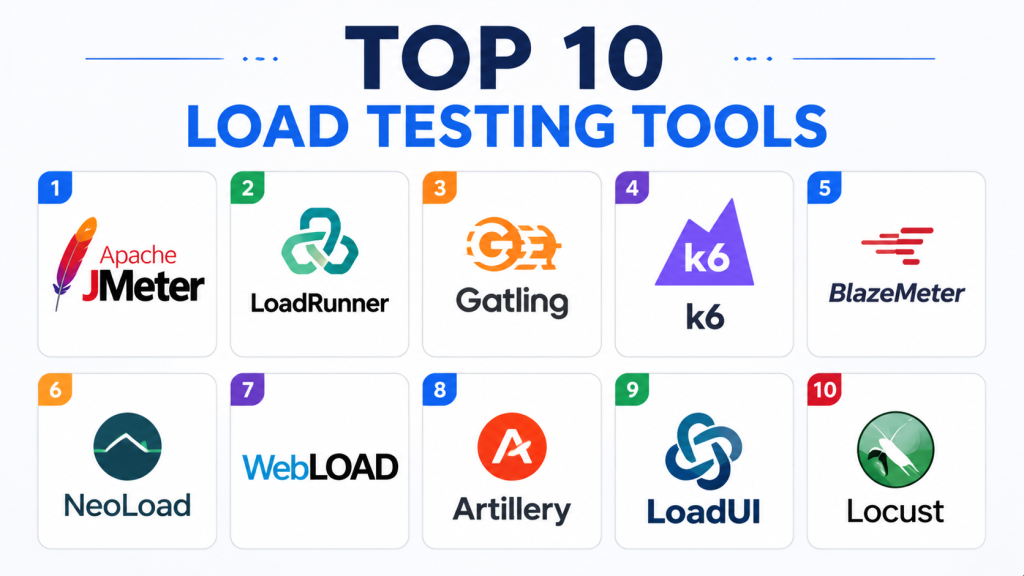
Top 10 Load Testing Tools
1 — Apache JMeter
Short description: Apache JMeter is an open-source load testing tool widely used for web applications, APIs, and database performance testing. Ideal for developers and QA teams seeking a flexible solution.
Key Features
- HTTP, HTTPS, SOAP, REST protocol support
- Thread and concurrency simulation
- Distributed load generation
- Real-time monitoring and reporting
- Extensible via plugins
Pros
- Open-source and free
- Flexible and scriptable
- Large community support
Cons
- GUI can be heavy with large tests
- Learning curve for complex scenarios
- Limited cloud-based native features
Platforms / Deployment
Windows / macOS / Linux / Cloud (via integrations)
Security & Compliance
Not publicly stated
Integrations & Ecosystem
Integrates with CI/CD tools and monitoring platforms.
- Jenkins
- GitLab CI
- Grafana
- Prometheus
Support & Community
Strong open-source community, extensive documentation, forums, and tutorials.
2 — LoadRunner (Micro Focus)
Short description: LoadRunner is an enterprise-grade load testing platform for web, mobile, and enterprise applications, widely used by QA teams for large-scale performance testing.
Key Features
- Protocol-level testing
- Cloud and on-premises support
- Real-time performance metrics
- Advanced analytics and reporting
- Integration with DevOps workflows
Pros
- Enterprise scalability
- Rich protocol support
- Detailed reporting and analytics
Cons
- High licensing cost
- Complex setup and configuration
- Steep learning curve
Platforms / Deployment
Windows / Cloud / Hybrid
Security & Compliance
Supports encrypted traffic and enterprise security configurations
Integrations & Ecosystem
- Jenkins
- Azure DevOps
- Kubernetes monitoring tools
Support & Community
Official enterprise support with comprehensive documentation and consulting.
3 — Gatling
Short description: Gatling is a developer-focused load testing tool for web applications and APIs, providing high-performance simulation and code-based test scripting.
Key Features
- Scala-based scripting
- HTTP and WebSocket support
- Real-time metrics
- CI/CD integration
- High-performance simulation
Pros
- High concurrency simulation
- Open-source edition available
- Developer-friendly scripting
Cons
- Code-based scripting requires programming skills
- Smaller enterprise ecosystem
- GUI limited compared to competitors
Platforms / Deployment
Windows / macOS / Linux / Cloud via CI/CD
Security & Compliance
Not publicly stated
Integrations & Ecosystem
- Jenkins
- GitLab CI/CD
- Grafana
Support & Community
Strong developer community, online tutorials, and paid enterprise support options.
4 — k6
Short description: k6 is an open-source and cloud-ready load testing tool with a focus on developer-first scripting and integration into CI/CD pipelines.
Key Features
- JavaScript scripting for test scenarios
- API and web application testing
- Cloud load testing service
- Real-time metrics and dashboards
- CI/CD integration
Pros
- Developer-friendly scripting
- Cloud-ready execution
- Integrates with modern DevOps pipelines
Cons
- Advanced features require cloud subscription
- Limited GUI for scripting
- Open-source features may require setup
Platforms / Deployment
Windows / macOS / Linux / Cloud
Security & Compliance
Not publicly stated
Integrations & Ecosystem
- Grafana
- Jenkins
- GitHub Actions
Support & Community
Open-source community plus enterprise support via Grafana Labs.
5 — BlazeMeter
Short description: BlazeMeter is a cloud-based load testing platform compatible with JMeter, Gatling, and Selenium scripts for web and API performance testing.
Key Features
- Cloud-based load testing
- Script compatibility (JMeter, Gatling)
- Continuous testing support
- Real-time analytics and reporting
- Global traffic simulation
Pros
- Scalable cloud infrastructure
- Easy CI/CD integration
- Multi-script compatibility
Cons
- Subscription-based pricing
- Some advanced features only in enterprise edition
- Dependent on cloud environment
Platforms / Deployment
Cloud
Security & Compliance
Supports encrypted traffic and secure test environments
Integrations & Ecosystem
- Jenkins
- GitLab CI/CD
- Slack
- Grafana
Support & Community
Enterprise support with extensive documentation and knowledge base.
6 — NeoLoad
Short description: NeoLoad is an enterprise load and performance testing tool for web, mobile, and API applications, emphasizing automation and continuous testing.
Key Features
- Web and mobile testing
- API load testing
- CI/CD integration
- Cloud and on-premises execution
- Real-time analytics
Pros
- Enterprise-ready automation
- Scalable test execution
- Advanced analytics
Cons
- Expensive licensing
- Learning curve for scripting
- GUI may be complex
Platforms / Deployment
Windows / Linux / Cloud / Hybrid
Security & Compliance
Not publicly stated
Integrations & Ecosystem
- Jenkins
- Bamboo
- Azure DevOps
- Grafana
Support & Community
Enterprise-grade support with consulting services.
7 — WebLOAD
Short description: WebLOAD is an enterprise-grade performance testing tool designed for web and mobile applications, emphasizing large-scale load simulation.
Key Features
- Web and mobile testing
- Cloud and on-premises support
- Advanced analytics
- Scriptable scenarios
- Real-time metrics
Pros
- Scalable for enterprise applications
- Strong analytics and reporting
- Supports multiple protocols
Cons
- Commercial licensing cost
- GUI learning curve
- Less community support than open-source tools
Platforms / Deployment
Windows / Linux / Cloud / Hybrid
Security & Compliance
Supports TLS, encryption, and secure testing environments
Integrations & Ecosystem
- Jenkins
- GitLab CI/CD
- Selenium integration
Support & Community
Official support and enterprise documentation available.
8 — Artillery
Short description: Artillery is a modern load testing toolkit for developers and QA teams focusing on APIs, microservices, and serverless applications.
Key Features
- Node.js-based scripting
- HTTP, WebSocket, and API testing
- Cloud and local execution
- CI/CD integration
- Real-time metrics
Pros
- Developer-focused and lightweight
- Easy scripting for APIs
- Integrates with CI/CD pipelines
Cons
- Limited enterprise analytics
- Smaller ecosystem
- Advanced load patterns may require custom scripting
Platforms / Deployment
Windows / macOS / Linux / Cloud
Security & Compliance
Not publicly stated
Integrations & Ecosystem
- GitHub Actions
- Jenkins
- Grafana
Support & Community
Open-source community support, paid enterprise support optional.
9 — LoadUI (ReadyAPI)
Short description: LoadUI is a GUI-based load testing platform for APIs and web applications, often paired with ReadyAPI for functional testing.
Key Features
- Drag-and-drop test design
- API load testing
- Real-time reporting
- CI/CD support
- Cloud and on-premises execution
Pros
- GUI-based usability
- Good API testing integration
- Quick test scenario creation
Cons
- Limited scalability for large enterprise traffic
- Licensing required
- Smaller community
Platforms / Deployment
Windows / Cloud / Hybrid
Security & Compliance
Not publicly stated
Integrations & Ecosystem
- Jenkins
- ReadyAPI functional testing
- CI/CD pipelines
Support & Community
Official support with documentation and forums.
10 — Locust
Short description: Locust is an open-source load testing tool for developers and QA teams that enables code-based distributed load simulation.
Key Features
- Python-based scripting
- Distributed load testing
- Real-time metrics
- CI/CD integration
- Web and API testing
Pros
- Open-source and free
- Highly scalable
- Developer-friendly scripting
Cons
- Requires Python knowledge
- Minimal GUI
- Enterprise-level analytics limited
Platforms / Deployment
Windows / macOS / Linux / Cloud
Security & Compliance
Not publicly stated
Integrations & Ecosystem
- Jenkins
- Grafana
- CI/CD pipelines
Support & Community
Open-source community support, extensive documentation online.
Comparison Table
| Tool Name | Best For | Platform(s) Supported | Deployment | Standout Feature | Public Rating |
|---|---|---|---|---|---|
| Apache JMeter | Open-source web/API testing | Windows, Linux, macOS | Self-hosted | Flexible scripting | N/A |
| LoadRunner | Enterprise-scale load testing | Windows | Cloud / Hybrid | Protocol-level testing | N/A |
| Gatling | Developer-focused API testing | Windows, Linux, macOS | Cloud / Self-hosted | High-performance simulations | N/A |
| k6 | Cloud-native testing | Windows, Linux, macOS | Cloud / Self-hosted | JS scripting, CI/CD | N/A |
| BlazeMeter | Cloud load testing | Cloud | Cloud | Multi-script compatibility | N/A |
| NeoLoad | Enterprise load testing | Windows, Linux | Cloud / Hybrid | Automated test execution | N/A |
| WebLOAD | Web and mobile load testing | Windows, Linux | Cloud / Hybrid | Large-scale simulation | N/A |
| Artillery | API/microservices testing | Windows, macOS, Linux | Cloud / Self-hosted | Lightweight developer-focused | N/A |
| LoadUI | GUI-based API testing | Windows | Cloud / Hybrid | Drag-and-drop GUI | N/A |
| Locust | Open-source distributed testing | Windows, Linux, macOS | Cloud / Self-hosted | Python-based scripting | N/A |
Evaluation & Scoring of Load Testing Tools
| Tool Name | Core 25% | Ease 15% | Integrations 15% | Security 10% | Performance 10% | Support 10% | Value 15% | Weighted Total |
|---|---|---|---|---|---|---|---|---|
| Apache JMeter | 9 | 7 | 8 | 8 | 8 | 7 | 10 | 8.3 |
| LoadRunner | 10 | 7 | 8 | 9 | 10 | 9 | 7 | 8.9 |
| Gatling | 9 | 7 | 8 | 8 | 9 | 7 | 9 | 8.2 |
| k6 | 8 | 9 | 8 | 8 | 9 | 7 | 9 | 8.3 |
| BlazeMeter | 8 | 8 | 9 | 8 | 8 | 7 | 8 | 8.0 |
| NeoLoad | 9 | 7 | 8 | 8 | 9 | 8 | 7 | 8.0 |
| WebLOAD | 8 | 7 | 8 | 8 | 8 | 7 | 7 | 7.6 |
| Artillery | 8 | 9 | 8 | 7 | 8 | 7 | 9 | 8.0 |
| LoadUI | 7 | 9 | 7 | 7 | 7 | 7 | 8 | 7.5 |
| Locust | 8 | 8 | 8 | 7 | 8 | 7 | 9 | 7.9 |
Scores are comparative. Enterprises may prioritize performance and reliability, while SMBs and developers may focus more on ease of use, scripting flexibility, and CI/CD integration.
Which Load Testing Tool Is Right for You?
Solo / Freelancer
Open-source tools like JMeter, Locust, and Gatling are ideal for developers and freelancers who need flexible scripting and lightweight setups.
SMB
SMBs should consider k6, BlazeMeter, and Artillery for cloud-friendly deployment, automation, and CI/CD integration.
Mid-Market
Mid-sized organizations benefit from NeoLoad and WebLOAD for scalable test execution and advanced reporting.
Enterprise
Large enterprises should evaluate LoadRunner, BlazeMeter, and JMeter Enterprise for enterprise-scale performance testing, protocol support, and analytics.
Budget vs Premium
Open-source platforms offer strong value but limited enterprise features; commercial tools provide advanced capabilities at a higher cost.
Feature Depth vs Ease of Use
Developer-friendly scripting tools favor flexibility (Locust, Gatling), while GUI-based enterprise platforms (LoadRunner, WebLOAD) prioritize operational efficiency.
Integrations & Scalability
Enterprises need integration with CI/CD pipelines, monitoring dashboards, and cloud-native infrastructure for scalable testing.
Security & Compliance Needs
Tools should support encrypted test traffic, secure credentials, role-based access, and secure deployment, particularly for enterprise and regulated workloads.
Frequently Asked Questions (FAQs)
1. What is a Load Testing Tool?
A Load Testing Tool simulates user traffic on applications or APIs to evaluate performance, scalability, and stability under stress.
2. Why is load testing important?
It ensures applications can handle expected traffic, avoids downtime, and identifies performance bottlenecks before production deployment.
3. Which tool is best for developers?
Apache JMeter, Gatling, and Locust are popular for code-based scripting and developer-friendly load testing.
4. Are cloud-based load testing tools better?
Cloud-based tools like BlazeMeter and k6 simplify distributed traffic simulation, scalability, and CI/CD integration.
5. What are common challenges in load testing?
Challenges include realistic scenario creation, accurate traffic simulation, resource provisioning, and interpreting metrics.
6. Can load testing be automated?
Yes. Most modern tools integrate with CI/CD pipelines to automate tests on code commits or scheduled intervals.
7. How many users should I simulate?
The number of users depends on expected peak traffic, infrastructure capacity, and business requirements.
8. Are open-source tools reliable for enterprises?
Yes, but enterprises may require support, advanced features, or distributed execution that open-source tools alone may not provide.
9. How do load testing tools integrate with monitoring?
They often push metrics to dashboards like Grafana, Prometheus, or cloud monitoring services to analyze performance trends.
10. When should organizations perform load testing?
Organizations should perform load testing before major releases, during peak traffic periods, or when migrating to new infrastructure.
Conclusion
Load Testing Tools are essential for ensuring application stability, performance, and scalability in modern web, mobile, and API environments. While open-source tools like JMeter, Gatling, and Locust offer flexibility for developers, commercial platforms like LoadRunner, BlazeMeter, and NeoLoad provide enterprise-scale capabilities, advanced analytics, and cloud-native integrations. Choosing the right tool depends on organizational size, budget, infrastructure complexity, traffic expectations, and CI/CD integration requirements. Organizations should shortlist suitable tools, run pilot tests, validate integrations and metrics, and ensure performance aligns with operational and business goals.

Find Trusted Cardiac Hospitals
Compare heart hospitals by city and services — all in one place.
Explore Hospitals
his gave me a better understanding of how load testing tools help measure system performance under heavy traffic. I’d like to explore which tool fits different testing needs best.