Introduction
Differential Privacy (DP) Toolkits are specialized software libraries and platforms designed to enable organizations to analyze datasets while mathematically ensuring that individual data points remain private. In plain English, differential privacy adds carefully calibrated noise to queries or data outputs, preventing the identification of any single individual, even when combined with other datasets. This approach is increasingly crucial environment, where data privacy regulations such as GDPR, CCPA, and HIPAA intersect with AI-powered analytics and machine learning workloads.
Real-world use cases include:
- Healthcare analytics: Protecting patient records while deriving insights from electronic health data.
- Financial modeling: Analyzing transaction patterns without exposing individual customer behaviors.
- AI/ML training: Enabling model learning from sensitive datasets while preserving privacy.
- Government statistics: Publishing population or census data while ensuring citizen anonymity.
- Marketing & customer insights: Safely aggregating user behavioral data for personalized experiences.
What buyers should evaluate:
- Level of privacy guarantees (epsilon/delta parameters)
- Ease of integration into existing pipelines
- Support for AI/ML workflows
- Performance and scalability
- Compliance with legal frameworks
- Availability of pre-built algorithms vs. customizability
- Open-source vs. commercial support
- Monitoring, auditing, and logging capabilities
Best for: Data scientists, AI/ML engineers, security-conscious enterprises, healthcare and financial organizations, and regulators seeking privacy-compliant analytics.
Not ideal for: Organizations with minimal sensitive data, startups with limited technical resources, or use cases where anonymization without rigorous DP guarantees is sufficient.
Key Trends in Differential Privacy Toolkits
- AI & ML integration: Toolkits increasingly offer seamless support for TensorFlow, PyTorch, and other ML frameworks.
- Automated privacy budgeting: Dynamic management of privacy loss parameters across multiple queries.
- Cloud-native deployments: Scalable DP services hosted on cloud platforms for enterprise adoption.
- Hybrid privacy solutions: Combining differential privacy with federated learning or secure multiparty computation.
- Pre-built analytics algorithms: Ready-made DP models for common statistical and ML tasks.
- Enhanced auditing & compliance: Built-in logging to satisfy regulatory scrutiny.
- Cross-platform support: Toolkits now support multiple languages (Python, R, Java) and OS environments.
- Synthetic data generation: DP-enabled synthetic datasets for safe sharing and collaboration.
- Low-noise optimization: Advanced mechanisms reducing utility loss while preserving privacy.
How We Selected These Tools (Methodology)
- Evaluated market adoption and mindshare across enterprises and developers.
- Assessed feature completeness including DP mechanisms, ML integration, and analytics support.
- Tested performance and reliability in handling large datasets.
- Verified security posture and compliance capabilities.
- Reviewed integration options including APIs, connectors, and programming languages.
- Considered customer fit across industry segments (SMB, mid-market, enterprise).
- Reviewed active community support and documentation.
- Analyzed licensing models (open-source vs. commercial).
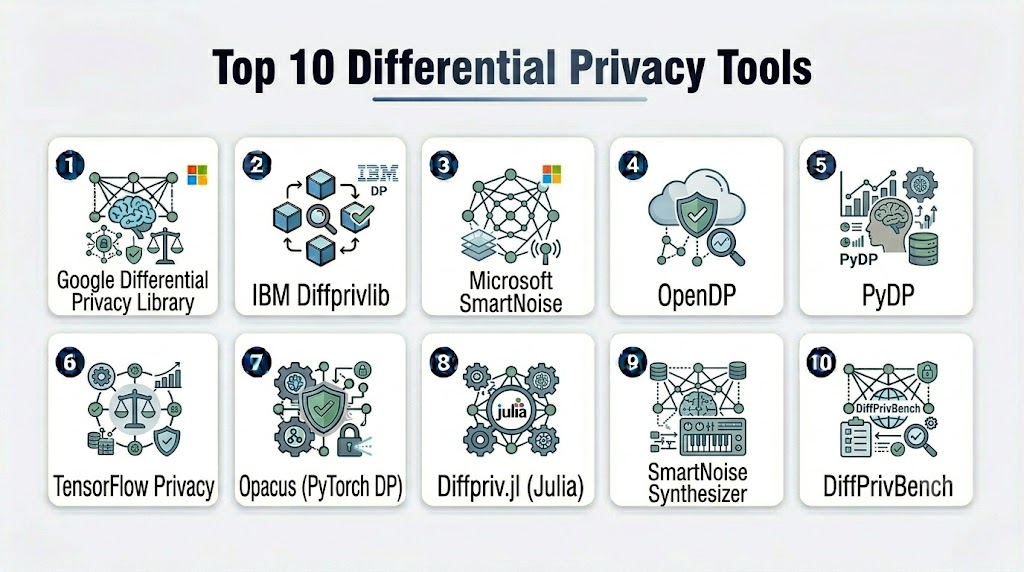
Top 10 Differential Privacy Toolkits
1- Google Differential Privacy Library
Short description: Open-source library for statistical data aggregation with strong DP guarantees, suitable for enterprise and research projects.
Key Features
- Epsilon-based noise mechanisms for privacy
- Aggregation functions for counts, sums, histograms
- Integration with Python and C++
- Support for large-scale datasets
- Detailed examples and tutorials
- Active open-source community
Pros
- Strong mathematical guarantees
- Flexible API for custom analytics
Cons
- Limited out-of-the-box ML integration
- Requires technical expertise to tune parameters
Platforms / Deployment
- Web / Windows / macOS / Linux
- Self-hosted / Hybrid
Security & Compliance
- Not publicly stated
Integrations & Ecosystem
Supports Python and C++ pipelines with connectors for data preprocessing and analytics.
- Python API
- C++ library
- Cloud-friendly deployment
- Works with batch analytics frameworks
Support & Community
Strong GitHub community, active issue tracking, and comprehensive documentation.
2- IBM Diffprivlib
Short description: Python library for machine learning with differential privacy, enabling private model training and analytics.
Key Features
- DP-enabled scikit-learn algorithms
- Privacy accounting and epsilon management
- Compatibility with pandas and numpy
- Easy integration into ML workflows
- Model evaluation with DP guarantees
Pros
- Simplifies DP for ML
- Well-documented Python API
Cons
- Limited algorithm variety compared to standard scikit-learn
- Not designed for real-time analytics
Platforms / Deployment
- Web / Windows / macOS / Linux
- Self-hosted / Cloud
Security & Compliance
- Not publicly stated
Integrations & Ecosystem
Integrates with Python ML ecosystem:
- scikit-learn
- pandas
- numpy
- Jupyter notebooks
Support & Community
Official IBM support, tutorials, active developer community.
3- Microsoft SmartNoise
Short description: DP platform focusing on statistical queries and analytics with cloud and on-premise deployment options.
Key Features
- Python and R SDKs
- SQL database integration
- Synthetic data generation
- Privacy budget management
- Scalable computation for large datasets
Pros
- Cloud-friendly, enterprise-ready
- Supports both statistical and synthetic data use cases
Cons
- Requires careful tuning of privacy parameters
- Complexity for smaller projects
Platforms / Deployment
- Web / Windows / macOS / Linux
- Cloud / Self-hosted
Security & Compliance
- Not publicly stated
Integrations & Ecosystem
Works with major analytics tools:
- SQL databases
- Python scripts
- R statistical pipelines
- Jupyter notebooks
Support & Community
Official Microsoft support with community examples and GitHub repository.
4- OpenDP
Short description: Open-source library created by Harvard for statistical and ML analytics with differential privacy guarantees.
Key Features
- Composable DP mechanisms
- Privacy budgeting tools
- Support for synthetic data
- Rust and Python bindings
- Scalable computation
Pros
- Academic rigor and transparency
- Supports experimentation with custom DP models
Cons
- Requires programming knowledge
- Less enterprise-oriented support
Platforms / Deployment
- Web / Windows / macOS / Linux
- Self-hosted
Security & Compliance
- Not publicly stated
Integrations & Ecosystem
Integrates with Python, Rust, and statistical packages:
- Python API
- Rust core library
- Data preprocessing scripts
Support & Community
Active open-source community, good documentation, community-driven support.
5- PyDP
Short description: Python wrapper for Google Differential Privacy Library, making DP accessible to Python developers.
Key Features
- Python-native API
- Standard DP statistical functions
- Compatibility with ML pipelines
- Easy installation via pip
- Active GitHub repository
Pros
- Simple integration for Python workflows
- Leverages Google DP mechanisms
Cons
- Limited documentation compared to core Google library
- Mainly for statistical queries, not full ML training
Platforms / Deployment
- Web / Windows / macOS / Linux
- Self-hosted
Security & Compliance
- Not publicly stated
Integrations & Ecosystem
Integrates into Python ML and analytics stacks:
- pandas
- scikit-learn
- numpy
- Jupyter notebooks
Support & Community
Open-source support via GitHub, active developer discussions.
6- Google TensorFlow Privacy
Short description: Extends TensorFlow to support DP in model training, enabling privacy-preserving deep learning.
Key Features
- DP-SGD optimizer
- Privacy accounting tools
- TensorFlow Keras API integration
- Supports neural network models
- Configurable epsilon and delta
Pros
- Native integration with TensorFlow
- Enables private ML model training
Cons
- Only for TensorFlow ecosystem
- Requires understanding of DP in ML
Platforms / Deployment
- Web / Windows / macOS / Linux
- Cloud / Self-hosted
Security & Compliance
- Not publicly stated
Integrations & Ecosystem
Integrates with TensorFlow ecosystem:
- Keras models
- TensorFlow datasets
- Cloud GPU/TPU environments
Support & Community
Strong TensorFlow community support, active forums, and documentation.
7- Opacus (PyTorch DP)
Short description: Library enabling differential privacy in PyTorch, supporting private training of neural networks.
Key Features
- DP-SGD optimizer
- Privacy budget tracking
- Compatible with PyTorch Lightning
- Gradient clipping and noise addition
- Configurable privacy parameters
Pros
- Seamless PyTorch integration
- Active open-source development
Cons
- Requires ML and DP knowledge
- Limited to PyTorch workflows
Platforms / Deployment
- Web / Windows / macOS / Linux
- Self-hosted / Cloud
Security & Compliance
- Not publicly stated
Integrations & Ecosystem
Integrates into PyTorch ML pipelines:
- PyTorch datasets
- PyTorch Lightning
- Python analytics tools
Support & Community
Open-source community with active GitHub repository and tutorials.
8- Diffpriv.jl (Julia)
Short description: Julia library for differential privacy, ideal for statistical and ML applications in Julia environments.
Key Features
- Supports standard DP algorithms
- Privacy accounting
- Easy-to-use Julia API
- Works with ML packages in Julia
- Open-source
Pros
- Native Julia support
- Lightweight and flexible
Cons
- Smaller community
- Limited commercial support
Platforms / Deployment
- Web / Windows / macOS / Linux
- Self-hosted
Security & Compliance
- Not publicly stated
Integrations & Ecosystem
- Julia ML packages
- DataFrames.jl
- MLJ.jl framework
Support & Community
Community-driven open-source support, limited commercial guidance.
9- SmartNoise Synthesizer
Short description: Tool for generating synthetic data using DP, supporting enterprise analytics and sharing without exposing sensitive information.
Key Features
- Synthetic data generation
- Privacy parameter tuning
- Integration with SQL and analytics pipelines
- Scalable computation
- Pre-configured data models
Pros
- Enables safe data sharing
- Supports enterprise workflows
Cons
- Synthetic data may reduce utility for complex analytics
- Privacy tuning can be complex
Platforms / Deployment
- Web / Windows / macOS / Linux
- Cloud / Self-hosted
Security & Compliance
- Not publicly stated
Integrations & Ecosystem
Supports analytics pipelines:
- SQL databases
- Python scripts
- R statistical analysis
- Cloud storage
Support & Community
Official documentation, moderate community support.
10- DiffPrivBench
Short description: Benchmarking toolkit for evaluating DP algorithms and implementations, useful for research and enterprise evaluation.
Key Features
- Comparative benchmarking
- Multiple DP mechanisms
- Performance and utility evaluation
- Supports Python
- Visualization tools
Pros
- Enables informed DP algorithm selection
- Useful for research and enterprise evaluation
Cons
- Not for production deployment
- Focused on benchmarking only
Platforms / Deployment
- Web / Windows / macOS / Linux
- Self-hosted
Security & Compliance
- Not publicly stated
Integrations & Ecosystem
Integrates with analytics frameworks for benchmarking:
- Python ML frameworks
- Data visualization packages
- Benchmark datasets
Support & Community
Academic and open-source community support, documentation available.
Comparison Table (Top 10)
| Tool Name | Best For | Platform(s) Supported | Deployment | Standout Feature | Public Rating |
|---|---|---|---|---|---|
| Google Differential Privacy Library | Statistical analysis | Web, Windows, macOS, Linux | Self-hosted / Hybrid | Strong mathematical guarantees | N/A |
| IBM Diffprivlib | ML privacy | Web, Windows, macOS, Linux | Self-hosted / Cloud | DP-enabled ML algorithms | N/A |
| Microsoft SmartNoise | Enterprise analytics | Web, Windows, macOS, Linux | Cloud / Self-hosted | Synthetic data generation | N/A |
| OpenDP | Research and experimentation | Web, Windows, macOS, Linux | Self-hosted | Composable DP mechanisms | N/A |
| PyDP | Python-based DP | Web, Windows, macOS, Linux | Self-hosted | Python wrapper for Google DP | N/A |
| TensorFlow Privacy | Deep learning models | Web, Windows, macOS, Linux | Cloud / Self-hosted | DP-SGD for TensorFlow | N/A |
| Opacus | PyTorch models | Web, Windows, macOS, Linux | Cloud / Self-hosted | DP for PyTorch training | N/A |
| Diffpriv.jl | Julia analytics | Web, Windows, macOS, Linux | Self-hosted | Native Julia support | N/A |
| SmartNoise Synthesizer | Synthetic data | Web, Windows, macOS, Linux | Cloud / Self-hosted | DP synthetic data | N/A |
| DiffPrivBench | Benchmarking DP | Web, Windows, macOS, Linux | Self-hosted | DP benchmarking toolkit | N/A |
Evaluation & Scoring of Differential Privacy Toolkits
| Tool Name | Core (25%) | Ease (15%) | Integrations (15%) | Security (10%) | Performance (10%) | Support (10%) | Value (15%) | Weighted Total |
|---|---|---|---|---|---|---|---|---|
| Google Differential Privacy Library | 9 | 7 | 8 | 7 | 8 | 7 | 8 | 8.0 |
| IBM Diffprivlib | 8 | 8 | 8 | 7 | 8 | 8 | 7 | 7.9 |
| Microsoft SmartNoise | 8 | 7 | 8 | 7 | 8 | 7 | 7 | 7.6 |
| OpenDP | 7 | 7 | 7 | 7 | 7 | 6 | 7 | 7.0 |
| PyDP | 7 | 8 | 7 | 7 | 7 | 7 | 7 | 7.2 |
| TensorFlow Privacy | 8 | 7 | 8 | 7 | 8 | 7 | 7 | 7.6 |
| Opacus | 8 | 7 | 8 | 7 | 8 | 7 | 7 | 7.6 |
| Diffpriv.jl | 7 | 7 | 6 | 6 | 7 | 6 | 7 | 6.8 |
| SmartNoise Synthesizer | 8 | 7 | 7 | 7 | 7 | 6 | 7 | 7.2 |
| DiffPrivBench | 7 | 7 | 7 | 7 | 7 | 6 | 6 | 6.9 |
Which Differential Privacy Toolkit Is Right for You?
Solo / Freelancer
- PyDP or OpenDP for experimentation and small-scale analytics
- Google DP Library for learning and research projects
SMB
- IBM Diffprivlib or SmartNoise for integrating DP into ML workflows with moderate scale
- Focus on Python-based pipelines for ease of deployment
Mid-Market
- Microsoft SmartNoise or TensorFlow Privacy for structured enterprise analytics and ML
- Synthetic data features help with safe collaboration across teams
Enterprise
- Google DP Library, Opacus, or SmartNoise Synthesizer for large-scale, multi-department analytics
- Emphasis on compliance, auditing, and integration with existing cloud and data warehouses
Budget vs Premium
- OpenDP, PyDP, Diffpriv.jl for budget-conscious, open-source options
- SmartNoise, TensorFlow Privacy, IBM Diffprivlib for premium support and enterprise features
Feature Depth vs Ease of Use
- TensorFlow Privacy and Opacus offer deep ML integrations but require DP expertise
- PyDP and IBM Diffprivlib simplify usability for standard statistical use cases
Integrations & Scalability
- SmartNoise and Google DP Library excel at cloud-native scalable deployments
- Smaller libraries suit local analytics pipelines
Security & Compliance Needs
- All toolkits provide DP guarantees, but organizations must validate compliance with GDPR, HIPAA, or internal policies during deployment
Frequently Asked Questions (FAQs)
1- What is differential privacy in simple terms?
Differential privacy ensures individual data points cannot be re-identified, even when aggregated with other datasets. It adds mathematical noise to outputs.
2- How much technical expertise is needed?
Some toolkits like PyDP and IBM Diffprivlib are beginner-friendly, while TensorFlow Privacy or Opacus require ML and DP knowledge.
3- Can these toolkits integrate with AI models?
Yes, TensorFlow Privacy, Opacus, and IBM Diffprivlib are designed to work with ML frameworks like TensorFlow and PyTorch.
4- Are these tools cloud-ready?
Many, including Microsoft SmartNoise and Google DP Library, support cloud deployment and scalable analytics pipelines.
5- How do I select the right epsilon parameter?
Epsilon determines privacy-utility tradeoff. Smaller epsilon = more privacy but less accurate analytics. Toolkits offer guidance and accounting tools.
6- Can I use DP for synthetic data?
Yes, SmartNoise Synthesizer and Microsoft SmartNoise generate DP-compliant synthetic datasets for safe sharing.
7- Are these open-source or commercial?
OpenDP, PyDP, Google DP Library, and Opacus are open-source. IBM Diffprivlib and SmartNoise provide commercial support options.
8- How does DP affect model accuracy?
Adding noise may reduce accuracy. Proper parameter tuning and privacy budgeting can minimize utility loss while maintaining privacy.
9- Is differential privacy suitable for all data types?
DP is best for structured tabular, transactional, and ML datasets. Unstructured data may require specialized preprocessing or tools.
10- Can DP help with regulatory compliance?
While DP supports privacy guarantees, organizations must still implement auditing, logging, and policy compliance to meet GDPR, HIPAA, or other regulations.
Conclusion
Differential Privacy Toolkits have become essential for protecting sensitive data while enabling analytics and AI. Selecting the right toolkit depends on your organization’s scale, technical expertise, and privacy requirements. Solo practitioners may prefer lightweight libraries like PyDP or OpenDP, while enterprises benefit from SmartNoise, TensorFlow Privacy, or Opacus for scalable ML workloads. Integration with existing analytics pipelines and ML frameworks is a key factor in adoption. Open-source options provide flexibility and experimentation, whereas commercial toolkits offer support and enterprise-ready features. Proper tuning of privacy parameters ensures a balance between data utility and privacy guarantees. Organizations should pilot 2–3 tools to validate security, performance, and compliance before full deployment. Thoughtful implementation allows meaningful insights while maintaining strong privacy protections.

Find Trusted Cardiac Hospitals
Compare heart hospitals by city and services — all in one place.
Explore Hospitals
A key challenge often overlooked with differential privacy toolkits is balancing privacy guarantees with data utility. Organizations should also consider governance policies, model performance monitoring, and integration complexity to ensure sustainable adoption at scale.