Introduction
Embedded Finance Platforms help non-bank companies add financial services directly inside their own products. Instead of sending users to a bank, payment provider, or lender, businesses can offer payments, cards, accounts, lending, wallets, payouts, or banking-like services inside their existing app or marketplace. This matters because modern customers expect financial actions to happen inside the platforms they already use. Marketplaces want seller payouts, SaaS companies want embedded payments, gig platforms want cards, and fintechs want faster banking infrastructure without building everything from scratch.
Real-world use cases include:
- Embedded payments and payouts
- Virtual and physical card issuing
- Business banking inside SaaS platforms
- Marketplace seller onboarding
- Embedded lending and working capital
- Digital wallets and treasury workflows
What buyers should evaluate:
- Supported financial products
- Regulatory and banking partner model
- API quality
- Card issuing and payment capabilities
- Ledger and account infrastructure
- Compliance workflows
- Geographic coverage
- Security controls
- Pricing model
- Support and implementation timeline
Best for: Embedded Finance Platforms are best for SaaS companies, marketplaces, fintech startups, neobanks, payroll platforms, vertical software businesses, ecommerce platforms, gig economy apps, and enterprises that want to offer financial services inside their own customer experience.
Not ideal for: These platforms may not be necessary for businesses that only need simple payment acceptance or basic invoicing. In those cases, a standard payment gateway, accounting tool, or payout provider may be easier and faster to deploy.
Key Trends in Embedded Finance Platforms
- Vertical SaaS platforms are becoming financial hubs: Industry-specific software companies are embedding payments, lending, cards, and banking workflows directly into their products.
- Banking-as-a-Service is becoming more regulated: Buyers now need stronger due diligence around sponsor banks, compliance responsibilities, customer onboarding, and transaction monitoring.
- Embedded payments remain the largest entry point: Many companies begin with payments and later expand into cards, accounts, financing, and treasury services.
- Card issuing is becoming more programmable: Platforms want virtual cards, spend controls, real-time authorization, merchant controls, and transaction-level metadata.
- Ledger infrastructure is now a key requirement: Embedded finance products need reliable ledgers to track balances, transactions, fees, settlement, and account activity.
- Compliance automation is becoming essential: KYC, KYB, AML, fraud monitoring, sanctions screening, dispute workflows, and reporting are now core platform requirements.
- Global coverage is harder than it looks: Financial products are highly regional, so buyers must check country availability, licensing, banking partners, and local regulations.
- APIs are becoming more modular: Teams increasingly choose separate providers for payments, issuing, lending, banking, ledger, compliance, and treasury rather than one full-stack provider.
- AI is improving risk and support workflows: AI can support fraud detection, underwriting, transaction review, customer support, and operational monitoring, but financial governance remains critical.
- Embedded finance is shifting from feature to revenue model: Platforms are using financial services to increase retention, create new revenue streams, and deepen customer engagement.
How We Selected These Tools
The Top 10 Embedded Finance Platforms were selected using a practical SaaS and fintech infrastructure evaluation model:
- Market adoption and recognition across fintech, SaaS, marketplaces, banking infrastructure, and payments
- Feature completeness across payments, cards, accounts, banking infrastructure, lending, treasury, and APIs
- Developer experience, including documentation, sandbox support, API clarity, and integration speed
- Regulatory and compliance readiness for financial product delivery
- Security posture signals, including access controls, encryption, fraud controls, and enterprise readiness
- Geographic and ecosystem coverage across major markets and financial use cases
- Operational reliability, including settlement, uptime, ledger accuracy, and support quality
- Fit across customer segments, from startups to enterprise platforms
- Ability to support embedded workflows inside SaaS, marketplaces, fintech apps, and enterprise products
- Long-term relevance as embedded finance expands into payments, banking, lending, cards, and global money movement
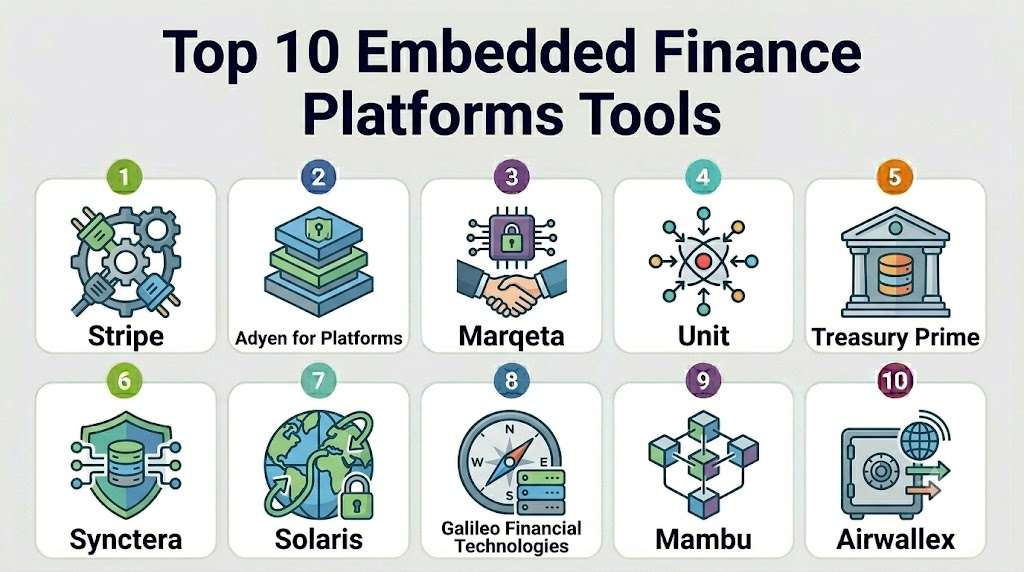
Top 10 Embedded Finance Platforms Tools
1- Stripe
Short description: Stripe is a major payments and financial infrastructure platform used by SaaS companies, marketplaces, ecommerce businesses, and fintech builders. It supports embedded payments, billing, payouts, financial accounts, and platform monetization workflows.
Key Features
- Embedded payments and checkout infrastructure
- Marketplace and platform payment flows
- Billing and subscription management
- Payout and treasury-related capabilities
- Developer-friendly APIs and documentation
- Fraud and risk management tools
- Global payment method support
Pros
- Strong developer experience
- Broad payment and platform ecosystem
- Good fit for SaaS, marketplaces, and digital businesses
Cons
- Advanced financial services may vary by region
- Pricing can become complex at scale
- Some banking-like services require careful eligibility and compliance review
Platforms / Deployment
Web / Cloud / API-based deployment
Security & Compliance
Stripe is built for payment and financial infrastructure workflows. Buyers should verify current compliance documentation, security controls, access management, data protection, and regional requirements during procurement.
Integrations & Ecosystem
Stripe integrates well with ecommerce, SaaS, marketplace, subscription, and fintech workflows.
- Ecommerce platforms
- SaaS billing systems
- Marketplace payouts
- Fraud prevention tools
- Accounting and finance systems
- Developer APIs and webhooks
Support & Community
Stripe provides extensive documentation, developer resources, support channels, and enterprise support options. Support availability may vary by plan and account type.
2- Adyen for Platforms
Short description: Adyen for Platforms helps marketplaces, platforms, and SaaS businesses embed payments, onboarding, payouts, and financial services into their customer journeys. It is strong for global platforms that need unified payment infrastructure.
Key Features
- Platform payment processing
- Seller and sub-merchant onboarding
- Split payments and payouts
- Global payment method support
- Risk management tools
- Unified commerce capabilities
- Financial product expansion options
Pros
- Strong fit for global marketplaces and platforms
- Unified payments and payout infrastructure
- Useful for complex multi-party payment flows
Cons
- May be more enterprise-oriented than startup-friendly
- Implementation can require payment operations expertise
- Feature availability varies by region and business model
Platforms / Deployment
Web / Cloud / API-based deployment
Security & Compliance
Adyen is designed for global payment and platform commerce workflows. Buyers should verify current compliance, security, risk management, and regional regulatory details before deployment.
Integrations & Ecosystem
Adyen fits platforms that need payment orchestration, seller onboarding, and global financial workflows.
- Marketplaces
- SaaS platforms
- Ecommerce systems
- POS and omnichannel commerce
- Payout workflows
- Risk and fraud systems
Support & Community
Adyen provides enterprise-focused support, documentation, and implementation resources. Buyers should validate onboarding timelines and support expectations.
3- Marqeta
Short description: Marqeta is a modern card issuing platform that enables businesses to create virtual and physical card programs. It is suitable for fintechs, expense platforms, gig economy apps, marketplaces, and businesses that need programmable card issuing.
Key Features
- Virtual and physical card issuing
- Real-time authorization controls
- Spend controls and card rules
- Tokenization and wallet provisioning support
- Transaction metadata and reporting
- API-first issuing infrastructure
- Useful for expense, payout, and embedded card programs
Pros
- Strong card issuing specialization
- Useful for programmable spend control
- Good fit for fintech and platform card programs
Cons
- Not a full embedded banking platform by itself
- Requires program design and compliance planning
- Pricing and availability should be reviewed by region
Platforms / Deployment
Web / Cloud / API-based deployment
Security & Compliance
Marqeta is designed for card issuing and financial infrastructure workflows. Buyers should verify current compliance, card network requirements, security controls, and issuer-bank responsibilities.
Integrations & Ecosystem
Marqeta is useful where cards are central to the embedded finance product.
- Expense management platforms
- Gig economy payouts
- Business card products
- Consumer fintech apps
- Digital wallets
- Real-time transaction controls
Support & Community
Marqeta provides developer resources and business support. Enterprise buyers should validate onboarding, sponsor bank requirements, and program management support.
4- Unit
Short description: Unit is a Banking-as-a-Service platform that helps companies launch financial products such as accounts, cards, payments, and money movement features. It is useful for startups and platforms building embedded banking experiences.
Key Features
- Banking-as-a-Service APIs
- Account creation workflows
- Card issuing capabilities
- Money movement and payments
- Customer onboarding support
- Compliance-related workflows
- Developer dashboard and API documentation
Pros
- Strong fit for embedded banking products
- Useful for fintech startups and vertical SaaS platforms
- Helps reduce the complexity of building banking features
Cons
- Availability depends on region and partner-bank model
- Compliance responsibilities must be clearly understood
- Not ideal for businesses that only need basic payments
Platforms / Deployment
Web / Cloud / API-based deployment
Security & Compliance
Unit supports regulated embedded banking workflows through its platform and banking relationships. Buyers should verify security controls, compliance responsibilities, sponsor bank structure, and operational requirements directly.
Integrations & Ecosystem
Unit supports embedded banking workflows inside fintech and SaaS products.
- Banking accounts
- Debit cards
- Payments and transfers
- Fintech onboarding
- Vertical SaaS finance products
- Compliance workflows
Support & Community
Unit provides documentation, onboarding, and platform support. Buyers should validate implementation timelines, compliance support, and partner-bank requirements.
5- Treasury Prime
Short description: Treasury Prime is a Banking-as-a-Service platform that connects fintechs and businesses with banks through APIs. It is suited for companies building embedded banking, accounts, payments, and money movement products.
Key Features
- Bank API connectivity
- Account and payment infrastructure
- Embedded banking workflows
- Partner bank access model
- Compliance and operational support concepts
- Developer APIs
- Useful for fintech and banking integrations
Pros
- Strong bank connectivity positioning
- Useful for businesses needing embedded banking infrastructure
- Good fit for bank-fintech partnership models
Cons
- Requires careful bank and compliance alignment
- Implementation may involve multiple stakeholders
- Product availability depends on partner banks and use case
Platforms / Deployment
Web / Cloud / API-based deployment
Security & Compliance
Treasury Prime is built for bank-connected embedded finance workflows. Buyers should verify security controls, regulatory responsibilities, bank partner requirements, and compliance support during evaluation.
Integrations & Ecosystem
Treasury Prime fits businesses that need API-based access to banking infrastructure.
- Fintech apps
- Bank partnership programs
- Embedded banking products
- Account services
- Payments and transfers
- Treasury workflows
Support & Community
Treasury Prime provides business and developer support resources. Buyers should confirm bank onboarding processes, technical support, and compliance responsibilities.
6- Synctera
Short description: Synctera is a Banking-as-a-Service platform that helps fintech companies and businesses build banking products with bank partner support, APIs, compliance workflows, and operational infrastructure.
Key Features
- Banking-as-a-Service infrastructure
- Bank partner marketplace model
- Account and payment capabilities
- Card program support
- Compliance workflow support
- Developer APIs
- Operational tools for embedded finance programs
Pros
- Useful for fintech-bank partnership models
- Supports embedded banking product development
- Helps manage parts of operational and compliance complexity
Cons
- Requires careful program planning
- Banking features and availability can vary by region and partner
- Not ideal for simple payment-only businesses
Platforms / Deployment
Web / Cloud / API-based deployment
Security & Compliance
Synctera supports regulated financial workflows through banking partnerships. Buyers should verify security controls, compliance roles, auditability, sponsor bank responsibilities, and operational support.
Integrations & Ecosystem
Synctera works well for fintechs and platforms that need bank-backed infrastructure.
- Banking products
- Card programs
- Payments and money movement
- Compliance workflows
- Bank partner integrations
- Fintech operations
Support & Community
Synctera provides onboarding, documentation, and business support. Buyers should validate implementation resources and bank partner fit.
7- Solaris
Short description: Solaris is an embedded finance and Banking-as-a-Service platform based in Europe. It helps companies offer financial products such as accounts, cards, payments, lending, and digital banking experiences.
Key Features
- Banking-as-a-Service infrastructure
- Account and card products
- Payment and money movement support
- Lending and digital finance capabilities
- European embedded finance focus
- Compliance and regulated infrastructure
- API-based product delivery
Pros
- Strong European embedded finance positioning
- Useful for banking-like products and digital finance use cases
- Supports multiple financial product types
Cons
- Best fit is region-dependent
- Implementation can be complex
- Buyers should verify licensing, product availability, and compliance responsibilities
Platforms / Deployment
Web / Cloud / API-based deployment
Security & Compliance
Solaris operates in regulated financial services environments. Buyers should verify current licensing, compliance obligations, security controls, data protection, and product-specific requirements.
Integrations & Ecosystem
Solaris supports companies building embedded financial services in supported European markets.
- Digital banking products
- Card programs
- Payment flows
- Lending workflows
- Fintech applications
- Platform finance products
Support & Community
Solaris provides business-focused support and implementation resources. Buyers should validate regional support, onboarding timelines, and compliance guidance.
8- Galileo Financial Technologies
Short description: Galileo Financial Technologies provides financial technology infrastructure for card issuing, digital banking, payments, and embedded finance programs. It is used by fintechs, neobanks, and financial service providers building scalable financial products.
Key Features
- Card issuing infrastructure
- Digital banking platform capabilities
- Payment processing support
- Account and transaction workflows
- API-based financial services infrastructure
- Program management support
- Useful for fintech and banking products
Pros
- Strong fit for fintech and digital banking programs
- Useful for card and account-based products
- Supports scalable embedded finance infrastructure
Cons
- May be more suitable for serious fintech programs than small experiments
- Implementation can require financial operations expertise
- Pricing and availability should be reviewed directly
Platforms / Deployment
Web / Cloud / API-based deployment
Security & Compliance
Galileo is designed for financial technology infrastructure. Buyers should verify security controls, compliance support, card network requirements, data handling, and bank partnership responsibilities.
Integrations & Ecosystem
Galileo fits fintechs and platforms building card, account, and digital banking products.
- Neobanks
- Card programs
- Digital wallets
- Payment workflows
- Embedded banking products
- Financial app infrastructure
Support & Community
Galileo provides business and technical support options. Buyers should confirm onboarding, program management, and implementation expectations.
9- Mambu
Short description: Mambu is a cloud banking platform that supports core banking, lending, deposits, and financial product configuration. It is useful for banks, fintechs, lenders, and embedded finance businesses that need flexible core banking infrastructure.
Key Features
- Cloud-native core banking
- Lending and deposit product configuration
- API-based banking infrastructure
- Flexible product setup
- Integration with fintech ecosystems
- Support for digital banking and embedded finance
- Useful for banks and financial service providers
Pros
- Strong core banking and lending flexibility
- Useful for fintechs and banks building configurable products
- Good fit for teams needing a modern banking backend
Cons
- Not a simple plug-and-play embedded finance provider
- Requires implementation planning and integration work
- Businesses may still need partners for payments, cards, or compliance
Platforms / Deployment
Web / Cloud / API-based deployment
Security & Compliance
Mambu is used in regulated banking and financial service environments. Buyers should verify current compliance documentation, security controls, access management, data residency, and deployment responsibilities.
Integrations & Ecosystem
Mambu fits organizations that need core banking infrastructure as part of an embedded finance or digital banking stack.
- Digital banks
- Lending platforms
- Deposit products
- Fintech ecosystems
- Payment integrations
- Compliance and onboarding tools
Support & Community
Mambu provides documentation, implementation resources, partner ecosystem support, and enterprise support options. Buyers should validate implementation partner availability and service levels.
10- Airwallex
Short description: Airwallex is a global payments and financial platform that supports business accounts, payments, cards, FX, payouts, and embedded finance capabilities. It is suitable for companies needing global money movement and financial infrastructure.
Key Features
- Global business payments
- Multi-currency accounts
- Card issuing and expense workflows
- FX and cross-border money movement
- API-based financial infrastructure
- Payout and treasury workflows
- Useful for platforms and global businesses
Pros
- Strong fit for global payments and multi-currency workflows
- Useful for businesses operating across markets
- Combines payments, cards, accounts, and FX capabilities
Cons
- Product availability varies by region
- Not every embedded banking use case may be supported
- Buyers should verify compliance, pricing, and supported currencies
Platforms / Deployment
Web / Cloud / API-based deployment
Security & Compliance
Airwallex operates in financial services and payments environments. Buyers should verify current licensing, security controls, compliance documentation, data protection, and regional product availability.
Integrations & Ecosystem
Airwallex is useful for platforms and businesses that need global embedded financial workflows.
- Global payouts
- Multi-currency accounts
- Business cards
- Marketplace payments
- Treasury workflows
- Cross-border finance operations
Support & Community
Airwallex provides documentation, business onboarding, and support options. Buyers should validate regional support, implementation guidance, and account management availability.
Comparison Table
| Tool Name | Best For | Platform Supported | Deployment | Standout Feature | Public Rating |
|---|---|---|---|---|---|
| Stripe | SaaS, marketplaces, and payments | Web / API | Cloud | Developer-friendly embedded payments | N/A |
| Adyen for Platforms | Global marketplaces and platforms | Web / API | Cloud | Unified platform payments and payouts | N/A |
| Marqeta | Card issuing programs | Web / API | Cloud | Programmable card issuing | N/A |
| Unit | Embedded banking startups | Web / API | Cloud | Banking-as-a-Service APIs | N/A |
| Treasury Prime | Bank-connected embedded finance | Web / API | Cloud | Bank API connectivity | N/A |
| Synctera | Fintech-bank partnership programs | Web / API | Cloud | Bank partner marketplace model | N/A |
| Solaris | European embedded finance | Web / API | Cloud | Regulated BaaS infrastructure | N/A |
| Galileo Financial Technologies | Digital banking and card programs | Web / API | Cloud | Financial technology infrastructure | N/A |
| Mambu | Core banking and lending platforms | Web / API | Cloud | Cloud-native banking core | N/A |
| Airwallex | Global payments and business finance | Web / API | Cloud | Multi-currency financial infrastructure | N/A |
Evaluation and Scoring of Embedded Finance Platforms
| Tool Name | Core 25% | Ease 15% | Integrations 15% | Security 10% | Performance 10% | Support 10% | Value 15% | Weighted Total 0-10 |
|---|---|---|---|---|---|---|---|---|
| Stripe | 9 | 9 | 9 | 9 | 9 | 8 | 8 | 8.75 |
| Adyen for Platforms | 9 | 8 | 9 | 9 | 9 | 9 | 8 | 8.75 |
| Marqeta | 8 | 8 | 8 | 8 | 8 | 8 | 8 | 8.00 |
| Unit | 8 | 8 | 8 | 8 | 8 | 8 | 8 | 8.00 |
| Treasury Prime | 8 | 7 | 8 | 8 | 8 | 8 | 7 | 7.75 |
| Synctera | 8 | 7 | 8 | 8 | 8 | 8 | 7 | 7.75 |
| Solaris | 8 | 7 | 8 | 9 | 8 | 8 | 7 | 7.85 |
| Galileo Financial Technologies | 8 | 7 | 8 | 8 | 8 | 8 | 7 | 7.75 |
| Mambu | 8 | 7 | 8 | 9 | 8 | 8 | 7 | 7.85 |
| Airwallex | 8 | 8 | 8 | 8 | 8 | 8 | 8 | 8.00 |
Which Embedded Finance Platform Tool Is Right for You?
Solo / Freelancer
Solo founders and early fintech builders should start with platforms that offer strong documentation, sandbox testing, and developer-friendly APIs. Stripe, Airwallex, and Unit may be practical depending on whether the product needs payments, global finance, or embedded banking.
For early experiments, avoid overbuilding. Start with one core financial feature, such as payments, payouts, cards, or account verification, and expand only after validating demand.
SMB
SMBs should focus on speed, pricing clarity, support, and compliance simplicity. Stripe, Airwallex, Unit, Marqeta, and Adyen for Platforms can be useful depending on the business model.
If the SMB is building a marketplace, payments and payouts may matter most. If it is building a fintech app, accounts, cards, and compliance workflows may be more important.
Mid-Market
Mid-market platforms usually need more reliable infrastructure, better support, approval workflows, reporting, and integration depth. Adyen for Platforms, Stripe, Marqeta, Treasury Prime, Synctera, and Airwallex are strong candidates.
At this stage, teams should assess operational support, compliance obligations, customer onboarding flows, reconciliation, ledger accuracy, and data exports.
Enterprise
Enterprises should evaluate Adyen for Platforms, Stripe, Mambu, Galileo Financial Technologies, Solaris, Treasury Prime, and Airwallex depending on geography and use case.
Enterprise buyers should involve product, engineering, compliance, legal, finance, risk, security, and operations teams before selecting a provider.
Budget vs Premium
Budget-conscious teams should start with one clear embedded finance use case and avoid buying a full-stack platform too early. Payment-first platforms may be easier to launch than full banking infrastructure.
Premium platforms may cost more but can provide stronger support, broader capabilities, better global coverage, improved compliance workflows, and enterprise-grade reliability.
Feature Depth vs Ease of Use
For ease of use and developer experience, Stripe is often a strong choice. For global platform payments, Adyen for Platforms is strong. For card issuing, Marqeta is highly relevant.
For deeper banking infrastructure, Unit, Treasury Prime, Synctera, Solaris, and Galileo are useful. For core banking and lending configuration, Mambu may be more suitable.
Integrations and Scalability
Scalable embedded finance requires more than APIs. Teams need ledgers, reconciliation, reporting, customer onboarding, compliance checks, dispute workflows, payout logic, fraud monitoring, and operational dashboards.
Before scaling, test the platform with real customer journeys, transaction volumes, settlement flows, failed payments, compliance edge cases, and support requests.
Security and Compliance Needs
Security-focused buyers should evaluate encryption, API access controls, SSO, MFA, audit logs, role-based permissions, fraud controls, transaction monitoring, and incident response.
Compliance-focused buyers should understand who owns KYC, KYB, AML, sanctions screening, customer support, dispute handling, reporting, and regulatory communication.
Frequently Asked Questions
1- What is an Embedded Finance Platform?
An Embedded Finance Platform helps companies add financial services such as payments, cards, accounts, lending, wallets, or payouts into their own product. It reduces the need to build banking infrastructure from scratch.
2- What is the difference between embedded finance and Banking-as-a-Service?
Embedded finance is the broader concept of adding financial services into non-financial products. Banking-as-a-Service is one infrastructure model that enables banking-like features through APIs and bank partners.
3- Which Embedded Finance Platform is best?
There is no single best platform for every business. Stripe, Adyen for Platforms, Marqeta, Unit, Treasury Prime, Synctera, Solaris, Galileo, Mambu, and Airwallex serve different needs.
4- Are Embedded Finance Platforms only for fintech companies?
No. They are also used by SaaS platforms, marketplaces, ecommerce businesses, payroll tools, logistics platforms, travel companies, gig platforms, and enterprise software vendors.
5- What financial products can be embedded?
Common embedded financial products include payments, payouts, virtual cards, physical cards, bank accounts, wallets, lending, FX, treasury services, and business finance tools.
6- Do I need a banking license for embedded finance?
Not always. Many platforms work with regulated banks or licensed financial partners. However, compliance responsibilities vary, so businesses must understand their legal and regulatory role.
7- What are common mistakes when choosing a platform?
Common mistakes include ignoring compliance responsibilities, underestimating implementation time, choosing only by API design, skipping regional availability checks, and not planning customer support workflows.
8- How long does implementation take?
Implementation time varies by product type. Simple payments may launch faster, while banking, cards, lending, or regulated account products can require deeper compliance, partner-bank, and operational setup.
9- Are embedded finance platforms secure?
They can be secure when implemented with strong controls, encryption, access management, fraud monitoring, and compliance governance. Buyers should still perform security and vendor risk reviews.
10- Can embedded finance create new revenue?
Yes. Platforms may generate revenue through payment fees, interchange, lending revenue share, subscription upgrades, FX spreads, or value-added financial services, depending on the model and regulations.
Conclusion
Embedded Finance Platforms help businesses turn financial services into native product experiences. The right platform can improve customer retention, create new revenue streams, reduce operational friction, and enable faster product expansion. Stripe and Adyen for Platforms are strong for payments and marketplaces, Marqeta is strong for programmable card issuing, Unit, Treasury Prime, Synctera, and Solaris are relevant for embedded banking, Galileo supports fintech and digital banking infrastructure, Mambu is useful for configurable core banking and lending, and Airwallex is strong for global payments and multi-currency finance. The best next step is to shortlist two or three platforms, map your exact financial use case, test APIs in a sandbox, review compliance responsibilities, compare pricing, and validate implementation support before scaling.

Find Trusted Cardiac Hospitals
Compare heart hospitals by city and services — all in one place.
Explore Hospitals
One often underestimated challenge with embedded finance platforms is managing dependencies on multiple banking and third-party partners. Service disruptions or API changes across the ecosystem can directly affect reliability and customer experience.